Non-polluting fusion with the Focus machine
Non-polluting fusion, another possible approach?
The Focus experiment
The results obtained so far do not have the same level of reliability as those of the Sandia Z-machine, but we found it interesting to mention these experiments to show the very wide range that MHD allows, regarding increasing the density and temperature of a plasma. In this regard, the Focus experiment is very original. It remains to be seen, in this case, whether the high temperatures measured using the X-ray flux actually correspond to the plasma temperature or to the impact effect on the anode. E. Lerner, who is far from having the means of the powerful New Mexico laboratory, is convinced that this indicates that a temperature of over one billion degrees (100 keV) was achieved. We will leave him the responsibility for this conclusion.
Operating principle
June 1st, 2006
FOCUS is an experiment that many people have been talking about since the early 2000s. You can find information in the Wikipedia encyclopedia at :
http://en.wikipedia.org/wiki/Plasma_focus
Fusion, for everyone, immediately evokes two unique approaches.
-
Fusion in Tokamaks, corresponding to the expensive ITER experiment, which will be installed in Cadarache, north of Aix-en-Provence
-
Fusion by lasers, as in this other "cathedral for engineers" called the Megajoule project, located in Barp, near Bordeaux.
Fusion also exclusively refers to that of deuterium and tritium, which is the one that occurs at the lowest temperature. Deuterium is the first isotope of hydrogen, whose nucleus is composed of a proton and a neutron. The nucleus of tritium contains a proton and two neutrons.
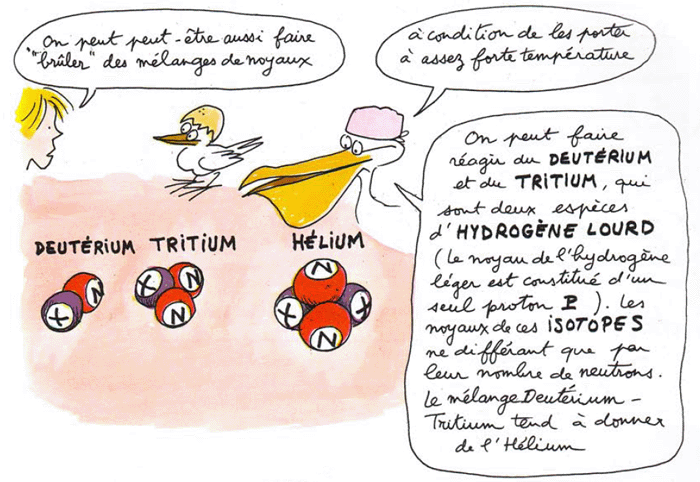
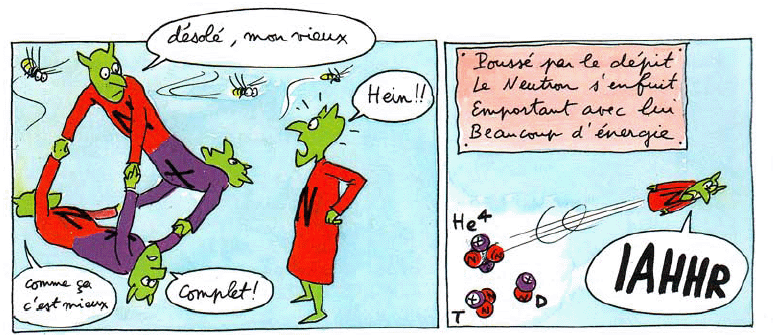
Their fusion, which occurs when the temperature reaches 100 million degrees (at a rapid rate), produces a helium nucleus and a fast neutron with an energy of 14 MeV (14 million electron volts). At the core of the Sun, the temperature of the "boiler" is only 15 to 20 million degrees and fusion occurs at a much slower rate (otherwise the Sun would explode).
Heavy hydrogen molecules resemble light hydrogen molecules almost identically. They have the same chemical properties :
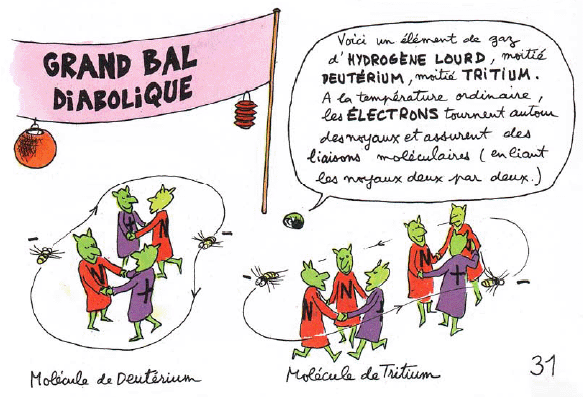
On the left, a D-D molecule and on the right, a T-T molecule. The bond is ensured by electrons, represented here by bees. The "nucleons" are represented by little devils. Protons, electrically charged, are in purple, neutrons, electrically neutral, are in red.
From 3000°, hydrogen "is completely ionized", the electrons leave the nuclei and hydrogen (light or heavy) becomes plasma, a mixture of an "electron gas" and electrically charged nuclei. But around 100-150 million degrees these nuclei tend to react :
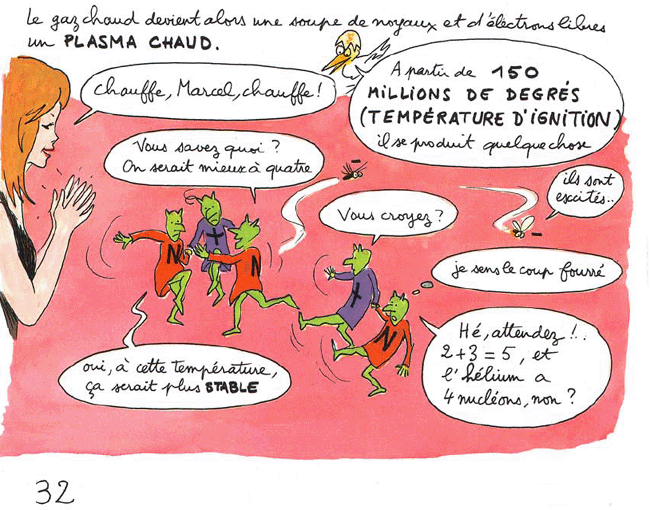
Here is the diagram of heavy hydrogen fusion :
The reader can become familiar with all these concepts related to nuclear energy by consulting my free downloadable comic strip
Yours in Energy
available on the website http://www.savoir-sans-frontieres.com at the address :
http://www.savoir-sans-frontieres.com/JPP/telechargeables/Francais/energetiquement_votre.htm
It is the emission of this 14 MeV fusion neutron that causes the problem, because these particles cause induced radioactivity in all the structures of the reactor. These neutrons integrate into the materials of the reactor structures, creating a number of unstable substances that become radioactive by default and constitute waste. This neutron flux also alters the reactor structures, may ultimately compromise the solidity of its components and impair the proper functioning of the solenoids ensuring plasma confinement.
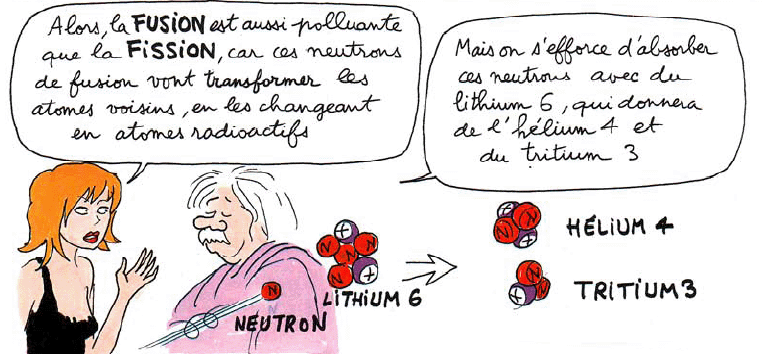
The drawing above evokes the regeneration of tritium. In practice, fusion neutrons do not only recreate tritium. They also create many radioactive isotopes, by the effect of artificial radioactivity (as opposed to "natural radioactivity" linked to radioactive isotopes existing in nature, and which were initially created in supernova explosions, then integrated into the mass of the Earth at the time of its formation). A lithium envelope behaves like a "fertile material" which is supposed to continuously recreate tritium, which is radioactive (half-life: 12 years) and does not exist in nature.
The average person generally does not know that fusion is like "nuclear chemistry", where you start from a "fusion mixture", a "reaction" and which gives "reaction products". Deuterium-tritium fusion is just one of the possible reactions. But since it is the one that occurs at the lowest temperature
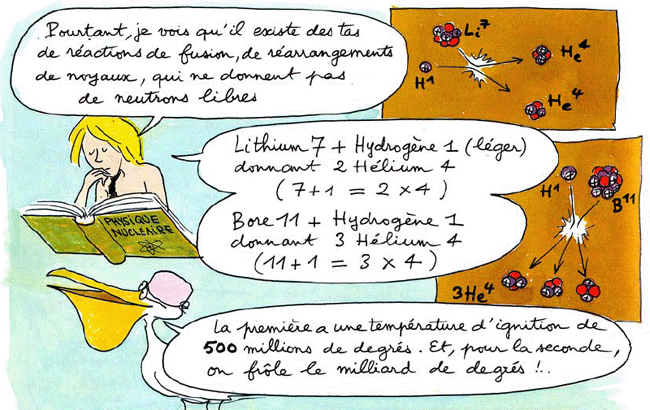
**Non-polluting fusion reactions, free of radioactivity and radioactive waste! **
We saw, in a dossier dedicated to the Z-machine, that a temperature of two billion degrees was reached in 2005 at the Sandia laboratories in New Mexico. Incidentally, it should be noted that the purpose of the experiment was not to achieve such high temperatures, but to create a simple X-ray source at a few million degrees. However, unexpectedly, this plasma compressor provided ... two billion degrees, in a perfectly undeniable way. This outlier result immediately created an unease within the teams that have been managing these expensive projects for decades, such as :
-
Laser fusion (in France: Megajoule)
-
Fusion in tokamak machines (in France: ITER)
But we will see that this Z-machine could not be the only one capable of producing such hot plasmas (while the ITER device, operating continuously, cannot increase its temperature). By analogy, one could say that there is as much difference between this new range of high-temperature fusion machines and the tokamak as between internal combustion engines and steam engines.
Thus, by comparison, ITER is the steam engine of modern times
To better understand these types of machines, it is necessary to become familiar with the electromagnetic forces at work in electrical conductors, then in discharges.
Take a "flexible" solenoid, a simple loop in which we pass a current. This coil will generate a field that will act on the wire carrying the electric current through the Laplace force I x B
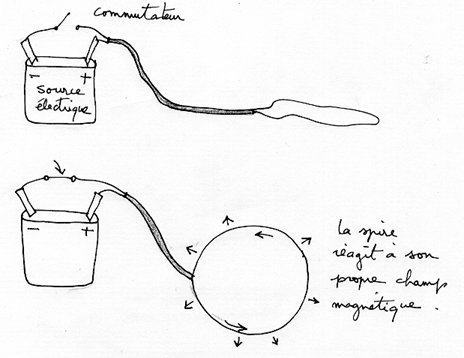
Expansion of a coil under the effect of its own magnetic field
This is typically the experiment you may have seen at high school or at the Palais de la Découverte.
If the current is strong enough, this can cause the electrical conductor to rupture. In my laboratory in the 1960s we created magnetic fields...