Untitled Document
The first article published in France, in 1974
introducing the "Deltaplane"
December 11, 2007
There was a time when I collaborated closely with the magazine Science et Vie, which even sent me as a "reporter" to the United States in 1976, on the occasion of the bicentenary of the American Revolution, to report on the progress of science there. This trip provided part of the material for the book "Les Enfants du Diable", downloadable on this site. Some time earlier, an article of mine had been featured on the cover of the magazine, under the title "A plasma engine for UFOs". At that time, the psycho-socio-immunological reaction mechanism had not yet reached the magazine's editorial staff. Since more than thirty years I have been banned from the magazine, as well as from the entire range of science popularization magazines. All this because of my misplaced interest in the UFO subject.
No, you won't find me explaining the functioning, the background, of the Z-machine or presenting my work in cosmology or astrophysics. I accept with dignity my status as an outcast. You can find the article on the MHD saucer on the site http://www.ufo-science.com.
One of my readers, Elno, has scanned an amusing archive document which is probably the first article published in France on the "Delta wing", in the magazine Science et Vue. You will see the prediction of the birth of the .. ULMS. The only mistake concerns the fineness attributed to the Manta wing, which was somewhat overestimated, that I had tried and later bought. As for the rest, it's more or less correct.
It all began that year, when a certain Bob Yannis made the headlines by taking off, in a glider, very early one morning on the Champs-Elysées. If a reader finds the photo from that time, we could include it. In 1974, the "floating transversals" had not yet been invented, nor the "floatings". I use the language known to specialists. The result was that we flew straight, with a descent speed of 2.5 m/s, reaching 4 m/s in turns. These turns could only be performed in a glide. At that rate, as indicated in the article, we could only make slope soaring in strong updrafts. The angle was 90°. The wing, very curved and with low aspect ratio, could parachute. I had several times landed in a clearing, in the middle of a forest, "pushing everything" and descending vertically at 6 m/s (the descent speed of a hemispherical parachute, which is very well endured with good ankles). There was no "form plan". Flat, the wing was just a piece of dacron with four hems and some slats.
When I learned of the existence of these machines, I immediately wanted to fly on one. At that time, the son of the climber Lachenal had bought one, single-seater. There were no two-seaters yet. He was operating at the Grands Montets, in Chamonix. For a fee, he would hook you under this assembly of tubes, canvas and cables, then throw you down a fairly steep ski slope. It was recommended to keep the nose of the wing lowered. When the sail "faced" (I use a nautical term), it was enough to push on the control bar. Then you would make a flight of about a hundred meters, a few meters above the ground, at most ten. Landing on skis was not a major difficulty. Lachenal would then bring the wing and pilot back up using a snowmobile.
Enthusiastic about this new sport, I decided to buy a "Manta" (the price at the time was 1800 F). You received the whole thing in a large cardboard cylinder. In the following months I made many flights in the ski resorts of the region, using the "tire-fesses" to gain altitude, take off and land. But when summer came, the snow had disappeared. Not knowing what to do, I modified an old pair of skis by fitting them with ... baby carriage wheels. It was a risky thing because once you had started, braking was simply impossible. I made a few flights with these wheeled skis.
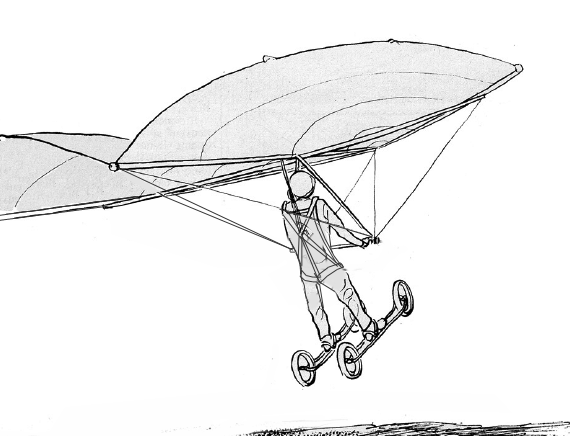
When the snow had melted...
Many quite crazy ideas were conceived on both sides of the Atlantic at that time. But I think this idea deserves to be in the annals.
Having learned that other crazy flyers had gathered in Chamonix, I went to meet them, my wing fixed on the roof of my green Deuche.
That's where I met Michel Katzman, who was to become one of my best friends and with whom I would fly for 15 years. When he discovered my wheeled skis, he collapsed on the grass, laughing his head off, then went to join his group and said to them:
- "Come on, I'm going to show you a complete madman!"
Indeed, I didn't know that you could take off by running. I hadn't found it in any manual, for the good reason that manuals didn't exist yet. Michel taught me how to take off by running, which I did without difficulty. Then his girlfriend Odile Monrozier set out to teach me my first "Big Flight", that of Cluses, where there are a few hundred meters of elevation. The day before, a friend from the region said to me:
- "Listen, I'm a bit worried that you're flying without a helmet. I have my brother's mountain helmet. I'll give it to you, I'll feel more at ease."
This aluminum helmet was too small, and if I had added the Gallic horns, I could have resembled Obelix. Odile, before taking off for the first time, described the flight plan to me. We could clearly see, below, the field on which we would have to land. She took off gracefully. When it was my turn, a regrettable incident occurred. At that time, we flew seated. The "reclining harnesses" appeared later. The pilot was therefore attached, thanks to a harness made of strong nylon straps, by a rope that passed just behind his head and was attached to the keel with a carabiner.
When I took to the air, the rope tilted the helmet forward and I found myself in total darkness. The time it took me to put one hand in the middle of the control bar and try to lift this damned helmet from the other side, I had lost altitude and was heading towards a tree that I should have normally flown over by ten good meters. I remembered what I had learned at Supaéro and in the Black Mountain, when I was flying gliders. In this case, instead of trying to regain altitude immediately, you had to head straight for the obstacle and only pull up at the last moment. That's what I did. I still had to run through the high branches to get past the obstacle, always flying with one hand. The rest of the flight was similar. I skimmed the roofs of the farms. It was impossible to remove this damned helmet, because of the impossibility of maneuvering the closure clip with one hand. So I flew the entire time, often less than ten meters above the ground, flying with one hand and holding the helmet with the other to avoid complete blindness.
My torment seemed about to end when I realized that I had a telephone line in front of me, between two poles. So a tight turn, "PTL" (L-shaped terrain takeoff) and landing in the grass. Things like that are not forgotten. I stayed for a long time the ...