Astrophysics simulation galaxy physics
Work by Frédéric Baudemont
Computer Scientist
April 10, 2004
Frédéric worked on programming Newtonian interaction on a sphere S2, using Newton's law and an "anti-Newtonian" law based on curvilinear (geodesic) distance. The galaxy: 10,000 point masses. The twin matter: a few large point masses (yellow) distributed throughout the rest of space. The "dynamical friction" between the two subsystems has yielded these first promising results, which merely confirm what we obtained with Frédéric Landsheat back in 1992. This is only a very modest beginning. Frédéric could, with a galaxy of 10,000 points, move to a "two-population" model and already achieve a more realistic simulation, albeit in 2D. Suggestion: 90% of the galaxy's mass in the form of a cluster-like subsystem without rotation (equivalent to Population I stars, the oldest). 10% of the mass (but 90% of the points) representing interstellar gas and Population II stars (younger). Never done anywhere before.
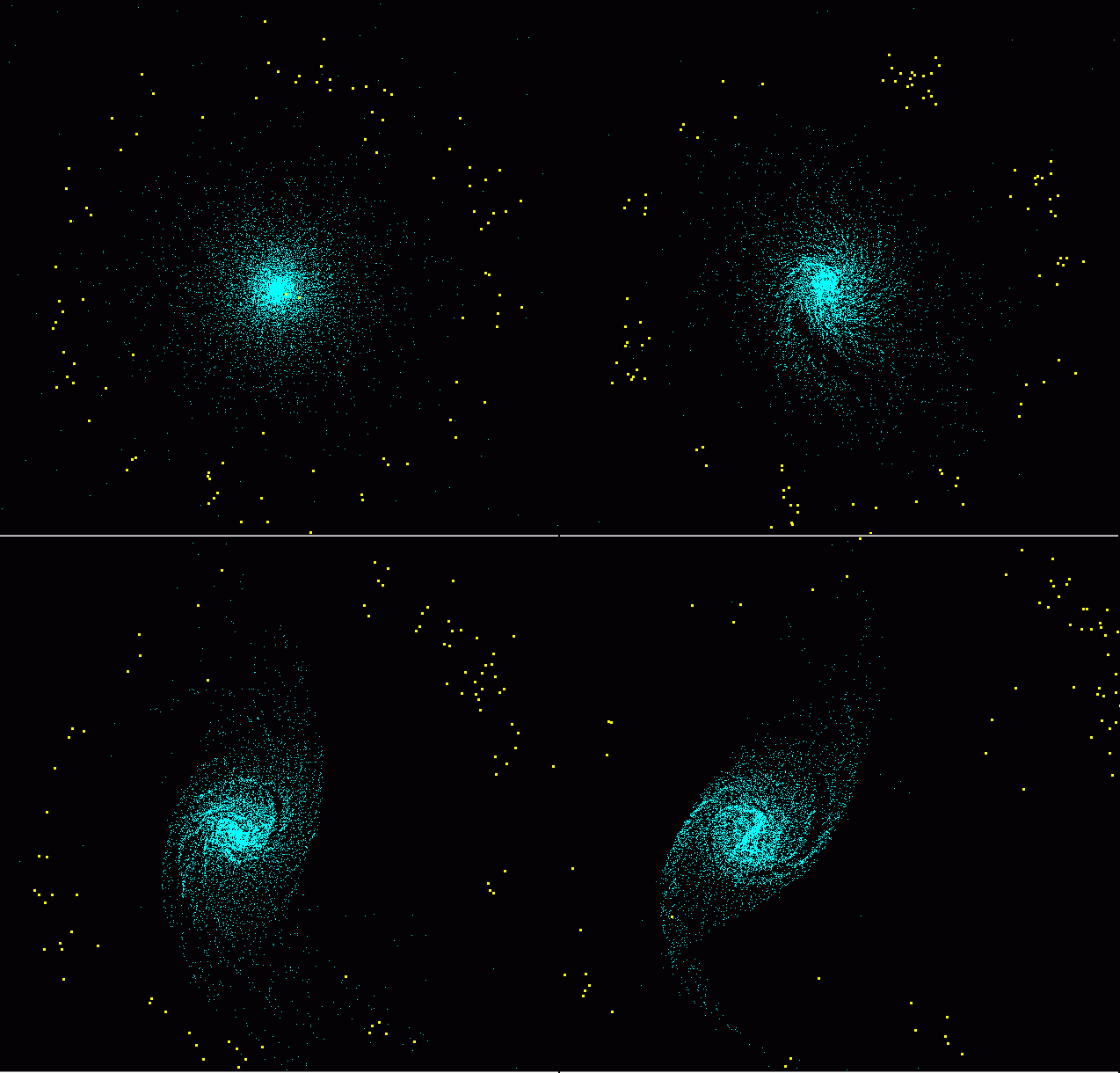
According to the principle of the Epistémontron project, this is entirely "wild" research. Therefore, software developed by participants must be systematically and immediately shared, including source code (which we will do, Agostini and I). And we intend to give this project a global reach. Welcome to the club. Jump on this train that departs like an express—join a new adventure:
astrophysics @ home: Astrophysics west of the Pecos*
Remember that:
"Astrophysics is too serious a science to be left in the hands of astrophysicists" (Poincaré)
To view the result of Frédéric Baudemont's work, October 25, 2004:
http://perso.club-internet.fr/frederic.baudemont/Galaxie5000.avi
Note the stability and regularity of the spiral structure—something never achieved before. It should also be noted that Baudemont maintains a spiral structure, whereas Descamp and I obtained a barred spiral in 1992. There may be something significant here to understand and clarify. But I must admit that the untimely intervention of a 25-year-old Canadian, even a bright one, completely disrupted this dynamic a few months ago. With all the difficulties we were each facing (health for some, work or financial issues for others), we certainly didn’t need this kind of interference. We had told ourselves, “Galaxies can wait.” I sometimes use the term “untimely.” An untimely person is someone who intrudes into a project, wrecking everything out of greed or stupidity. Sadly, I’ve experienced this kind of misfortune too often in my career.
That said, Baudemont's remarkable work remains. He has just produced, back-to-back at the end of October 2004, two highly interesting animations. One shows the formation of a galaxy interacting with an environment of twin matter, with the yellow points visibly dispersing around it. The matter then responds via “dynamical friction,” forming a very beautiful and remarkably stable spiral structure, apparently spanning six turns. It would be interesting to know whether this structure can persist over a greater number of turns. Our own galaxy has completed about 70–80 turns since its birth. Still, a galaxy is not a system built from a single population of point masses, and moreover, this is in 2D.
November 2, 2004: Baudemont sends me a second AVI file that clearly shows gravitational instability, or Jeans instability, at work within a 2D population of point masses uniformly distributed in space.
Gravitational instability in 2D with a single population (1.5 MB)
Back to Guide Back to Homepage
Number of visits to this page since May 10, 2004: