Nuclear Fusion Z Machine and Clean Energy
The Latest Echoes of Sphinx
by Julien Geffray
May 21, 2007
How, for a year now, Americans have been rushing ahead and the French have been slowing down.
Let's take a moment to look back at the past year: in March 2006, the Sandia laboratories in the United States announced a groundbreaking discovery: the Z-machine accidentally generated 3.7 billion degrees (see the original press release in English). An extreme temperature never before achieved, 100 times hotter than the core of the Sun, seven times higher than the core of a hydrogen bomb, and four times higher than theoretical predictions without any real explanation. With such a temperature, a new path was thus opened for controlled nuclear fusion, not only for hydrogen isotopes as defined classically in successive projects such as ITER or the Mégajoule lasers, but especially what is totally new, two nuclear reactions previously impossible to consider: lithium-hydrogen (requiring a minimum of 500 million degrees) and boron-hydrogen (starting from a billion degrees). These two particular nuclear reactions are practically free of radioactivity - except for some minor parasitic reactions - and would offer powerful and completely non-polluting nuclear power plants, using as fuels elements that are pure and very abundant on Earth. In short, the long-awaited energy remedy for our planet suffering from rampant pollution.
Throughout 2006, the Z-machine and the possibilities it offered were described in a popular way by Jean-Pierre Petit:
- A Glimmer of Hope in this World of Brutes
- The Sandia Z-machine - Fusion without pollution or radioactivity within reach!
- Analysis of the article by Malcolm Haines published in Physical Review Letters
- 3.7 billion degrees and everyone doesn't care
- Some clarifications (FAQ)
- Open letter to Nicolas Hulot
- Open letter to politicians
The existence of an equivalent French machine, although less powerful, was also highlighted: the ECF of the Gramat Military Experimental Center (CEG) located in Lot. ECF stands for "Flux Compression Experiment" but in fact the machine is nicknamed Sphinx.
Multiple attempts were made to push national media to address this topic and politicians to take interest in it, without real success (an article in the webzine Futura-Sciences and only a brief mention in Science & Vie and Sciences et Avenir). An article published on the Internet in the forum Agoravox caused a lot of commotion. Contacts with politicians were attempted. A high-level scientist, in charge in Russia of nuclear fusion issues, even agreed to support the awareness campaign initiated by JPP and one of his colleagues, a "bomb veteran", by writing a signed letter to be handed directly, explaining the interest of this research and even suggesting a Franco-Russian collaboration in the field! But to whom should this letter be given in France (it would require a scientific official close to politics) if no one is ready or able to listen to such a speech?
Unfortunately, these attempts remained dead letters. For two reasons:
- This study of fusion by "z-pinch" or in French "magnetic compression" is perceived, especially from the point of view of allocated budgets, as being in direct competition with the ITER project, a very different solution implemented in our country. French specialists in magnetic compression are therefore too few to be heard, and some of them have even left to work in the US on the Sandia laboratories' Z-machine.
- These researches are "potentially proliferating". In other words, they can lead to the realization of new generation nuclear weapons. In this case, the explosion of the hydrogen bomb would no longer be triggered by a classic small A-bomb, difficult to produce. Instead of this "match", a compact system derived from the Z-machine, much easier to design for any country and especially escaping any control, since it uses "simple" power electronics. The famous uranium enrichment stage, which is the cause of heavy geopolitical problems but allows a relative control of proliferation, would become in fact useless.
The obvious goal of all this commotion was to open Sphinx to civilian researchers, while this French Z-machine is exclusively reserved for military engineers. At present, its capacity of 2.5 to 5 million amperes is unable to generate the temperature of the American Z-machine, which delivered 18 million. But such a device can be upgraded relatively easily. The Sandia Z-machine was indeed dismantled in September 2006 to undergo a renovation increasing its capacity by 50%. It is the ZR program (for "Z Refurbished") that should be fully operational in the summer of 2007, this time with an intensity raised to 27 million amperes, still delivered in 100 nanoseconds. The temperatures achieved in this way are expected to increase further. And as we will see later, the Americans will not stop there: they have already set a new technique to reach 60 million amperes.
Officially, a few months ago, the French military did not really know on which foot to dance. On one hand, these researches seem very promising, but the CEG does not really have researchers who can explore this new field on a fundamental level. On the other hand, the DGA wants to completely control these researches in case something important comes out, and to put a defense seal on it. This is also a fear that one can have regarding the Sandia laboratories, actually managed by the defense ministry and the American army (the funds come from the NNSA, the National Nuclear Security Administration)... and this is precisely the interest of conducting other independent research elsewhere. Dilemma: how to open the Gramat military center to civilians?
The answer, depressing for some or a simple predictable observation for others, has been given by journalist Matthieu Quiret in the edition of May 16, 2007 of the economic daily Les Échos, accessible online at the address:
http://www.lesechos.fr/info/metiers/4576329.htm
and whose content we reproduce here (the interesting passage is in red):
**
* *****
**** **
**
Les Échos
of May 16, 2007
Competences
NUCLEAR
The French Z machine ignores energy
Little "Sphinx".
In the middle of Quercy, at the Gramat Studies Center (CEG), the DGA has been exploiting a small French Z machine (2.5 million amperes) for several years, called "Sphinx". Like its big sister, it is mainly used to test the resistance of nuclear warheads.
Unlike it, it will not undergo any civilian experiments. A few years ago, the researchers from Gramat had indeed launched some proposals to their military authority to diversify their studies, without success.
Asked by "Les Echos", the very "fierce" CEG now claims to have no energy projects.
This investment reluctance worries the specialists of the magnetic compression.
French competences in this field of power electronics are threatened, says one of them.
In Great Britain, an equivalent machine, the Magpie of the Imperial College (1.4 million amperes), is actively working on magnetic compression, notably on American funds. Not powerful enough to reach the nuclear objectives of the Z machine, it is used by the Americans to complement their research on magnetic compression itself. The Russians are also about to invest in this research topic.
Now, at least, we know clearly what to expect. Despite the competences that France has and the help offered by the Russians, the army has decided: there will be no French civilian research on magnetic compression fusion.
Meanwhile, where are the Americans and where are they going? In the same issue of the journal Les Échos, in a sort of contradiction with the evocation of the blocking of all French research in the field, controlled nuclear fusion of hydrogen through the Z-machine is widely popularized in a second article titled "Nuclear: the American Z machine defies Iter" that you can read at the address:
http://www.lesechos.fr/info/metiers/4576219.htm
We reproduce here the illustration of this article:

**How the American Z-machine fuses hydrogen isotopes
(deuteron-deuteron reaction generating moderately energetic neutrons at 2.45 MeV)
It is the already old indirect technique of the "hohlraum", the "x-ray oven" compressing and heating a capsule containing hydrogen isotopes until fusion, thanks to a special foam and a tungsten wire cage. The experiment was successfully carried out for the first time on the Z-machine on April 7, 2003 (press release). The direct attack without using the hohlraum technique, by ultra high temperature, of nuclear reactions that produce almost no neutrons (lithium-hydrogen or boron-hydrogen) thanks to the recent wire cage technique in stainless steel (3.7 billion degrees at the end of 2005) is not yet mentioned. But the idea of fusion by magnetic compression is beginning to gain traction in the French media.
Until now (1996-2006), the Sandia laboratories' Z-machine was this:
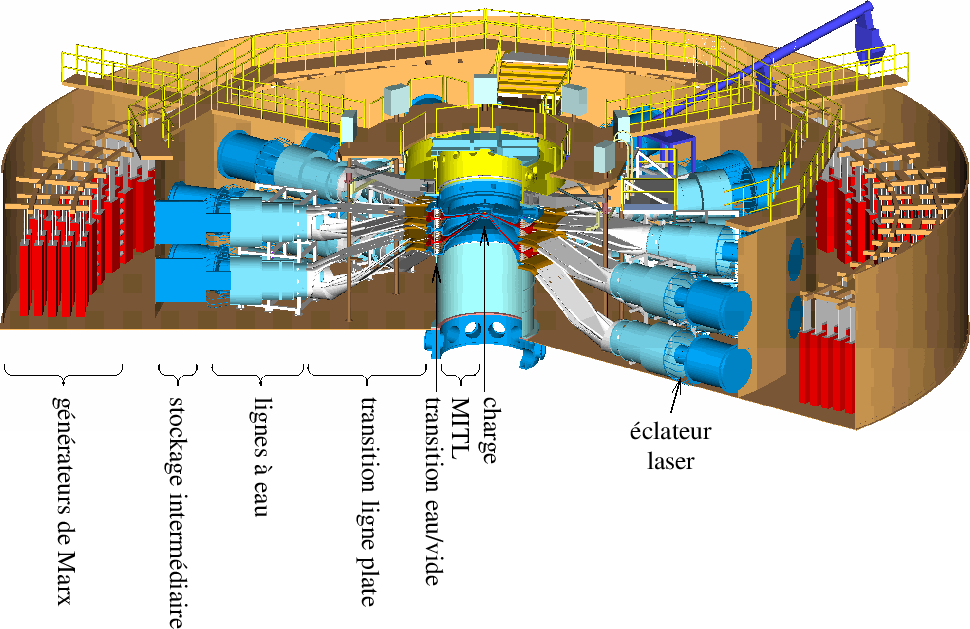
The Z-machine in cross-section. Note the size of the brown basin and the length of the water lines in blue.
Span: 33 meters. And when the current is switched, here are the electrical arcs spreading across the surface of the huge oil and water insulating basin:
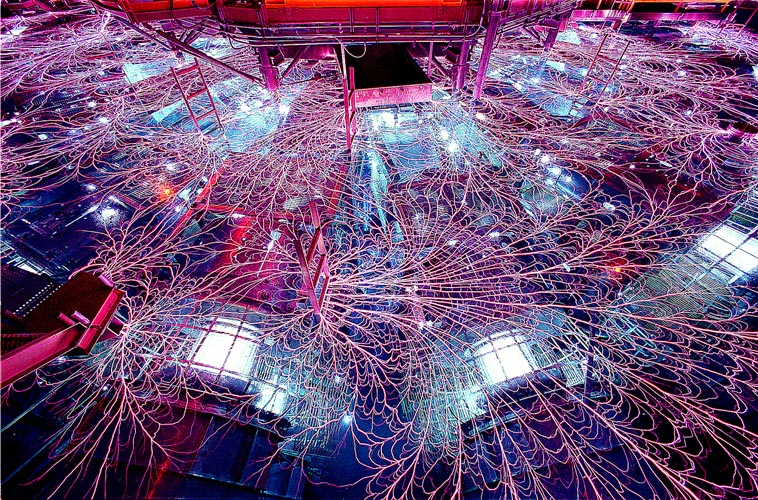
Short circuits running across the surface of the Z-machine, between metal parts emerging
"Water lines" allow increasing the power delivered to the target by compressing the initial electrical pulse (on the order of a few microseconds) delivered by the peripheral Marx generators, so that the final pulse delivered on the wire cage in the center lasts only 100 nanoseconds.
Question: how to increase the power? Several possibilities:
A first answer is given mechanically with ZR in 2007: the same method is kept but the constituent elements are improved. For example, there are still 36 Marx generators of the same size as the old ones but with capacitors storing twice as much energy. The 4 joule gas laser trigger common to the 36 switches is replaced by 36 individual laser triggers. The water-insulated transmission lines are vertical and tri-plateau (previously horizontal bi-plateau) less bulky and generate fewer bubbles, etc.
Nothing would prevent "stacking all these elements" afterwards. By doubling the height of the basin, a "double ZR" would mechanically give 54 million amperes.
The French specialist Mathias Bavay, who emigrated to the USA at Sandia due to not receiving the requested funding in France at Gramat, had imagined a Z-machine capable of delivering 60 million amperes immediately in 100 nanoseconds, thanks to an ingenious magnetic flux self-compression using two coaxial liners, without explosives (for details see the popular explanation of his thesis).
Jean-Pierre Petit, on the other hand, suggested replacing the cumbersome "Marx generators + conductive lines + basin" assembly with an explosive flux compression generator, an ultra-compact device generating 100 million amperes invented by Andreï Sakharov in the 1950s (the MK-2 generator) or a more perfected variant (such as the DEMG disk generator, faster). The Russians are indeed masters of the art of "high pulsed power". Read about it on the page The basic principles of Russian MHD machines.
The drawing below is only schematic. It is a simple "laboratory of a university or Grand Ecole" in order to achieve a first approach to these questions. The Sakharov generator, with its solenoid, can give very high electrical intensities, but the discharge time is too long. To discover an ultra-fast explosive generator, see the Russian DEMG, incredibly clever ( see in the middle of this page ) .
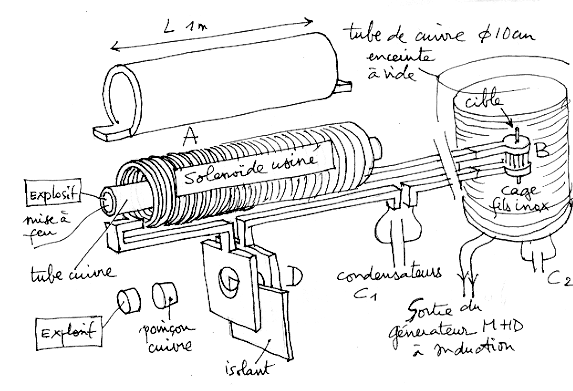
Schematic setup evoking a coupling between a Z-machine and a Sakharov generator
On the right: the MHD induction generator, a simple solenoid surrounding the target. At the bottom: the ultra-fast rivet switch, propelled by explosive
But another promising path for magnetic compression fusion within a Z-machine seems to be emerging in the United States, with the support of the Russians: the LTD generator (Linear Transformer Driver) whose very rapid progress was announced in great detail by the Sandia laboratories in April 2007. Read about it:
The Z-machine boosted by LTD --- ---