Z-machine and LTD fusion
The LTD-enhanced Z-machine
by Julien Geffray
May 21, 2007
Activity and news are resuming around nuclear fusion thanks to the Z-machine, at least in the United States. For the French Z-machine Sphinx, it's another story, because the DGA has indeed locked everything up, as you can see by reading this article published in Les Echos of May 16, 2007:
**
* *****
**** **
**
Les Echos
of May 16, 2007
Competences
NUCLEAR
The French Z machine is ignoring energy
Small "Sphinx".
In the middle of Quercy, at the Gramat Study Center (CEG), the DGA has been operating a small French Z machine (2.5 million amperes), named "Sphinx", for several years. Like its big American sister, it is mainly used to test the resistance of nuclear warheads.
Unlike it, it will not undergo any civilian experiments. A few years ago, the researchers from Gramat had tried to convince their military superiors to diversify their studies, without success.
Asked by "Les Echos", the very "fierce" CEG today claims to have no energy projects.
This reluctance to invest worries specialists in magnetohydrodynamics (MHD).
French expertise in this field of high-power electrical engineering is under threat, says one of them.
In Britain, an equivalent machine, the Imperial College's Magpie (1.4 million amperes), is actively working on magnetic compression, especially with American funding. Not powerful enough to reach the objectives of the Z machine, it is used by Americans to complement their research on compression itself. The Russians are also about to invest in this research area.
Note: "Compression" is the French translation of "pinch", which means "to pinch". Thus, the Z-machine falls into the class of plasma machines called "Z-pinch", where the plasma is "pinched" along the OZ axis of the system. All Z-pinch machines are also MHD machines, a discipline in which France was very advanced thirty years ago and which was completely and deliberately abandoned in the mid-1970s. In this absence of official reaction also lies a large part of misunderstanding and simple incompetence. Military MHD, for example, remains totally nonexistent in France, whereas in the US, Russia and other countries it ... runs. One could summarize this with a simple sentence:
While other countries are driving with their foot on the accelerator, the French are standing on the brakes
Another remark: Alain Juppé was appointed "minister of the environment". As such, many representatives of environmental preservation associations have recently been invited. But this is inseparable from an energetic action in favor of new energy sources. And there, there is a complete absence. Absence of motivation, but also of information and ... of skills. But let's get back to the subject of the article.
In the USA, the news about the new generation "LTD generators" is fascinating and the progress is faster than expected. The Sandia laboratories published a press release on April 24, 2007 titled:
Rapid-fire pulse brings Sandia Z method closer to goal of high-yield fusion reactor (Ultra-fast pulses bring the Z-machine closer to a high-yield fusion reactor)
The article, fully translated a bit further down on this page, describes a generator called LTD (for Linear Transformer Driver) that could be translated as "linear transformer switch" which should allow controlled nuclear fusion really usable in the Z-machine. The LTD would make the Z-machine more compact and less complex, making obsolete the huge water and oil insulated tank and the "water lines" that were necessary to modulate the pulse over time. It will also allow repeated shots at a frequency of 0.1 Hertz, where the current Z-machine can hardly perform one shot per day! The LTD generators are not really a surprise since the French Z-machine Sphinx has been equipped with them for a long time. The novelty comes from the performance achieved by the Russians with their latest LTDZ model:

Russian LTDZ generator of 100 GW: 1 million amperes and 100 kV
Diameter: 3 meters - Depth: 22 centimeters
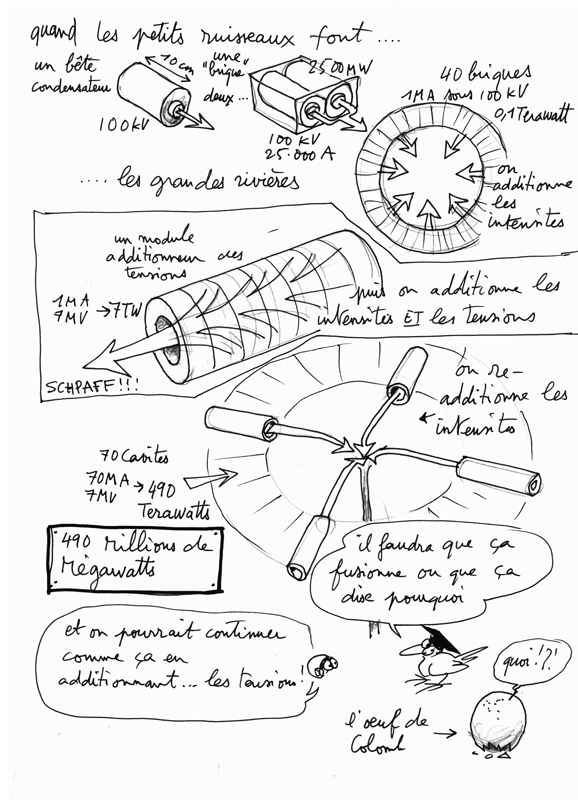
Let's simply explain the LTD generator: it is an assembly composed of "bricks", each the size of a shoebox containing two capacitors and a switch. Interconnected in parallel and arranged in a circle in the version that interests us, 40 of these "bricks" form a single "toroidal cavity".

Cross-sectional diagram of a "brick" making up the LTDZ
1: two GA 31165 capacitors (100 kV, 40 nF), 2: multi-gap HCEI switch, 3: outlet nozzle, 4: magnetic core, 5: insulation, 6: vacuum or oil cavity, 7: charging cavity, 8: caprolactone rods
This Russian version, the most elaborate currently, is tested at the High Current Electronics Institute (HCEI) in Tomsk, Siberia, where the Sandia laboratories have just acquired four. Note the American-Russian rapprochement on Z-pinch fusion... This Russian LTD, the most powerful in the world (100 gigawatts), is capable of delivering 1 million amperes at 100,000 volts, in a pulse lasting natively 100 nanoseconds (so without the need to compress the duration). It is also designed to fire every 10 seconds! Now, this is precisely the rhythm defined for a future operational magnetic compression fusion power plant, which would function literally like a "two-stroke fusion" (compression, expansion).
The concept seems reliable. The previous version of this LTD, identical but twice less powerful (20 bricks generating 0.5 million amperes at 100,000 volts) has already been validated by the Sandia laboratories following a cycle of more than 11,000 shots. At Tomsk, a switch has fired more than 37,000 times every 12 seconds.
Since these cavities are modular, Sandia plans to stack them like donuts on a rod and then multiply these rods. There would thus be 70 cylindrical modules arranged radially, each containing 70 LTDs stacked coaxially. The efficiency of this configuration is unstoppable:
- In each module, which is about twenty meters long, the 70 internal LTDs are connected in series to add their voltages. Each module would therefore produce one million amperes and seven million volts at the output.
- The 70 modules would then be connected in parallel to add their currents, resulting in a machine delivering 70 million amperes at seven million volts.

Sandia "IFE driver" project of 104 meters in diameter.
70 million amperes, 7 million volts, 490 terawatts theoretically. 70 modules of 70 LTDs each, totaling 392,000 capacitors.
Taking into account the inevitable losses, especially along the MITL (Magnetically Insulated Transmission Line) conductors, Sandia expects 60 million amperes at 6 million volts to be usable. This would represent a power of 360 terawatts before injection on the target.
This test bench would be laid out flat, according to a plan as indicated on the diagram. The Kurchatov Institute Russians have suggested also stacking these modules vertically. One could even imagine a spherical symmetry. As one of the scientists working on the subject says: it's a bit like playing with Meccano...
LTD assembly diagram
It's ... Russian, simply. A simple idea. The progress is considerable. As stated in the Sandia text (which repeats what I have always said for a long time. My first mention of the "two-stroke fusion" with MHD compressor is found in Science et Vie in 1975, I believe) it is the path of pulsed fusion, by compression. The "explosion engine" against the steam engine of the third millennium: ITER.
If we go back to the January 1979 issue of Pour la Science, we will find the Z-machine in its initial form, built at Sandia by Yonas. The power was already considerable, but it lacked focusing. Gerald told me in 1976, when I met him at Sandia: "we can concentrate in a volume the size of a pigeon egg, but we can't do better." The essential progress was "the cage of canaries", the famous "wire liner" which allowed a focusing that no one had imagined. They concentrated 240 stainless steel wires, arranged according to a cylinder of 8 cm in diameter along a plasma cord of 1.5 mm in diameter. And there it was, the temperature rise, bingo! As for the rest, it's power electronics, at long last. One must add the legendary Russian trick, quick to lower the prices. They did not delay in catching the ball, understanding what the 2005 manipulation contained with its three and a half billion degrees. Knowing very well that it is by no means a limit. It is 35 times the temperature reached in the JET of Culham, whose Iter must be the expensive successor. It is seven times the temperature that reigns in the core of a hydrogen bomb, 175 times that which reigns in the core of the sun.
Some people say and write "We would like to point out that the fusion conditions have not yet been achieved with these Z-pinches (while with Tokamaks ...). Let them start by demonstrating the possibility of obtaining fusion reactions with this method..."
To demonstrate? How? Where? With what money? What researchers? ....
It will be done, but not here.
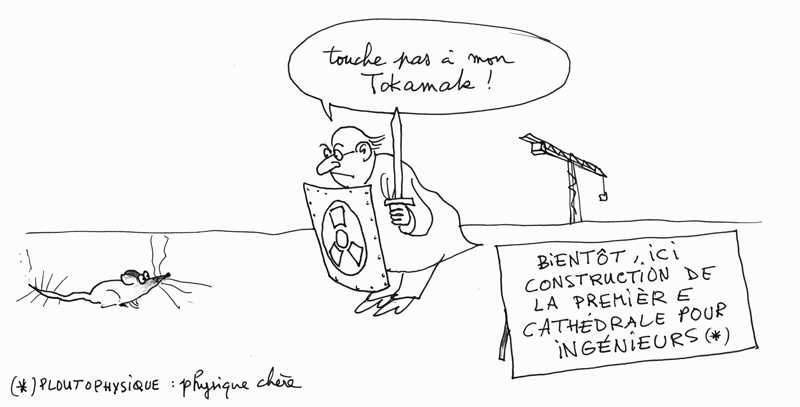
At the rate things are going, that is, at a ... furious pace, except in France where we sleep on our ears, as usual, the pulsed path will give its fusion reactions before the first pickaxe is even taken to this pharaonic project. We recall that the decision to get into this was personally made by a great French scientist, well known: Professor Jacques Chirac. Will Sarkozy dare to stop this dinosaur at the beginning of the race, this "social plan on a regional scale". With these recent advances, it would be worth thinking.
The two seven-year terms of Chirac are really ... pure politics. How to surf on public opinion, how to be re-elected, how to manipulate such or such group. And you want me to make a prediction? Chirac will reposition himself as a great defender of the planet, of the environment. He will play the role of the Capitol goose, now that he is no longer the occupant. We recall the time when Hulot used to visit him regularly, entering the courtyard of the Elysée on his scooter. Jacquot gave long speeches ... outside the hexagon. He will find a perch somewhere to give ecological morality lessons.
Do you bet?
My readers tell me "why not contact Juppé? and the new minister of research, Valérie Pécresse?"
Me, I meet whoever wants, tomorrow. But for a whole year we have chased after politicians of all kinds, in vain. We thought that with the elections we would have more luck. Mistake. When approaching Hulot (and even Hubert Reeves, his scientific advisor): complete failure. Many have ... absolutely not understood, they and their technical-scientific entourage. Bayrou opened wide eyes. The campaign staff of Ségolène Royal suggested we read her blog. Etc....
In any case, we have one thing, one card in hand, since early 2007: a letter from a "Russian oil", responsible for fusion at the Kurchatov Institute, covered with scientific distinctions, titles, member of the academy of sciences. This letter, he wrote it. It is at our disposal. It advocates the development of Z-pinches. But as I have already said, we don't have a ... recipient! We can't put such a document on a net blog. If someone from Valérie Pécresse's entourage comes forward (or herself, who knows?), the Russian signs and sends.
The latest experimental results of the Russian LTDZ generators will be presented at the 2007 international congresses (International Pulsed Power Conference and Symposium on Fusion Engineering) in Albuquerque, New Mexico, from June 17 to 21. The interested reader can already read a popularized report from Sandia laboratories of September 2006 which presents this concept of LTD coupled to the Saturn machine. This one is certainly less powerful but the content of this document is directly transposable to the Z-machine. Read also the Russian scientific paper on these latest generation generators, presented at the last international congress: 100 GW Fast LTD Stage.
Here is the article published on the official website of Sandia laboratories on April 24, 2007, translated into French:
http://www.sandia.gov/news/resources/releases/2007/rapid-fire-pulse.html
--- ****
** **
************ **

Télécharger l'image JPEG à 300dpi "fowler.jpg" - 2,2 Mo

**

Télécharger l'image JPEG à 300dp, "LTD-check-out.jpg" - 2,1 Mo


Télécharger l'image JPEG à 300dpi "LTD-system.jpg" - 1,6 Mo

**

Télécharger l'image JPEG à 300dpi “insulators.jpg" - 1,4 Mo

**** --- ********
Link to the original article:
April 24, 2007 Ultra-fast pulses bring the Z-machine closer to a high-yield fusion reactor A revolutionary circuit capable of firing thousands of shots without failing In Siberia and not in Area 51: Sandia researcher Bill Fowler tests the circuits of a LTD generator capable of producing very strong electrical pulses quickly and repeatedly. (Photo by Randy Montoya) ALBUQUERQUE, N.M. — An electrical circuit capable of providing enough power to finally achieve controlled nuclear fusion with high efficiency and, what is just as important, doing so every 10 seconds, has been intensively tested in preliminary experiments and computer simulations within the Sandia laboratories hosting the Z-machine.
The Z-machine, when fired, is currently the largest producer of X-rays on earth, and it has already generated fusion neutrons. But repeated rapid shots are necessary for future operational power plants in order to be able to produce electrical energy from seawater. This was not considered feasible until now.
Sandia is a laboratory of the National Nuclear Security Administration .
How does it work?
An explosion engine that ignites a single cylinder and then waits hours before starting again would not take the car far.
Similarly, a machine that would provide the human race with unlimited electrical energy, from abundant and inexpensive seawater, could not be satisfied with firing a single shot and then remaining idle for the rest of the day. It must provide energy to fuse hydrogen pellets every 10 seconds, and maintain this rhythm for millions of shots between each maintenance — a sort of internal combustion engine for nuclear fusion. This is at least the fusion method advocated in the Z-machine at Sandia and elsewhere, under the name "inertial confinement fusion".
Sandia scientists Dillon McDaniel (second from the left) and Steve Glover (on the right) examine in Siberia, along with Alexandar Kim (HCEI, Tomsk, Russia), a 500 kA LTD before its shipment to Sandia (the person on the left is the Sandia interpreter Roman Kahn). This LTD has been tested at Sandia for two and a half years.
Being unable to produce fusion except in an episodic manner, this method has been overshadowed by the technique called "magnetic confinement fusion" — which uses a magnetic field to try to contain continuous fusion reactions, from which energy must be extracted.
However, the emerging electrical circuit at the edge of the technological forest could change the balance between the two systems. Considered already "revolutionary" even by usually conservative researchers, it could well close the apparent gap between the first method and the second.
The generator is capable of firing every 10.2 seconds in brief and powerful bursts of electricity.
"This is the most significant progress in the research for electricity production in many decades," admits Keith Matzen, director of the Pulsed Power Center at Sandia.
The new system, called Linear Transformer Driver (LTD), was created by researchers at the Tomsk High Intensity Institute in Russia, in collaboration with American researchers at Sandia.
Rick Stulen, vice-president at Sandia of the Foundation for Science, Technology and Research, states in this regard that "this new technology not only represents a remarkable technical advancement, but also demonstrates the strong commitment of Sandia scientists and engineers within the international community." The royal road to nuclear fusion The circuit — a switch closely coupled to two capacitors — is approximately the size of a shoebox and is nicknamed a "brick". When several bricks are put together in groups of 20 and electrically connected in parallel in a circular container resembling a large, the resulting cavity can transmit half a million amperes at 100 kilovolts.
Such a cavity has been tested in Sandia's Zone 4, where it has been fired without failure more than 11,000 times.
Boris Kovalchuk (HCEI, in a gray suit) shows the plans of a new LTD device to Sandia researcher Dillion McDaniel, in front of Alexandar Kim (the person on the right is not identified) Because these cavities are modular, they can be stacked like donuts on a metal rod called a "rod". Arranged in an appropriate configuration, they could fire 60 million amperes and 6 million volts, theoretically enough to generate high-yield nuclear fusion with all the necessary parameters to design a real power plant.
"This is a revolutionary advancement," says Craig Olson, a senior scientist and head of the "Inertial Fusion Energy by Pulsed Power" program at Sandia.
The new generation model, currently tested in Tomsk, transmits 1 million amperes at the same voltage and with the same speed. Five units have been built; four have been acquired by Sandia, and one by the University of Michigan. Each costs $160,000. They also, according to the Sandia scientist Mike Mazarakis who supervised the tests on the Siberian site, work as expected without imperfection.
"It's an incredible achievement," says Sandia vice-president Gerry Yonas, a specialist in the Z-machine and the Advanced Concepts Group of Sandia.
Advantages of the new technology Fortunately for Sandia's accountants but unfortunately for the fans of the famous photo full of electric arcs and sparks taken by the Z-machine's official photographer Randy Montoya, the new switch makes obsolete the huge insulated tank filled with hundreds of thousands of liters of water and oil, which is currently an integral part of the Z-machine's structure. It was above the surface of the liquid that the characteristic electric arcs originated, a phenomenon as appreciated for its artistic qualities as it is disliked by engineers because of the energy it represents. Also obsolete is the complex set of power switches, which was necessary to reduce the initial pulse from microseconds to nanoseconds.
The LTD generator produces its pulse directly in the 100 nanosecond class. This works well thanks to its design which drastically reduces inductance, which usually slows down the transmission of electricity.
Dillon McDaniel examines the insulators that are placed between the layers of capacitors of the 250, 500, and 1000 kilo-ampere LTDs.
It does this in part by eliminating the huge plates and long cables of the current Z-machine, which all generate magnetic fields. In the new system, each brick has almost no wires. Two capacitors the size of small thermos bottles are tightly connected to a switch the size of a Tupperware. This leaves little opportunity for the slowing magnetic fields to manifest.
Moreover, joining the bricks in parallel in a cavity not only adds their currents, but also reduces inductances to levels even significantly lower than previously possible.
Several of these sub-assemblies connected in parallel are then connected in series to add their voltages this time.
This gives an extremely powerful machine capable of performing a series of shots very quickly, requiring only a thin layer of oil bathing the loops and switch lines.
The LTD technology is 50% more efficient than the current Z-machine firing devices, in terms of usable energy to injected energy ratio. The Z-machine currently has a 15% efficiency on its load (which is already a very good efficiency compared to other fusion solutions).
However, there is a certain cost to this efficiency.
The funds allocated to the Z-machine have been historically dedicated to military purposes, related to defense: its experiments aim to produce data for supercomputer simulations that help maintain the strength, efficiency, and safety of the United States' nuclear deterrent. Even without its repetitive firing capability, a powerful LTD-based machine would still simulate better the conditions created by nuclear weapons, so the data collected from these laboratory explosions can be used with greater certainty in refined nuclear computer simulations. The US has refrained from testing nuclear warheads under real conditions for 15 years.
Repeated firing, the machine could well become the basis of the first operational nuclear fusion power plant, within twenty years. Progress in this direction will eventually require funding from the "Energy" branch of the US Department of Energy.
To assert itself as a viable solution, this new concept would cost 35 million dollars over five to seven years, to build a test bench with 100 cavities. If the test is positive, future generations of Z-machines would be designed using LTD generators.
So far, the funding has come from two initiatives of the Congress through the programs of the National Nuclear Security Administration of the US Department of Energy, funds from research directed by internal Sandia laboratories, and the Sandia Inertial Confinement Fusion program.
"It's like building a Meccano toy," says Matzen. "We think we need 60 million amperes for a good fusion efficiency. But although our simulations show that it is possible, we won't really know until we build it." The device was designed by the head of high-voltage pulsed research in Tomsk, Alexandar Kim, and the switch was developed by Boris Kovalchuk; its acceleration from microsecond to 100 nanoseconds was entrusted to Sandia's Dillon McDaniel, and encouraged by his colleagues Rick Spielman and Ken Struve; the work was supervised at Sandia and Tomsk by Sandia researcher Mike Mazarakis; the tests at Sandia were conducted by Bill Fowler and Robin Sharpe; the Z-IFE fusion energy program at Sandia was initiated and is managed by Craig Olson.
The recent results on the development of LTDs will be presented at the International Pulsed Power Conference and the IEEE Symposium on Fusion Engineering, which will be held in Albuquerque in June 2007.
Sandia has filed a patent application on a high-power pulsed accelerator invented by William Stygar, using an LTD system as a primary current generator to replace conventional Marx generators.
Sandia is a multi-program laboratory, managed by the Sandia Corporation, a Lockheed Martin company, for the National Nuclear Security Administration of the US Department of Energy. Sandia has major responsibilities in national security, energy, and environmental technologies, and economic competitiveness.
Contact for News and Media at Sandia:
Neal Singer, , (505) 845-7078
To conclude these two articles, which J.P. Petit asked me to write for his website, I will note that although he was one of the first to draw the public, scientists and ... scientific journalists' attention to this set of questions, providing often very detailed details and analyses (like that of Malcolm Haines' paper), none of them mentioned these efforts, nor did they include a link pointing to his site. It's not new and unfortunately, it's highly likely that this will not change.
May 21, 2007 **Julien Geffray ** --- ---