Astronomy galaxies redshifts quasars
****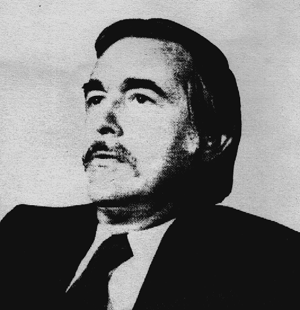 | Halton Arp | is a world-famous astronomer, author of a famous "Atlas of peculiar galaxies". Since the 1960s, Arp has systematically been interested in everything that the cosmos could contain that was strange or incongruous. He thus found, for example, pairs of galaxies presenting "abnormal redshifts", in the sense that the galaxy in the foreground was receding at 10,000 km/s while its companion, located in the background |
|
|---|
Halton Arp
is a world-famous astronomer, author of a famous "Atlas of peculiar galaxies". Since the 1960s, Arp has systematically been interested in everything that the cosmos could contain that was strange or incongruous. He thus found, for example, pairs of galaxies presenting "abnormal redshifts", in the sense that the galaxy in the foreground was receding at 10,000 km/s while its companion, located in the background
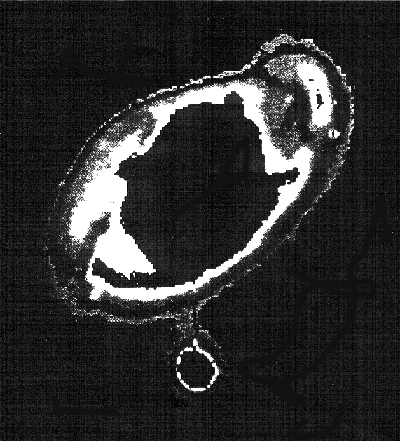
(the overlap of their images confirmed this) was moving away at only 4000 km/s. No one has ever been able to provide an explanation for these apparent violations of Hubble's law. ...When astronomers discovered quasars, a broad consensus was established to accept the idea that the measurement of their redshift was also that of their distance, very large. In these conditions, given their brightness, these quasars, "quasi stellar objects", should, having the size of a large star, radiate as much energy as an entire galaxy. No one has ever been able to provide a credible model explaining where these mysterious objects could get their energy. Therefore, it was perfectly legitimate, in the spirit of free confrontation of ideas, that other hypotheses could be proposed. By obtaining several images like the one on the right, Arp proposed the hypothesis that the redshifts of quasars could have another origin and correspond to objects emitted by galaxies. Hence this kind of bridge visible on this image. The scientific community took this very badly. Astronomers declared that these "bridges" were only optical artifacts resulting from fortuitous alignments. Some even questioned Arp's intellectual integrity, claiming that these famous matter bridges only appeared on his own photographs. Geoffroy Brurbridge, a famous astrophysicist, tried in vain to calm things down; in 1983, the Caltech telescope time allocation committee decided to bar Arp from access to the instruments at Mount Palomar and Mount Wilson. Arp was ordered to redirect his work towards more conventional research. He preferred to refuse and resigned from the California Institute of Technology to take a position at the Max Planck Institute in Munich. After this incident, Brurbridge wrote, "No responsible scientist, even opposed to Arp's theses, can accept this injustice."
..The average person would tend to believe that in the United States scientists could in principle be more open to new ideas or simply critical ones. It is therefore clear that this is not the case.

../../bons_commande/bon_global.htm