Patrick Baudry, astronaut
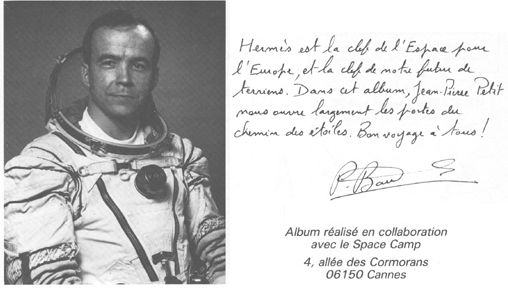
| Patrick Baudry | was an astronaut.
| It is known that during all space flights, every astronaut had a "double", ready to replace him in case of last-minute failure. During Jean-Loup Chrétien's flight to the Mir station, Baudry was "his double". The French then benefited from a second place on a space station, and, as is the rule in such matters, Baudry was on the trip. He thus boarded an American space shuttle and made a mark by arriving with a baguette under his arm and a beret on his head. |
|---|
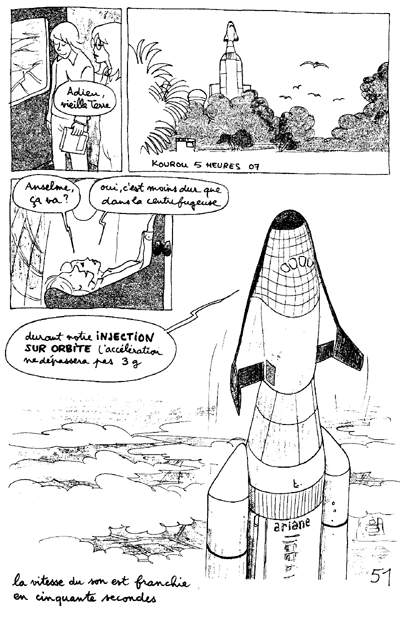
...During this flight, the Americans tested the effectiveness of their laser firing stations installed on the ground. For this purpose, a mirror was fixed on the left side of the shuttle, which it presented towards the ground. The shooting was supposed to be carried out from the island of Hawaii, but the beam missed its target by 400 km, the aiming calculations having been made by mixing feet and meters (it is known that this kind of error later caused the crash of an American space probe on the surface of Mars). One might think, "but why on earth don't the Anglo-Saxons finally decide to count distances in meters instead of feet, speeds in kilometers per hour instead of knots, and capacities in liters instead of gallons?". A pilot friend of mine once said to me, "If we did so, the number of air disasters would be considerable, because pilots around the world, both civilian and military, count in feet, knots and gallons". If we suddenly told pilots "descend to three thousand meters", it is very likely that many of them, thinking "feet", would crash into the ground. Therefore, the Americans may perhaps consider the loss of a lunar module as a lesser evil. ...After his flight on the American shuttle, Baudry worked on the "Hermès project" for a few years. It was a French space shuttle project that the Ariane V rocket could have placed in orbit, but it was eventually abandoned. Jean-Loup Chrétien somewhat played the role of the official French astronaut in the media, in France or abroad. Baudry, perhaps less flexible and more independent, with private investors, launched a "Space Camp" project that was set up near the Cannes airport in the 1980s, if I remember correctly. In the USA, "Space Camps" are quite popular among young Americans. Baudry took the formula and tried to develop it in France. If you read "Le Tour du Monde en Quatre Vingt Minutes" (which initially had the title "Operation Hermès") and was prefaced by Baudry (see the photo), you will see, in the form of drawings, many installations that equipped the Cannes Space Camp while it was still in operation.
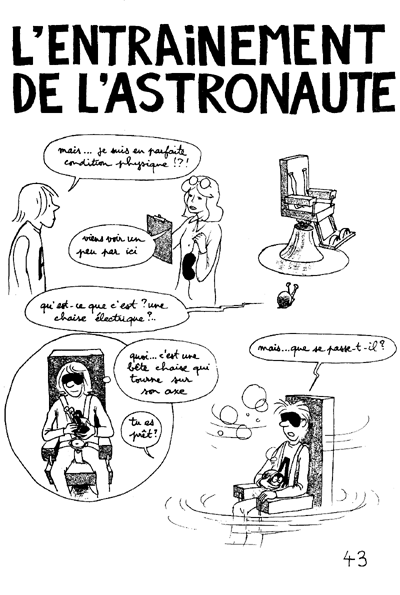
...The young trainees were grouped into "crews" and prepared for a space mission, obviously simulated. Everything was included, from theoretical classes to various trainings: centrifuge, spinning stool, simulation of walking in reduced gravity, piloting a seat equipped with rockets for docking on what would resemble the back of the Hermès service module, etc. In the center there were two installations, whose use concluded the training sessions. One, equipped with computers, was supposed to be the ground control room (a small-scale replica of the "Jupiter Room" of Kourou, in French Guyana). The other represented the interior of the Hermès cabin and could accommodate four or five trainees. Instead of windows, the aspiring astronauts could contemplate a simulated landscape using computer-generated images. ...Such a setup can obviously only survive with subsidies. The affair eventually collapsed financially and the bankers gave the thumbs up. It is evident that the only place where a "Space Camp", if it were to rise from the ashes, could be installed would be near the Toulouse CNES and under its guidance. Therefore, in a "City of Space" we find the former collaborators of Baudry, such as Philippe Droneau.
...Baudry, for his part, describes himself in his recent book "Le Rêve Spatial Inéchevé" (Taillandier edition) as "a test pilot at Airbus". ...A word about this book. It describes in quite some detail the path of Gagarin to his historic flight. Baudry reveals many quite picturesque details, such as the fact that Gagarin may have urinated along the rocket that was to take him, just before takeoff. The Russians are not believers (at least when they called themselves "Soviets") but they are superstitious. Just before this historic flight, Korolev, the father of Russian astronautics, after placing a one-kopeck coin on the rail on which the wagon carrying the massive "Semiorka" moved into position for its launch, to be crushed by the passage (the coin, not the rocket), went to urinate in the huge pit into which the gases from the multiple engines would be released. According to Baudry, these rituals would now be part of all Russian space flights. Thanks to Baudry, we have information that seems credible regarding the death of the first Russian cosmonaut, during a recovery flight on a MiG-17. After having paid a lot with his person as a warm communicator and then as a deputy, Yuri Gagarin wanted to be able to sit again at the controls of a fighter jet. He was a few hours away from flying in this recovery, guided by a very experienced instructor, when their aircraft crashed into the ground. According to the information gathered by Baudry, Gagarin's MiG-17 would have been caught in the turbulence of a commercial aircraft passing through an area where it had absolutely no business being at that time. These disturbances would have immediately put the MiG-17 into a spin, at the moment it was approaching, and the two pilots would not have had time to activate their ejection seats or, counting on their maneuvering skill, would have hoped until the last moment to save the aircraft. ...Baudry then develops quite convincing criticisms regarding the International Space Station (ISS or International Space Station). As many space specialists have already said, people up there will only repeat, at great expense, everything the Russians did in their Mir station over twenty years (as a US senator opposed to the project said: "we will put people in there and make them go around in circles"). Since long-duration stays have already been carried out in the Russian Mir station, now defunct, this will not be a novelty. Baudry says that in fact, we don't really know what to do with this expensive station (one hundred billion dollars). We talk about "microgravity experiments". However, Baudry immediately points out that it is sufficient for an astronaut to move around the station by grabbing the walls, or for an antenna to be oriented, or for a simple engine to transmit vibrations, or for someone to slam a locker door a bit too hard for this microgravity to turn into an illusion. If we really wanted to perform experiments in minimal gravity, it would be more appropriate to have them carried out automatically, in a completely independent module. Second "project" related to the ISS: conducting experiments "in the vacuum of space". However, this vacuum becomes an illusion as soon as we take into account the pollution caused by the use of rockets and retrorockets of the shuttles approaching the station. This seems logical. ...Satellites provide excellent photos from space. Telescopes easily do without the presence of humans who would only disturb their operation. The Russians have long since tested the techniques of assembling large structures, which could foreshadow future space trains, destination Mars. In short, what are we doing up there other than going around in circles? We now know the conditions of adaptation to weightlessness, its disadvantages and the means to remedy them. We know how to feed in space, to wash, to use the toilet. Except for the act of sex in weightlessness, everything has practically been tested. The fact that some consider the partial use of the station as a luxury hotel for tourists or as a public advertising site is in itself a very bad sign. ...Baudry then rightly mentions the incomprehensible abandonment of flights to the Moon. Indeed, human exploration was quite expensive, but the Russians, with their "Lunokhod", had demonstrated the ease of exploring our satellite using "remote-controlled" robots. Indeed, since the Moon is only 400,000 km away, it is entirely possible to pilot one of these "rolling trash cans", mounted on tracks, from a simple console on Earth. From this control post, one can pilot sample collections, fairly deep drilling, negotiate seismic studies. One could have ventured onto the far side of our satellite. We finally know very little about it. Even if the Moon is apparently devoid of atmosphere, of life, even if it is essentially mineral, surprises would have been possible (whereas there are none from a station like the ISS). In the long term, it would have been entirely possible, as Baudry points out, to install a permanent international station on the Moon, which is four days from Earth (compared to more than a year for Mars). The lunar rocks contain oxides. As the Moon receives a significant amount of solar energy, an oxygen and all sorts of atom extraction plant could have been set up on the lunar body, foreshadowing the installation of humans in other more distant places within the solar system. Even reduced by a factor of six, the lunar gravity allows humans to escape demineralization and generally the various disadvantages of weightlessness. ...By placing them at some distance from the station, real "space vacuum" experiments could have been developed. The low lunar gravity and the absence of atmosphere would also allow, quite quickly, the implementation of rail launch systems, using simple linear electric motors. The energy would come from batteries, recharged using primary energy from the Sun. Another advantage: less pollution. By magnetically guiding a module, one could impart to it, by acting on it with electromagnetic forces, a speed much higher than that which the most powerful terrestrial rockets can give to probes, which forces us to use the "slingshot effect". For example, it took several years to position the Galileo probe in orbit around Jupiter using the slingshot effect twice: once around Venus, then again by brushing past the Earth. What limits the speed of probes propelled in a conventional way is the ejection speed of the rockets and the fact that during the acceleration phase, it is not only the probes that must be accelerated, but also the inert mass of the propulsion system and the fuel. From the purely technological space standpoint, the installation of facilities on the Moon would be of great interest.
...All these technologies would have produced various spin-offs. Space has already provided some: for example, microcomputing. High-capacity batteries, which equip "wireless" tools, are another. Finally, there is a spin-off that is less talked about, but which interests hundreds of millions of households, those of wealthy countries: the progress made for diapers (indispensable in space stations, until the advent, in "Skylab", of a real toilet). The Moon is a good location for conducting physics experiments where ultra-vacuum is required (like particle accelerators). As seismic activity is practically nonexistent there, it is a good place to install giant telescopes on the far side, away from light pollution. But above all, the exploration of the Moon would have revealed a part of the unknown, of dream. It is unthinkable that an object of this magnitude could contain nothing but vast expanses of basalt. However, as Baudry noted, dream is an important part of space projects. In the case of the ISS, it has completely disappeared. ...Indeed, the complete absence of human activity, on or even near the Moon, is a complete mystery. Unless there are already people up there who do not want to be disturbed.
When he made his space flight, Baudry boarded the American shuttle wearing a beret and a baguette. This was not to the liking of the CNES and the Quai d'Orsay. Later, he tried to set up a Space Camp in Cannes, and that's where I met him. Again, the help was not forthcoming. While Jean-Loup Chrétien, more "in line", was continuing his space flights and public relations operations, Baudry's career was collapsing. Bankruptcy of his Space Camp, the formula later taken over by the CNES in Toulouse with as director his assistant. Abandonment of the European space shuttle project Hermès. Today, Baudry serves as a valet for the son of Dassault, Serge, presenting business jets to wealthy clients.
One day, an academician told me, "Be insignificant and you will be covered with honors." I believe that it is this insignificance that the former astronaut Claudie Haigneré owes her "brilliant political career." Having completely failed in her task as Minister of Research and Technology, she was quickly reassigned to a position in the European Parliament.
Have you noticed how the champions of bureaucratic jargon benefit from an indestructible job stability?
- And since he had done nothing wrong, they gave him a state funeral*
Auroch's Horn, Georges Brassens ---
