Von Zborowski's beetle
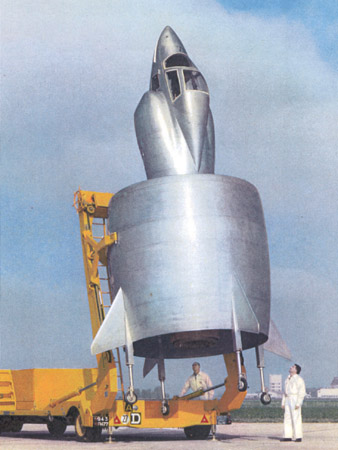 | L | e "Coléoptère" | was an aircraft built and tested in France in 1959 as a single prototype, which was unfortunately destroyed during testing after reaching 900 meters in altitude. The idea originally came from a German: Von Zborowski. It was one of the "secret weapons" Hitler hoped would allow him to regain the advantage toward the end of the war. As Allied bombers regularly damaged runways, the twin-engine Messerschmitt 262, which required a long takeoff run, was often grounded. Von Zborowski's vertical takeoff aircraft would have solved this problem. The French recruited this German defector, just as the Americans later recruited Von Braun from Peenemünde. A machine based on his concept was studied and built around a turbojet: the "flying ATAR," powerful enough to enable vertical takeoff. In horizontal flight, it was planned that Von Zborowski's aircraft could, by injecting kerosene into the space surrounding the engine, operate as a "static rocket," allowing it to reach Mach 3. The prototype's destruction was a great misfortune, as this type of aircraft could have given rise to an entire generation of revolutionary fighter jets. Currently, the only operational vertical takeoff aircraft is the British Harrier (the harrier is an English dog used for pack hunting). |
|---|---|---|
The "Coléoptère" was studied in France in 1959 by engineer Pierre Lhoste (now retired and my neighbor), on behalf of SNECMA. After the prototype's destruction and the project's abandonment, he went on to work at the CEA.
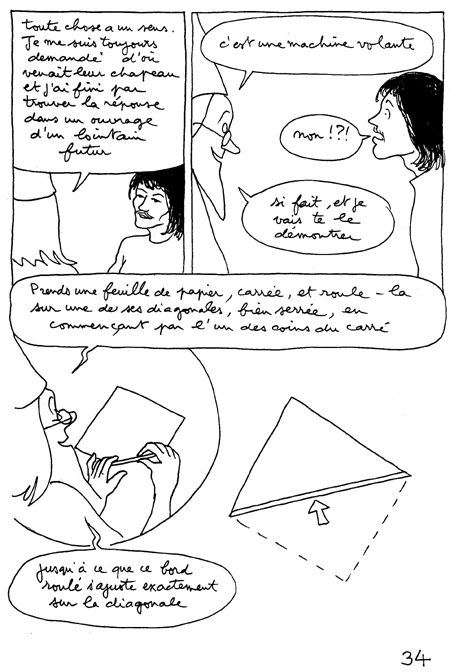
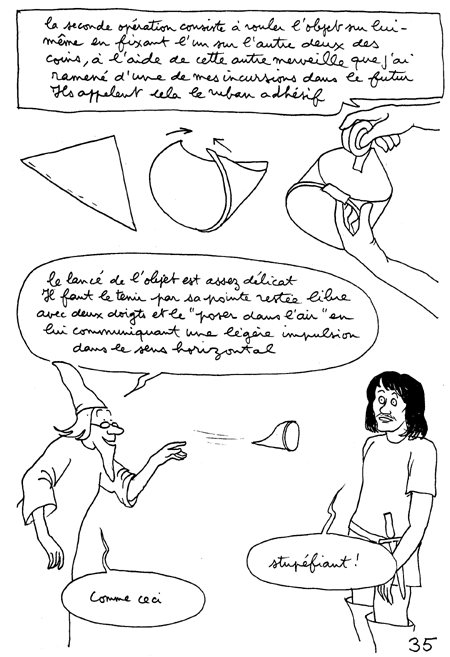
It would be incorrect to believe that a ring wing aircraft must have poor flight qualities. In fact, since this wing is "completely wrapped around itself," losses caused by "wingtip vortices" are eliminated. The following pages, taken from a comic strip, show how one can build a ring wing oneself, which flies very well. In fact, it's one of the best paper airplanes I know.
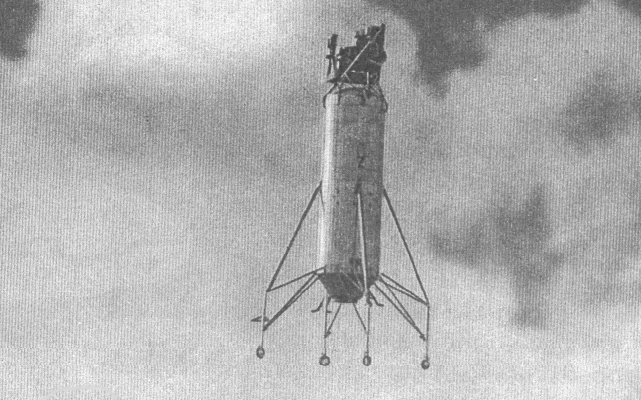
....The Coléoptère was built around an extraordinary engine: the "flying ATAR," shown here in flight. It was designed to demonstrate the feasibility of vertical takeoff. First tested under a gantry, it was later tested free of any constraints, as indicated. Its simple landing gear is visible, as well as the pilot's seat perched atop the turbojet body. This photo was taken at an altitude of just a few tens of meters. Flight control was achieved by adjusting the jet's direction using flaps placed in the exhaust nozzle.