Untitled Document
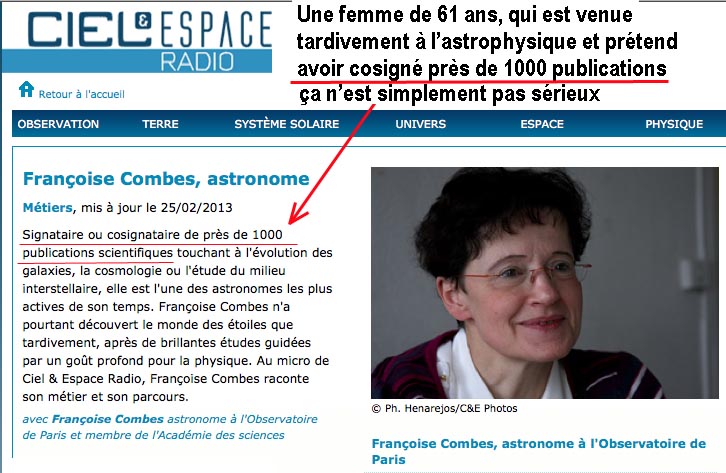
This image accompanies a long radio interview with the academician (elected in 2004). I believe this text, which is not a journalistic excess, but which the person herself confirms, speaks for itself. You will learn in passing that Françoise Combes only came late to astrophysics and cosmology, that she also devotes half of her time to reading new published works, and that she is on mission on average twice a month. So do the math. She has therefore signed, or co-signed, between one and two articles per week since she began her career.
True scientists will conclude for themselves.
I met her about fifteen years ago, during the thesis defense of an student of Evangelina Athanassoula, at the Marseille Observatory. A thesis "on the dynamics of galaxies" which consisted of setting initial conditions, for example two sets of mass points throwing themselves at each other, and after extensive computer calculations to obtain an image which was then sought in some catalog.
Athanassoula thus directed many theses based on this principle, usually taking foreign students as pupils who could then settle, with a doctorate in hand, in some astrophysics chair created for them.
I imagine that Athanassoula had to retire after a career filled with "non-works". The same goes for her husband, Albert Bosma.
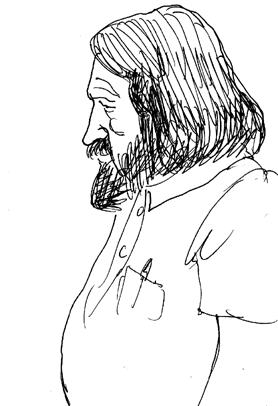
Bosma, 15 years ago.
Albert Bosma, who managed to have me banned from speaking at a French-French astrophysics conference in Montpellier about fifteen years ago, where I was supposed to speak about galaxy dynamics, simply by declaring:
- If Petit speaks, I'm leaving...
For twenty years Bosma and his wife Athanassoula used a powerful computer, installed at the Marseille Observatory (which I did not have access to), the GRAPE system, without notable results, other than deducing the mass distribution in galaxies, based on their rotation curves.
That day I showed them (Athanassoula and Françoise Combes) the results of computer simulations carried out by Frédéric Descamp, on the DAISY computer in Germany, interacting in 2D a galaxy and an environment of negative mass. Then a beautiful barred spiral appeared very quickly, which lasted for dozens of turns without losing its arms.
Françoise Combes, pale, immediately said to me:
- We can get the same thing with cold gas!
Indeed, shortly after, the magazine Ciel et Espace published beautiful photographs taken from simulations she had done. Cautious, I had a friend, who presented herself as an amateur astronomer, and after having praised the lady, asked her how long these structures lasted, which was not specified in the article.
The answer came: a little more than one turn...
The spiral structure takes its place in the gas disk. This disk is very thin: 300 light years thick against 100,000 in diameter. The thickness of a microgroove or a CD.
Initial conditions: the rotation curve of these same galaxies: solid body near the center, differential rotation at the periphery. That is, the angular velocity decreases as one moves away from this central region.
We throw "cold gas" into this disk. The Jeans length varies as the square root of its temperature. If the temperature is low, this gas tends to clump together. Add differential rotation: the spiral structure is then very easy to obtain. However, and all such simulations tend to show this, this gas heats up. The molecules that make it up acquire velocities exceeding the galaxy's escape velocity, and the arms... evaporate. Athanassoula faced this problem throughout her career.
For this structure to last, these galaxies would have to continuously collect cold gas. Françoise Combes never managed to demonstrate sufficient amounts of this cold hydrogen for her model to become credible.
The hypothesis of the presence of cold gas between galaxies is hardly supportable. On the contrary, the presence of very hot gas (hydrogen heated to tens of millions of degrees) between these same galaxies has been demonstrated. The collisions between these elements were accompanied by X-ray emissions.
And this is perfectly normal. For this gaseous mass not to have been captured over time by the galaxies, the hydrogen atoms must have velocities exceeding the galaxies' escape velocity, on the order of 1000 km/s. What is the temperature of a hydrogen gas whose thermal agitation speed is 1000 km/s?
Answer: 40 million degrees.
How was this gas heated to such a temperature? At the time of the ignition of the first generation of stars in elliptical galaxies. These galaxies then behaved like ovens, the young stars being very active. The matter can also be ejected in jets. The future spiral galaxies, in the proto-galaxy state, do not lose their gas, which remains in a diffuse halo. The galaxies, in their primitive stage, forming a collisional system, the gaseous halos are rotated, but not the "bulges" whose fossil is represented in our Milky Way by the hundred of globular clusters forming a subsystem with spherical symmetry (which does not rotate). The collisions will cool the gas of the light protogalaxies, which will however retain the angular momentum acquired during the collisions. Hence these ultra-flat gas disks, in which "secondary stars" (called Population II) will be born.
The expansion separates the galaxies from each other, and also separates the intergalactic hydrogen atoms, which can no longer lose energy by radiation, except exceptionally, corresponding to the X-ray radiation measured.
Unlike Ms. Combes, with her thousand publications, I never managed to publish, in the 1980s, my work on these spiral galaxies. Each submission was returned with the message:
- Sorry, we don't publish speculative works.
Until I finally gave up, abandoned. I even lost the superb bitmap file that showed this animation.
But one must regain composure, take oneself back, even at 76 years old. Now, the money raised by book sales allows me to attend conferences. The "point of access" might be mathematical physics (I will present my first paper there in September 2013).
Mood swing: this whole story of dark matter, dark energy, Modified Newtonian Dynamics: nonsense! For half a century astrophysics and cosmology have been sinking into activities that are nothing more than show....
Françoise Combes may be the emblematic image of contemporary astronomy and astrophysics, through the accumulation of "increasingly precise data" leading to a measurement of a "near 1%" lack of knowledge and understanding. Astrophysics, cosmology and beyond, fundamental physics have become show. One must accumulate speeches,...