Portrait of the mathematician Jean-Marie Souriau
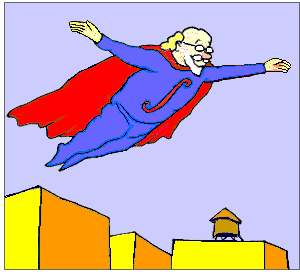
See on the site.
"Gramps" Souriau
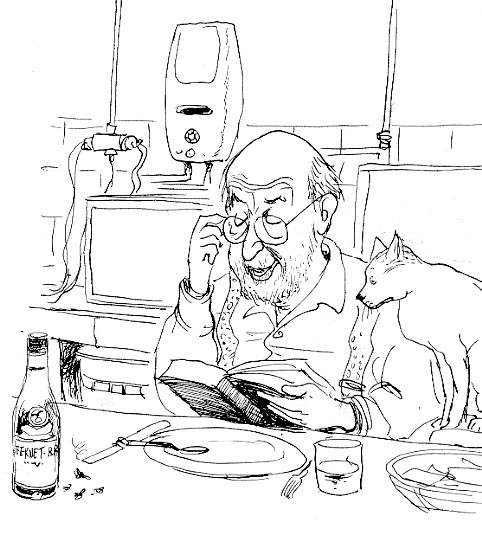
( Alias the mathematician-Geometer Jean-Marie Souriau ) is a key figure in my scientific life. Thanks to him I undertook a very painful additional training in mathematics, a process in which he shows great patience. At eighty-three years old, he has an inexhaustible creativity, thanks to a magic liqueur, Fernet-Branca, which his mother already gave him in his bottle. A powerful neuronal stimulant, at the same time as a remedy for many ills, this artichoke-based liqueur is variously appreciated. According to Souriau "When you taste this brew for the first time, you think it is a product for stripping silverware. Then you come to regret that it is not one".
Gramps is one of the pioneers of Symplectic Geometry (I suspect him of being the reincarnation of Lagrange, but, obviously, I have no proof). He is also the father of this tool that is
the coadjoint action
of a group on its moment space
., which allows the geometric status of objects of physics (mass, energy, momentum, etc.) to emerge.
Souriau used it to produce, for example, the first geometric interpretation of spin.
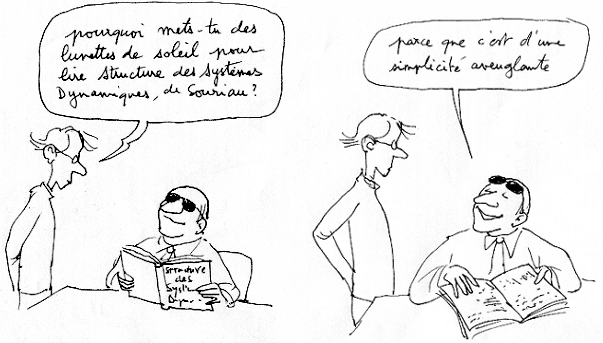
A detail that matters: the man neither speaks nor understands English. He has therefore published a significant part of his work in French, in two highly dense works: Géométrie et Relativité (Hermann, 1964) and Structure des Systèmes Dynamiques (Dunod 1974) , texts of flawless hermeticism which are important contributions to Mathematical Physics, but are of course out of print and often difficult to find. Mathematical Physics must not be confused with Theoretical Physics, of which Souriau gives a personal definition: Physics, minus experiment and Mathematics, minus rigor. In Géométrie et Relativité Souriau takes up work initially done by Kaluza by introducing an additional dimension, a fifth dimension. When one writes that the second-member tensor of Einstein's field equation has zero divergence, one classically obtains the equations of fluid mechanics, in their simplified form (the Euler equations). In a geometric context endowed with an additional dimension the Maxwell equations appear, which is not the case with four dimensions. The approach furthermore brings out a scalar and a supernumerary equation, without immediate interpretation. It is therefore "an equation in search of a phenomenon" (a situation which is generally that of superstring theory). Any suggestion concerning the physical interpretation of this "scalar plus equation" set would obviously be welcome. Contact us.
Souriau's work is extremely varied. Contrasting with many so-called "pure" mathematicians, he considers that mathematics and physics are and must be indissolubly linked. He is one of the rare mathematicians I know who is capable of locating at first glance the carburetor or the battery, under the hood of an automobile engine. In the site
presentation of other researchers' work
), I mentioned his work on the
. It is known that the relative positions of the planets, the distribution of their orbits remains a mystery. The famous Titus-Bode law constitutes only an empirical description of it. Based on resonance mechanisms, Souriau showed that the planets tended to position themselves on orbits corresponding to a "golden law" (based on the golden ratio). Why does this mythical number appear here? It is known that numbers are divided into different sets. There are integers, then rationals (numbers that can be put in the form of a ratio of two integers), then irrationals (which cannot be described in this way) etc. One knows how to "measure the degree of irrationality" of a number, this measure having been introduced by Emile Borel. In this respect the golden ratio, solution of the equation:
- x - 1 = 0
is the most irrational of all numbers. What connection is there then with resonance? Imagine that you pluck a vibrating string, which would oscillate with a period T1. The sound emitted could make a neighboring string resonate, with a nominal period T2. The resonance will be maximal if T2 = T1. It will be notable if the ratio of the periods is a rational fraction (harmonic ratio), much weaker if this ratio is close to an irrational number, such as for example square root of two, and minimal if the ratio is equal to the golden ratio.
.Souriau, by his own admission (as apparently all mathematicians do) finds his ideas while sleeping.
He thinks (like many others, who do not dare say it out loud) that our planetary physics has been bogged down to the hub for half a century, the last notable contribution being, according to him, that of the Nobel Prize winner Richard Feynman, concerning quantum electrodynamics. Souriau even planned to write a book that would have been entitled "Fifty Years of Non-Physics". Indeed, superstring theory hardly seems, in spite of declarations like those of Thibaud-Damour (see further on) to bear fruit, or even simple buds. Thirty years after the "pioneers" "opened the way", it remains essentially a matter for amusing oneself among friends, given that this "theory" has never been capable of interpreting the slightest observation, the slightest phenomenon or of proposing the slightest experiment. However (see Structure des Systèmes Dynamiques) Souriau made important contributions to quantum theory by managing to reconstruct the various equations (Schrödinger, Klein-Gordon, Dirac, Pauli, Maxwell) starting from groups, this constituting "geometric quantization". Thus the quantum vision of reality would follow from an extension of the geometric context, from four to five dimensions, the fifth dimension, or "fiber", being closed.
Recently (end of 99), Jean-Marie imagined a variant of the
(presented in Grenoble, early 2000, during an epistemology congress). Early 2000 he is interested in quasicrystals (discovered in 1984). As soon as I have a moment, I will present this new work, also presented during this colloquium, on my site.
At this dawn of the third millennium, he has finally invented a pun that kept our readers in suspense for more than two weeks, and whose solution was finally found, the same day, independently, by
Xavier JANC
Dominique GIGON
. Here is this pun:
Click on it to get the solution, after having checked that you are over eighteen.
November 9, 2004
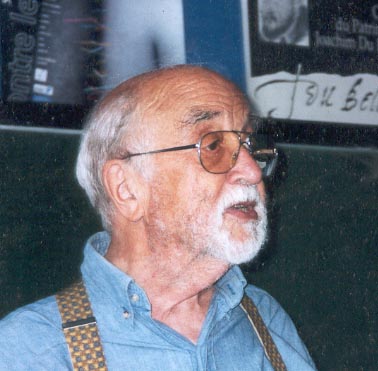
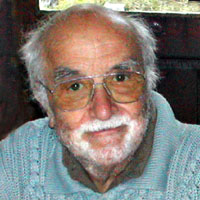
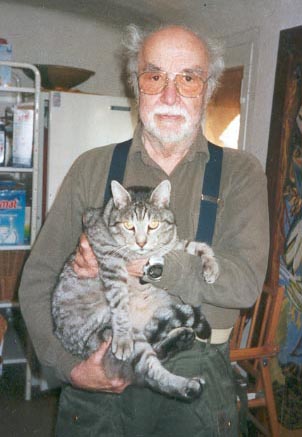
A photo of Souriau
Common sense, which others call utopia
J.M.Souriau
May 2006
Pioum, Souriau's cat, died suddenly at the age of 14.
Pioum, Souriau's cat.
Pioum was not an ordinary cat. Having absolute trust in humankind he had the habit of going to sit on the knees of any visitor, whoever it might be. We were all very affected by his disappearance, so much had we become accustomed to having him on our knees when we came to do math sessions in Jean-Marie's kitchen. After having lived so many years alongside this great mathematician it is not to be excluded that Pioum may, without our knowledge, have been able to acquire a few notions of group theory or differential geometry. Indeed, at certain moments of our discussions his gaze seemed to light up, as if he were following our remarks with interest, without saying a word, since cats, in principle, are not endowed with speech.
A week ago Pioum went to greet his master, on his bed. Jean-Marie then went to have his breakfast. When he returned to the bedroom Pioum had discreetly passed from life to death, for an unknown reason. No doubt Pioum must have gone to cat heaven.
We all know what place Pioum held in Jean-Marie's life, who nevertheless has many children, grandchildren and friends. This disappearance is added to a sudden shortage of Fernet-Branca, the supermarket located opposite Jean-Marie's home having decided to no longer make this drink available to the public, although it is extremely beneficial on many levels and has been since his childhood the favorite drink of Professor Souriau, to which he attributes many of his discoveries in mathematics.
Jean Marie Souriau died in March 2012.
D
isappears one of the main founders of Mathematical Physics. An astonishing figure combining, in mathematics, an intuitive agility and a disheveled creativity, and in physics a perception a keen sense of observation and of decoding phenomena.
Souriau's favorite phrase:
Theoretical physics, which has become a physics without experiment and a mathematics without rigor, has made science become a vast psychiatric hospital where it is the madmen who have locked up the others. The scientific period of these last decades, where science has become media-oriented and virtual, could be summed up by the formula: " fifty years of non-physics ".
S
ouriau, it was the big eight in geometry, abstraction to take your breath away, immediately followed by a close reconnection with the things of reality.
Unforgettable
An interview with J.M.Souriau by his student and friend the mathematician Patrick Iglesias.
A video where I interview Jean-Marie at his home, in 2008, on his site ( "catastrophe" )
Number of consultations of this page since May 24, 2006 :