archives farewell speech Eisenhower speech Senator Robert Byrd on Iraq war
Important archive documents
March 11, 2005
Readers have asked me for "permission to copy these files onto their own websites." These files do not belong to me. I believe Eisenhower's statements should be known by as many people as possible. Please post these files on your websites. Share these words.
The first is the farewell speech delivered by President Dwight D. Eisenhower on American television on January 17, 1961, addressed to all his fellow citizens. It is entirely focused on a solemn warning regarding the danger posed by the growing power of the U.S. military-industrial complex. Eisenhower uses the term "military-industrial complex." He warns his fellow citizens that if this entity is not controlled, it risks becoming a genuine threat to the democratic functioning of the country.
To download and listen to this 5-megabyte video
Byrd delivered his speech to an empty chamber. This image comes from the film "The War Machine" and shows the empty benches of Congress before which the Senator spoke.

The second document is much more recent. It is a speech delivered on February 12, 2003, by Senator Robert Byrd of Virginia, just before the American attack on Iraq began. He delivered this speech to a nearly empty chamber, and no one echoed his words. There is a shot where the president is seen squirming uncomfortably in his seat. The full text in English follows.
March 13, 2004: Source Voltaire Network
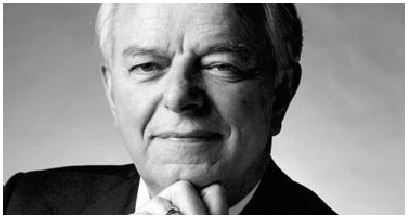
Robert Byrd, a Democratic Senator, is the senior member of the U.S. Senate. The video above shows him as an early opponent of the American operation in Iraq. A few days ago (early March 2005), he sparked controversy by comparing George W. Bush to Hitler. Referring to the changes Bush has implemented in the Senate, he expressed the view that Bush had begun filling the courts with right-wing judges. He recalled that Hitler, before fully seizing power, had played the "democratic game," remaining "within the law."
To download and listen to this 7-megabyte video.
Complete speech of February 12, 2003, in English and French
Speech delivered by Byrd in the U.S. Senate on October 18, 2003
My comment: How is it possible that it took two years before we learned about such a speech? At the U.S. Senate, it takes an 82-year-old man to dare say such things. In the film "The War Machine," we see a senator say during a public meeting, "I bless our nation's war industry" (to whom his jobs and his seat are owed).
Our French media are beneath contempt. The global situation is grave and worsening daily. Interest groups have seized power in various countries. It's not only in the United States. The UN (which de Gaulle contemptuously called "that thing!") is powerless. Selfishness and interests are unleashed. Frustrations and misery become the breeding ground for all despair and extremism. In wealthy nations, fear is preparing to justify all excesses. Yet no one seeks real solutions. No one dares consider one of the urgent measures that must be implemented immediately:
Transparency
It would be more important to make bank accounts public, dismantle tax havens and money-laundering structures than to track individuals. This would attack the problem at its root, rather than merely treating the symptoms.
In our French media, Eisenhower's speech and the film "The War Machine" are ignored, pushed to obscure time slots. Truth does not sell. It is astounding that in these times of great danger, the highest-rated time slots are filled with the most trivial programs. But this is the result of information liberalism.
Back to Guide Back to Homepage
Number of visits to this page since March 11, 2005: