Armageddon 9/11 terrorism
My reactions to the events that occurred in the USA on September 11, 2001, and to the consequences in terms of geopolitics.
Updated on November 16, 2001

 | science1 | jp-petit.com |
|---|---|
...Is there not a way to allow thousands of people to evacuate a building in a few minutes, without using stairs? See Infernal Tower.
...These events, a few days after they occurred, have caused me various reflections.
About the attacks themselves :
...The vulnerability of aircraft appears total, staggering. How can we prevent air pirates, determined to do anything, from bringing on board simple razors, objects undetectable by X-ray, like ceramic knives, extremely sharp? How to protect passengers and the crew cabin? The only solution is to make sure that this cabin cannot be accessed during the flight, except by an order from the ground (except for the evacuation of the crew through a hatch operated by explosive bolts). This would prevent air pirates from taking control of the aircraft. This type of cabin protection is similar to that of bank vaults against a robbery. A reader, Alain Butler, writes me "there is an even simpler solution: that the pilot cabin be completely isolated from the rest of the cabin, with access through a separate door". This is indeed relevant and implies a complete rethinking of aircraft design. Heavy, expensive, but perhaps in the long run, indispensable. Adding an extra door to an airplane is not a simple thing. The structure must be reinforced. But it may not be impossible, especially since pilots could use a more narrow door. Here is an example of a solution that would not modify the structure of the aircraft, but only its interior layout and the design of its access door. Top drawing: the front access of the aircraft, as it is currently designed.
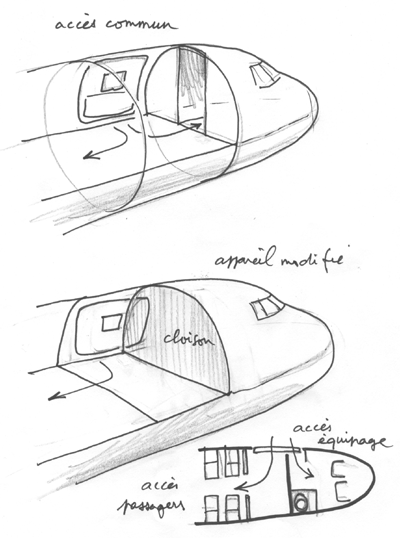
...Bottom drawing, the modified aircraft. During boarding, passengers and pilots enter "through the same door", sharing access. But once the door is closed, the crew cabin is completely isolated from the rest of the aircraft, by a partition. A chemical toilet and a kitchen setup will now be part of the pilot space. The emergency evacuation of passengers through this access is somewhat hindered, but between two evils, isn't it necessary to choose the lesser one? Moreover, the access area can be increased in new models. The advantage of this formula is its relatively low cost. The essential thing is that the passage of terrorists towards the pilot cabin can no longer take place. No civilian pilot, whatever the threat these men might pose to the passengers, would accept to crash his aircraft into a city. We then fall back into "ordinary terrorism", with hostages. Note that Israeli airplanes have their pilot cabin separated by two successive doors, the intermediate space serving as an airlock, which excludes any forced entry into the cabin. If this solution is applicable in current airplanes, it is not bad either.
September 21, 2001: Alexandre Bérubé, a Canadian engineer, suggested the introduction of anesthetic gas emitters in the passenger cabin. It's better to land anesthetized than dead, all things considered. He adds, and this is his opinion, that terrorists would find it difficult to bring masks on board that would protect them from this gas. Coupling this with the two-door system, serving as an airlock, would allow one of the pilots, after the operation is launched and with video control, to intervene in the passenger cabin, and possibly identify and neutralize the perpetrators of the attack. In the case where this co-pilot would also be taken hostage by an attacker, we would be back to the previous problem, the free pilot having orders to bring the plane down, whatever the threats.
...We are facing an extremely intelligent and well-prepared terrorism. The synchronization of actions on the different planes had to be total. Indeed, the terrorists being very poorly armed, the passengers, learning what their fate could be, through their mobile phones, could rush them, having nothing left to lose, in which case the terrorists could be completely overwhelmed. They had to quickly kill the pilots and turn the pilot cabin into a stronghold, the time (a few tens of minutes) that the planes were in view of their targets.
...The planes were chosen because they were making trans-American flights, thus filled with kerosene. The hijackings were carried out immediately after takeoff, turning them into real flying bombs. We are struck by the flight behavior of the plane that hit the second tower. It is making a significant turn, in order to crash as much as possible into the building. Only a relatively experienced pilot could have carried out such a last-minute maneuver, with a turning approach, instead of flying straight (which would have been easy, as the twin towers stood out easily from the rest of the buildings in Manhattan due to their height: 400 meters).
...The terrorists and organizers of the attacks knew very well what would happen after the impact. Kerosene was essential to attack the structures, steel and concrete, and to soften them. Otherwise, a simple impact would have caused limited damage. They also knew that the floors would collapse one on top of the other, in a "domino" style. All of this had been studied for a long time, simulated, and perhaps even tested on models or buildings. The attack was planned by building engineers, among others. This phenomenon makes real "giants with feet of clay".
...The lack of foresight was, as usual, the rule. It is true that if a screenwriter had proposed such a movie in a production house, they would have replied "say, don't you think you're going too far?". The logical consequence is that we must now consider everything, trying to put ourselves in the shoes of people who do not hesitate and seek to cause maximum human damage. This logical sequence passes through the use of nuclear and bacteriological weapons. For memory: a nuclear bomb is the size of a tennis ball (or even smaller, since it's the trigger of a neutron bomb that can be housed in an 88 mm mortar shell). A bacteriological weapon is a simple test tube. Emptying it into the water supply of a large city, and containing, for example, a virus or a bacterium with a high reproduction rate, it can cause tens or hundreds of thousands of deaths in a few hours.
...This is not an action aimed at blackmail. There is no demand. This act is a declaration of war by people driven by religious factions. Trying to find "responsible parties" to bring to justice, as Bush said, is practically a futile thing, a reflex of the West. Carrying out retaliation does not seem to be a solution either, against people for whom the sacrifice of their lives is considered a natural act.
**About fanaticism. **
...We will later question the causes of such a situation, which has a planetary character. As a French official reminded us, it is religious dignitaries who decide the "fatwas", acts of holy war. They believe they are directly inspired by God. We are therefore faced with people who function as in biblical times, or in ancient Babylon, or Assyria. In these countries, at times when cruel acts have always amazed historians, it must be remembered that war decisions were not made by "politicians" but "directly inspired by gods", or a god. The king or war leader who launched the operations did not feel in any way responsible, in the sense that, for example, "this decision had been suggested to him during a dream". There are also decision-making processes historically based on drawing lots:
- What should I do? Negotiate or go to war against my neighbor?
...The vulnerability of the opponent is perceived as an effect of divine will: "If our opponent is vulnerable, even completely unarmed, it is because our god has placed him in our hands". If we do not enter into this "religious logic" that propels us thousands of years back, nothing is understandable with our western criteria. ...There is then a chain of decision and action. Religious leaders are deeply convinced of fulfilling the will of their god. Those who are subject to them are also convinced of being the relay of a divine will, which their leaders transmit to them. There are "sacrificers" and the "sacrificed". In a recent TV report, a manufacturer of explosive vests destined for Palestinian suicide bombers was questioned in his cell. He was asked why he himself would not go and sacrifice. His answer:
- Everyone has their job. My job is to design and manufacture explosive vests, the job of the suicide bombers is to put them into action.
He could have added:
- Our Ayatollahs do not have to sacrifice themselves. Everyone is in the place assigned to them by God. The suicide bombers are actually the most rewarded in our paradise. If one day I received an order to become a suicide bomber, it would not be a problem for me. Explosive vest manufacturer, suicide bomber: all of this is the same. As for our Ayatollahs, they are also in their place. There must be a mobile phone to receive the voice of God. That's their job.
...The psychological profile of the "armed arm" of this action is particularly important to understand. One might be surprised by the "level of culture and education" of many suicide commandos. It would be a very serious mistake to believe that these commandos are only recruited from disadvantaged environments, from desperate people, from people without a future. Among the members of recent (and future) commandos are people who, due to the studies they have done, or their family situation, could have occupied comfortable positions in their society, or in a foreign country. We then face the general problem of fanaticism, which escapes all logic. Its key is conditioning, which, as we have seen, acts from childhood. It is the same conditioning that could produce the Nazis, the Red Guards, and now the fundamentalists. At the base, there is obviously a feeling of distress, a general questioning of the individual on the meaning of his life, of life. This distress can be objective (poverty, total absence of future prospects) or subjective. It can also be induced, provoked. The reaction is then to abandon all psychological and decision-making autonomy to a leader, whatever he may be. This can be an Ayatollah, or a Guru, or a politician, a "Fuhrer", a fanatic priest (as was the case during the religious wars of the past, or ... the Crusades). A psychological contract is then established between the leader and his disciples. The disciples manufacture and strengthen their leader, who, if he does not act with interest and cynicism, and feels "responsible for his flock". The leader molds the thoughts of his disciples. At the base, there must be a religious or (and) political ideology, often condensed in a text, a book constituting "the fundamental thought". How could millions of men, who had sometimes received sophisticated education, give their lives based on texts, raw or reinterpreted, so simplistic? The answer is that the text is not important. The important thing is the effectiveness of the brainwashing, whatever it may be. No person in the world, including you, me, is immune to such a phenomenon. The "mind" of a human being can indeed be compared to the bridge of a ship. A "personality" (our conscious self) receives information through its sensory organs. It witnesses scenes, reads texts, hears words spoken, directly or through any media. It has a certain psychological and decisional autonomy, which depends on its level of education, the conditioning it has been subjected to since childhood. This autonomy is relative because decisions are made in relation to moral references that depend on cultures: respect or non-respect of others, of oneself, the sense of sacrifice, "self-giving", "courage", "cowardice", submission, dominance, individualism or the impossibility of existing outside a social group, subjective perception of one's interest, or clan or ethnic interests, "level of humanism or universalism", opposed to racism or sectarianism, "ethnic horizon", where "the other", "the enemy" begins, vision of the post-mortem future, motivating (reincarnation, "the response of the sacrificed in a paradise", hope for a better life in an afterlife, or even simple masochistic nihilism, desire to annihilate oneself to escape one's personal problems). The range of psycho-social references is very broad. Nevertheless, only a relatively small percentage of "free choice" emerges from this set, the rest being a matter of conditioning. In the past, religious messages were the main vehicle of these, completed by specific tribal or ethnic speeches. Today, the media, vehicles of violence and sadism, bear enormous responsibility. Rambo, for example, has turned against its authors. Many viewers found that the explosion of the trade center resembled "Independence Day". Indeed, it seemed like special effects. ... No one is surprised that an individual, wherever he is on this planet, can witness, in a ritualized way, ten murders a day, simply by turning on his television. No one is surprised that children's toys can be in the image of very diverse destruction weapons. No one is surprised that a bathing suit (Bikini) was given the name of a place where a nuclear weapon was tested. How could a French engineer have titled a book in which he told the story of nuclear armament in our country "Next to my bomb". How could Edward Teller casually nickname the H-bomb: "My baby". How could scientists, in the framework of the Manhattan project, have given names taken from religious speeches to preliminary nuclear experiments for war actions. The first "H" assembly had been called "The Kaaba", well before Muslims were perceived by Americans as a potential enemy. While the USA is a nation in principle Christian, the code name of the first nuclear explosion had been "Trinity" (the Trinity). Why this systematic taste for blasphemy? To better understand the psychology of the scientist collaborating with the military: link. ...There is therefore a "doctrinal body". I might surprise you by saying that it could be replaced by any text at all. Returning to the image of the human personality, we return to that of the command bridge, the ship's helm, this ship being a ... man. The human personality seems (to us, westerners) to be made of one piece. But it's as if, "inside a human head", several levels of the self are discussing. There is the conscious self, which "reasons" with what it thinks is "its logic". There is the unconscious self, which functions with another, which integrates the experience lived by the individual since birth, unconsciously accumulated. There is the ethnic self, specific. There is the educational self (education received, readings, media conditioning). Any decision made during a life is the result of a "debate" between the different components of the human personality. Still, this is only a western view. Mystics of all kinds will add an inspiration, whether founded or not: it is not for us to decide on such a metaphysical question. ...The fanatic chooses to renounce his own autonomy and beyond his responsibility as a human being. A or some leaders then decide for him. This abandonment can be assimilated to an abandonment of duty, "the commander abandoning his helm". By abandonment, we must also include its corollary: a psychological invulnerability attitude, a guarantee of invulnerability. The invulnerability then brings the comfort of a structure, with the comfort of group support. By feeling that he belongs to a multitude, the human being makes, to gain this benefit, the sacrifice of his personality, and possibly of his life. ...Subjectively, this price seems light to him. The leader, in a way, does the same, insofar as he himself merges by perceiving himself as an emanation of a group and a propagator of a thought. One can then speak of auto-hypnosis. Having once approached a sect inspired by Hinduism (the Ram Shandrah sect), not as a member but in the intention of going to retrieve one of my friends, I was able to see the essential mechanisms of a sect at work. The key is "non-thinking". In some, this non-thinking takes the mask of "meditation". To meditate is to "empty oneself", to stifle the flow of disturbing thoughts, the real background noise preventing "the spirit" from manifesting within individuals. One could say, anyway, that emptying one's thoughts can have good sides. When people are tortured by objective or subjective anxieties, the act of "emptying themselves", even for just a few moments, a few hours, a few minutes, can only do them good. Any psychologist would agree with this idea. ...Whether this Spirit exists or not is another problem. It is not for us to pronounce on the reality or unreality of any metaphysical phenomenon. We simply analyze the result. In some mystics, such a practice will lead to a simple detachment from the world, to the renunciation of a sexual life, to the "pleasures of this world". This is asceticism, which can go as far as medieval mortification. One could call them passive mystics. "They merge in their communication with the invisible", seeing it only as a strictly personal experience. Some think that physical pain brings one closer to "the Spirit" (the medieval flagellants). The danger is much greater where proselytism begins (abandonment of offspring, parents, any family or social cell, giving one's goods to the sect, making one's person, one's skills, one's talents available for the sect's interests). ...The leader of the sect can quickly acquire a schizoid or paranoid structure, if he does not already have it. There are "mystics" or "laymen". There are ideological messages that resemble religious corpora surprisingly. ...Let's move on to the essential mechanism, of a hypnotic type. There is no hypnosis without the abandonment of vigilance, without renouncing all objectivity in favor of subjectivity. I will cite a personal experience, which anyone can repeat. It is an experience of voluntary abandonment of decisional freedom, which is translated by a takeover by a third party. When I was a student at the École Supérieure de l'Aéronautique in Paris, in the sixties, one of our classmates had come across "a hypnosis manual" with which he played a lot, he said, in conducting experiments with his sister. We decided to participate in experiments (innocent in content). The first step was to create a relative sensory isolation (standing, motionless, eyes closed, in a place not subject to sound influences). In such a situation, after ten to twenty minutes, one "loses one's footing". The sensation of verticality, the topology of the place, fades: one sways. Next to oneself, as soon as one finds oneself in this ambiance (silence, eyes closed), a manipulator then delivers an injunction, using the most convincing voice possible. The "game" consists of emptying one's head, of getting rid of any thought that could block his message. This is essential "for the good success of the operation". People who practice apnea know how to empty their heads, simply because any mental activity, whatever it may be, consumes oxygen. While one deliberately lowers one's defenses, the "hypnotist assistant" (who can be anyone) relentlessly repeats his message. This will work better if, subjectively, his tone, his arguments are convincing and his voice "warm". This man then places the one who, deliberately, has decided to be the subject, in a situation of suggestion. An order devoid of moral connotation, like raising one's arms, will penetrate more easily into the "unoccupied mind" of the subject, if this order does not trigger any "moral-socio-immunological" defense mechanism. When one participates in this strange experience, the result of the experience can occur after a variable time: from a few minutes to thirty minutes or an hour. It depends on the subject's ability to "lower his mental defenses" and on the hypnotist's ability to be convincing. Any external noise, any laugh, any incongruous thought brings the subject back to "square one". What matters is to realize that any individual who would participate in this "game" would, after some time, see his arms escape his own will for a more or less long time. For me, it lasted one or two seconds, after thirty minutes of hammering in the following way:
- Your arms are light. See, you can't hold them. They rise. You can't hold your arms. Let them go up!
...It seems as if the body, in vain questioning the "decision-making bridge", said, during the whole experience:
- What the hell am I doing? There's a guy ordering me to raise my arms. It's been hammering my brain for twenty minutes. Is there anyone up there to tell me what I should do?
...The key phenomenon is the change of connection to the order-giving structures. For the follower, it is the submission to the four wills of a guru. In sects, it is recommended to meditate in front of a photo of the Guru, if possible at 1/1 scale, so that an extremely perverted unconscious imprinting occurs. ...The absurdity of the orders, their immorality, especially on a sexual level, no longer enters the picture. The personality has been in a way disconnected, put out of circuit. The effectiveness of such a procedure obviously depends on a lot of factors, the suggestibility of the subject, the "aura" of the guru, the influence of the charismatic leader, the dictator, and ... the pressure of the group. Because the group pressure multiplies the power of the leader. . The intellectual and cultural level of the individual does not come into play. Very rough people can be difficult to suggest. Others, apparently more intellectually equipped, can quickly fall. I was surprised to find in this sect that I had entered, fanatical intellectuals and ... members of the CNRS, colleagues I knew!
...We have spoken of a simple psychology experiment. Imagine the result when this is tinged with political ideology, with religiosity. There is then total adherence. With hindsight, one can wonder how intelligent people could have been seduced by such silly texts as Mein Kampf or ... the Little Red Book (which, personally, I never managed to finish, so bored I was. Yet, in France too, we had our "Maoists"). But the content is not important. Slogans, suras, mantras, orders can function as hypnotic instruments. I had a housekeeper who had joined the Japanese-origin sect Nishiren, Shosu, established in many countries, whose only practice consists in the repetition of a single "word": Nàm Yoho, Renge Kyo. It is only taught to the followers that the repetition of this magical word will effectively mold their soul, ensure their salvation, etc. Most of them do not even know the exact meaning of it (...).
...It all depends on the effects of such a practice. A "stylite", a hermit living on top of a column, sealed in his silence, does not disturb anyone. Unless, having become a "star", someone exceptional by this behavior, he inspires followers. Paradoxically, the member of a sect, in de-personalizing, desperately seeks to exist, even in a collective sacrifice!
...These days, we have heard on television former Palestinian suicide bombers, whose action failed due to a technical failure of their equipment, testify. Their faces reflected a kind of inner peace, calm, serenity. - Would you do such a gesture again? - Only God knows.
...Significant answer. It's as if the individual answered "why do you ask me to express a feeling, an opinion, when I have, at the level of my individuality, ceased to exist?"
...The public does not understand this mental invulnerability. Don't we say that someone has "become armored"? For the fanatic, anything that does not come from his "cell", his group, his or his religious leaders, can only be a lie, manipulative. Mentally, he recites phrases from his holy book, interpreted by his thought leaders, slogans, mantras, phrases from the Little Red Book, to block this "perverse" thought. Edgar Morin spoke of this invulnerability of French communists, after the war of 39-45, when news arrived about pogroms, internment camps, gulags, purges, mass deportations. Nothing of all that could be true. It could only be "pure inventions of the bourgeois press".
...Another idea to keep in mind is a "snowball effect". The number multiplies the phenomenon, almost exponentially. We saw it with Nazism. Many European intellectuals were amused by the antics of the young Nazi party and the grand demonstrations of this ridiculous "Mr. Hitler". Suddenly, the mayonnaise took and everything started to collapse, in less than ten years. The opposite is also true. After that war, Nazism did not completely die out, but entered a phase of rapid recession. No one, in Germany, had been Nazi, apparently. This is what René Girard calls mimetism. The effect is dangerous. Another element of fanaticism, noted by Girard, is the importance of the scapegoat, an individual or an ethnic group literally demonized. It is him or her who allows the group to "cleanse" itself of its guilt, its fear, its anxieties. The sacrificed martyr reunites the communities. The individual or ethnic scapegoat focuses the energy of the individuals. Hitler had very well used this against the Jews. In French far-right tendencies, the "bougnoule" constitutes an "ideological pole". When one does not know what to fight for, it is easier to fight against something. During the McCarthy era, communism had the face of Satan. Previously, in the deep south, it was the blacks who provided this image to the Ku Klux Klan. Today, for the Muslim fundamentalists, America is "the Great Satan".
Addition of October 11, 2001: The newspaper L'Express in its number 1722 of September 27 - October 3, 2001 published the testimony of a son of an SS, who preferred to remain anonymous. This text, page 100, was titled "My father, this SS". It is a Frenchman whose father, now deceased, had joined in the late autumn of 1943 when the regime was already beginning to collapse, to go fight on the Russian front, in the "Das Reich" division. There were thousands of French people, committed to the Nazi cause, who did the same, forming a "legion" where many were killed in combat. In his testimony, this man talks about a father "in love with Saint-Simon, Proust and Theilard des Chardin" and the answer that he gave him when he asked why he had joined this conflict and whether he had been afraid of dying: "I was a fanatic. It was absolutely indifferent to me". After his unit was decimated, he had managed to escape death and was imprisoned in Fresnes prison, after being arrested by the French. Many of his comrades-in-arms were shot, which left him, according to his own admission, completely indifferent: "I had chosen my side, I was ready to die". "Everything about him was smooth. He had no doubt about his mission. Nothing could have diverted him from his path. It was his job, like others go to the office", said the witness, his son.
...People often provide in their speech the keys to their behavior. This French SS one day confided to his son:
- I loved to be a brick in a wall.
...The symbol is very explicit. A brick is an element of an entity called "wall". Considered individually, it is not functional, it is meaningless. However, when integrated into a wall, it gains its full strength. Thus, the fanatic's approach starts from his impossibility to exist as an individual. This situation is too uncomfortable for him. He finds no way to fit into the world he lives in, neither by developing his own talents, nor by starting a family, nor by building something by himself. This individual life seems simply unbearable to him. The existence through a collective entity seems to be the only solution, and this integration approach, which imposes itself as absolutely imperative, comes before the ideological or moral content of the group he adheres to. He is, moreover, perfectly capable of changing groups. Wilhelm Reich, a German psychologist, attracted by the psychoanalytic movement (by the way, died mad in the United States) had been active in communist groups in the 1930s. He was surprised to see how easily German Communist Party officials had suddenly become officials of the SS party, swapping one "idealism" for another, apparently diametrically opposed. In fact, the ideological content was of little importance. What these people had mainly sought in these two types of structures was to become "bricks in a wall". Such an attitude implies the dissolution of the personality. The man becomes a number, totally identifying with his function in the structure. He no longer has any personal ideas, no longer needs to make the effort to acquire them. Once, a very entertaining film: "Fanfan la Tulipe", was produced, with Gérard Philippe sharing the lead with the plump and mischievous Gina Lollobrigida. In the script, Fanfan joins the army to be closer to the thoughts of the beautiful girl, daughter of a recruiting sergeant. During this scene of enlistment, Fanfan hears the sergeant's speech, which essentially says:
- If you want to think about nothing and let the king take care of it for you...
...This sentence struck me. It can be applied to any ideology or fanatic movement. One could just as well say:
-* If you want to think about nothing and let (Hitler), (Stalin), (Mao), (the local ayatollah), (the guru) take care of it for you...*
...All of this is interchangeable. The ideological or religious content, the goals pursued, are of no importance, only the adherence, the fusion in the group counts. The brick lost in the wall no longer needs to express itself as an individual, a process that had until now seemed so painful, unbearable. The SS obeys orders, that's the essential thing. The fanatic of the People's Republic of China, at the time when Perrefite so well described it in his book "The Day China Awakens", responds like an automaton reciting a "quote from Chairman Mao". The fundamentalist will quote a verse from the Koran, according to the interpretation provided to him. But, most of the time, he does not feel bound to respond, since that is not his role. An inscription may appear on a wall, of which a brick will bear only a fragment, or even nothing at all. Thus, questioned, the "brick" can only answer "read what is written on the wall to which I belong". For this "brick", the essential thing is not the inscription, but the fact of belonging to a wall, of being "conforming to something, to a model, of merging into a group, of dissolving into an ideology, into a blind belief. One perfectly understands the expression "it feels like talking to a wall". Strictly speaking, this is exactly what happens when one tries to discuss with a fanatic.
...Everything that tends to dissolve the personality of individuals, their critical thinking, their distance from situations, is potentially dangerous for them and for others. Thus, there is no difference between a sect, a totalitarian political movement, a religious current where fanaticism and intolerance have developed.
...This integration of a "brick in a wall" can lead to several effects. In sects, the goal may be prosaically fraud, the exploitation of a mass of adherents by an oligarchy, financial or sexual exploitation, or even both at the same time. We have spoken of a wall. One could specify by evoking an edifice made up of an arch. The guru, the leader, the spiritual head becomes the keystone. It also does not exist independently, it stands only by virtue of the converging forces, which it itself directs, which it is the focal point of, and which are communicated to it by the stones of the edifice. In its own way, the "keystone" also loses its personality, its individuality. It is nothing more than an element of the structure that it has both created and which has "elevated it to the top". The leader creates the group and the group creates the leader. Each validates the other. If the group disintegrates, the leader loses all legitimacy, ceases to play a resonant role. If the keystone disappears, the edifice disintegrates. The whole is more than the sum of its parts. A protein is much more than the sum of the atoms that compose it. Disintegrated, disorganized, the former edifice becomes unrecognizable. If the "message" conveyed by such an edifice, such a group, could be assimilated to an inscription on a wall or to the very form of the edifice, when it disintegrates, the message ceases to be readable. It is then useless to question individually the bricks, stones or debris, since the whole made sense. This is why one has always been so surprised by the sudden disappearance of the discourse of groups that may have exerted a very important pressure on history, after their disintegration (the word must be taken literally here). It is not simply a renunciation, but the loss of the ability to express oneself. Only the whole made sense.
...The behaviors of the "bricks" can be varied. Their function may be to serve as a harem for a guru, to collect funds for the sect, but also to participate in a powerful expansionist movement (Nazism, Islamic fundamentalism), acting in the most violent way possible. The theme of the suicide commando may then be part of the "mission", since individual interest, the instinct of self-preservation have been completely annihilated. There is no difference between the behavior of this French Nazi, mentioned above, designated to go to the Russian front at a time when everything was already decided, which equates to a suicide mission, and that of one of the members of the following groups:
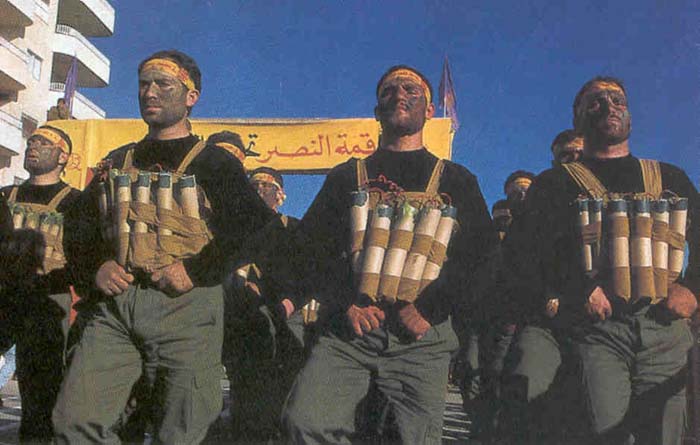
**A suicide commando of Hezbollah parading in southern Lebanon in February 1997. ** ---
**Mutual misunderstandings. Failure of "futurism". **
...The Americans seem to have seen nothing coming. Or rather, if they had some messages, coming from people who probably risked a lot by transmitting them, they found it too huge to believe. At the time of the Gulf War, we had information, of unverifiable origin, mentioning the existence of Iraqi commandos, present on US territory, ready to commit bacteriological warfare acts. With hindsight, was it so crazy? ...The United States believe in the god of technology. They listen to millions of phone calls, from a distance. It seems that the recent operations were set up by people who may have simply avoided calling each other. But communicating without a phone, for an American, is hardly imaginable. The old techniques of half a century ago, consisting of giving orders by placing announcements in newspapers, completely caught the "homo-technologicus" off guard. After the Nairobi attacks, missile strikes were carried out. Were they justified? Apparently, nothing was obvious. Hence a criticism by many specialists on the way the Americans collect intelligence. And those people say "nothing beats direct contact". ...But can one believe in what one considers a priori impossible? Let's go back. Do you remember the surprise of the Americans, discovering the extent of Soviet achievements in the space field? The French press of the time mentioned "a miracle fuel". But no: the rockets were huge from the start, because the Russians had much more ground to cover than the Americans to reach their territory. The Russian "space conquest" was only the civilian fallout of the Soviet military strategic projects. Currently, the Chinese are developing large rockets. Same motive, same punishment. They are "far from everything and everyone". This is why, to camouflage their strategic equipment project, they have discovered a fierce desire to install a base on the Moon. I still remember, when I was a child, what French scientists and, in general, Westerners said about the Russians, before all this broke out (especially their first atomic bomb). Many believed they were incapable of competing with Western technology ("perhaps only in the field of biology..."). The surprise was brutal. The Soviets thought differently. Semiorok has a 99.7% success rate. It is an incredible do-it-yourself job, due to the brilliant Korolev. While the Americans were sketching, in their engineering offices, the fantastic engines of the future Saturn V rocket, facing formidable combustion instability problems in such large "coquettes", the Russians assembled dozens of reliable engines, at the bottom of their rockets. I was a rocket test engineer, so I know a bit about the subject. Semiorok was stocky, more rigid than its American counterparts. In Russia, the rustic was also fantastically resourceful. Witness the suspension and launch system of the rockets, without sophisticated devices or jacks, simply because of... gravity.
...The West would be greatly mistaken to underestimate the abilities of Arab countries to assimilate, recover Western technologies, or simply bypass these technologies, by acting... differently. When these airplane cabins were taken over, people wondered: "how did they manage to bring weapons on board? Were they plastic pistols? Not even that. Three determined men can take over an airplane with... cutters. One should have thought of it. Who would have predicted something like that? The kamikaze, who immediately decided to die, and who will not respect anyone, any human life, needs nothing. The whole thing is to manage to force the pilots to open the door, by slitting the stewardesses, one after the other.
- Please, Mike, open up, they're going to kill me......
...There are psychology manuals focused on hostage-taking. Everyone knows "you have to establish contact, parley, negotiate, wear down the opponent's nerves". But no one has thought to write a psychology manual for people involved in a kamikaze operation. ...Remember the war in Japan. The Americans had not anticipated the kamikazes. Their first attack caused devastation. The atomic bomb stopped the phenomenon. Between the Japanese and the Americans: mutual misunderstanding. Before the Japanese attack, Japan armed itself, swelled up immoderately, militarized. The United States reacted with an embargo, saying: "the Japanese don't have raw materials. They're finished....." ...And it was Pearl Harbour, not at all expected, yet logical for a people who prefer to die rather than lose face. On the Japanese side, there may have been the same recklessness:
- If we attack by surprise, without warning, and invade all of Asia, the Americans won't dare to risk so far from their territory.
...Error, the Yankees carried out a reconquest, island by island. The Japanese had not anticipated the atomic bomb either. The Americans obtained the surrender of the Empire of the Rising Sun through a bluff.
- We give you forty-eight hours to surrender, without conditions. Otherwise, we will destroy one of your cities every day.
...False, they didn't have atomic bombs in reserve. But the bluff worked. There was also, on the American side, the intelligence to understand that it would not be appropriate to touch the person of the emperor, as a divine symbol. Prosecuting Hiro-Hito in court, hanging him like a common war criminal, as was done with German officials at Nuremberg, might have been a major mistake that was not committed. And yet, it was not obvious.
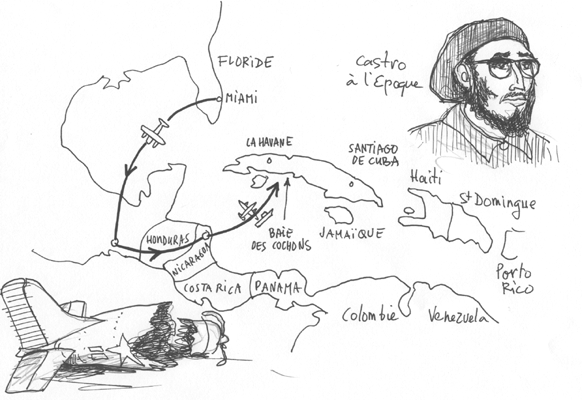
...Hitler did not think, it is said, that the USA would enter the war. Yet they had intervened in 14-18. He also believed he could conquer Russia "in a few weeks", but there was Stalingrad, where German soldiers in summer uniforms were trapped. History is full of mistakes, of failed or successful attempts. Kennedy won a dangerous bet with the Cuban missile crisis. But the "Bay of Pigs" operation, in this same island, was a failure, linked to a poor assessment of the situation.
...Do the Americans understand global geopolitics? Are they not the ones who armed the Taliban to put the Russians in difficulty, on that ground? It is possible that the price to pay today proves to be exorbitant. Conversely, Schwarzkoff, after the rapid collapse of Iraqi troops, was ready to march on Baghdad to capture Saddam Hussein, but was abruptly stopped on presidential order. Because Saddam, in the end, might have been a better barrier against Iran than a puppet installed by the Americans and supported by them.
21 September 2001: Following a comment from Alexandre Berube, a Canadian engineer: He said that the Americans had not initially armed the Taliban, but that their aid had gone to the "Mujahideen", as early as 1997, in their anti-Soviet struggle. He also highlights the versatility of the Americans, both in foreign policy and in commercial policy. This is his view of the American system in general. In a program on Arte yesterday, we learned that Afghanistan was one of the most powerful drug producers in the world, especially heroin.
...In this text, there may be errors, possibly many. I can only rely on my personal experiences, always subjective, and on what is transmitted to me by the media, always questionable. I will mention any information, regardless of its source. To contact me. I obviously speak of information or remarks that bring something concrete, not the expression of simple opinions. My site is not a forum.
...General Massoud is dead. Fantastic operation: two fake journalists blow themselves up with their television cameras. Let us do them this justice: the imagination of the terrorists is extraordinary. After recent events, everything becomes possible. Conversely, how do the Muslim fundamentalists dare to attack a people who were the first, and the only one, to use a nuclear weapon twice? We hear them say: "the Americans are cowards" (....). The "muscular" response seems insoluble, inappropriate. One can note, however, a historical fact without precedent, at least in our modern history: Bush has all powers. Moreover, he has a "credit" of several thousand innocent deaths. In addition, no power in the world is able to threaten the USA militarily, especially since there are strong indications that the United States have an arsenal that goes "way beyond nuclear". Having mastered the problem of 4th generation weapons, of very low power and bulk, using antimatter stored in crystals as a detonator, it is possible that they are capable of massively pulverizing any region of the globe, without creating a nuclear winter, with a cluster of mini-bombs the size of a golf ball. It is hard to see the Russians defending the ... Afghans. The Chinese are not ready to influence the fate of the world. The most surreal media event was probably seeing the Iranian ayatollahs "condemn violence".
...What is happening on this planet? One could call it the beginning of the third world war, in a form that, as usual, no one had been able to imagine: a war... of religion, using terrorism, "the nuclear weapon of the poor". As usual, no one had been able to foresee the magnitude of such a phenomenon. It is not certain that the Americans really understand what they are dealing with. One can doubt whether they have perceived who the real puppet masters of all these operations are: the Mullah, the ayatollahs, the true fundamentalist power, which is essentially religious. The West also reacts with its culture and its laws. Bush spoke of "bringing the guilty to justice". However, the fundamentalists obey another law: the sharia. Two worlds, separated by light-years, are confronting each other. Poverty, frustrations, inequalities have thrown millions of people into the hands of fanatical, schizophrenic fundamentalists, "receiving their orders from God". On the other hand, the West, and above all the Americans, are unable to understand the very meaning of the words "injustice", "inequality", which are the essence of the ideology, of the economic theories of free competition and free enterprise. Some claim, are consumed by hatred, born of despair, others are ready to dispense "charity", without realizing that it is urgent for the human race to begin to see itself as a global entity and not as a patchwork of nationalities. Many Western countries have abolished the death penalty, while depriving people of food, medicine, and access to contraception is already condemning them to death. ...The war is declared. This means that it will also take an economic turn. Western economies are fragile. Oil remains a Achilles' heel. Everything will be done to destabilize the adversary, to provoke social disorders in Western countries that will inevitably accompany a strong economic recession and a tenfold increase in unemployment, which will exacerbate the manifestations of the far-right groups and possibly push Muslims living in France into the arms of fundamentalists coming from an Algeria already in full disintegration and perfectly capable of playing a "rear base" role. ...Conversely, the rich countries are still unable to envision a globalization of planetary problems. Globalization, as well as great ideas like "Europe", dear to Robert Schuman, are globalizations and Europes of the rich, designed in the interest of the latter and not in the interest of the populations. They are essentially capitalist projects. The competition between countries allows pressure on wages and a tenfold increase in profits. At the level of companies, the big devour the small.
...How could an American, champion of "laissez-faire", dear to Reagan and Thatcher, imagine otherwise? His morality, naive, coincides with this world view. At best, in rich countries, one considers charitable acts, while the problems are infinitely more serious.
...Is it possible to say something that is not completely idiotic about the recent events? The age of all violence is not yet over. In a few years, vast regions of the planet (or almost all of it) may find themselves in a situation that would make the Hundred Years' War seem like a big joke. Economic and monetary chaos is at our doorstep. Planetary misunderstanding is more exacerbated than ever. In Israel, Jews and Arabs settle accounts dating back more than two thousand years. The Americans, for their part, must see themselves as completely innocent victims, while their twin towers, aside from sheltering innocent brokers and brave mothers of families working as secretaries, were also (also) the fortress of all the J.R. Ewings. In the mind of the average American, the Trade Center was the colossus of free enterprise. A colossus. with feet of clay, apparently. From the Pentagon also came the order to get rid of the liberal Allende, who had made the mistake of receiving Castro at his home. Later, "by discreetly making several thousand people disappear" thanks to his death squads, Pinochet rid Chile of the "communists" and the Americans, in return, financed a sympathetic economic boom. This is the "Pax Americana".
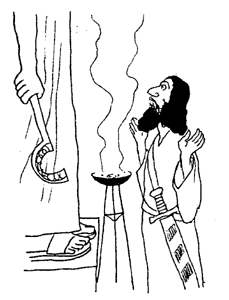
...In 66 AD, the Jews rebelled one last time against the Romans. The fantastic Roman war machine got underway. It besieged Jerusalem, which fell. The Jews had always been convinced that only Yaweh decided the fate of the weapons. The Romans, methodical, after reaching the last stronghold, which was the temple, began to demolish the fortress Antonia, which stood on the periphery (and which had housed the garrison with which they monitored the activities of the Jews below). Then came the collapse. At the moment when the Romans advanced towards the most sacred place for the Jews, the priests were making sacrifices, within the temple (which the Romans later destroyed), hoping for a last-minute miracle.
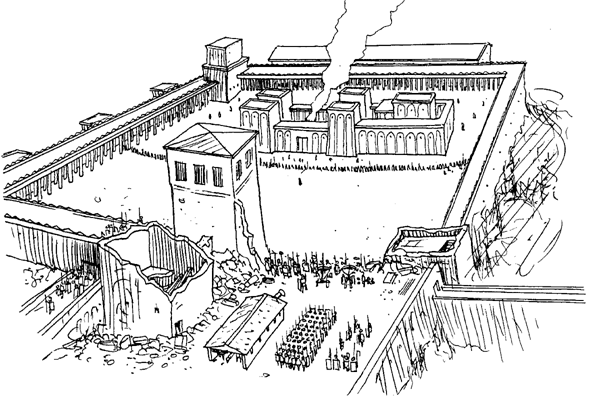
The capture of the Temple of Jerusalem (excerpt from the Bible in BD by J.P.Petit)
...There remained the Zealot fortress of Masada, considered impregnable. The Romans besieged it. They crucified on the circumvallation wall all the Jews who tried to escape. Then they built a ramp four hundred meters long, which allowed them to bring their battering rams protected from enemy blows at the height of the wall.
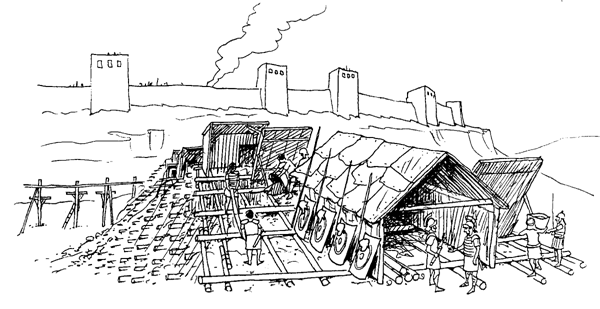
Construction of the attack ramp of Masada (excerpt from the Bible in BD by J.P.Petit)
...Then the walls fell. The thousands of Zealots barricaded there committed suicide to the last, which tends to prove that religion, as a strategic driver, does not always work. The Americans are far from being a "degenerate" people. They are perplexed but young and combative. The way they unite is spectacular.
...That said, the destructive capacities accumulated, the spread of nuclear weapons (India, Pakistan, Israel and maybe in Arab countries, in the form of terrorist weapons), the spread of biological and chemical weapons, mean that the situation has completely changed compared to 39-45. Likewise, in 39, no one expected a world war, at this scale. The very notion of "front" fell completely. Reflecting, does the planet on which we live have the means to afford a third world war? Is it really reasonable? One can doubt it, whatever the motivations of the parties involved. The cost of such an operation risks being without any historical precedent that can be compared to it. We, Europeans, may be living, as in 1939, during a "strange war" situation, almost surreal. The whole world may be on the brink of an apocalyptic conflagration.
...A better option, as Luztiger, a Jew who became a Christian, said, would be "that the hearts of men change". Are they capable of that? Poverty and/or fanaticism have eaten the brains of some. Blindness reigns among the wealthy, who refuse to acknowledge the glaring injustices, to consider that they may bear some responsibility. Does God exist? If so, I believe we will need a big helping hand.
..................................................................................................................................;14 September 2001 **Jean-Pierre Petit **
20 September 2001
....One does not hear only nonsense in the media, especially on the radio. I heard a man on Europe1 who is called, I think, Guillaume Bigot. Again, two points were emphasized. The first is that the extremists that humans are currently facing are far from being complete idiots. The second is that they follow a logic that has its own coherence. We will come back to this later. In general, there are still many voices raising the question "we must put an end to all fundamentalisms". And in this phrase, one should understand both religious and civil fundamentalisms. One cannot escape adherence to a system of moral values. These are gathered in a set called "law" or "laws" in the plural. The Taliban have theirs, but people on Wall Street also have their laws. Bigot mentioned the trial that a Western pharmaceutical company had brought against people who tried to make a clone of an anti-AIDS drug, to try to make it affordable for African countries, for example. The company hid behind patents, industrial property, behind laws ensuring the protection of its interests. However, Bigot added, if the law sides with this company and if these "biological pirates" are condemned and their production of a similar product is prohibited, it could cause a million deaths. This trial, it is fundamentalism, a Western-style fundamentalism.
...And Bigot added: what are our moral values, in the West? On what logic do we base ourselves? The young lawyers, at university, learn from the start the famous phrase "law is not equity". It is heavy with meaning. Thus, law, "justice" can give the right to the murderer, the executioner, the one who starves, because their acts are "legal". ...There are laws recognized by several countries and there are laws specific to certain countries. In the capitalist sphere, there are "tax havens", "flags of convenience", "banking sanctuaries". Is it possible to continue living like this? Will Switzerland be able to continue guaranteeing its bank clients the confidentiality of their transactions, the possibility of hosting dirty money, of dubious origin or destined for criminal financing?
...Another point, mentioned during the program, brings us back to the ideas of the French psychologist René Girard (who lives in the USA). He emphasizes two important psychological axes, as drivers of human behavior. It is first the duality "desire-hatred" and the theme of the scapegoat. Among the disadvantaged people, from the children of our suburbs to the people of favelas, slums, everything is done to excite their desire. Thanks to the globalization of the media, they can be informed of what is happening in the rest of the world. They can discover that in the USA there are luxury hotels, and even brothels for pets. On the sensual level, people who live under a strict constraint discover that elsewhere, the most blatant luxury, the most unrestrained sexual freedom can exist. But for them, the slightest mistake can lead to the noose, a bullet in the head or even public beheading (recent report on Afghanistan under the Taliban's rule). One can imagine their frustration and, at the limit, their desire, conscious or unconscious, for sex, food, freedom, for the consumption of the most diverse things. Hence this thought: "I cannot afford all these pleasures (it is indeed the word that should be used). So those who can afford all of them must be punished".
...The rich countries have been extremely imprudent in displaying their wealth and their freedoms. They have also remained deaf to the cries of the people crushed by all kinds of misery. In the Europe1 program, someone mentioned the reaction of a high school student, in a French high school, who was asked for a minute of silence in memory of the American victims and who then said: I suggest we dedicate this minute of silence to the memory of all the victims of violence, and he cited inter-ethnic conflicts in Africa that had caused a much larger number of deaths, and about which no one had cared. It is indeed a matter of compassion. But who has been the object of ours? Has it not been very selective?
...America has become the scapegoat for all frustrations. It serves as a target, but let us not be mistaken, all rich countries are targeted and responsible. Paradoxically, the emirs of Saudi Arabia or those of Kuwait are in the background, those who squander considerable fortunes in grotesque luxury. But "they practice charity" and especially secretly finance the armament of terrorists. The situation of Bin Laden demonstrates this in fact. Others carry out these financings discreetly, either out of conviction or because they are threatened.
...I was extremely surprised to see Bush's reaction, as I heard, entering a Mosque to try to calm things down, saying, as far as I remember, "that America's goal was to end violence and punish the guilty, not to declare war on Islam". This politically strong and daring gesture seems unexpected. ...Currently, would Americans make the mistake of creating a blind and nameless massacre? It seems to me that this would be a serious strategic mistake, causing them to lose the advantage paid for with the death of five or six thousand civilians. Of course, asking people who have suffered such a wound to remain calm is easy to say. Today (September 20), discussions would take place between Taliban religious leaders. Some would suggest that Bin Laden leave the country "voluntarily". But if no information is given about the country that would then host him, what guarantee would there be that he would actually leave the country? These same media say that everything will depend later on Mullah Omar's decision. If one approves the acts of a man, one gives him political asylum. This is what the Taliban have done so far. If Bin Laden is forced to leave the country, he would become a fugitive. Whether he is or is not the real mastermind of the attacks is secondary. He has sufficiently multiplied media statements advocating attacks on civilian victims to have identified himself with the image of this suicidal terrorism. Bin Laden is no longer just an individual, but a symbol. By asking them to leave their country, the Taliban would disavow him, refuse to be "solidary guarantors" with him, the price to pay possibly being too high. But would they? And if they do, who would officially accept to welcome this man now? It is easy to shout in the streets that he is a hero, less easy to put oneself in a position to take the shrapnel from the grenade that could hit him.
...We are on a razor's edge. We are, historically, facing essential choices. Nothing will ever be the same again. The strategic situation has changed. Rich countries can no longer let poor countries suffer, be ravaged by AIDS, hunger, and insult poverty by displaying luxury. More than twenty years ago, an American, or two American authors (there are madmen everywhere) had published their own analysis of geopolitics, borrowing expressions from military field medicine. When a confrontation occurred, doctors went to the battlefield and made a quick triage, based on evacuation and treatment possibilities. All the armies in the world, even the most sophisticated, do not have resuscitation teams available for every injured person. Thus, the authors recalled, the doctors put labels on the injured, classifying them into categories (possibly using a code). One of the categories was "shall not survive" (will not survive). It was useless to take care of them, to try to evacuate them. At most, some doses of morphine to shorten their suffering. At the other end, the "walking wounded" (injured, but able to walk). Between these two extremes, a whole palette. The two American authors used this classification to analyze the situations of different countries. India, as far as I remember, was classified among the "shall not survive", due to the very high birth rate. And so on. ...It is true that anything is published in the world and that Americans are not the only ones to be foolish. I am simply citing this anecdote to show the level of absurdity that "human thought" can sometimes reach. The Nazi classification included "sub-humans", among which the Slavs were grouped together. Jews were to be exterminated. The Slavs were to give their land to the Aryan conquerors and serve as their slaves. It was with such principles that Hitler sent his hordes eastward. Von Paulus, the chief general, received orders to distribute in the units. German soldiers were not to hesitate to eliminate prisoners and to eliminate civilian populations if they could be a hindrance, a burden, or a risk in their actions. Hitler hoped to thus terrorize these "sub-humans", leading the Soviets, initially extremely disorganized, which Operation Barbarossa had completely caught by surprise, to a faster collapse. However, the opposite result was obtained. Knowing what fate was reserved for them, the Soviets fought to the death, practiced the technique of scorched earth, devastating their own country. There were no suicide commandos (the concept may not have been invented yet), but units defended their territory, killing themselves to the last. And there was Stalingrad. The Germans hoped to open the way to the oil of Baku, which they urgently needed. They could not pass, and this defeat marked the beginning of the end for them.
...The current situation shows one thing: brutality, selfishness, which push people to despair (and into the arms of the fundamentalists) do not pay. The terrorist weapon is formidable on two levels. One: the perpetrators are not locatable. Two: countries practicing terrorist actions can inflict greater damage on rich countries than they themselves suffer. In terms of terrorism, we have not yet seen anything. Technically, anything is possible. One of the participants in the Europe1 program pointed out that a fully fueled commercial airplane had a destructive power a hundred or a thousand times greater than that of a cruise missile. However, to turn this civilian airplane into a bomb, it would have been sufficient to use a few knives. ...Of course, measures will be taken. Double doors will be installed in airplanes, with an airlock. But other things will follow. Why not a nuclear bomb in the Channel tunnel? If suicide terrorism becomes widespread, people will no longer dare to take public transport. If this fear translates into a surge in racism, lynchings, everything will become uncontrollable.
...There are people who profit from wars. Remember the Iran-Iraq conflict and the numerous European companies that supplied... both belligerents with shells, mines, etc. Remember these specialists, Western mercenary-scientists, whom Saddam Hussein had secured at great expense. The "Great" ones also played this game. The Russians supported Arab countries, the Americans supported the Taliban. Today, obviously, this game has become extremely dangerous, the ally of yesterday could become the enemy of tomorrow, possibly in secret. It has even become dangerous to attack an adversary. The Americans have economically brought the Russians to their knees, that is a fact. These, who could not afford both "butter and guns", collapsed. It was said that there had been economic aid, which had disappeared in the hands of the Eastern mafia. Possible. It is difficult to move from a "planned economy", from a generalized bureaucracy, to a market economy. A reorientation was, in principle, extremely delicate. The result is what? The former Soviet Empire has fragmented into uncontrollable ethnic groups. The Russian mafia is everywhere. Some ethnic groups have nuclear weapons, missiles. Imagine yourself in the place of a Russian who sees his country devastated, who sees his daughters turned into prostitutes in Moscow station, and who is offered by a fundamentalist the purchase of some technical secrets related to nuclear weapons, or even operational devices. Imagine yourself in the place of a South American who sees his country pillaged by companies like "United Fruit". To these countries, America is ready to send combat helicopters to fight drug traffickers. It would have been better, perhaps, to ensure their development by creating road networks allowing peasants to transport their products. It would have been better, perhaps, when it was still possible, to support their economies by providing them with equipment to modernize, by buying their products, even if, in relation to American equivalents, they were "unprofitable".
...Short-sightedness, everywhere. On the simple level of intelligence, it was a mistake. Let's not even talk about "human values" since these words have not yet entered the customs.
...The Arab world is huge. It is also a powder keg. The West will never be able to kill three billion individuals. That being said, the Arabs have a strategic weakness: they do not have a "rear base". They do not have heavy industry, a source of high technology. If the Russians decide to refuse to send spare parts to Gaddafi, within two years his air force will be grounded, even if he is swimming in oil. If technologically advanced countries decide to cut the Arab countries from access to the information superhighways, and if no one helps them, it is not by attaching messages to the legs of raptors that they will be able to fill this void. Without satellites, no propaganda, even no information. Information has become a weapon today. Terrorists are said to have used the Web extensively to plan their actions. But what would happen if the Arab world were deprived of computers, if it were excluded from the Web?
...This situation is strange and new. Until now, the rebel always had a rear base somewhere, a source of supply. Today, who will ensure the logistical support of the fundamentalists? To cut their financial support, one would have to target tax havens, whose specialists say that half of financial transactions pass through these channels of total opacity. However, if the Westerners, who benefit from these structures, do not attack them, really, these watertight compartments will prevent investigations from progressing. On the contrary, lifting the secrecy would allow quick tracking of the sponsors of criminal actions. Bush, at the time of his inauguration, had refused to attack this "freedom of countries to choose their tax system". Will he change his mind?
...Simple digression that should not make us lose sight of the essential issue: to shed light on all fundamentalisms, religious or... secular, on all forms of oppression, exploitation, fraud, and plunder. Will political (and religious) leaders take this step, will they accept to reconsider the consequences of the "founding texts" that serve as the basis for their "civilizations"? The whole world is holding its breath.
21 September 2001:
Yesterday, a virus alert. The target was banking systems and enterprise management systems. The cost would have been, apparently, particularly high. In fact, cyber warfare exists, potentially. The Chinese have openly announced that they intend to invest heavily in this direction. Experience has shown that anyone could access practically anything, anywhere, from any point on the globe (including one of these famous "cybercafés"). The defense of systems relies on multiple data storage in units disconnected from the network (CD-ROM). In the case of the recent attack on banks and companies, it took time to identify the virus. Its program had triggered chaotic bank transactions, from account to account. The remedy consisted of restoring the systems to a previous state, using CD-ROM storage after verifying that the virus had been eradicated. A virus only spreads when the computer is running. It jumps, from one file to another, and like any virus, it duplicates itself elsewhere, exponentially. We have all suffered such attacks, more or less violent. The first thing our antivirus software offers is "quarantining the infected files". The financial damages that companies and banking systems suffer each year are considerable. In this area, discretion is required, otherwise the reliability of such structures would be immediately called into question. The legal arsenal, repressive, has an effectiveness that depends on the number of criminals. If there are too many, they would create an unmanageable movement. It is suspected that companies selling antivirus software at a relatively moderate price produce it themselves. By circulating the disease, they would reinforce their effectiveness by immediately putting "the medicine" on the market. This requires updating antivirus software, very cheap (30 F per year). But no one can avoid it. Antivirus software is difficult to hack. Moreover, their relatively low price makes them as common as a mouse or a floppy disk drive. It is less complicated to buy an antivirus software for 500 F than to try to hack it and chase after the latest versions. ...The commercial, banking, and industrial systems use electronic money transfers intensively. A generalized viral attack could at best saturate the defense capabilities. But the weapon is double-edged. The financiers of the attacks are largely speculators. Nevertheless, it is possible that this recent attack is a sign of the intensification of the phenomenon. It is thought that the computer experts from Eastern countries would have been pioneers in the creation of viruses, this becoming "the computer weapon of the poor", just as terrorism has been compared to "the nuclear weapon of the poor", the first targeting the disorganization of Western banking and commercial paradises, blackmail, extortion of funds, or the disorganization of large defense systems.
27 September 2001
...The United States has just launched an operation "Justice without limits" (infinite justice). On September 23, during a television program (Capital), our current finance minister, Laurent Fabius, and a Swiss investigator who has long advocated for tax transparency were confronted. I could only catch the end of the program. Nevertheless, this Swiss man smiled at the statements of Mr. Fabius, who claimed to detect in political circles, for the first time, "a beginning of will" to clarify the issue of dirty money, tax havens, etc. And the Swiss man replied without hesitation:
- I don't believe in such an evolution, neither in terms of tax and financial transparency, nor in terms of extraditions. Half of the current financial transactions pass through this system of tax havens (and he showed a map where the Caribbean Sea, among others, seemed dotted with such paradisiacal places). When Bush became president, he immediately made his position clear by declaring "that countries have the right to choose their tax systems as they see fit". However, international organized crime, drug cartels (of which Afghanistan is the largest producer in the world), and terrorism use these circuits, which they know well. Mr. Fabius, you know very well that in France anyone can open a bank account tomorrow in any bank, whose holder could have an "offshore" (outside territorial waters) address. It remains impossible to trace, legally, the real "beneficial owners" of the accounts, and we cannot know who the real orderers are.
...In other words, if you can access the volumes of the transactions themselves, the amounts of the assets, you cannot know who is behind what. Therefore, our entire banking system is protected by walls of secrets, which are active complicity. It is impossible to imagine that this system could change overnight, because everyone would be immediately involved. At the limit, politicians who loudly demand "that all the light be shed" would immediately receive a backlash revealing embezzlements or shady circuits concerning the funding of numerous operations, not to mention their election campaigns. It is easier to send boys to Afghanistan than to go into the accounts of the global financial international.
...A second point concerned details provided about the gas pipeline destined to transport the natural gas, recently discovered in abundance in the southeast of Turkmenistan, near the city of Mary. See the map below:
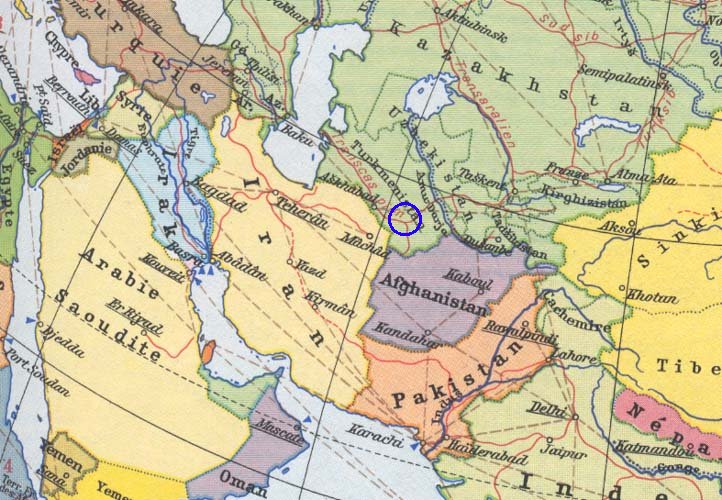
...This allows you to see how the different countries are landlocked, interwoven with each other, in this part of the world, the "Balkans of Asia". In the center, Afghanistan with two of its cities: Kabul and Kandahar. Problem: how to transport this natural gas to the consumer countries, the "client countries", essentially the Western countries.
-
Through the north, that is, through Russia, plagued by its mafia, increasingly unstable and uncontrollable? No.
-
Through Iran? Unthinkable.
...The only remaining route was the southern one, passing through Afghanistan and Pakistan (see the marked route).
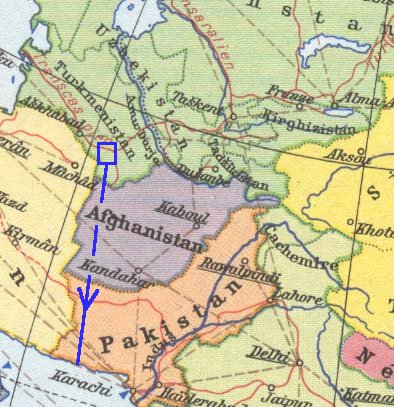
...Pakistan was very interested because this gas transit on its territory could provide it with an energy resource and also be a source of revenue, in the form of royalties. Afghanistan is a real patchwork of ethnicities. It turned out that the one composed of the Taliban was on the route of the pipeline, in the southwest of the country. The faceless, stateless capitalists, the global capitalist international, therefore decided that political power would fall into the hands of the Taliban. If the commander Massoud, recently assassinated by a terrorist-kamikaze action, had occupied the southwest of Afghanistan, this role would have been assigned to him. Unfortunately, he was stationed in the east of the country. Thus, you can see how things depend. The capitalists of all countries (by what other name could we call them?), completely blinded by their search for profits, seem to completely overlook the possible political backlash. France once gave refuge to the Ayatollah Khomeini, at Naufles Castle. Why? To play on different tables and perhaps one day, if he became the Iranian state leader, to recover a small something on the oil price?
...Who knows.
1st October 2001
...I have doubts about the accidental nature of the Toulouse disaster. The coincidence is indeed very disturbing. Nothing seems easier than to blow up such a nitrate of ammonia depot (or a hydrocarbon tank, or any other high-risk installation of this type). Two solutions: fire a rocket with an old LRAC (Lance Roquette Anti-Char) of recovered origin, without an auto-directing system. In France, we have many sites surrounded by housing that are entirely vulnerable to such shots, especially if the weapon is handled by a person who doesn't care about saving his own life. Regarding nuclear sites, this type of attack has been thought about. The tank containing the radioactive products is itself surrounded by a concrete enclosure. However, the whole is completely vulnerable to an airplane impact, given that our nuclear installations were designed to withstand the impact of an airplane of ... 9 tons.
...Returning to the Toulouse tragedy: this explosion could also have been triggered remotely, by radio, after a accomplice had placed a seemingly ordinary charge against this installation, possibly before the attack on the twin towers on September 11, at a time when no one could have imagined that such an action could be undertaken.
29 October 2001
The weeks pass. I saw a TV program yesterday, quite well done. The conclusion is not encouraging. When the Soviets found themselves in difficulties, with an uprising in Afghanistan, the Americans simply wanted to avenge those who, in the past, had helped their communist enemies, especially in Vietnam, who would not have been able to overcome the B-52s without external help. The exact phrase was "we wanted to bleed America". The Afghans, rebels against Moscow, therefore benefited from arms very quickly and in large numbers. For this, the Americans used Pakistan where, according to CIA officials, no more than a half dozen Americans were ever present, who channeled more than a billion dollars in high-tech military aid. The Soviets therefore found themselves in difficulty quite quickly. This situation worsened when the Americans decided to provide the Mujahideen in large quantities with infrared-guided Stinger missiles, which were both very sophisticated and easy to use, capable of waiting without firing at a Soviet combat helicopter at three thousand meters. Overnight, the Soviets lost air superiority and were therefore unable to provide ground support for their motorized troops, who were decimated in the narrow mountainous valleys of Afghanistan, which were favorable to ambushes. In this game, the match was lost in advance. An ex-Pakistani intelligence official showed, during this program, a video tape on which the director of the CIA, wearing the classic Afghan cap, was seen on an exceptional visit, visibly satisfied, of the damage inflicted on the Soviets.
Throughout this program, many important things were learned. It seems that there was a "text of the prophet", on which the Saudi fundamentalists rely, according to which no soldier of a foreign army could stay in "Holy Land". However, during the Gulf War, it was necessary. Balancing the goat and the cabbage, King Fahd signed a protocol according to which, after the intervention, the Americans would leave. However, they, neglecting the wish of the Prophet, remained on site. Hence a new subject of anger following a violation of a treaty with religious implications, which we, Westerners, would have great difficulty in measuring the impact.
The questions of big money were mentioned. The specialists admitted that, in foreign policy, Uncle Sam made little difference between geopolitics and the interests of J.R. Ewing, thus often pursuing a short-sighted policy. The question of the gas pipeline, already mentioned here (see map), seems central. But, apart from this discovery of gas fields in Turkmenistan, it is actually the entire region that increasingly appears as a second "Middle East", rich in all kinds of hydrocarbons and with a large Muslim population. It seems that a caprice of destiny has made it so that, except for the Texas oil fields, it would be mainly in regions with a strong Muslim presence that the black gold would have chosen to flourish. When the Soviets decided to withdraw from Afghanistan, the Americans were satisfied but did nothing to help this country, ravaged by ten years of war, to rebuild. It then became the scene of bloody tribal conflicts, which no one cared about, until it was learned, from afar, that people called "Taliban" had taken Kabul after a long siege and a merciless civil war. A "strong, majority" regime, according to an American assessment of the time, whose territory had the good fortune of being on the route of the future gas pipeline. Everything was therefore well in the best possible geopolitics.
During the program, it was learned that the Americans, who had suffered several attacks from a certain Bin Laden, had for many months tried to negotiate with the Afghan ethnic groups, and the Taliban, and this well before the September 11, 2001 attacks. They wanted these latter to hand over the famous terrorist, "in exchange for which substantial financial aid could flow into the country". At the beginning of 2001, during one of these informal meetings, in Germany, the Taliban did not come. The Americans then threatened military intervention, according to a Pakistani present at these meetings (although this fact was later denied by an "American official"). Experts later questioned the evaluation of the fortune of the Saudi billionaire, doubting that he alone could finance so many large-scale operations. What seems increasingly evident is that the Saudi Arabia, Wahhabi (a strict Islamic trend that, in good or bad times, performs about seventy decapitations with a sword, and locks up its women, applying the Sharia), would be supporting the fundamentalist movements behind the scenes, using with art the banking systems precisely put in place by the capitalist nations themselves.
What seems surreal is the lack of realism of the Americans, unfortunately legendary, in their geopolitical assessments. They are allies with people who clearly betray them or want to. We have seen them sympathize with their mortal enemies of yesterday, the Russians. Now they are in China. A journalist told us that in the current Middle East, the Iranians could be potential allies for them, given that they do not get along with the... Taliban, for ethnic and religious reasons. Personally, we are convinced that the religious component, as a powerful ferment in a Muslim collective unconscious, always very fertile and turbulent, remains underestimated by the Americans, and by Westerners in general. Just as much as the class struggle, the theories of free enterprise and parliamentary democracy may not be the key to analyzing all situations of a planet plagued by powerful dischronies.
9 November 2001
America is suffering, and we sympathize. Who could not be moved by the terrible tragedy it experienced on September 11, 2001? But, as the media have sometimes shown, there are many tragedies in the world that are not talked about. There are regions where people are killed with machetes to save bullets, others where hunger does its work. There have been several genocides. Genocides of the right and of the left, waiting for the genocides of the center, the moderate genocides. It is not good to shout "haro on the donkey!", to condemn those who pay dearly for their mistakes. We should simply ask ourselves, if we manage once again to straighten out a very difficult situation, to get through, how not to repeat these past mistakes. There was a man in Chile named Salvador Allende. He was an honest man, a good man, a democrat. But, for a JR Ewing, such a man seemed difficult to control. Honesty is always worrying because it is not for sale. One day, Allende received Castro: a major political mistake, a meeting that greatly worried JR Ewing. "Here is a communist!". A communist is the Great Satan for an American. What is a communist? If you asked an American encountered in the streets of a big city, or in the depths of the Midwest, he would probably not be able to answer you. America is Manichean. Countries that tend to resemble it are essentially democratic countries, "fond of freedom". Those who seem to move away from the American model are immediately suspicious, potentially capable of turning into "communist countries". That's it. In fact, the average American is fundamentally incapable of imagining for a single second that "the American way of life" could not be the model toward which every reasonable human being should strive. In the mind of every American, the country where he lives is the very symbol of freedom. Indeed, a statue symbolizing this stands at the entrance of New York Harbor. When people arrived in this New World by boat, it was the first thing that the immigrant or tourist saw rising on the horizon. A striking vision, for those who had this chance, before the transatlantic planes made it disappear for good.
After the war, Europe experienced the Marshall Plan. West Germany benefited from it. After being devastated by bombs, it was able to rebuild, becoming later a major economic power. It was not condemned, as in the Treaty of Versailles, to pay crushing war damages. America distributed cards to the players and provided them with a small pile of chips so they could rebuild. It was also an indispensable gesture to prevent these countries from being lured by the siren songs of the Eastern countries. It can be said that it worked.
In the Americas, in the plural, things had been left to run their course. Cuba is very close to Miami, and it is known that this city, along with a few others, was a stronghold of American gangsters, the mafia. Cuba thus became a resort for mobsters. An ex-sergeant, Battista, opened wide the doors of his country to them. The island was the place of all corruption, all rackets. For example, the revenues from the highway toll between Havana and Santiago de Cuba, which ran along the island, were automatically collected by Battista's own wife, who used this money to expand her already impressive wardrobe. Havana was the brothel of America. There was no family in the city that did not have a daughter on the street. Then came a certain Fidel Castro, a bourgeois, former lawyer, who took to the hills, and imposed himself as a symbol of revolt for an entire people. On the other side: nothing redeemable, nothing presentable. Battista was still a poor sergeant. One day, everything changed. Havana fell like a ripe fruit. Almost all the Cuban notables fled after the American gangsters had left first, in their speedboats or their private planes. Cuba suddenly found itself without doctors, without engineers, without technicians and... without spare parts. What happened then? The Cubans turned to the only ones who offered them help: the Russians. It was either that or starve. Thus, America found itself with a communist country at its doorstep, less than a hundred miles from its shores. The CIA was then called into action. A plan was set up, which consisted of making the international public opinion believe that the Cuban people, crushed by Castro's dictatorship, were revolting. Miami was not far, but starting the operation from this part of the American coast did not seem like a good plan. So they chose to launch the commando, made up of 1,600 Cuban exiles in the USA, from Nicaragua.
They arrived in motorboats, with a small number of landing barges, bringing old Sherman tanks. This was the Bay of Pigs operation, in the center and south of the island, where it is very narrow. Logically, this landing commando should have quickly established a bridgehead. Then, part of the population, whom the CIA experts said had been surveyed, should either join this group or passively watch this landing, whose main aim was to split the island in two: Santiago in the east, Havana in the west. A few days would have been enough to justify sending an expeditionary force, made up of Marines, to support the Cuban counter-revolution. Moreover, one must not forget that, revolution or not, the Americans had (and still have) the Guantánamo naval base, in the southeast of the island. But things did not go at all as the experts had predicted. Castro found immediate and massive support in the Cuban population, by simply making a vibrant call on the radio: "Come defend your revolution!" He sent some old Russian T-34 tanks. Trucks brought volunteers in mass, on the spot, carrying a heterogeneous armament, and often nothing more than a bamboo pole carved into a spear. The commandos stalled, not because of the strategic superiority of their opponents, but because of their numbers. They laid down their weapons before a human ant hill. Of the 1,600 men in the commando, 1,500 were captured within 72 hours. Medially speaking, for the USA, the aftermath was positively catastrophic. Not only did Castro not execute or hang those Cubans had nicknamed the "guzanos" (vermin), but he sold them to Cuban families in exchange for their weight in medicines or ten thousand dollars per person.
Cienfuegos
This explains why America was traumatized when it witnessed the rise of a Chilean socialism, whose leader was Allende. This time, the destabilization movement was better prepared. The CIA could count on part of the Chilean population, particularly on the truckers' union. Countries have economic systems that can present weak points. The Chilean communication system was a weak link, which the Americans skillfully exploited. They funded a strike by Chilean transporters, which put the country in a state of complete economic stress. At the same time, the military, headed by General Pinochet, seized power. Allende was killed defending, with weapons in hand, the presidential palace. Chile then came under the control of a military junta, eager for power. Pinochet methodically eliminated opponents and progressives by killing them. Thanks to these assassinations, he established a very particular balance in the country, while the United States rewarded such a return to common sense with a significant influx of dollars. In other South American countries, such development aid was even unnecessary. After the overthrow of the democratic forces in place and the establishment of a puppet government, under the control of the CIA and the American State Department, the country could be placed in a state of neo-colonialism (banana republics). Again, the priority was given to the fight against the implantation of communism (which involves what the Americans fear most: the negation of private property). In the South American continent, the foreign policy of the United States can be considered a success. Inequality dominates everywhere, which, with the complicity of strong military powers, guarantees political stability. While it preaches democracy, America distrusts it like the plague, when it tends to establish itself outside its own borders. Let's say that America accepts, at the limit, that a country becomes democratic, provided that it does not immediately close itself to American investors, that is to say, to a reasonable neo-colonialism. If we let countries benefit from the exploitation of their local wealth, where would we go? There was a time when Egypt was still "governed" by a king, a certain Farouk. Politically incompetent, he was overthrown by a group of military men, led by General Neguib. America let it happen. A military junta, in principle, can be easily corrupted. They are people who accept accounts in Switzerland and with whom one can generally reach an agreement. But Egypt quickly came under the control of a passionate progressive nationalist: Abdel Gamel Nasser, and America began to regret the good old days of King Farouk. Pragmatic, the Americans decided to now support the most conservative political representatives in the East. Saudi Arabia is an example of a finished product of this policy. Likewise, an important American support was given to the Shah of Iran, Reza Pahlavi. Skipping the years, we come to the American support given to the Taliban regime, already mentioned above. Again, the absolute priority was given to anything that could block communism. In this sense, support for regimes with a strong religious base had its logic: to form a barrier against a fundamentally atheistic Marxism. The problem lies in the potentially uncontrollable nature of certain regimes, as was the case, for example, in Iran. As soon as the Shah, for health reasons, was forced to give up power, the Ayatollah Khomeini, whom we, the French, had taken care of for years in Naufle-le-Château, immediately seized power, transforming the country into an Islamic republic and sending Iran back ten centuries. By supporting the most conservative and fundamentalist regimes, the United States has themselves forged weapons that could turn against them in the most violent way possible: through terrorism. This is where we are.
When he speaks behind this wooden building marked by the American eagle, Bush has pathetic sides, as do the American senators singing, the day after the September 11 attacks, "God bless America": God bless America! When he is filmed in his fantastic high-altitude flying computer above Afghanistan, the American Secretary of Defense still suggests the incredible American naivety, as if, from such a vantage point, full of electronics, the Yankees were incapable of seeing the realities of the world they are flying over.
We are living in a key era of world history, but no one seems to really understand the path to follow. It seems as if the opposing forces are trying to implement the old solutions. Unfortunately, you don't always win, as in Chile. Then we witness diplomatic crusades that defy imagination, like the meeting between the American, Russian and Chinese leaders. Everyone seems to be looking for a recipe that could work. Is it a matter of high technology? Who should be bought? On whom can we rely?
Strategically, the Americans seem completely out of their depth and lack imagination. They navigate (and bomb) blindly. They are searching in the mountains of Afghanistan for the person they believe is responsible for the attack they have just suffered, without really realizing that they now have six million Muslims on their territory and that congresses focused on international jihad, bringing together the leaders of the most well-known and active terrorist factions, have been held on their own soil, all these people having obtained a visa to enter the American territory without the slightest difficulty. At these congresses, the most extreme statements were made, real calls to murder, with complete impunity, since apparently, among the twenty thousand active CIA agents, none seem to know Arabic. Associations "for humanitarian purposes" began to flourish on American soil from the 1980s. On their letterheads, on the left, in English: "Palestinian Orphan Assistance Association" and on the right, in Arabic: "Jihad Warriors Recruitment Committee". It was all about thinking. Six months before the World Trade Center attack, an imam, murderer of a rabbi, was arrested on American soil. Curiously, this charge was finally not retained against him, probably due to one of the many peculiarities of American laws. The police still searched the home of this religious extremist and seized a large number of notes written by his hand, in Arabic. Thinking they were "cultural documents", they neglected to have them translated. Six months later, after the deadly attacks, they discovered, after finally reading these documents, that they would have allowed them to understand the plots against the American nation and even to know what the targets were.
Back to the ground. Facing the Taliban warriors, the Americans seem to make errors similar to those that made them lose the Vietnam War, that is, above all, not understanding what kind of war they are facing. When they decided to launch a large-scale bombing operation in North Vietnam, with the famous B-52s, they thought that their carpet bombing technique would quickly bring their adversary to his knees. But, once again, the US intelligence services completely ignored the deep changes that had been carried out by Ho Chi Minh and General Giap: the transformation of almost the entire country into a vast termite colony. Hanoi, well before the first American bombs fell, had already become a nearly subterranean city, with galleries extending up to thirty meters deep, associated with ventilation systems. Ignoring this detail, the Americans did not understand why the crushing of such a small country with a bomb tonnage equivalent to all that had been dropped during the Second World War did not seem to significantly weaken its resistance capabilities and morale. In the same way, how could an American understand how a Taliban warrior functions, for whom there is no more enviable destiny than to die in battle, with weapons in hand. It is written in the Quran: he who dies "on the path of Allah", that is, in the Jihad, has his sins erased at the same time. He then enters a paradise so delicious, so sensual, abundantly described in the book, a paradise where, in a dreamlike setting, seventy pure virgins, with lowered eyes, the famous "houris", await the transformed warrior, under the shade. In a country where sexual frustration is intense, despite the institution of polygamy, how could one dream of a better end? In 1944, the Americans were completely overwhelmed by the "divine wind", otherwise known as the Kamikaze phenomenon. In the first moments of this totally unexpected attack, the American fleet suffered heavy losses. Fortunately for the United States, things were already too advanced for this Japanese retaliation to really influence the outcome of the war. The recapture of the islands had put Japan within reach of American bombers. It quickly found itself without raw materials, without fuel, without means of war production, its main factories having been conscientiously devastated. The massive bombings of the last moments of the war (including the terrible bombing of Tokyo with incendiary bombs), followed by the spectacular demonstration of the destructive power of the nuclear, led to the surrender of the Japanese military junta, the real power in place, the Emperor being reduced to a symbolic role. In Afghanistan, the war is very difficult to play. By blending in with the population and implanting their barracks and defense means in the heart of urban and village concentrations, that is, by taking their own civilian population hostage, the Taliban fighters make the continuation of the bombings hardly sustainable, each action being followed by the broadcast of television sequences showing children killed, lined up. The actions on Afghan soil also seem difficult, given the nature of the terrain. The only effective military instrument would be the combat helicopter. Unfortunately, the Taliban have inherited thousands of Stinger missiles, given by the Americans when the main idea was to make the communists pay for the support given to the Viet Cong. Missiles that any illiterate can use, stored in caves, in a very scattered manner, and which prohibit any aerial movement below three thousand meters altitude. The Americans therefore do not have control of the sky, even though there are no Afghan planes left in a condition to take off. This belongs to these unmanned vehicles, the Stinger missiles, capable of taking down any flying machine within less than three kilometers of the shooter. As for going after the Afghan warriors on foot, on their own terrain, full of caches, it is tantamount to suicide. There remains the famous "Northern Alliance". But this is only a small number of tribes (a total of fifteen hundred tribes in Afghanistan!). Since the elimination of the commander Massoud, the political intelligence of the northern warriors does not seem very reliable. These are people for whom the concept of "democratic representation" is probably quite obscure.
Bin Laden recently launched a message on the airwaves where he said that the world is now the stage for religious conflicts. Western state leaders immediately affirmed the opposite, as well as the Arab representatives, rushing to declare that the now world-famous terrorist did not speak on behalf of Muslims. However, I am not sure he is entirely wrong. The current world is experiencing a whole set of converging crises. One of them has a spiritual dimension. People feel the need to know why they reside on this planet, which they are tenants of. A Westerner would say "he is looking for a meaning to his life", a perfectly legitimate aspiration. Let's call it a search for a moral value system if we are afraid of the metaphysical dimension of the questioning, it doesn't matter. Now, let's look at the image of the value system that the Western world offers to the rest of the world. There we see the mess, corruption, selfishness, cynicism, and the oppression of the other or indifference to their suffering. Let's not make easy demagogy. The same "virtues" are also at work in the rich Arab countries or within the privileged castes, the oligarchies of other Muslim countries. The designation of the "Great Satan" is timely to focus the hatred resulting from the frustrations of the Arab masses towards the Western countries and to obscure the serious shortcomings of rich Muslims in billions.
We are facing a "war of images" and by saying this I do not limit this speech to the media aspects only. It is urgent that Western countries restore an already very degraded image among poor countries. However, if we witness cross-chases of diplomacy that are supposed to demonstrate the solidity of the "coalition", we hear no head of state mention, for example, the eradication of tax havens. At the same time that they shower Afghanistan with expensive smart bombs (six billion cents for a cruise missile!) the Americans drop small yellow packages containing food. I would be curious to know the cost ratio of the two operations. All of this has a surreal aspect. At the national level, justice has decided to temporarily place the President of the French Republic above the law. Seeing this, one would be tempted to say to Chirac: "Do you know that your foolish dishonesty, even if it remains a very common phenomenon in the French political caste, is unfortunately very untimely. All of this falls very very badly, you know."
Which Western religious leader would be in a position to lead a "moral crusade" on a global scale? Even the Westerners have stopped believing in their own.
On the other side, for example, the Saudi princes, champions of double games, while they periodically and discreetly, in the arms of sufficiently well-paid call girls, perform some stress relief in Western countries, manage to appear as "guardians of the holy places" and "guarantors of an Islamic orthodoxy" (Wahabi). But it's all just a question of image.
Muslims say they do not have a clergy capable of representing them. That's a pity and the voices of moderates seem very weak at a time when psychopathic imams, ready to turn twelve-year-old children into suicide commandos, surf on waves of hatred created and fueled by all kinds of frustrations. In truth, we do not know how many weapons and stockpiles of explosives have been introduced onto our own territory by the fundamentalists over the last ten years. However, we have a painful experience: that of the Algerian War, where, with the benefit of hindsight and especially the final failure of the Algerian revolution, we realize that everything was not "black or white" as many had wanted us to believe. Still, it is technically extremely easy, as has been demonstrated in fact, to set two communities against each other in a life-and-death struggle; with some well-negotiated attacks. In truth, all European countries have become real powder kegs.
No one has a miracle solution, a magic potion. But one thing seems certain: at a time when a march towards the moralization of politics, towards a new humanism could simply be an asset for the "Western camp", the dominant religion remains focused on the worship of the golden calf, alias Dow Jones, Cac 40 or Nikkei index.
14 November 2001
The media had mentioned, in the previous days, a possible counterattack by the Taliban. In fact, they had deserted Kabul without firing a single shot. Male inhabitants are shaving their beards, women are coming out of their blue camping tents and wire mesh "burkas", loudspeakers are playing music, images of pin-ups are reappearing behind shop windows. Unthinkable twenty-four hours earlier. One still remembers the capital executions, men and women, by rifle, hanging or beheading, in stadiums, in public, after the Mullah's speech. On the TV screens, the number of provinces now under the control of the "Northern Alliance" increases every day. They speak of the "post-Taliban" era. History always has parts of the unpredictable, but in this confusion, we find a constant of the Islamic saga. People in Arab countries easily and massively group behind a country-leader or a man-leader. These human mayonnaises rise very quickly, and collapse just as quickly. Many Arabs were "all behind Nasser", then "all behind Saddam Hussein". Today, Oulama Bin Laden, the Mullah Omar and Afghanistan as symbols have played these roles of vanguard, of fragile keystone. One does not need much memory to recall the expanses of the Sinai, dotted with abandoned tanks and even... shoes, against the offensive of Tsahal, the Israeli army. In 91, the armies of Saddam Hussein were shredded by American bombs. In a few hours, the Iraqis had no radar, no planes in a condition to take off. The missile sites, priority targets of cruise missiles, were subjected to intensive attacks. There, the American rolling press seems to have once again taken effect, despite the reserved forecasts. At a respectful distance from the Stinger missiles (graciously offered by Uncle Sam to the Afghans and capable of taking down any flying machine flying less than three thousand meters away), the planes bombarded the Taliban barracks, their arms and ammunition depots, at the price of some "collateral damage". The armored vehicle parks were methodically pulverized, perfectly distinguished by the bombers, two fingers on the joystick of their guidance system, using light amplification systems. In principle, the Taliban cannot count on any source to replenish their arms. It is difficult to maintain morale under these conditions. Their front lines were conscientiously sprayed by B-52s, flying well beyond the range of the air defense. Despite the exhortations of their mollahs, the Taliban took their bags and ran or even turned their backs after seeing their comrades reduced to shreds by the carpet bombing. Now, what will happen? Books appear, where readers learn what had always been known: that this situation is the logical consequence of the policy pursued in the Middle East since 1930 by the JR Ewing of the time, the Standard Oil. Previously, a Saudi family, the Abdel-Aziz, had formed an alliance with a local ultra-conservative religious power, the Wahhabi faction. Thanks to this symbiosis between political power and religious power, this tribe managed to take control of the country by force. When oil was discovered in the region, Standard Oil was able to enter into very profitable contracts with this Abdel-Azziz family, whose current king Fahd is a descendant, for both parties. These contracts demonstrated the stability of the agreements, thanks to various aspects: a strong, ultra-conservative regime, capable of crushing any opposition, operating in total symbiosis with religious institutions. Symmetrically, a very active religious power, whose coffers were strongly funded by oil revenues, imposed in the country and outside of Saudi Arabia an education in "Quranic schools". Both imposed themselves in the eyes of the Muslim community as "the guardians of the holy places".
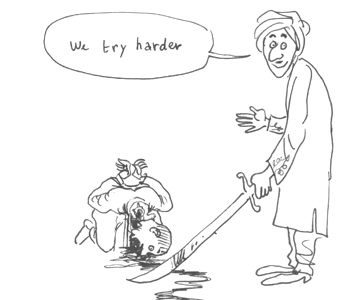
The living conditions of the Saudi people, or of the modern slaves working for "native Saudis" in a country where Sharia now regulates social life, mattered little to the oil-consuming states, who could also be exporters of various goods, including arms. How could the French have amused themselves by mentioning the condition of the Saudi woman at a time when the important thing was to secure the order of 350 Leclerc tanks? (an order essential to finance the development of our own defense means, we were told). A few days ago, television presented a report from a port located in the Strait of Hormuz. In this region, the high revenues from oil had allowed an important development of port facilities, capable of receiving large-tonnage cargo ships. At the end of the chain, these products were then loaded onto countless wooden dhow boats, these typical regional vessels, once sailed with sails, now equipped with powerful diesel engines, capable of dispersing all these goods in ports where cargo ships would be unable to enter due to excessive draft. Beyond the docks, sparkling buildings, but in the holds of these dhows, "immigrant workers", "brothers of race" from neighboring regions, without any rights, without any social coverage, loading and unloading the dhows for the equivalent of five francs a day. Men who, after a hard day's work, had to walk five kilometers to reach slums where they had to cram together, fifteen or twenty: simple courtyards covered with tarpaulins, rented at exorbitant prices. The bus: too expensive. And how to "send money back to the country"? The managers of this import-export business, on the other hand, drive in limousines, have gold Rolex watches, and linen djellabahs. Indeed, the JR Ewing and the Ben Laden are very similar. In terms of exploitation and cynicism, neither has anything to teach the other. The television is currently focusing on the political aspects in Afghanistan, while the radios remind us of the economic underpinnings of this whole affair: the immense hydrocarbon riches located in Central Asia, in Turkmenistan or elsewhere, whether gas or oil. It seems to us that, more than the so-called "political" outcome, the "surface decisions", the choice of the route for the transportation of these riches, will be decisive for the future of a large part of the planet. If the southern route is maintained (through Afghanistan), then the northern route would imply a closer collaboration between the West and its former enemy, Russia, and, as an indirect consequence, an aid to the development of the former giant, fallen to the ground, even if only through the royalties received. Again, the fact of having prioritized the economic collapse of the "reds", if this strategy proved effective, has led to a terrible backlash. North or South, heads or tails? What about secret agreements that the Americans might have made with the Pakistanis, in exchange for the free overflight of their territory? I heard on 15 November that OPEC had, once again, tried to raise the price of crude by reducing its production: a classic oil production blackmail, with impact on Western economies. But, if I understood correctly, it was... Russia that had foiled this maneuver by increasing its own exports. More than ever, the economy is a powerful weapon. Now that Bin Laden and the Mullah Omar are hiding, the manipulation of oil taps remains a means of action but (consequences of agreements between Bush and Putin?) "the West" reacts. Beyond that, can we continue to practice laissez-faire in terms of global energy resources? When the Central Asian republics demanded their independence, the Russians, after having mainly drawn on their oil resources for decades, said: "Very well, but we will leave you now, do it yourself". Then, old installations were covered in rust. The "carpet-baggers" of all nationalities arrived, eager to become the "new rich" of these countries floating on black gold reserves, but now unable to exploit and transport them themselves. Next to these new nabobs, people are wandering in a country in full decomposition or refugees from neighboring countries at war, trying to survive, where luxury stores are next to vermin. It is the whole anarchic development, in regions with wealth, that is being questioned. The UN and the World Bank should extend their powers and, in certain regions of the globe, replace this wild liberalism, too dangerous because by definition irresponsible.
Counter updated on November 9, 2001. Number of consultations :