9/11 attacks terrorism
Regarding the attacks themselves
...The vulnerability of aircraft appears total and staggering. How can one prevent air pirates, determined to do anything, from bringing onto a plane simple razors, or other objects undetectable by X-ray such as ceramic knives, which are extremely sharp? How can passengers and the cockpit crew be protected? The only solution: ensure that the cockpit cannot be accessed during flight except by an order from the ground (except in case of emergency evacuation of the crew through a hatch activated by explosive bolts). This would prevent air pirates from taking control of the aircraft. This type of cockpit protection is similar to that used in bank vaults against armed robbery. A reader, Alain Butler, writes to me: "There's an even simpler solution: the cockpit should be completely isolated from the rest of the cabin, with access through a separate door." This is indeed relevant and would require a complete redesign of aircraft. Heavy, expensive, but perhaps ultimately indispensable. Adding an extra door to an airplane is not a simple matter—the structure would need reinforcement. But it may not be impossible, especially since pilots could use a more compact door. Here is an example of a solution that would not alter the aircraft's structure, but only modify its interior layout and the design of its access door. Top drawing: current front access to aircraft.
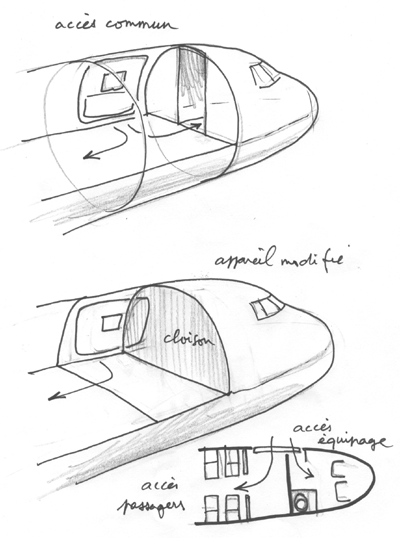
...Bottom drawing: modified aircraft. During boarding, passengers and crew enter "through the same door," sharing access. But once the door is closed, the crew cabin becomes completely isolated from the rest of the aircraft by a partition. A chemical toilet and kitchen facilities will now be part of the pilot area. Emergency passenger evacuation through this access point is slightly hindered, but when faced with two evils, isn't it better to choose the lesser one? Moreover, the access area could be enlarged in new models. The advantage of this design is its relatively low cost. The essential point is that terrorists can no longer move freely toward the cockpit. No civilian pilot, no matter the threat posed to passengers, would ever willingly crash their aircraft into a city. We would then revert to "ordinary terrorism," involving hostage-taking. Note that Israeli aircraft have their cockpit separated by two successive doors, with the intermediate space serving as an airlock, effectively preventing forced entry. If this solution can be applied to current aircraft, it is certainly not a bad idea.
September 21, 2001: Canadian engineer Alexandre Bérube suggested installing anesthetic gas emitters in the passenger cabin. It's better to land unconscious than dead. He adds, as his opinion, that terrorists would find it difficult to bring gas masks onboard to protect themselves from the gas. Combined with a two-door system functioning as an airlock, this would allow one pilot, after initiating the procedure and verifying via video surveillance, to enter the passenger cabin and possibly identify and neutralize the attackers. In the event that this co-pilot were also taken hostage by an attacker, we would return to the previous situation, with the remaining free pilot instructed to bring the aircraft down regardless of threats.
...We are facing an extremely intelligent and technically well-prepared terrorism. The synchronization of actions across multiple aircraft had to be total. Indeed, since the terrorists were very lightly armed, passengers, learning their fate via mobile phones, could have rushed them, having nothing left to lose, in which case the terrorists might have been completely overwhelmed. They had to quickly kill the pilots and turn the cockpit into a fortified stronghold, within the few tens of minutes it took for the aircraft to reach their targets.
...The planes were chosen because they were trans-American flights, thus heavily fueled with jet fuel. The hijackings occurred immediately after takeoff, transforming them into true flying bombs. We are struck by the flight behavior of the aircraft that hit the second tower: it made a sharp turn to maximize impact into the building. Only a relatively experienced pilot could have executed such a last-minute maneuver, approaching in a turn rather than flying straight (which would have been easy, since the Twin Towers stood out clearly from the rest of the Manhattan skyline due to their height: 400 meters).
...The terrorists and organizers of the attacks clearly knew what would follow the impact. The jet fuel was essential to attack the structural elements—steel and concrete—and soften them. Otherwise, a simple impact would have caused only limited damage. They also knew that the floors would collapse one onto the other, in a "domino" effect. All of this had been studied in great detail, simulated, and perhaps even tested on scale models or buildings. The attack was conceived by building engineers, among others. This phenomenon turns the towers into "giants with feet of clay."
...As usual, lack of foresight was the rule. Indeed, if a screenwriter had proposed such a film to a production company, they would have replied, "Hey, don't you think you're going a bit too far?" The logical consequence is that we must now consider every possibility, trying to imagine the mindset of people who will stop at nothing and seek to inflict maximum human casualties. This logical progression leads to the use of nuclear and biological weapons. For reference: a nuclear bomb is the size of a tennis ball (or even smaller, since the neutron bomb trigger can fit inside an 88 mm mortar shell). A biological weapon is simply a small vial. If emptied into a major city's water supply, containing, for example, a virus or bacterium with rapid reproduction, it could kill tens or even hundreds of thousands within hours.
...This is by no means an act of extortion. There are no demands. This act is a declaration of war by individuals driven by religious factions. Pursuing "those responsible" for prosecution, as Bush said, is practically futile—a reflex of Western thinking. Retaliation also seems no solution when facing people for whom sacrificing their lives is considered a natural act.
From September 20 to December 11: 3,024 consultations. New consultations:
Back to Geopolitics Summary Next Document ("Fanaticism")