Cuba Castro Pig Bay
The Pig Bay Affair
In the Americas, plural, loose ends had been left behind. Cuba is very close to Miami, and it is well known that this city, along with a few others, had long been a stronghold of American organized crime, the mafia. Cuba thus became a vacation spot for mobsters. An ex-sergeant, Batista, opened the doors of his country wide to them. The island became a place of every kind of corruption and racketeering. For example, the toll revenues from the highway running from Havana to Santiago de Cuba, which followed the island's coast, were automatically collected by Batista's own wife, who used the money to further expand her already impressive wardrobe.
Havana was the brothel of the Americas. There wasn't a single family in the city that didn't have a daughter on the streets. Then came a certain Fidel Castro, a respectable bourgeois, former lawyer, who took up arms, quickly becoming a symbol of rebellion for an entire people. Opposing him: nothing salvageable, nothing respectable. Batista remained a mere, mediocre sergeant. One day, everything collapsed. Havana fell like a ripe fruit. Almost all of Cuba's notable citizens fled, after the American mobsters had escaped first, taking off in their speedboats or private planes. Cuba suddenly found itself without doctors, engineers, technicians—and even without spare parts. What happened then? The Cubans turned to the only ones who offered help: the Russians. It was that or starve. Thus, America found itself with a communist country just a hundred miles off its shores.
The CIA was then called into action. A plan was devised to make the international public believe that the Cuban people, crushed under Castro’s dictatorship, were rising up in revolt. Miami was not far away, but launching the operation from that part of the American coast did not seem like a good idea. So, the commando—comprised of 1,600 Cuban exiles living in the U.S.—was instead launched from Nicaragua.
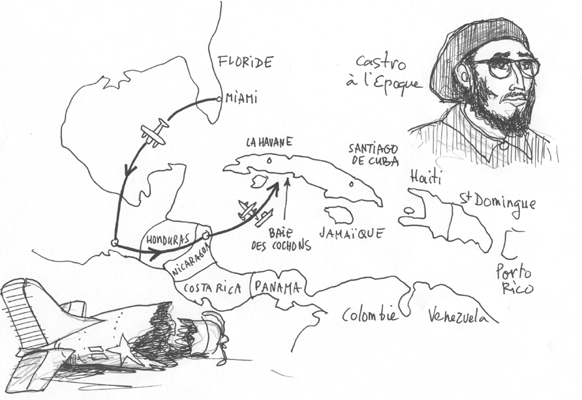
They arrived in motorized boats, supported by a small number of landing barges carrying old Sherman tanks. This was the Bay of Pigs operation, centered in the middle and southern part of the island, where it is narrowest. Logically, this landing force should have quickly established a beachhead. Then, according to CIA experts who claimed to have surveyed the population, a portion of the Cuban people would either join the group or passively observe the landing, whose main objective was to split the island in two: Santiago in the east, Havana in the west. Just a few days should have sufficed to justify sending a full expeditionary force, composed of Marines, to support the Cuban counter-revolution. Moreover, one must not forget that, revolution or not, the Americans already possessed (and still possess) the naval base at Guantánamo, located in the southeast of the island.
But things did not go at all as the experts had predicted. Castro immediately found massive and enthusiastic support among the Cuban population, simply by broadcasting a stirring radio appeal: "Come defend your revolution!" He sent a few old Russian T-34 tanks. Trucks brought volunteers in large numbers, many carrying a hodgepodge of weapons, and often nothing more than bamboo poles sharpened into spears. The commandos were stalled—not due to their opponents' strategic superiority, but because of their sheer numbers. They surrendered their weapons to a human swarm. Of the 1,600 men in the commando, 1,500 were captured within 72 hours.
Media-wise, the aftermath was positively catastrophic for the U.S. Not only did Castro not execute or hang those whom Cubans had nicknamed "guzanos" (vermin), but he sold them back to Cuban families living in exile, in exchange for their weight in medicine or ten thousand dollars per person.
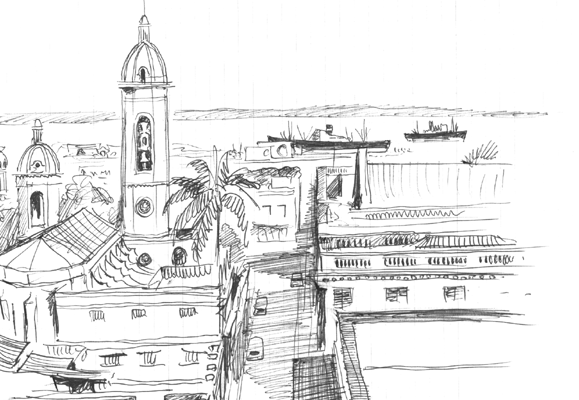
Cienfuegos
This explains why the U.S. was traumatized when it witnessed the rise of a socialist government in Chile led by Allende. This time, the destabilization effort was better prepared. The CIA could count on part of the Chilean population, particularly the truckers' union. Countries have economic systems that can present weak points. The Chilean communication system was a vulnerable link, which the Americans skillfully exploited. They financed a strike by Chilean transporters, plunging the country into complete economic crisis. Meanwhile, military forces led by General Pinochet seized power. Allende died defending the presidential palace with weapons in hand. Chile then fell under a military junta eager for power. Pinochet systematically eliminated opponents and progressives by killing them outright. Through these assassinations, he established a very particular balance in the country, while the U.S. rewarded this return to "common sense" with a significant influx of dollars.
In other South American countries, such development aid was not even necessary. After overthrowing the existing democratic forces and installing a puppet government loyal to the CIA and the U.S. State Department, the country could be placed under neo-colonial rule (banana republics). Again, the priority was the fight against the spread of communism (which, in the eyes of the Americans, meant the most feared thing of all: the denial of private property). In South America, U.S. foreign policy can be considered a success. Inequality dominates everywhere, and with the complicity of strong military powers, this inequality guarantees political stability.
From September 20 to December 11, 2001: 3,024 consultations. New consultations:
Return to Geopolitics Summary Continue "Geopolitics in Daily Life"