Geopolitical extremism, right wing, scapegoat
Geopolitics of the Day
1
September 20, 2001
...We don't hear only nonsense in the media, especially on the radio. I heard a man on Europe1, who I believe is called Guillaume Bigot. Again, two points were emphasized. The first is that the extremists we are currently facing are far from being complete idiots. The second is that they follow a logic that has its own coherence. We will come back to this later. Generally speaking, there are still many voices raising the cry "we must put an end to all fundamentalisms". And in this sentence, one had to understand both religious and civil fundamentalisms. One cannot escape an adherence to a system of moral values. These are gathered in a set called "law" or "laws" in plural. The Taliban have theirs, but the people of Wall Street also have their laws. Bigot mentioned the trial that a Western pharmaceutical company had brought against people who were trying to make a kind of clone of an anti-AIDS drug, in an attempt to make it affordable for African countries, for example. The company hid behind patents, industrial property, behind laws, ensuring the protection of its interests. However, Bigot added, if the law sides with this company and if these "biological pirates" are condemned and if their production of a similar product is forbidden, it could cause maybe a million deaths. This trial, it is fundamentalism, a Western-style fundamentalism.
...And Bigot added: what are our moral values, we in the West? On what logic do we base ourselves? Law students starting at university learn from the beginning the famous phrase "law is not equity". It is heavy with meaning. Thus, law, "justice" can give reason to the murderer, the executioner, the one who starves, because their acts are "legal". ...There are laws recognized by several countries and there are specific laws of determined countries. In the capitalist sphere, there are "tax havens", "flags of convenience", "banking sanctuaries". Is it possible to continue living like this? Will Switzerland be able to continue guaranteeing its bank clients the confidentiality of their transactions, the possibility of housing dirty money, of dubious origin or destined for criminal financing?
...Another point, mentioned during the broadcast, brings us back to the ideas of the French psychologist René Girard (who lives in the USA). He emphasizes two important psychological axes, as drivers of human behavior. It is first the duality "desire-hatred" and the theme of the scapegoat. Among the disadvantaged people, from the children of our suburbs to the people of favelas, of slums, everything is done to excite their desire. Thanks to the globalization of the media, they can be informed of what is happening in the rest of the world. They can discover that in the USA there are luxury hotels, and even pet brothels. On the sensual level, people who live under iron constraints discover that elsewhere, the most blatant luxury, the most unrestrained sexual freedom can exist. But for them, the slightest mistake can lead to the noose, a bullet in the head or even public beheading (recent report on Afghanistan under the Taliban's rule). One can imagine their frustration and, at the limit, their desire, conscious or unconscious, for sex, food, freedom, for the most diverse consumption. Hence this thought: "I cannot afford all these pleasures (for that is the word that should be used). So those who can afford all of this must be punished".
...The rich countries have been extremely imprudent, by displaying their wealth and their freedoms. They have also remained deaf to the cries of the people crushed by all kinds of misery. In the Europe1 broadcast, someone mentioned the reaction of a high school student, in a French high school, who was asked for a minute of silence in memory of the American victims and who would have then said: I suggest that we dedicate this minute of silence to the memory of all the victims of violence and he cited inter-ethnic conflicts in Africa that had caused a much higher number of deaths, and about which no one had cared. It is indeed a question of compassion. But who has been entitled to our compassion? Has it not been very selective?
...America has become the scapegoat of all frustrations. It serves as a target, but let us not be mistaken, all rich countries are targeted and responsible. Paradoxically, the emirs of Saudi Arabia or those of Kuwait go into the background, those who squander considerable fortunes in grotesque luxury. But "they practice charity" and especially secretly finance the armament of terrorists. The situation of Bin Laden proves this fact. Others operate these financings discreetly, either out of conviction or because they are threatened.
...I was extremely surprised to see the reaction of Bush, according to what I heard, entering a Mosque to try to calm things down, saying, as far as I remember, "that the goal of America was to end violence and punish the guilty, not to declare war on Islam". This politically strong and bold gesture seems unexpected. ...Right now, will the Americans make the mistake of creating a blind and nameless massacre? It seems to me that this would be a serious strategic mistake that would cost them the advantage paid for with the price of five or six thousand civilian deaths. Of course, asking people who have suffered such a wound to keep their composure is easy to say. Today (September 20), discussions would take place between Taliban religious dignitaries. Some would suggest that Bin Laden leave the country "of his own free will". But if no information is given about the country that would then host him, what guarantee would there be that the man would have actually left the country? These same media say that everything will depend later on the decision of Mullah Omar. If one approves the acts of a man, one gives him political asylum. This is what the Taliban have done so far. If Bin Laden is forced to leave the country, this would make him a fugitive. Whether he is or is not the real responsible for the attacks is at the limit secondary. He has sufficiently multiplied media statements advocating attacks on civilian victims to have identified himself with the image of this suicidal terrorism. Bin Laden is no longer just an individual, but a symbol. By asking them to leave their country, the Taliban would disavow him, refuse to show themselves "solidary guarantors" with him, the price to pay possibly becoming too high. But will they? And if so, now, who would officially accept to host this man? It is easy to shout in the street that he is a hero, less easy to put oneself in a situation to take the shrapnel of the grenade that could hit him.
...We are on a razor's edge. We are, historically, facing essential choices. Nothing will ever be the same again. The strategic situation has changed. The rich countries can no longer let the poor countries suffer, be ravaged by AIDS, hunger, insult poverty by displaying luxury. More than twenty years ago, an American, or two American authors (there are madmen everywhere) had published their own analysis of geopolitics by borrowing expressions from military field medicine. When a confrontation took place, the doctors went to the battlefield and made a rapid triage, based on the possibilities of evacuation and treatment. All the armies of the world, even the most sophisticated, do not have resuscitation teams available for each injured person. Thus, the authors recalled, the doctors put labels on the injured, classifying them into categories (possibly using a code). One of the categories is "shall not survive" (will not survive). It is useless to take care of them, to try to evacuate them. At most, some doses of morphine to shorten their suffering. On the other end, the "walking wounded" (injured, but able to walk). Between these two extremes, a whole palette. The two American authors used this classification to analyze the situations of different countries. India, as far as I remember, was classified among the "shall not survive", given the very high birth rate. And so on. ...It is true that anything is published in the world and that Americans are not the only ones to have human stupidity. I just cite this anecdote to locate the level of aberration that "human thought" can sometimes reach. The Nazi classification included "subhumans", among whom the Slavs were grouped in bulk. Jews had to be exterminated. But the Slavs had to give their land to the Aryan conquerors and serve as slaves. It was with such principles that Hitler sent his hordes eastward. Von Paulus, chief general, received orders to distribute in the units. German soldiers should not hesitate to eliminate prisoners and to eliminate civilian populations, if those could represent a hindrance, a weight, or a risk in their actions. Hitler hoped to terrorize these "subhumans", to lead the Soviets, initially extremely disorganized, that the "Barbarossa" operation had completely caught off guard, to a faster collapse. But the opposite result was obtained. Knowing what fate was reserved for them, the Soviets fought to the death, practiced the "burned earth" technique, devastating their own country. There were no suicide commandos (the concept may not have been invented yet) but units defended their square of terrain, killing themselves to the last. And there was Stalingrad. The Germans hoped to open the way to the oil of Baku, which they urgently needed. They could not pass and this defeat marked the beginning of the end for them.
...The current situation shows one thing: brutality, selfishness, which drive peoples to despair (and into the arms of fundamentalists) do not pay. The terrorist weapon is formidable on two levels. One: the perpetrators are not locatable. Two: the countries practicing terrorist actions can inflict on the rich countries damages greater than those they suffer. In terms of terrorism, we have not yet seen anything. Technically, everything is possible. One of the participants in the Europe1 broadcast pointed out that a fully fueled commercial airplane has a destructive power a hundred or a thousand times greater than that of a cruise missile. However, to turn this civilian airplane into a bomb, it would have been sufficient to have a few cutters. ...Of course, measures will be taken. Double doors will be put in airplanes, with a lock. But other things will follow. Why not a nuclear bomb in the tunnel under the English Channel? If suicide terrorism becomes widespread, people will no longer dare to take public transport. If this fear translates into a surge of racism, into lynchings, everything will become uncontrollable.
...There are people who profit from wars. Remember the Iran-Iraq conflict and the numerous European companies that supplied... both belligerents with shells, mines, etc. Remember these specialists, Western mercenary-scientists, whom Saddam Hussein had secured at great expense. The "Big" ones also played this game. The Russians supported Arab countries, the Americans supported the Taliban. Today, obviously, this game has become extremely dangerous, the ally of yesterday could become the enemy of tomorrow, possibly in the background. It has even become dangerous to attack an adversary. The Americans have economically brought the Russians to their knees, that is a fact. These, who could not afford "butter and cannons" at the same time, collapsed. It was said that there had been economic aid, which had disappeared in the hands of the East mafia. Possible. It is difficult to move from a "planned economy", from a generalized bureaucracy, to a market economy. A reorientation was, in principle, extremely delicate. The result is what? The former Soviet Empire has fragmented into uncontrollable ethnic groups. The Russian mafia is everywhere. Some ethnic groups have nuclear weapons, missiles. Put yourself in the place of a Russian who sees his country ravaged, who sees his daughters transformed into prostitutes in the Moscow station, and who is offered by a fundamentalist the purchase of some technical secrets related to nuclear energy, or even operational devices. Put yourself in the place of a South American who sees his country pillaged by these companies like "United Fruit". To these countries, America is ready to send combat helicopters to fight against drug traffickers. It would have been better, perhaps, to ensure their development by creating road networks allowing peasants to transport their productions. It would have been better, perhaps, when it was still time, to support their economies by providing them with equipment allowing them to modernize, by buying their productions, even if, in relation to their American equivalents, these were "unprofitable".
...Short-sightedness, everywhere. On the simple level of intelligence, it was an error. Let's not even talk about "human values" since these words have not yet entered the customs.
...The Arab world is huge. It is also a powder keg. The westerners will never be able to kill three billion individuals. This being said, the Arabs have a strategic weakness: they have no "rear base". They have no heavy industry, no autonomous source of high technology. If the Russians decide to refuse to send spare parts to Gaddafi, in two years his aviation will be grounded, even if he is swimming in oil. If the technologically developed countries decide to cut the Arab countries from access to the information highways, and if no one helps them, it is not by attaching messages to the legs of birds that they will be able to fill this gap. Without satellites, no propaganda, even no information. Information has become a weapon today. The terrorists are said to have widely used the Web to plan their actions. But what would happen if the Arab world were deprived of computers, if it were excluded from the Web?
...This situation is strange and new. Until now, the rebel always had a rear base somewhere, a source of supply. Today, who will ensure the logistical support of the fundamentalists? To cut their financial support, it would be necessary to target the tax havens, whose specialists say that half of the financial transactions pass through these channels of total opacity. However, if the westerners, who benefit from these structures, do not attack them, really, these watertight compartments will prevent investigations from progressing. On the contrary, the lifting of secrecy would allow to quickly trace the sponsors of criminal actions. Bush, at the time of his inauguration, had refused to attack this "freedom of countries to choose their tax system". Will he change his mind?
...Simple digression that should not make us lose sight of the essential issue: to shed light on all fundamentalisms, religious or... secular, on all forms of oppression, exploitation, fraud and plunder. Will the political (and religious) leaders take this step, will they accept to reconsider the consequences of the "founding texts" that serve as the basis for their "civilizations"? The whole world is holding its breath.
21 September 2001:
Yesterday, a virus alert. The target was the banking systems and the enterprise management systems. The cost would have been particularly important. In fact, computer warfare exists, potentially. The Chinese have openly announced that they plan to invest heavily in this direction. Experience has shown that anyone could access practically anything, anywhere, from any point on the globe (including one of these famous "cybercafés"). The defense of the systems relies on multiple data storage in units disconnected from the network (CD-ROM). In the case of the recent attack on banks and enterprises, it took time to identify the virus. Its program had triggered chaotic bank transactions, from account to account. The remedy consisted of returning the systems to a previous state, using the CD-ROM storage after verifying that the virus had been eradicated. A virus only spreads when the computer is running. It jumps, from one to the next, from file to file and like any virus, it duplicates elsewhere, exponentially. We have all suffered such attacks, more or less violent. The first thing our antivirus software suggests is "quarantining the infected files". The financial damages that enterprises and banking systems suffer each year are considerable. In this area, discretion is in order, otherwise the reliability of such structures would be immediately questioned. The legal arsenal, repressive, has an efficiency that depends on the number of offenders. If there are too many, they would create an unmanageable movement. It is suspected that the companies selling, at a relatively moderate price, antivirus software, produce them themselves. By circulating the disease, they would reinforce their effectiveness by immediately putting "the medicine" on the market. This imposes an update of the antivirus software, very cheap (30 F per year). But no one can avoid it. Antivirus software is difficult to pirate. Moreover, their relatively moderate price makes them as commonplace as a mouse or a floppy disk. It is less complicated to buy an antivirus software for 500 F than to try to pirate it and chase the latest versions. ...The commercial, banking and industrial systems use "electronic money" transfers intensively. A generalized viral attack could at the limit saturate the defense possibilities. But the weapon is double-edged. The financiers of the attacks are for the most part speculators. Nevertheless, it is possible that this recent attack is the forerunner of the intensification of the phenomenon. It is thought that the computer experts from the Eastern countries would have been pioneers in the creation of viruses, this becoming "the computer weapon of the poor", just as terrorism has been compared to "the nuclear weapon of the poor", the first aiming at the disorganization of the Western banking and commercial paradises, blackmail, extortion of funds or the disorganization of vast defense systems.
27 September 2001
...The United States have just launched an operation "Justice without limits" (infinite justice). On September 23, during a television program (Capital), our current finance minister, Laurent Fabius, and a Swiss investigator who has long advocated for tax transparency were confronted. I could only catch the end of the program. Nevertheless, this Swiss man smiled in front of the statements of Mr. Fabius, who claimed to detect in political spheres, for the first time, "a beginning of will" to make clear the dirty money, tax havens, etc. And the Swiss man replied without hesitation:
- I don't believe in such an evolution, neither in terms of tax and financial transparency, nor in terms of extraditions. Half of the current financial transactions pass through this system of tax havens (and to show a map where the Caribbean Sea, among others, seemed dotted with such paradisiacal places. When Bush became president, he immediately made his position clear by declaring "that countries have the right to choose the tax systems that suit them"). However, international organized crime, drug cartels (of which Afghanistan is the largest producer in the world) and terrorism use these circuits, which they know well. Mr. Fabius, you know very well that in France anyone can open a bank account tomorrow in any bank, whose holder could have an "offshore" (outside territorial waters) domicile. It remains impossible to trace, legally, the real "beneficial owners" of the accounts and it is not possible to know who the real order-givers are.
...In other words, if one can access the volumes of the transactions themselves, the amounts of the assets, one cannot know who is behind what. Thus, our entire banking system is therefore protected by walls of secrets that are as much active complicity. It is impossible to imagine that this system could change suddenly, because everyone would be immediately involved. At the limit, politicians who loudly demand "that all the light be shed" would immediately receive a backlash revealing embezzlements or dubious circuits concerning the financing of numerous operations, not to mention that of their election campaigns. It is easier to send boys to Afghanistan than to go into the accounts of the international financial system.
...A second point concerned details given about the gas pipeline intended to transport the recently discovered abundant natural gas in the southeast of Turkmenistan, near the city of Mary. See the map below:
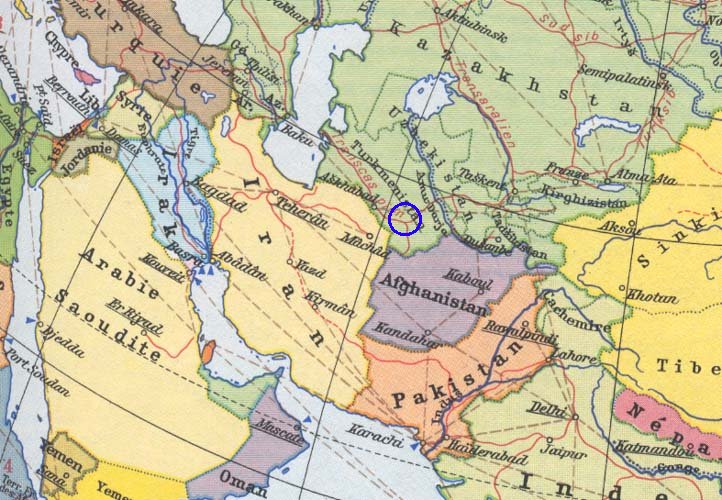
...This allows to see how the different countries are landlocked, intertwined with each other, in this region of the world, the "Balkans of Asia". In the center, Afghanistan with two of its cities: Kabul and Kandahar. Problem: how to transport this natural gas to the consumer countries, the "client countries", essentially the Western countries.
-
Through the north, that is, through Russia, riddled with its mafia, increasingly unstable and uncontrollable? No.
-
Through Iran? Unthinkable.
...The only remaining route was the southern one, passing through Afghanistan and Pakistan (see the marked route).
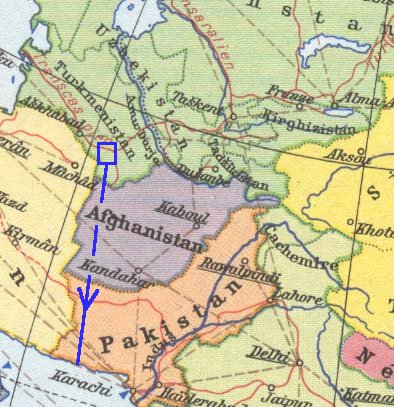
...Pakistan was very interested because this gas transit on its territory could ensure it an energy resource and also a source of income, in the form of royalties. Afghanistan is a real patchwork of ethnicities. It turned out that the one composed by the Taliban was on the route of the pipeline, in the southwest of the country. The faceless, stateless capitalists, the international capitalist, therefore decided that political power would fall into the hands of the Taliban. If the commander Massoud, recently assassinated by a terrorist kamikaze, had occupied the southwest of Afghanistan, this role would have been his. Unfortunately, he was stationed in the east of the country. Thus, one can see how things depend. The capitalists of all countries (by what other name could one call them?), completely blinded by their search for profits, seem to completely miss the possible political backlash. France once gave refuge to the Ayatollah Khomeini, at Naufles Castle. Why? To play on different tables and perhaps one day, if he became the Iranian State leader, to recover a little something on the oil price?
...Who knows.
1st October 2001
...I have doubts about the accidental nature of the Toulouse disaster. The coincidence is still very disturbing. Nothing seems easier than to blow up such a nitrate of ammonia depot (or a hydrocarbon tank, or any other major risk facility). Two solutions: to fire a rocket with an old LRAC (Lance Roquette Anti-Char) of recovered origin, without an auto-directing system. In France, we have countless sites surrounded by houses that are entirely vulnerable to such shots, especially if the weapon is handled by a man who doesn't care about saving his own life. Regarding nuclear sites, this type of attack has been thought about. The tank containing the radioactive products is itself surrounded by a concrete enclosure. However, the whole is completely vulnerable to an airplane impact, given that our nuclear installations were designed to withstand the impact of an airplane of ... 9 tons.
...Returning to the Toulouse tragedy: this explosion could also have been triggered remotely, by radio, after a accomplice had placed a seemingly ordinary charge against this installation, possibly before the attack on the twin towers on September 11, at a time when no one could have suspected that such an action could be undertaken.
29 October 2001
The weeks pass. I saw a broadcast on television yesterday, quite well made. The conclusion is not encouraging. When the Soviets found themselves in difficulties, with an uprising in Afghanistan, the Americans simply wanted to take revenge on those who, in the past, had helped their communist enemies, especially in Vietnam, who would not have been able to overcome the B-52s without external help. The exact phrase was "we wanted to bleed America". The Afghans, rebels against Moscow, therefore benefited from arms very quickly and in great numbers. To do this, the Americans used Pakistan where, say CIA officials, never more than half a dozen Americans were present, who had channeled more than a billion dollars of high-tech military aid. The Soviets therefore quickly found themselves in difficulty. This situation worsened when the Americans decided to supply the Mujahideen with large quantities of infrared-guided Stinger missiles, which were both very sophisticated and easy to use, capable of waiting without a fight for a Soviet combat helicopter at three thousand meters. Overnight, the Soviets lost air superiority and were therefore unable to provide support to their motorized troops, which were decimated in the narrow valleys of the Afghan foothills, favorable to ambushes. In this game, the match was lost in advance. An ex-Pakistani intelligence official showed, during this broadcast, a video tape on which one could see, on an exceptional visit, the director of the CIA, wearing the classic Afghan turban, coming to check on site, with visible satisfaction, the damage inflicted on the Soviets.
Throughout this broadcast, many important things are learned. It seems that there was a "text of the prophet", on which the Saudi fundamentalists rely, according to which no soldier of a foreign army can stay in "Holy Land". However, at the time of the Kuwait war, this was a necessity. Balancing the goat and the goat, King Fahd signed a protocol according to which, after the intervention, the Americans would leave. However, they, neglecting the wish of the Prophet, remained on site. Hence a new subject of anger following a violation of a treaty with religious implications, which we, westerners, would have great difficulty in measuring the impact.
The questions of big money were mentioned. The specialists admitted that in foreign policy, Uncle Sam makes little difference between geopolitics and the interests of J.R. Ewing, thus often pursuing a short-sighted policy. The question of the gas pipeline, already mentioned here (see map), seems central. But, in addition to this discovery of gas fields in Turkmenistan, it is actually the entire region that is increasingly presenting itself as a second "Middle East", rich in all kinds of hydrocarbons and with a large Muslim population. It seems that a whim of fate has made it that, except for the Texas oil fields, it would be mainly in regions with a strong Muslim presence that the black gold would have chosen to bloom. When the Soviets decided to withdraw from Afghanistan, the Americans were satisfied but did nothing to help this country, ravaged by ten years of war, to rebuild. It then became the scene of bloody tribal conflicts, which no one cared about, until it was learned, from afar, that people called "Taliban" had taken Kabul, after a long siege and a merciless civil war. A "strong, majority" regime, according to an American assessment of the time, whose territory had the good fortune of being on the route of the future gas pipeline. Everything was therefore well in the best possible geopolitics.
During the broadcast, it was learned that Americans, who had recently suffered several attacks by a certain Bin Laden, had for many months tried to negotiate with Afghan ethnic groups, and the Taliban, long before the September 11, 2001 attacks. They wanted these people to hand over the famous terrorist, "in exchange for which substantial financial aid could flow into the country". In early 2001, during one of these very informal meetings in Germany, the Taliban did not show up. The Americans then threatened military intervention, according to a Pakistani present at these meetings (although this fact was later denied by an "American official"). Experts later revised their assessment of the Saudi billionaire's personal fortune, casting doubt on whether he alone could finance so many large-scale operations. What seems increasingly evident is that Saudi Arabia, Wahhabi (a strict Islamic movement that, year in, year out, carries out about seventy sword executions of criminals, and locks up its women, thus applying the sharia), would be supporting fundamentalist movements behind the scenes, using with skill the banking systems precisely set up by capitalist nations themselves.
What seems surreal is the lack of realism of the Americans, unfortunately legendary, in their geopolitical assessments. They are allies with people who clearly betray them or are only waiting to do so. We have seen them show sympathy with their mortal enemies of yesterday, the Russians. Now they are in China. A journalist told us that in the current Middle East, the Iranians could be potential allies for them, given that they do not get along with the Taliban, for ethnic and religious reasons. Personally, we are convinced that the religious component, as a powerful force in the Muslim collective unconscious, always so fertile and turbulent, remains underestimated by the Americans, and by Westerners in general. Just as much as class struggle, theories of free enterprise and parliamentary democracy may not be the key to analyzing all situations on a planet plagued by powerful dischronies.
November 9, 2001
America is suffering, and we sympathize. Who could not be moved by the terrible tragedy it experienced on September 11, 2001? But, as the media sometimes showed us, there are many tragedies in the world that are not talked about. There are regions where people are killed with machetes to save bullets, others where hunger simply does its work. There have been several genocides. Right-wing and left-wing genocides, waiting for center-genocides, moderate genocides. It is not good to shout "haro on the donkey!", to denounce those who pay dearly for their mistakes. We should simply ask ourselves, if we manage once again to straighten out a very difficult situation, to get through, how not to repeat these past mistakes. There was a man in Chile named Salvador Allende. He was an honest man, a good man, a democrat. But, for a JR Ewing, such a man seemed difficult to control. Honesty is always disturbing because it cannot be bought. One day, Allende received Castro: a major political mistake, a meeting that greatly worried JR Ewing. "Here is a communist!". The communist is the Great Satan for an American. What is a communist? If you asked an American encountered in the street of a big city, or met in the depths of the Midwest, he would probably not be able to answer you. America is Manichaean. Countries that tend to resemble it are essentially democratic countries, "passionate about freedom". Those that seem to deviate from the American model are immediately suspicious, potentially capable of turning into "communist countries". That's it. In fact, the average American is fundamentally incapable of imagining for even a second that the "American way of life" might not be the model toward which every reasonable human being should strive. In the mind of every American, the country where he lives is the very symbol of freedom. Indeed, a statue that symbolizes this stands at the entrance of New York Harbor. When people arrived in this New World by boat, it was the first thing the immigrant or tourist saw rising on the horizon. A breathtaking sight, for those who had this chance, before transatlantic airplanes made it disappear for good.
After the war, Europe experienced the Marshall Plan. West Germany benefited from it. After being devastated by bombs, it was able to rebuild, later becoming a major economic power. It was not condemned, as in the Treaty of Versailles, to pay crushing war damages. America distributed cards to the players and provided them with a small pile of chips so they could rebuild. It was also an essential gesture to prevent these countries from being lured by the siren songs of the Eastern countries. One could say that it worked.
Digression on the Cuban Revolution and the Bay of Pigs affair.
While advocating democracy, America distrusts it when it tends to establish itself outside its own borders. Let's say it accepts, at the limit, that a country becomes democratic, provided that it does not immediately close itself to American investors, that is, to a reasonable neo-colonialism. If we let countries benefit from the exploitation of their local wealth, where would we go? There was a time when Egypt was still "ruled" by a king, a certain Farouk. Politically incompetent, he was overthrown by a group of military officers, led by General Neguib. America let it happen. A military junta, in principle, can be easily corrupted. These are people who accept Swiss bank accounts and with whom one can generally reach an agreement. But Egypt quickly fell under the control of a passionate progressive nationalist: Abdel Gamal Nasser and America began to regret the good old days of King Farouk. Pragmatic, the Americans decided to now support the most conservative political representatives in the East. Saudi Arabia is an example of the finished product of this policy. Similarly, important American support was given to the Shah of Iran, Reza Pahlavi. Skipping the years, we come to the American support given to the Taliban regime, already mentioned above. Again, the absolute priority was given to anything that could act as a barrier against communism. In this sense, aid to regimes with a strong religious base had its logic: to serve as a bulwark against a fundamentally atheistic Marxism. The problem lies in the potentially uncontrollable nature of certain regimes, as was the case, for example, with Iran. As soon as the Shah, for health reasons, was forced to give up power, the Ayatollah Khomeini, whom we, the French, had taken care of in Naufle-le-Château for years, immediately seized power, transforming the country into an Islamic republic and sending Iran back ten centuries. By supporting the most conservative and fundamentalist regimes, the United States themselves forged weapons that could turn against them in the most violent way possible: through terrorism. We are there.
When he speaks from behind this wooden building marked with the American eagle, Bush has pathetic sides, as do the American senators singing, the day after the September 11 attacks, "God bless America": God bless America! When he is filmed in his fantastic high-altitude flying computer above Afghanistan, the American Secretary of Defense still suggests the incredible American naivety, as if, from such a vantage point, full of electronics, the Yankees were unable to see the realities of the world they are flying over.
We are living through a key period in world history, but no one seems to really understand the path to follow. It seems as if the opposing forces are trying to implement the old solutions. Unfortunately, you don't always win, as in Chile. Then we witness diplomatic crusades that defy imagination, like the meeting between the American, Russian and Chinese leaders. Each one seems to be looking for a recipe that could work. Is it a matter of high technology? Who do you have to buy? On whom can you rely?
Strategically, the Americans seem completely out of their depth and lack imagination entirely. They navigate (and bomb) at random. They are searching in the mountains of Afghanistan for the person they believe is responsible for the attack they have just suffered, without really realizing that they now have six million Muslims on their territory and that congresses focused on the international Jihad, bringing together the leaders of the most well-known and active terrorist factions, have been held on their own soil, all these people having obtained a visa to enter the American territory without any difficulty. At these congresses, the most extreme statements were made, real calls to murder, with complete impunity since apparently, among the twenty thousand active CIA agents, none seem to know Arabic. "Humanitarian" associations began to flourish on American soil in the 1980s. On their letterheads, on the left in English: "Association for the aid of Palestinian orphans" and on the right in Arabic: "Committee for the recruitment of Jihad warriors". It was all very thoughtful. Six months before the attack on the World Trade Center, an imam was arrested on American soil, a murderer of a rabbi. Curiously, this charge was finally not retained against him, probably due to one of the many oddities of American laws. The police still searched the home of this religious extremist and seized a large number of notes written by his hand, in Arabic. Thinking they were "cultural documents", they neglected to have them translated. Six months later, after the deadly attacks, they discovered, after finally reading these documents, that they would have allowed them to understand the plots against the American nation and even to know what the targets were.
Back to the ground. Facing the Taliban warriors, the Americans seem to make errors similar to those that made them lose the Vietnam War, that is, above all, not understanding what kind of war they are facing. When they decided to launch a large-scale bombing operation in North Vietnam, with the famous B-52s, they thought that their carpet bombing technique would quickly bring their adversary to his knees. But, once again, the US intelligence services completely ignored the deep changes that had been carried out by Ho Chi Minh and General Giap: the transformation of almost the entire country into a vast termite hill. Hanoi, well before the first American bombs fell, had already become a city almost entirely underground, with galleries extending up to thirty meters deep, associated with ventilation systems. Ignoring this detail, the Americans did not understand why the crushing of such a small country with a tonnage of bombs equivalent to all that had been dropped during World War II did not seem to significantly weaken its resistance capabilities and morale. In the same way, how could an American understand how a Taliban warrior functions, for whom there is no more enviable destiny than to die in battle, with weapons in hand. It is written in the Koran: he who dies "on the path of Allah", that is, in the Jihad, has his sins erased. He then enters a paradise so delicious, so sensual, abundantly described in the book, a paradise where, in a dreamlike setting, seventy pure virgins, with lowered eyes, the famous "houris", await the transformed warrior, under the shade. In a country where sexual frustration is intense, despite the institution of polygamy, how could one dream of a better end? In 1944, the Americans were completely overwhelmed by the "divine wind", otherwise known as the Kamikaze phenomenon. In the first moments of this totally unexpected attack, the American fleet suffered very heavy losses. Fortunately for the United States, things were already too far advanced for this Japanese retaliation to really influence the fate of the weapons. The reconquest of the islands had put Japan within reach of American bombers. It quickly found itself without raw materials, without fuel, without means of war production, its main factories having been conscientiously devastated. The massive bombings of the last moments of the war (including the terrible bombing of Tokyo with incendiary bombs), followed by the spectacular demonstration of the destructive power of the nuclear, led to the surrender of the Japanese military junta, the real power in place, the Emperor being reduced to a symbolic role. In Afghanistan, the war is very difficult to play. By blending in with the population and implanting their barracks and defense means in the heart of urban and village concentrations, that is, by taking their own civilian population hostage, the Taliban fighters make the continuation of the bombings difficult to sustain, each action being followed by the diffusion of television sequences showing children killed, lined up. The actions on Afghan soil also seem not very easy, given the nature of the terrain. The only effective military instrument would be the combat helicopter. Unfortunately, the Taliban have inherited thousands of Stinger missiles, given by the Americans when the main idea was to make the communists pay for the support given to the Viet Cong. Missiles that any illiterate person can use, stored in caves, very dispersed, and which prohibit any aerial movement below three thousand meters altitude. The Americans therefore do not have control of the sky, although there are no Afghan planes left in a condition to take off. This belongs to these unmanned devices that are the Stinger missiles, capable of taking down any flying machine within less than three kilometers of the shooter. As for going to chase the Afghan warriors on foot, on their own terrain, full of caches, it is tantamount to suicide. There remains the famous "Northern Alliance". But this consists of only a small number of tribes (a total of fifteen hundred tribes in Afghanistan!). Since the elimination of the commander Massoud, the political intelligence of the northern warriors does not seem very reliable. These are people for whom the concept of "democratic representation" is probably quite obscure.
Bin Laden recently broadcast a message saying that the world is now the stage for religious conflicts. Western heads of state immediately affirmed the opposite, as did Arab representatives, rushing to declare that the now world-famous terrorist did not speak on behalf of Muslims. I am not, however, sure that he is entirely wrong. The current world is experiencing a whole set of converging crises. One of them has a spiritual dimension. People feel the need to know why they reside on this planet, which they are tenants of. A Westerner would say "he is looking for a meaning to his life", a perfectly legitimate aspiration. Let's call it a search for a moral value system if we are afraid of the metaphysical dimension of the questioning, it doesn't matter. Now, let's look at the image of the value system that the Western world offers to the rest of the world. It shows a mess, corruption, selfishness, cynicism, and the crushing of the other or indifference to their suffering. Let's not make easy demagogy. The same "virtues" are also at work in the rich Arab countries or within the privileged castes, the oligarchies of other Muslim countries. The designation of the "Great Satan" is timely to focus the hatred resulting from the frustrations of the Arab masses towards the Western countries and to obscure the serious shortcomings of rich Muslims in billions.
We are facing a "war of images" and by saying this I do not limit this discourse to the media aspects alone. It is urgent that Western countries restore an already greatly degraded image among poor countries. Yet, if we witness diplomatic crusades that are supposed to demonstrate the solidity of the "coalition", we hear no head of state mention, for example, the eradication of tax havens. At the same time that they shower Afghanistan with expensive smart bombs (six billion cents for a cruise missile!) the Americans drop small yellow packages containing food. I would be curious to know the cost ratio of the two operations. All of this has a rather surreal aspect. At the national level, justice has decided to temporarily place the President of the French Republic above the law. Seeing this, one would be tempted to say to Chirac: "Do you know that your stupid dishonesty, even if it remains a very common phenomenon in the French political caste, is unfortunately extremely untimely. All of this falls very, very badly, you know."
Which Western religious leader would be in a position to lead a "moral crusade" on a global scale? Even the Westerners have stopped believing in their own.
On the other side, for example, the Saudi princes, champions of double-dealing, while periodically and discreetly, in the arms of sufficiently well-paid call girls, performing small stress-relief sessions in Western countries, manage to appear as "guardians of the holy places" and "guarantors of a Muslim orthodoxy" (Wahhabi). But it's all just a matter of image.
Muslims say they do not have a clergy capable of representing them. That's a pity and the voices of the moderates seem very weak at a time when psychopathic imams, ready to turn twelve-year-old children into suicide commandos, surf on waves of hatred created and fueled by all kinds of frustrations. In truth, we do not know how many weapons and stockpiles of explosives have been introduced into our own territory by the fundamentalists over the last ten years. Yet we have a painful experience: that of the Algerian War, where, with the benefit of time and especially the final failure of the Algerian revolution, we realize that everything was not "black or white" as many had wanted to make us believe. Still, it is technically extremely easy, as has been demonstrated in fact, to set two communities against each other in a life-and-death struggle; with a few well-negotiated attacks. In truth, all European countries have become real powder kegs.
No one has a miracle solution, a magic potion. But one thing seems certain: at a time when a move towards the moralization of politics, towards a new humanism, could simply be an asset for the "Western camp", the dominant religion remains focused on the worship of the golden calf, alias Dow Jones, Cac 40 or Nikkei index.
November 14, 2001
The media had mentioned, in previous days, a possible counterattack by the Taliban. In fact, they left Kabul without firing a single shot. Male inhabitants shave their beards, women come out of their blue camping tents and wire mesh "burkas", loudspeakers play music, images of pin-ups reappear behind store windows. Unthinkable twenty-four hours earlier. One remembers the capital executions, men and women, by rifle, hanging or beheading, in stadiums, in public, after the Mullah's speech. On television, the number of provinces now under the control of "the Northern Alliance" increases every day. They speak of "the post-Taliban". History always keeps parts of the unpredictable, but in this mess we find a constant of the Islamic saga. People from Arab countries easily and massively group behind a country-leader or a man-leader. These human mayonnaises rise very quickly, and collapse just as quickly. Many Arabs were "all behind Nasser", then "all behind Saddam Hussein". Today, the Ulama Bin Laden, the Mullah Omar and Afghanistan as symbols have played these roles of vanguard, of fragile keystone. One does not need much memory to remember the expanses of the Sinai, dotted with abandoned tanks and even .. shoes, in front of the offensive of Tsahal, the Israeli army. In 91 the armies of Saddam Hussein were shattered by American bombs. In a few hours, the Iraqis had no radar, no planes in a condition to take off. The missile sites, priority targets of cruise missiles, were the subject of intensive attacks. There, the American rolling press seems to work again, despite the reserved forecasts. At a respectful distance from the Stinger missiles (graciously given by Uncle Sam to the Afghans and capable of taking down any flying machine flying less than three thousand meters away), the planes bombed the Taliban barracks, their arms and ammunition depots, at the price of some "collateral damage". The armored vehicle parks were methodically pulverized, perfectly distinguished by the bombers, two fingers on the joystick of their guidance system, using light amplification systems. In principle, the Taliban cannot count on any source to replenish their arms. It is difficult to maintain morale under these conditions. Their front lines were conscientiously drenched by B-52s, flying well beyond the range of the air defense. Despite the exhortations of their mullahs, the Taliban took their belongings and ran or even turned their backs after seeing their comrades reduced to shreds by the carpet bombing. Now, what will happen? Books appear, where readers learn what we had always known: that this situation is the logical continuation of the policy pursued in the Middle East since 1930 by the JR Ewing of the time, the Standard Oil. Previously, a Saudi family, the Abdel-Aziz, had formed an alliance with a local ultra-conservative religious power, the Wahhabi faction. Thanks to this symbiosis between political and religious power, this tribe managed to seize control of the country by force. When oil was discovered in the region, Standard Oil was able to pass with this Abdel-Aziz family, now "representative", whose current king Fahd comes from, very interesting contracts for both parties. These demonstrated the stability of the agreements, thanks to different aspects: a strong, ultra-conservative regime, capable of crushing any opposition, operating in total symbiosis with religious authorities. Symmetrically, a very active religious power, whose coffers were strongly funded by oil revenues, imposed in the country and outside of Saudi Arabia an education in "Quranic schools". Both imposed themselves in the eyes of the Muslim community as "guardians of the holy places".
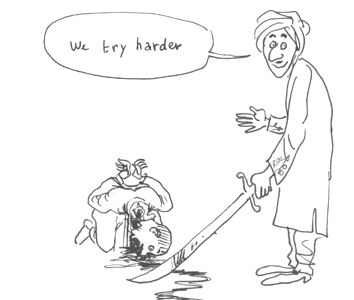
The living conditions of the Saudi people, or of the modern slaves working for "native Saudis" in a country where the Sharia now regulates social life, mattered little to the oil-consuming states, which could also be exporters of various goods, including arms. How could the French have amused themselves by talking about the condition of the Saudi woman at a time when the important thing was to secure the order of 350 Leclerc tanks? (an order indispensable to finance the development of our own defense means, we were told). A few days ago, television presented a report made in a port located in the Strait of Hormuz. In this region, the high revenues from oil had allowed an important development of port facilities, capable of receiving large-tonnage cargo ships. At the end of the chain, these products were then loaded onto countless wooden dhow boats, typical of the region, once sailed with sails, now equipped with strong diesel engines, capable of dispersing all these goods into ports where cargo ships would be unable to enter due to excessive draft. Beyond the docks, sparkling buildings but, in the holds of these dhows, "immigrant workers", "brothers of race" from neighboring regions, without any rights, without any social coverage, loading and unloading the dhows for the equivalent of five francs a day. Men who, after a hard day's work, had to walk five kilometers to reach slums where they had to crowd fifteen or twenty in simple courtyards covered with tarps, rented at exorbitant prices. The bus: too expensive. And how to "send money back to the country"? The managers of this import-export, on the other hand, drive in limousines, have gold Rolex watches, linen djellabahs. Indeed, the JR Ewing and the Ben Laden are very similar. In terms of exploitation and cynicism, neither has anything to teach the other. The television currently focuses on the political aspects in Afghanistan, while the radios remind us of the economic undercurrents of this whole affair: the immense hydrocarbon wealth located in Central Asia, in Turkmenistan or elsewhere, whether gas or oil. It seems to us that, more than the so-called "political" outcome, the "surface decisions", the choice of the route for the transportation of these riches, will be decisive for the future of a large part of the planet. If the southern route is maintained (through Afghanistan), then the Pakistan, a large proportion of the world's hydrocarbon production will pass, if not under the control of Muslim countries, at least through their territories. Now, the experience has cruelly shown that the choice of the most "stable" regime is not necessarily the best. The northern route would imply closer cooperation between the West and its former enemy, Russia, and as an indirect consequence, help in the development of the former giant, fallen to the ground, even if only through the royalties received. Again, the fact of having prioritized the economic collapse of the "reds", if this strategy proved effective, has led to a terrible backlash. North or South, heads or tails? What about secret agreements that the Americans might have made with the Pakistanis, in exchange for the free overflight of their territory? I heard on November 15 that OPEC had once again tried to raise the price of crude oil by reducing its production: a classic oil production blackmail, with an impact on Western economies. But, if I heard correctly, it was ... Russia that had foiled this maneuver by increasing its own exports. More than ever, the economy is a powerful weapon. Now that Bin Laden and the Mullah Omar are hiding, the management of the oil taps remains a means of action but (consequences of agreements between Bush and Putin?) "the West" reacts. Beyond that, can we continue to practice laissez-faire in terms of global energy resources? When the Central Asian republics demanded their independence, the Russians, after having mainly drawn their oil resources for decades, said: "Very well, but now we leave you, do it yourself". Then, old installations rusted. Arrived the "carpet-baggers" of all nationalities, eager to become the "new rich" of these countries floating on black gold reserves, but now unable to exploit and transport them themselves. Next to these new nabobs, people wander in a country in full decomposition or refugees from neighboring countries at war, trying to survive, where luxury stores are next to vermin. It is all the anarchic development, in regions with wealth, that is being called into question. The UN and the World Bank should expand their powers and, in certain regions of the globe, replace this wild liberalism, too dangerous because by definition irresponsible.
November 15, 2001
We learned that Mullah Omar had "ordered the withdrawal of his troops from the city of Kandahar. The Westerners, especially the French, are all relieved that the Americans have fought the war for them and there are no more voices protesting against the bombings of Afghan cities. Reports made in Kabul showed astonishing things. The Americans have clearly carried out strikes on targets located in the middle of the city, using bombs dropped from fighter bombers or, which would need to be verified, from B-52s flying at 9,000 meters altitude. In any case, the precision of these strikes, almost to the meter, implies guidance of the bomb during its descent phase. The bombardier has on board a vision (monochrome, night) of the target site. During night operations, these images are obtained by electronic amplification of the light coming from the ground, when there is no cloud cover. Using a joystick, the bombardier then indicates to the bomb the selected target, which can be a warehouse, a tank repair park or a simple villa. This site, "illuminated" with invisible light, then attracts the guided bomb towards it. This bombing system has allowed the Americans to precisely bomb Taliban convoys. No more need to move at night under the cover of darkness.
The press has decided to opt for the accident theory in the case of the Airbus that just crashed in New York, in the Queens district, causing 260 new deaths. They mention the "turbulence" created by a plane that would have taken off two and a half minutes earlier. As a former aeronautical engineer (I graduated from Supaéro), I personally remain quite skeptical about this explanation. This vortex phenomenon created by large commercial airplanes is well known for decades. A 747 is indeed capable of leaving a strong residual turbulence after its takeoff or passage nearby. Therefore, airlines have decided that flights cannot follow each other within less than two minutes. Thus, the American Airlines Airbus had taken off two and a half minutes after the previous plane. These turbulence would then have had enough time to subside and disappear, at least lose enough strength not to damage an aircraft as claimed. Moreover, the tearing off of the vertical tail seems unlikely. Indeed, a commercial airplane that would lose its vertical tail would become quite unstable. The engines are attached to the wings in "sling" pods, which do not support much lateral sliding. A zigzag, "crab-like" movement could cause their detachment. But there are still many coincidences:
-
An accident presented as extremely rare (in fact, without known precedent), which causes the immediate crash of the aircraft, without any possibility of lateral maneuver.
-
Happening in such a way that the aircraft crashes into New York (...).
-
Not long after the capture of Kabul.
If it had been an act of terrorism, it would be a serious matter, because the only person who could have committed it would have to belong to the aircraft's maintenance team. When these aircraft are checked, these teams have access to many structural elements of the aircraft through inspection hatches. Among these structural elements: the attachments of the vertical tail and the engines. The person performing these checks is then perfectly able to fix bombs the size of a fist on these attachments, triggerable by radio from the ground (or activated by a "suicide passenger" on board the aircraft). The case then becomes unstoppable. If this line of investigation were confirmed, no one would dare to board an airplane anymore. It is already extremely difficult to control 100% all access points on board. Luggage is only inspected statistically. The fact of refusing to board a bag without the passenger who accompanies it is no longer a security criterion, since that person, having become a suicide terrorist, is ready to die in the plane where he boards. But controlling the maintenance services of all the airplanes in the world would be an impossible task. Maintenance companies could have been infiltrated by dormant commandos for years. As for the orders to carry out the act, they can, as we have seen, be given through messages hidden in the Internet network. Such commandos could therefore be activated remotely without any order transmission being intercepted. These commandos, completely autonomous, could also act on their own initiative.
No one, to my knowledge, had imagined a technique for dispersing biological weapons by mail. The theory of an attack carried out by a member of an infiltrated American maintenance team was becoming clearer, and the Americans would lose all confidence in the airlines and even the foresight of their government. It would be a total economic catastrophe. The drop in airplane seat bookings would no longer fall by 75% but practically to zero.
It is possible that the Americans reacted by favoring the accident theory to avoid complete panic. It is also possible that the press, if they had received messages claiming the attack, observed a complete blackout. But these are just hypotheses. On the contrary, the idea that an aircraft belonging to an American airline, taking off from Kennedy Airport, was the victim of a "rare and unprecedented accident," causing it to crash into New York, seems very strange.
A final remark: since September 11, the American mindset has irreversibly changed. They have always been champions of systematic forgetting. I had the demonstration of this during a visit to the country a few years after the end of the war in Vietnam. It seemed as if the war had never existed. It is recalled that the former soldiers, bitter, were sometimes treated as troublemakers in their own hometown and preferred to live in seclusion. America does not like "losers," the defeated, even when it is about their own children. American strategy has always been "turn the page and look to the future" or: "the show must go on." But this is different. No matter what measures are taken, the tranquility of the Americans on their own territory is over. It is impossible to forget an event that could happen at any time, in a totally unpredictable way.
November 21, 2001. The situation remains unclear. The anthrax alerts seem to have slowed down, although this absolutely does not mean that the bioterrorism threat has disappeared. It remains at an ... immeasurable distance. Kabul has "fallen," which means that the Taliban have simply fled to hide in the surrounding mountains. The disparate troops of the Northern Alliance are trying to clear the regions where the Taliban have taken refuge, but when they do not have strong air support, they sometimes retreat in disorder. Thus, we find ourselves in a complex situation. On the one hand, it would be extremely dangerous for the Americans to take charge of all the ground operations, and on the other hand, without American air support, the soldiers of the Northern Alliance would not have been able to carry out these "lightning advances." The Westerners are discovering the flexibility of the famous "Jihad." As much as Pakistanis and Arabs are ready to follow "the path of Allah" (this is the name of Jihad in the Koran), as much as, as one of them admitted in front of the cameras, when subjected to intense aerial bombardment, things no longer seem so obvious from a purely theological point of view. The time is for "political solutions." While barbers in Kabul are shaving the beards imposed by the Taliban and people are coming out of the basements with televisions and cassette players, armed groups belonging to one or the other of the two camps are seizing the vehicles of the "humanitarians" by simply tearing off their license plates. The price of oil is falling. Normal, with the 75% drop in kerosene consumption. OPEC tried to raise the price of crude oil by reducing its production, perhaps to create some disorder in Western economies. But it is the Russians who would have immediately compensated for this drop in production. Indeed, these September 11 attacks have changed many things, upset many alliances. A historical catastrophe in the etymological sense of the term (from kata: "next to" and strophedein: "to plow").
From September 20 to December 11, 2001: 3024 consultations. New consultations:
Back to the "Geopolitics" section Continue with "Geopolitics on a daily basis".