Definition of styles
The statements of George Friedman
October 2016
George Friedman is not a newcomer to the American political landscape. Just check his Wikipedia page. Seventy-seven years old, of Hungarian origin, parents who fled the communist regime. He teaches "political science" at the university level, but especially in the form of ongoing seminars in the state and private sectors, as a "consultant". He is also the founder of a company Stratfor, devoted to "intelligence". Stratfor for "Strategic Forecasting". Meaning: Strategic Forecasting. So it's a kind of strategy advisor. Me, this is the first time I've heard of him, but it's obvious that it's not the first time he's making such statements. Simply, today we are fed with videos, and there are volunteers who make subtitles. Thank you to them.
When I first heard about the activities of this company Stratfor, which acts as a secret advisor, the image of a clandestine CIA immediately came to mind. But I quickly realized that others had long since applied this label to this company, founded 20 years ago.
Here is a video where George Friedman speaks in a Chicago club. You will notice that he squints when he speaks, as if providing enlightening explanations, which amuse this modern Machiavel.
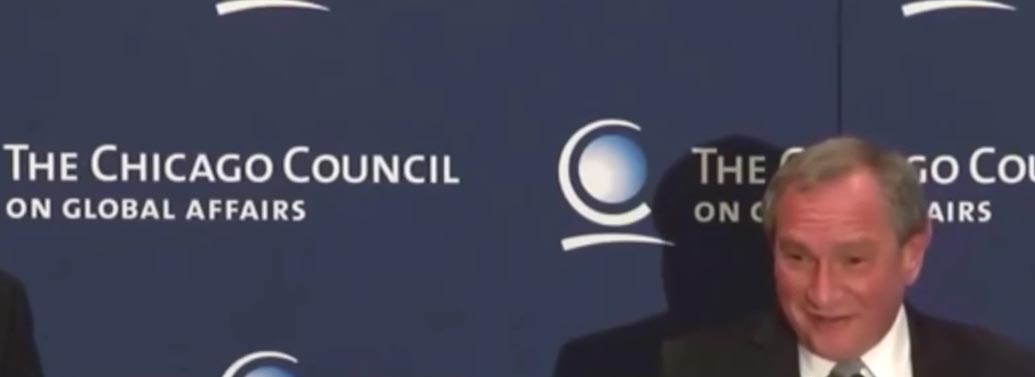
2016: George Friedman at the Chicago Council on Global Affairs
****The video
I try to summarize his thoughts. Peace is for the United States. The rest of the world, including Europe, must resign itself to experiencing a state of periodic war and social unrest. For Friedman, Europe is a non-existent entity, politically speaking. The USA have relations with countries, like Romania, France. But "Europe doesn't exist". It is an entity that has no personality and no autonomy.
A person in the audience then asks Friedman about the danger that Islamic extremism could represent for the United States. He replies that this does not represent a threat for the United States at the moment and immediately re-focuses his speech on his main interest, on the subject of his presentation, namely the relations between the different countries of Europe and Russia.
One cannot say that Friedman's statement is new. But it is expressed here in its crudest form. One could qualify it as nationalist, in the sense that there is:
-
The United States
-
The rest of the world
That's it. So his concern is the interests of the United States, exclusively, excluding the interests of all other countries, without exception. And by United States, understand the interest of the financial powers in this country. He openly presents his country as pursuing an imperialist policy. But he notes that the United States do not have the means to militarily control the rest of the planet. He cites, for example, the number of occupation troops in Iraq, after the invasion of the country. 130,000 G.I. in a country with 25 million people. And he adds that this proportion is very much lower than the ratio between the number of police officers present in New York and the population of the city.
So the only solution is to support the different parties in place by encouraging them to fight each other, to keep them in a state of weakness. This is the strategy of chaos, by Naomi Klein. It then becomes clearer why the USA did not seek, after the collapse of Iraq, to promote the establishment of a national unity government, mixing Shiites and Sunnis. In Saddam Hussein's Iraq, the Sunnis, a minority (20% of the population), had oppressed the Shiites, who were the majority. After the fall of Iraq, a Shiite president was put in place, who in turn oppressed the Sunnis, whose military leaders joined "DAESH". A foolishness? An error? Not at all if one considers that this policy is part of the strategy of inciting internal conflicts around the world.
What Friedman explains is that this is the policy of the United States, everywhere in the world. And he recalls that it was the policy of Reagan, or of the United States at the time of Reagan, where the conflict was incited between Iraq (Sunni) and Iran (Shiite). He adds that the USA provided arms to both belligerents (France, by the way, did the same). And he adds, "It's not very moral, it's morally indefensible, but we must agree that it worked very well." And he shows his satisfaction by squinting.
Thus, situations like those of Libya and Syria become suddenly clearer, if one integrates the American Machiavellianism. Friedman adds: "The USA control all the oceans of the world." And he adds, "we intervene with the peoples, but they cannot attack us." What does he mean by "we intervene". He later clarifies that these interventions take place completely without the approval of the UN. One can put anything under this label of intervention, justified by the "duty of intervention".
Regarding Ukraine, one must immediately refer to the maps he shows, without which the situation is not understandable. What about European countries? England has long been committed to American foreign policy. It is an island, which would be hard to consider as part of the European continent. France is a small country, currently in a steep decline, after the years of Hollande. No, the country that causes problems for the Americans is Germany, which, he says, "is unable to make a decision".
Indeed, Germany is subject to the attraction of Russia, with its energy resources, its gas, its minerals. On the other hand, Germany has capital, high technology. It needs an export market for its manufactured products. So all the efforts of the United States focus on the creation of a "sanitary cordon" to cut Germany off from Russia and here is the map he shows:
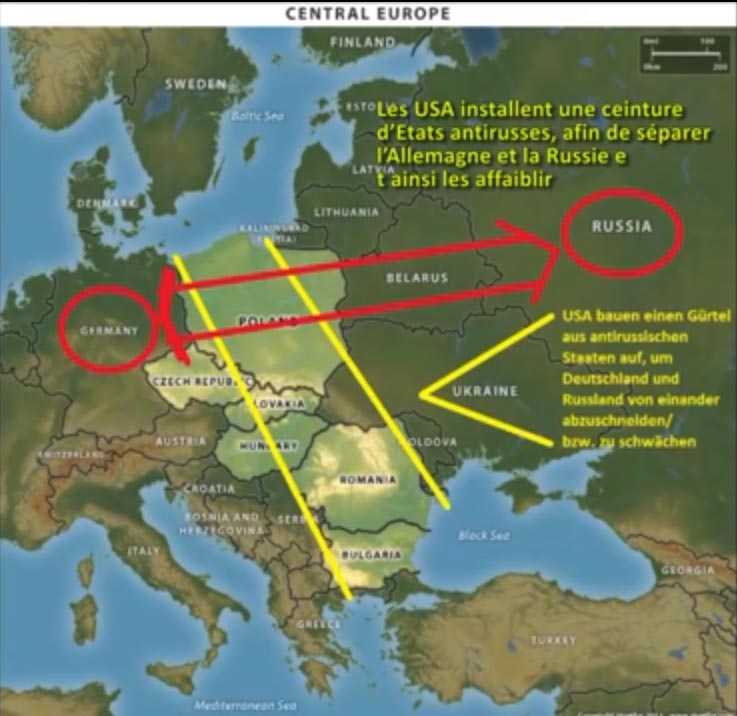
The "sanitary cordon" to isolate Russia from Germany
Among these countries, all those that belong to the former Soviet Union: Poland, Czech Republic, Slovenia, Hungary, Romania, Bulgaria. One can add Turkey, a NATO member. Below are the countries linked to NATO:
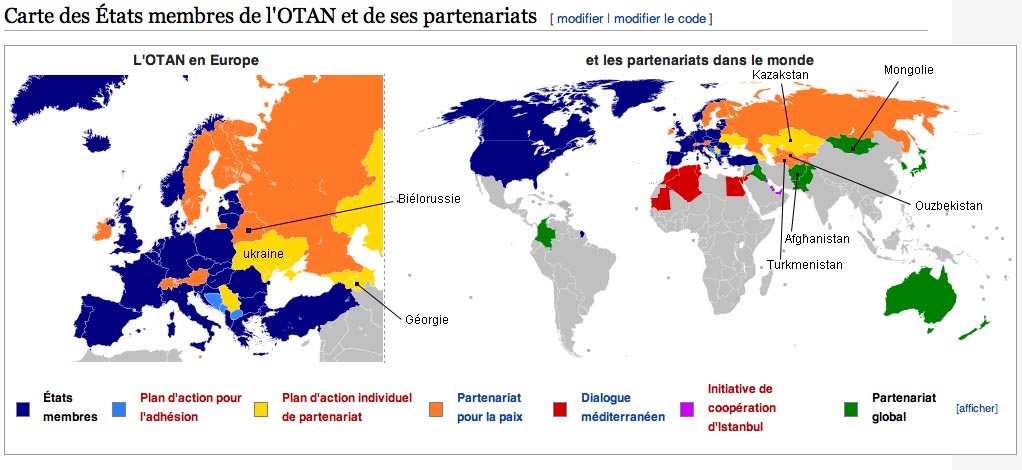
You can see that it's a lot of countries, especially since the first act of Sarkozy was to bring France back into this Atlanticist fold. George Fridman mentions the case of Ukraine where the USA pushes its pawns. Not in Belarus, which remained close to Russia despite the collapse of the USSR in 1991. Everywhere, the United States incite "color revolutions" and "spring-something", "spring-something else". We have seen how all that turned out. In Ukraine, America sends weapons, and "advisors". Friedman adds that an American general on a visit even went as far as awarding American medals to anti-Russian fighters.
This strategy of chaos is found everywhere.
Friedman is completely indifferent to what is happening in the rest of the world. Listen to him. Only American imperialism counts.
Detailing his map, Friedman mentions a "sanitary cordon" intended to cut Germany off from any communication with the Russians, and i...