The Brain-Washing Machine
May 17, 2002 – Learning about Violence
Completed June 7, 2002
This brief passage serves as a complement to the previous document I wrote in January. Violence is currently “in fashion.” The media increasingly reports on serial murders committed by young people. In various countries, some guys “lose their minds,” enter a place and shoot down countless people, like they’re at a shooting range. Eventually, they kill themselves too. And everyone is astonished. Why such acts? Quickly, psychologists and psychoanalysts appear to explain it all. There must be some reason.
The explanation—but you’ve seen it right before your eyes, day after day—yet no one ever thinks of it. Not a single journalist, psychologist, politician, or intellectual ever comes up with this idea. We’ve embedded violence into our primary medium—television—and into our movies. Do you remember those old black-and-white crime films from the 1950s starring Eddie Constantine, or the Western movies featuring Tom Mix? Back then, death was quite decorous. Poum! No blood at all. Cowboys, villains, and Indians all rolled around in the dust. When someone died on a battlefield, it was very “clean.” They’d sit comfortably, deliver their little speech, then suddenly their head would fall back.
I distinctly recall the first movie where “explosive vests” were used. It was a Western starring William Holden. At the end, a group of cowboys engaged in a desperate fight. Until then, we never saw bullet impacts. But someone invented a special vest with tiny explosives scattered all over it, plus some tomato concentrate. Thus bullets now produced spectacular effects. We saw chests being torn open, shirts exploding. Meanwhile, victims flew through the air, tossed about like rag dolls. Let me clarify: a bullet doesn’t actually make anyone fly. Take a 9mm bullet—a decent caliber. Fire it. What happens? You simply fall backward onto your butt. No more than if you fired an 11.43 bullet. I know weapons; I served as a marksmanship officer in the army in Bordeaux. So how can a single bullet, per Newton’s third law, send the person it hits crashing against a wall like a violent blow? Imagine a ten-kilogram log; fill it with lead. It won’t budge an inch.
Once, after a rather serious accident, I ended up in a hospital. I’d been bitten by a cat, and almost lost my right index finger due to “pasteurellosis” (a bacterium resistant to antibiotics). My roommate was a thirty-year-old journalist, a war correspondent. He’d been shot in Africa, in the arm. He was photographing a truck full of soldiers, yet didn’t even notice that one of them was shooting at him. At the time, he felt nothing; he only noticed that one arm hung uselessly, his humerus shattered. Often, when people are hit, they don’t even realize it. For blood to flow profusely, an artery must be severed; otherwise it remains quite subtle. A bullet hole is just a tiny puncture. Thus, we’ve invented an entirely fictional image of combat, far removed from reality. I’m talking about bullet impacts. Of course, artillery shells are completely different. But then they become impossible to depict. Every era has its own “codified horrors.” Those who’ve actually fought wars know that what we see on screen is far less horrific than reality.
Now let’s look at hand-to-hand combat. Movies involving martial arts have popularized this violent imagery. I think back to the fights of the 1950s. Remember Humphrey Bogart knocking out a tough guy? One quick hook, and the guy collapsed like a sack of potatoes. Note that this isn’t false; a good boxer can knock down a giant strongman with a single chin-jab. Let me explain: such a punch induces rapid head rotation and initial cranial trauma. The brain’s reaction results in loss of consciousness—similar to pilots experiencing “blackouts.” The brain isn’t something you can mess with so easily. Incidentally, I’m the only person I know who managed to knock himself out using his own fist. That happened in the 1960s. Back then, parachute handles were fixed to the left shoulder strap, above the ventral panel (today, emergency parachutes are stored inside backpacks):
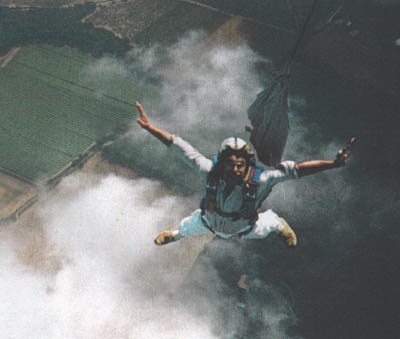
That’s me, a year or two ago, using a modern parachute where you pull a kind of reel located on the thigh. In our old 1960s parachutes, the handle was on the left strap. At the end of freefall, after twenty or thirty seconds, we’d symmetrically cross our arms over our chest. Then the left hand grabbed the handle. One day, though, I pulled it but nothing happened. Some small stone had lodged in the sheath. This occurred on Montfavet field near Avignon. In such cases, we develop incredible strength—enough to rip a door handle off. I pulled hard, and my motion caused the handle to strike my chin. Instant knockout. I didn’t let go of that damned handle. I came to under the slaps of my friends, who rushed over upon seeing me unable to get up and regain contact with the ground.
Thus it’s absolutely true that a 60-kilogram Humphrey Bogart could knock out a massive brute with a swift motion, grabbing his chin and spinning his head. That’s how Eddie Constantine sent big tough guys sprawling in my childhood movies. Afterwards, he’d straighten his tie or rub his hand. Nowadays, it takes much more. These blows make plenty of noise; their violence defies imagination and thus embeds itself in viewers’ minds. In reality, if these blows were truly delivered, most would kill or severely injure their targets. Today, in crime films, when a hero gets beaten up, he falls to the ground. Villains then kick him in the stomach. Yet a kick can rupture a liver, causing severe internal bleeding. A few years ago, a dispute broke out among youths in Aix-en-Provence, right on Mirabeau Street. It involved parking spaces. Two boys fought; one fell to the ground. The other did exactly what he’d seen in movies: he kicked him, killing him instantly.
In fights, we also see people wielding blunt objects. They smash balsa wood beams over heads. Later, sound effects are added. People watch these scenes and absorb them. A hero taking a beating can endure three broken chairs hitting his head, tumbling down stairs, getting struck by iron bars—all while surrounded by special effects making him seem to fly apart. Learn this: a bullet impact doesn’t move anyone. Try a 9mm bullet. It’s a decent caliber. Fire it. What happens? You fall backward onto your rear. No more than with an 11.43 bullet. I know weapons; I was a marksmanship officer in the army in Bordeaux. So how can a single bullet, per Newton’s third law, send the person it hits crashing against a wall like a violent blow? Imagine a ten-kilogram log filled with lead. It won’t budge an inch.
Once, after a rather serious accident, I ended up in a hospital. I’d been bitten by a cat, and almost lost my right index finger due to “pasteurellosis” (a bacterium resistant to antibiotics). My roommate was a thirty-year-old journalist, a war correspondent. He’d been shot in Africa, in the arm. He was photographing a truck full of soldiers, yet didn’t even notice that one of them was shooting at him. At the time, he felt nothing; he only noticed that one arm hung uselessly, his humerus shattered. Often, when people are hit, they don’t even realize it. For blood to flow profusely, an artery must be severed; otherwise it remains quite subtle. A bullet hole is just a tiny puncture. Thus, we’ve invented an entirely fictional image of combat, far removed from reality. I’m talking about bullet impacts. Of course, artillery shells are completely different. But then they become impossible to depict. Every era has its own “codified horrors.” Those who’ve actually fought wars know that what we see on screen is far less horrific than reality.
Now let’s look at hand-to-hand combat. Movies involving martial arts have popularized this violent imagery. I think back to the fights of the 1950s. Remember Humphrey Bogart knocking out a tough guy? One quick hook, and the guy collapsed like a sack of potatoes. Note that this isn’t false; a good boxer can knock down a giant strongman with a single chin-jab. Let me explain: such a punch induces rapid head rotation and initial cranial trauma. The brain’s reaction results in loss of consciousness—similar to pilots experiencing “blackouts.” The brain isn’t something you can mess with so easily. Incidentally, I’m the only person I know who managed to knock himself out using his own fist. That happened in the 1960s. Back then, parachute handles were fixed to the left shoulder strap, above the ventral panel (today, emergency parachutes are stored inside backpacks):
That’s me, a year or two ago, using a modern parachute where you pull a kind of reel located on the thigh. In our old 1960s parachutes, the handle was on the left strap. At the end of freefall, after twenty or thirty seconds, we’d symmetrically cross our arms over our chest. Then the left hand grabbed the handle. One day, though, I pulled it but nothing happened. Some small stone had lodged in the sheath. This occurred on Montfavet field near Avignon. In such cases, we develop incredible strength—enough to rip a door handle off. I pulled hard, and my motion caused the handle to strike my chin. Instant knockout. I didn’