History of Modern Palestine
August 2005
Page 2
I am now on page 2 of this story. After various attempts, I can only come to the conclusion: I lack data, knowledge. I don't know this second part of the story and I feel useless. I'm afraid of writing nonsense. Readers have sent me many maps, which I reproduce, randomly. But I need help to continue, with texts, historical data, not hysterical ones. We are here to try to understand, not to condemn. Amid all this, we imagine countless protagonists. The Jew, squeezed in "Exodus," arriving in this last chance land, with a number tattooed on his arm, having barely escaped a death camp, having lost all his family members. Not far away, the Palestinian resident, who doesn't know what is coming at him and into what horror he will end up, half a century later. Next to him, Arab nations with their Mullahs, their Imams, their obsessive beliefs of another age. Among the Jews, other Mullahs, other Imams, arriving with similar beliefs, just as rigid and unrealistic: "Greater Israel," "rebuilding the temple," etc...
The warlike revenge of a people who had bowed their heads for centuries (remember Moshe Dayan, the one-eyed, the winner of the Six-Day War). A herd pulled out of its ghettos, often passively led to the ovens, except for desperate uprisings like that of Treblinka camp and the Warsaw Ghetto revolt.
These Jews are fleeing, but how can we understand them. A million Russian Jews would have arrived in Israel, I believe, since the fall of the wall. But look at the rise of Nazi parties in ... Russia, even. Yes, there are skinheads even in the former USSR. They massacre the "bougnoule," the "youpin," in the streets of Moscow. Look at Stalin letting the Polish Jews be massacred in Warsaw, without doing anything.
Look at the UN, "this thing!" said de Gaulle, creating the problem, then leaving the protagonists to sort it out. Because there it is, the problem. The world created, after the war, a dilemma as big as a mountain, in a tiny territory, and "the world" does not want to take responsibility. "The world" watches all this on TV, eating fries and popcorn.
- Why can't they agree? They are almost of the same blood. In a street, you would confuse them...
We are all responsible for these killings, for all the killings, for all this despair, because we don't think, we don't move. But turning on the television, listening to politicians, is that called thinking? I admit I haven't found my account in it, and you?
Help me:

These maps need to be commented on, made to speak. I produce them, randomly, in disorder, as they have arrived to me.
First, here are maps extracted from a file published by the newspaper Le Point:

1947
UN Partition Plan.
In green, the Jewish state
In brown, the Arab state
After the horror of the Holocaust, the United Nations voted to divide Palestine between a Jewish State and an Arab State. Jerusalem became an international zone. This plan was rejected by the Arab states.
1949
War 1948-1949
In green, Israel
In brown: Arab territories
The Arab countries attacked Israel in 1948, just after its declaration of independence. Israel won the war and expelled 800,000 Palestinians.
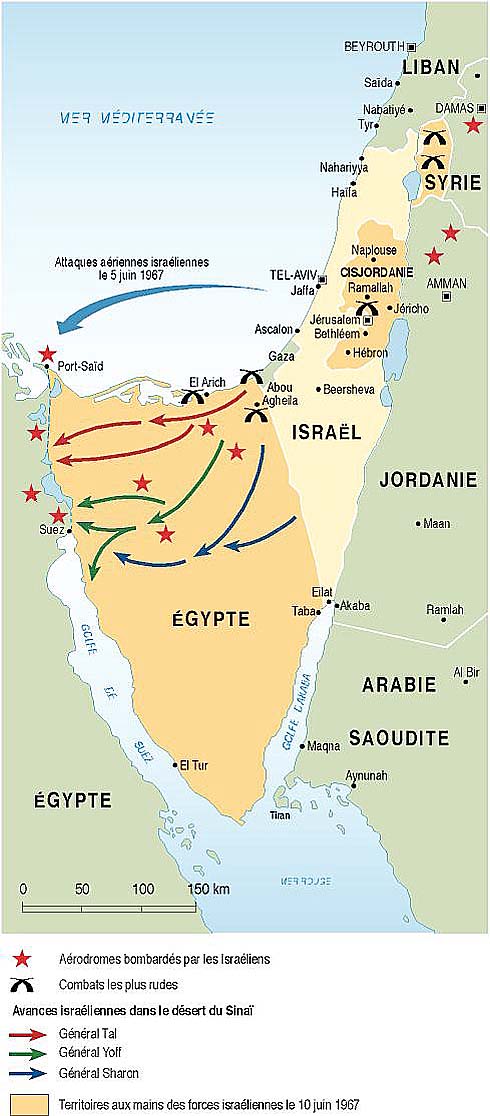
1967
Six-Day War
In green, Israel
Brown-green stripes: occupied territories.
2000
Camp David
(July 2000) then
Taba
(January 2001).
Israel considers returning most of the West Bank to the Palestinians. The agreements fail on East Jerusalem and the return of refugees.
In March, Prince Saudien Abdullah proposed the recognition of the State of Israel by Arab countries in exchange for a withdrawal from the territories occupied in 1967 (Six-Day War).
1 - Camp David
2 - Modern West Bank
3 - Jewish settlements in the West Bank
4 - The Ottoman Empire in 1914
5 - The Golan Heights
6 - The 1948 War
7 - The 1967 War
7 - East Jerusalem
8 - Water
9 - Oslo Accords
10 - The Arab World in 1939
11 - The Partition of Palestine in 49
12 - The Charm el Cheik Accords, 1999

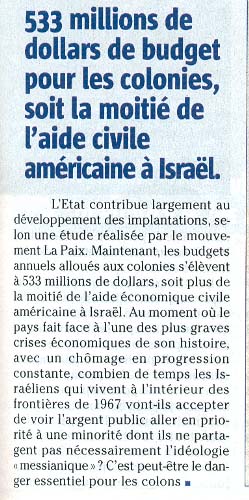
**Article in Le Point of June 20, 2003: The powder keg and the settlements: **
Counter initialized on August 19, 2005. Number of views since that day :