Flouzeland
Two weeks in Flouzeland
August 9, 2005
 **** ****
http://www.lefigaro.fr/reportage/20060315.FIG000000014_sous_marins_de_poche_pour_cheikhs_riches.html
**
Hervé JaubertRussian Ekranoplanes
****http://www.loriental.info/economie/649-dubai-world-traque-les-fraudes.html
**
http://www.20minutes.fr/planete/1119949-20130317-emirats-entrent-plain-pied-solaire
I had reacted immediately upon reading Malcolm's paper in Physical Review, in 2006
**
March 20, 2013. Eight years have passed.
It is true that I will not renounce anything I wrote on this page in 2005. We had been invited, my friend Christophe Tardy and I, to Dubai, by some kind of con man, who claimed to have been from the DGSE and had convinced one of the members of the ruling family (Cheikh Ahmed Bin Sulayem) to finance a company, "EXOMOS", whose goal was to develop and manufacture ... mini submarines, to transport and amuse the emirs.
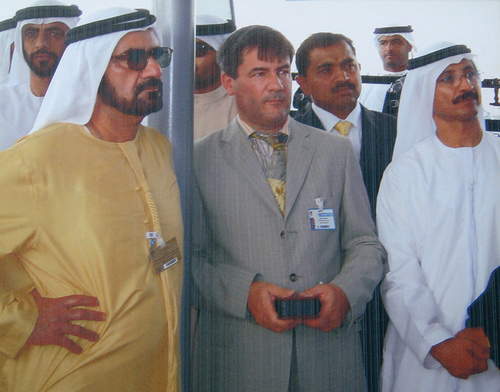
Hervé Jaubert with, to his right, Cheikh Mohammed. For example:
He was, in principle, from the naval school. But I imagine he had skipped the hydrodynamics classes. As Christophe said, looking at his submarines: "I don't see anything less hydrodynamic than a grand piano."
We swam in absurdity for two weeks. What had been our motivation for coming there? The submarines? Not really. But the emirs had a lot of money, and if we had been able to meet one of them, it would have been to say "Would you like to be the first country in the world to function entirely on solar energy?" Unfortunately, we were not given the opportunity, and we had nothing left to do but kill time, waiting for our return flight, two weeks later.
It was eight years ago.
The Emirate, working with the French company Total, has put into service the most powerful "solar thermal" power plant in the world: 100 MW. We will talk about it later.
When we arrived in Dubai in 2005, our "entrepreneur", to avoid naming him, had brought in a ground effect vehicle from an Eastern country, equivalent on a small scale to the . The video showed that if the device, a tandem two-seater, was piloted only by one person of moderate weight, the device could rise several meters above the ground, moving at a good speed. And with these short wings, the handling of such a device, moving at nearly 100 km/h, must not have been easy and apparently extremely dangerous. My reaction as an ex-Supaéro student and ULM pilot was to tell him immediately:
- If you want to kill an emir, or a son of an emir, once a week, success is guaranteed!
He put away this project of mini Ekranoplanes for emirs.
Jaubert had obviously been impressed by the sequence where James Bond, in the movie "Thunderball", was moving at high speed among the "bad guys" ( "bad guys" ) with a diving tank on his back, topped with a propeller with a square rudder driven by an electric motor. What needs to be specified is that Sean Connery (or his double) was actually discreetly pulled by a cable, at a moderate speed, the whole thing being accelerated at projection.
Inspired by this sequence, Jaubert had a dorsal equipment made, very effective, integrating a diving tank, plus a propulsion system. Unfortunately, the force applied was misaligned by more than 10 cm from the "drag center" of the diver, in other words, from the axis of his body. During the tests, due to this uncontrollable torque, his test diver immediately ended up with his nose planted in the mud. I suggested to Jaubert to modify the geometry of this equipment. Unfortunately, seventy copies had already come out of a mold. Again, on the engineering level, it was irreparable.
In the entrance hall were two models of a "submersible yacht". The first was a civilian version. Imagine a large yacht, twenty-five meters long, with a bulwark, cabin, bunks, WC, stern deck, and a piloting station. His emir having asked for "a yacht capable of diving", Jaubert immediately designed this surrealistic thing. Next to it, in this entrance hall, was "the military version" of the device, in khaki.
Christophe and I got to work, trying to reduce a bit the "Cx", the drag of such a monstrosity. I had imagined, for example, that the front bulwark could be folded forward, to no longer hinder the liquid flow. But Jaubert stopped us immediately. The boat was ... almost finished. Indeed, a few meters from the office where we had set up, in a large adjacent hall, workers were busy finishing the sanding of its hull. Nothing could be touched anymore.
A couple of years later, a man who had worked in the underwater industry called me on the phone. Jaubert wanted to secure his services. I advised him strongly to have on his contract that his travel, accommodation and car rental expenses would not be deductible from the envelope corresponding to his contract. And it was good that he took this precaution.
He spent a few months in Dubai. When he arrived, the submersible yacht, finished, had been put into the water. But as no one had done any calculation on the weight of the batteries, it tilted, like the Pitalug so dear to Marcel Pagnol. Jaubert removed some of them, until the proud ship regained a minimum of horizontal.
The submersion tests proved disappointing. With such a monstrous drag and an electric propulsion with sewing machine motors, the monster did not move at all. It was then that Jaubert, an endless chatterbox, said to his emir, a bit disappointed:
- In fact, I hadn't told you everything: it's a military project. The boat sails. And if there is some threat, it dives and waits, hidden on the bottom.
Thereupon, the emir's brothers got involved and became very angry upon seeing all the money that had been spent on this Exomos company, which had 140 employees, mainly Indians (the articles talk about a misappropriation of three and a half million dollars). They demanded that Jaubert repay them and confiscated his passport. Jaubert, who had contacted me asking if he could use the drawings I had made there for a book he was writing (which I refused), said to me, "I have regained my secret agent reflexes. I first sent my wife and son to the USA. Then I had some friends of mine buy a yacht, which I joined one night with a Zodiac. And it was with this yacht that I could reach the US coast."
It was in 2009. See, for the rest, .
Reality, bluff, publicity. I don't know. Another echo, dating from that day, Wednesday, March 30, 2013:
where the sentence is noted:
"Jaubert, this Frenchman, it is difficult to know whether it is a French James Bond, a swindler, or a fantasist."
Perhaps a mix of the three (which sometimes is the case within this DGSE). But, regarding Hervé Jaubert, whatever angle you approach the character from, one qualification seems to fit this specialist of swimming between two waters. He is above all Totally unsinkable. What is interesting today, is not the recall of this so sensational and lamentable story, nor that of the undeniable waste that the emirate has made a specialty of. The news of the day is the commissioning of the most powerful solar thermal power plant in the world: 100 MW.
This figure of 100 megawatts is important. It shows that solar energy can, not only contribute to domestic needs, but also reach an industrial scale. It is one or two orders of magnitude above photovoltaic solar installations, with limited efficiency, and one order of magnitude below powerful nuclear power plants. Solar thermal or photovoltaic is simply a question of investment. This installation represents 7% of the electricity needs of the United Arab Emirates.
However, upon checking, this power plant does not operate 100% on solar energy. It is a mix of solar power plant and thermal power plant. The tall towers, visible in the photo, are heat exchangers, associated with gas burners. The Emirates are rich in oil, but also in gas. This ensures here the production of electricity at night and regulates the level of production. It would have been good if the press agency's announcement had mentioned it. The word "concentration" evoked the concentration of this energy in a storage system, in large salt tanks (sodium and potassium nitrates), and I was taken in. In fact, reports indicate only that a better concentration is obtained by using parabolic mirrors and not cylindrical ones, which remains trivial. The oil circulates in the furnace at 400 degrees.
The Emirates are also working on another futuristic project, the construction of which should be completed in 2020, where the goal is to be able to do without oil, functioning entirely on solar energy. The problem is then the inverse of that of the northern regions. The buildings of Masdar must succeed in fighting the heat, the temperature being able to exceed 50 degrees in this desert. In the Emirates, energy is spent, not to heat, but to cool the buildings and all kinds of premises.
A small part of Masdar has been realized, coupled with a photovoltaic solar power production unit of 10 MW. The housing units consume only 60% of this electricity, the rest being redirected to Abu Dhabi, nearby, via the network. The report indicates that the panels must be cleaned of dust every two weeks, to avoid losing efficiency.
Masdar has a personal transport system with electric cars, without a driver, guided by an installation located underground (magnets) and return, after completing their task, to automatically recharge on charging stations powered by photovoltaic sensors.
It is a pity that the Sham 1 project did not aim from the start at a 100% solar power plant, with a storage system in salts, as has been done in Spain.
The extension of such projects is only a question of investment. Yes, doing without oil. Getting rid of the deadly danger of nuclear power would cost money, with an investment volume approaching the expenses made during a war.
But our survival is at this price.
In the reports, comparisons based on the cost per kilowatt hour are constantly brandished. But the health cost is forgotten. By choosing nuclear energy, and focusing on this cost, we overlook the fact:
We do not know how to manage, contrary to what Paul Henri Rebut thinks ("waste can be managed"), the radioactive waste produced by the power plants.
We do not know how to dismantle them - The pressure vessels and various installations subjected to neutron bombardment have limited lifetimes, due to the fact that this weakens them by transmuting atoms into helium (which amounts to creating cracks in the crystal lattice, as helium cannot bond with any other atom). When these pressure vessels (pressurized) have reached their lifetime, we do not know ... what to do with them.
Finally, the risk of a major accident is inevitable, inescapable, and what would emerge from an accident of a fast breeder reactor operating on plutonium would be much more damaging than those from generators operating on uranium, or on MOX.
Add that the "thorium branch" is another nonsense. Only the research for an aneutronic fusion Bore Hydrogen would make nuclear power a future, clean, inexhaustible and safe branch. But for that, it would be necessary ... to have imagination. When we are led by fools, we should not expect anything but nonsense.
Returning to Sham 1, we would like details, it's the efficiency of the mirror cleaning system. This is the essential problem that hinders the deployment of solar thermal in desert regions, where water is rare, too precious to be consumed for cleaning tasks. We see on the following photo the installation in batteries of the reflective mirrors, focusing the solar energy on their tube-focal:
.
A battery of mirrors from the Sham 1 installation, in Abu Dhabi. Such mirrors must be frequently cleaned, otherwise the deposit of sand or dust on their surface harms their reflective power.
Here is one of the cleaning units implemented in Abu Dhabi. It is a tank truck carrying two robotic arms, each equipped with four rotating brushes. .
The rotating brushes are in place. The mirrors are in vertical position.
One of the rotating brushes in action. Above, one can see a water injection pipe.
The installation is located in a very dry area, where there will be a strong evaporation of the water. We also know where this water comes from, necessarily fresh. There is none in the United Arab Emirates. All the fresh water consumed comes from desalination of seawater. Near Dubai, one can see the huge thermal power plant, operating on fuel, which produces not only domestic electricity, but also this fresh water, which the emirats consume without counting, since their road axes are bordered by green beaches, under which underground pipelines circulate.
The key question is "what fraction of the electricity produced must be used to desalinate seawater and clean the mirrors?". If this question is resolved, then the possibilities of solar thermal become infinite, not only in coastal regions, with the possibility of exporting the produced electricity using high-voltage direct current lines (from 400,000 to 800,000 volts) but according to a formula of solar on barges (a solution mentioned in Nexus in 2012). Barges that could be installed facing the southern coasts of France. A solution preferable to that of the project, too uncertain from a political point of view.
One will note in passing that there is a country that has a huge potential in solar energy, near a huge resource of fresh water. It is Egypt, which is reduced to the Nile valley. The production of electricity by solar energy would relieve the burden of the Aswan Dam, whose adverse effects on the environment are now known: cessation of silt supply, reduction of the delta surface.
If one integrates the management of seawater desalination, all the coasts of the Mediterranean countries could be equipped. These oceanic areas are located at latitudes where the insolation is important. Instead of producing electricity directly, these energy-producing countries could use it to produce hydrogen, by electrolysis, which could then be transported by sea, in compressed form, to consumer countries, using this 100% clean fuel, since it only produces ... water vapor.
There is an amusing detail in this matter of energy storage in the form of compressed hydrogen. This compression necessarily causes heating, with dissipation of calories using a radiator. This energy is then stored ... in nature. Conversely, when this compressed hydrogen is used, to burn it, it must be expanded. This expansion cools it. We raise its temperature using a heat exchanger, drawing the calories from the atmosphere. And, modulo some losses, we recover those that we had dissipated on the production and storage site in compressed form. Thus, when the ship carries this compressed hydrogen, it is discreetly accompanied by the calories that had been stored ... in the ambient air.
I will be 76 years old. Do not expect me to lead a fight for the development of such formulas (and many others). I have also become tired of the ostracism I have been subject to for three decades, which has not at all weakened, and which is based on reasons that have nothing to do with my scientific and technical skills.
But I felt obliged to report this advancement.
Other advances in the exploitation of solar energy could be made, using considerable surfaces, which no one thinks of: simply by covering the roadways and railway lines. For that, a government would have to have imagination, which is neither the case of the one currently in charge of the destiny of the country France, nor of those that will follow.
The nuclear lobby mocks the consequences of its choices, in terms of public health and risks. As Einstein said about the military: for such people, a brain is certainly not necessary. A cerebellum is quite enough. Their only reptilian reaction occurs as soon as these people perceive the sound of a rustling of bills.
I know how much the foolish decisions of the Hollande government, in terms of nuclear energy, had shocked me. How much all this showed that the efforts I had made in two years had been completely in vain. I will not insist further on this point.
Do not expect scientists, from the CNRS, to take any risk to denounce the absurdity of the French projects (ITER, Megajoule, the fast neutron breeder reactor Astrid, cooled by sodium). On the contrary, for example, the bulletin of the French Physical Society has opened its columns to Jacquinot, retired, founder of the IRFM (Institute for Magnetic Fusion Research). The way is open now. No one will contradict him. The academician Guy Laval, 77 years old, author of this remarkable sentence "let us wait for the first results of ITER to make a judgment", will not revise the 2007 report he supervised at the Academy of Sciences, regarding the possible exploitation of fusion to produce energy.
Is it worth mentioning that the cooling system of the pool near reactor number four, of Fukushima, recently experienced a 28-hour failure due to an electrical power failure. Is it worth mentioning that Areva has resumed the export of MOX to Japan, where the new right-wing government is gradually reopening all the power plants?
Is it worth mentioning that in Japan recent demonstrations have mobilized "thousands of people", in other words, nothing, on the scale of such a population.
Ah, I forgot. The Regional Council of the PACA region has recently welcomed a former museum director, retired, who will thus increase his pension by 2400 euros related to this position. He has joined the Europe Ecologie les Verts party. I cannot help but quote one of his ideas, regarding an attempt to oppose the mess of ITER. I tell you this because I have rarely seen more nonsense in my entire life. Here is what I heard from the mouth of this fool:
- It turns out that my daughter-in-law is related to the daughter of Thrieweiller. Thus, through her, we could have an interview with the partner of Hollande. We would explain ITER to her and she could then relay this to him, on the pillow (authentic!).
No doubt the PACA Regional Council must be proud of having secured the cooperation of a recruit with such imaginative capacity.
The magazine Nexus will remain the only one to have mentioned, when its January-February 2013 issue mentioned the complete failure of the NIF, the big brother of the Megajoule that will be completed, undeterred, near Bordeaux, and which will represent a complete waste of 6.6 billion euros.
Do not expect, either, in terms of research, that attention will be paid to an impulsive fusion (Z-machine or MagLif) and the feasibility of an aneutronic fusion. On this point, no luck, Malcom Haines, who had been the first to understand why it worked so well, was taken by his bone cancer in January 2013.
Malcom Haines, died in January 2013 His explanation of the high temperatures obtained in 2005 at Sandia (more than two billion degrees), based on a process of exchange between the electron gas and the ion gas, by MHD turbulence, took six years to be accepted, at the Biarritz conference, where I had joined him to support him, if necessary.
To be accepted, it depends on who. The French remain completely out of the game. At Polytechnique or the CEA, they still cling to the idea of "hot spots". It is curious how truly new and fruitful ideas (which lead, in a concrete and measured way, to the totally new field of hyper-hot plasmas, where one will one day speak of tens of billions of degrees) take time to emerge. It must be said that the brain of a polytechnician has only a low level of permeability. Me. .
It is true, moreover, that the ears are largely filled with the background noise of generators with super-numerical yields, "Tesla generators" and other nonsense, all tending to discredit any undeniable, concrete, solid breakthrough.
Vox clamat in deserto
**Here, we return to my notes from 2005: **
Some notes before the memories fly away.
I spent two weeks in Dubai with my friend Christophe Tardy, 36, an engineer. Dubai is not very far from Riyadh.
Well, not very far, that is. There, it was 48 degrees during the day, with 100% humidity. In such cases, one lives in air-conditioned buildings. Transportation is done by car. No question of walking more than 15 meters. At night, after having enjoyed the excellent meal prepared by the Italian chef, in a hotel located in the middle of the desert, with its hundreds of rooms arranged around a 100-meter by 300-meter water feature, we go "to take the heat" by spending two hours in the open air, in a giant Jacuzzi.
**The Courtyard Marriott Hotel. On the left, the restaurant. In front, the 100-meter by 300-meter water feature. On the right, a "reproduction" of the bell tower of Saint-Tropez, and in the background an approximate copy of the Bridge of Sighs in Venice with a canal and a Venetian bridge. View taken from the hotel's Jacuzzi. ** ****
JPP and Tardy, recovering in the hotel's Jacuzzi, at night
Below, the water feature around which the hotel (singular) is arranged:
**The artificial freshwater lake, 300 meters by 100 meters around which the Courtyard hotel is arranged (I did not count the rooms). **
Below, one of the restaurants where we dined (Italian) with the pool and the Jacuzzi in the foreground where we went for a dip at night. You can see that around the hotel it is the complete desert, as far as the eye can see.
The pool, the Jacuzzi and the Italian restaurant ****
San Pellegrino on the rock
Life in luxury hotels is not without danger, especially when the pools are bordered by a "drain", at the same level as the floor.
Despite what this sketch, taken on the spot at the hotel, might suggest, life in Dubai is far from being as strict as in Saudi Arabia. The mini-bars in the rooms are full of alcohol and in the center of the Italian restaurant, where we ate the best shrimp of our lives, there are piles of bottles of the best vintages.
The chef's shrimp (we had them three times in 15 days)
Seen at the Courtyard Marriott Hotel
The head of state, Sheikh Mohammed, owns the largest yacht in the world, with seven levels and two elevators, two runways for his helicopters.
The head of state's yacht (the front is to the left)
He travels in a 747 and has another one to transport his racehorses. In Dubai, they have built a 400-meter ski slope, with real snow. The Swiss mountains are painted on the walls, in trompe-l'oeil. It would take pages and pages to dwell on all the eccentricities sponsored by these multi-billionaire bedouins. .
Before 1960, on this coast, there was nothing. A cove to land (you can't imagine that this could have corresponded to the mouth of a river) where a few fishermen kept their boats. Behind, the desert as far as the eye can see. In front, the Persian Gulf. Gentle slopes. Water is not clear because of the presence of algae and plankton. No rock fish. As an Englishman I met at the hotel said:
It's lost in the middle of nowhere...
Dubai did not correspond to the arrival of a caravan route. Without oil, the place would have remained as it was. And then in 1960 they hit oil and started exploiting it. In Saudi Arabia, the emirs say "my grandfather kept goats". Here it is: "my father was a fisherman, or a caravaner".
No "backcountry", no culture, no history, no ruins. Pure geographical nothingness. But, all of a sudden, a mass of oil dollars coming in. Instead of just squandering them in Deauville or Cannes (but they do that too), the emirs decide to create a city, a country from scratch. But in these "United Arab Emirates", which used to be called "the pirate coast", there is strictly nothing. Not a single tree. Dubai then decides to "play the luxury tourism card". You have probably heard of it, the emirs have built artificial islands in the shape of palm trees. The first, whose villas will be habitable in a year, contains a thousand I believe. It was necessary to bring in earth, something to stabilize all that. Then pipes, a complete purification system, everything. We visited "the largest construction site in the world".
Emirati Coast. Palm Jumeirah
This represents the coast, 20 km west of the city of Dubai. In the Emirates, everything comes from oil, starting with electricity, produced by a thermal power plant located on the edge of the city, to the west. Fresh water is obtained by desalinating seawater. By circulating this water in pipes buried under the earth, brought for the occasion, we manage to grow grass, like in the famous song of the Jacques brothers ("but his dream was to see the grass grow..."). At the bottom of the image, you can see the Golf Club where Tardy and I had our lunch, obviously in glass cages with air conditioning. The green indicates the presence of grass. There are even palm trees, whose heads are in air at the temperature of what comes out of a hairdryer, and their feet in water. The seashore is bordered by a highway with grass, with the same functioning. Everything that grows is watered with desalinated water, arriving from below. The traffic on this highway, where accidents are daily, is very dangerous, the emirs considering that the road code "concerns the poor", as well as the right-hand traffic. One can overtake both on the right and on the left. We were able to survive thanks to the remarkable adaptability and anticipation of Christophe Tardy, who was my driver during these two weeks.
The "Palm Jumeirah" is this first "Marina" sitting on a completely imported soil by thousands of trucks. The width of the "palm" must be one to two kilometers. It is surrounded by a "coral" band, of the same artificial nature, where some passages have been made. On this band are placed villas with docks. But those that are built on the palms do not have them. One accesses them by a road located along the axis of each palm. On each side of the chains of "luxury" villas, which have been priced at one million dollars each. The first thousand were taken in 24 hours. Many were sold for double a few months later. But all this is in itself a very thick mystery. Indeed, the following image shows the villas, as they will appear once completed. A more detailed study dissuaded me from spending the billion dollars I had available on such a purchase.
The villas of Palm Jumeirah
These are villas with one floor and a terrace. Except for those at the end of the "palm", the others are 5 to 10 meters apart. In front, a piece of land, a four-meter by four-meter basin, a wall and a few meters of beach. At a hundred meters, an unobstructed view of "the neighbor next door". So these are the first HLM for the rich. Sarcelles on the sea, so to speak.
**Some of the 2000 villas under construction, at two million dollars each. In the foreground, a mudflat in the process of formation
**Photo: Christophe Tardy ****
April 2008: Four years later
This marina will cost, according to the National Geographic Magazine, a mere 14 billion dollars. Its construction began in 2001 and should be completed in 2013.
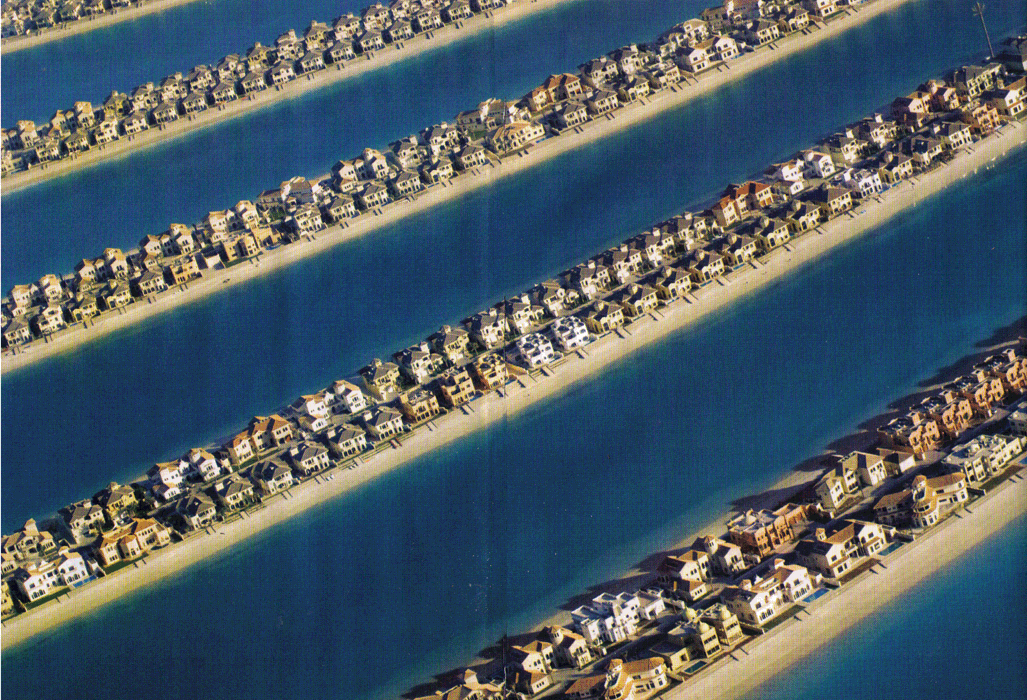
It is supposed to be a residence for the wealthy. As you can see, the distances between the houses are less than ten meters. If your neighbor turns up the radio a bit too loud: hello! But each has their "private beach section," to go and dip in water already putrid (but even if it were clean, the water in this region is murky, due to plankton. You can't see five meters. Regarding the invasion of this muddy area by algae, press articles have confirmed what I had seen in person in 2005. No one has considered a system to circulate the water!
Maybe, in a world where disorder and insecurity could spread, this kind of concentration camp for billionaires will be sought after. With a fleet of heavily armed speedboats patrolling ceaselessly in the canals and around the marina?
Nothing has been planned to allow water to circulate in these canals ending in dead-ends. Therefore, the seawater will stagnate, unless it is circulated with turbines. Engineers are studying systems to raise the sand from the beaches as it slides into the canal. When I visited the site, I could, by taking off my shoes and rolling up my pants, see that the sandy bottom was already covered with a layer of brown sponges, coming off in patches. So it's not the Caribbean water. In open sea, visibility is ten meters, and there is nothing to see but sand. To solve the problem and develop underwater sports, the head of state, Sheikh Mohamed, will throw a one-kilogram gold bar into the water every morning. That makes 365 kilograms of gold per year. This bar won't sink too deep. Indeed, the layer of sand is only 30 cm. Below that, a harder rock.
The photo above, inlay, shows one of Dubai's achievements, populated with skyscrapers. Dozens, including up to 70 floors, are under construction and tens of thousands of people work there day and night. A toilet or a shower faucet is installed every five seconds. The emirs have launched the construction of the tallest skyscraper in the world: 710 meters:
" Burg Dubaï " : the tallest building in the world : 710 meters. Under construction
This building, however, may pose visibility problems, as the weather is generally cloudy in Dubai, both day and night (we have never seen the stars in August) due to a sea mist.
Returning to the "Palm" marina, here is a photo taken by satellite, reported by a reader.
Satellite view
It is confirmed that their mega-marina is indeed visible from space:
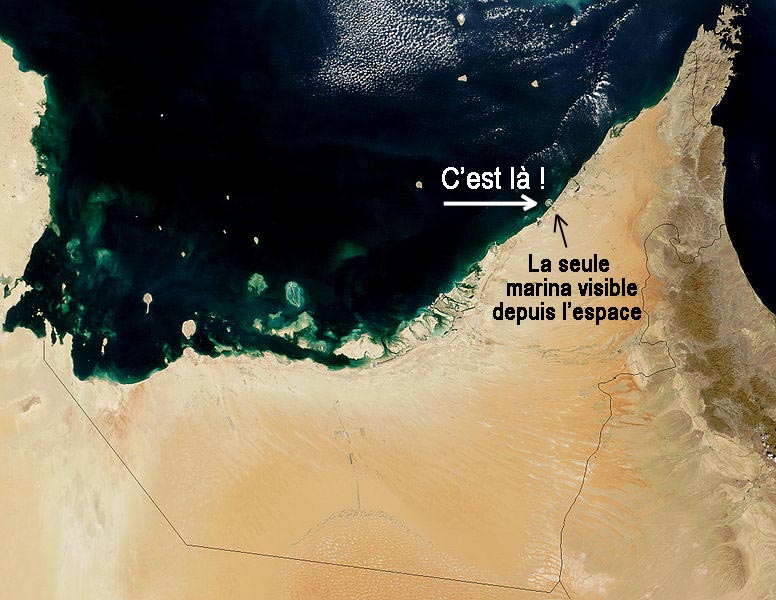
**United Arab Emirates, seen from space. On the seashore, you can see this marina in the shape of a palm. **
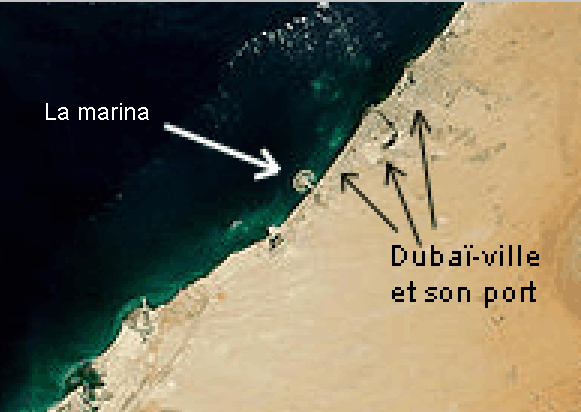
**Zooming in on the image **
Regarding photos taken by satellite, this is what you commonly find on the Internet:
Satellite photo
You can make out the presence of pedestrians, whose shadows you can see. When we were in Dubai, we met a guy who told us that the Americans recognized his features when he was in the parking lot of his company, examining a satellite photo. This simply represents a higher resolution. With current technology, the only way to truly go unnoticed is to walk around with an umbrella.
But let's return to Dubai, where there is no income tax, no corporate tax, and no social charges. Hospitals are free. The people who work are either master builders paid at high prices, or Indians or Asians paid very little. You pay a worker 200 dollars a month and an "Indian engineer" 2000 dollars. These people don't complain because they can thus support many of their compatriots from a distance, and they earn five to ten times what they would in their own country. The "high-end immigrants," Europeans or others, can earn in two or three years enough to pay for the villa they would have taken 20 years to buy on credit. Architects can express their wildest fantasies. Palm Jumeirah, visible from space, is "the largest construction site in the world." It is, however, just the beginning. Other projects will emerge. On the map above, you could see a set of white spots titled "The World," "The World." It is a set of islands representing countries. Each head of state or senator will thus be able to buy the island corresponding to their country. Visible from space, of course.
This "Palm Jumeirah" is, in fact, only a "draft" of larger achievements, such as the "Palm Deira," located to the east of Dubai port:
**The "Palm Deira" marina project. Diameter: eight kilometers: the Paris within the walls. Visible from space. **
To finish this tour, a view of one of the many shopping malls.
Shopping mall in Dubai
( Photo Christophe Tardy )
In this photo you have the whole of Dubai. In the foreground, on the right, the completely veiled woman (at the restaurant, the veiled woman slides her hamburger under her veil, which requires some training). On the left, the black chador (the woman scolding the man in white). On the right, the "fancy" chador and, just next to it, a woman in pants, bare shoulders. So it has nothing to do with Saudi Arabia. All these people cross paths without problems. Detail: it is not a view of Dubai at night. We are under air conditioning. It is 48 degrees outside and the sky is painted on the ceiling.
In Dubai, if you are not completely megalomaniac, you play below the net. Only oil kings can consider building a pyramid larger than that of Cheops.
[To have an idea of a more pharaonic project, you die
The project "The World," a set of artificial islands reproducing the terrestrial globe, which will be visible from space, is proceeding:
The set of islands forming the project "the World," in front of Dubai
This project will be subject to the same problems. A murky water, with visibility less than ten meters, nothing planned to allow marine currents to circulate in these canals, nor anything planned to prevent them from siltation. Nothing to do with a flat sea and a leaden sky, with 48° for four months a year, and the neighbor next door, at a hundred meters "in the continental parts." In a property located "on a coast," you will have a bit more space. Not much to entertain yourself, except to say that you might have Michael Jackson as a neighbor (here on a visit, in the Emirates, shortly after his trial).
2005: Michael Jackson being presented the "The World" project
Christophe had a phrase he repeated two or three times a day, which always hit the mark, summarizing the situation we were facing:
- Nothing about this is reasonable.....
I know of only one place on Earth where "fun" has been implanted in the desert, in a place corresponding to the English phrase:
Lost, in the middle of no-where...
"Lost in the middle of nowhere": That's Las Vegas. That works well. The recipe: gambling, women, alcohol, and drugs. In Dubai, they are not too strict about the Islamic prohibition of drinking. By emptying the mini-bar of the hotels, you can get drunk in complete discretion. You can even have a bottle of bourbon brought up, I imagine. There are Asian prostitutes in the bars for Europeans, discreet but present. How far will this go?
Dubai has therefore fully played the card of luxury tourism. You can obviously play golf, ride horses, play polo. The food is extremely well done. Our hotel had several restaurants, including one of the best Italian restaurants I have ever known, run by a Florentine master chef, but where the entire staff, including the kitchen, is Balinese. Obviously, the Balinese cooks have perfectly assimilated the art of Italian cuisine.
You can own a yacht, certainly, but only to show off. The islands are as flat as a hand. The sea baths: not great. The water is murky. The Sheikh Mohammed then had an idea: develop underwater tourism. The company Exomos therefore designs and builds recreational submarines, in all sizes (including "submersible yachts," the pinnacle).
Dubai is developing in the manner of western American cities during the gold rush, with a "negative unemployment rate." No crime or apparent police. It goes with full employment. Any delinquent would be immediately put on the first plane, their work permit being revoked. The city will expand westward for dozens of kilometers along an already congested highway, a site of monstrous traffic jams. If nautical tourism developed at the same pace, the submarine could present itself as an interesting alternative, provided one has a sonar anti-collision system, indispensable given the very limited visibility.
Underwater tourism? There must be something to see underwater. Specialists have studied the installation of diatoms capable of eating the algae floating in the gulf. Others plan to recreate underwater bottoms with the material of an underwater Disneyland. Here, the Caribbean, there, the Coral Sea. But will the fish accept to live in the accommodations intended for them? And what will they eat?
New problems for other specialists to ponder.
You have understood: this coast of the Emirates is a totally artificial world, plastered on sand with billions of petrodollars. There, the problems of the rest of the world reach only in a muffled, stifled way. The word "growth" has no meaning. When the price of a barrel increases, the oil rent follows. They don't even look for profitable investments. They build, that's all. In Dubai itself, there are developments composed of hundreds of luxury villas that remain unoccupied. The housing is neither for sale nor for rent. Who will live in these thousands of housing units that correspond to the construction of all these towers, which is proceeding at an impressive pace, almost ... delirious for our western eyes. We don't know. The emirs hope that this luxury tourism will one day take over and become the backbone of an economy when oil runs out. But will they win their bet? Will the waters of the Persian Gulf resemble those of the Bahamas? Nothing seems less certain.
In Dubai, the deserts are cheap and extend ... infinitely. The companies that set up there don't even wait for the building permit to be issued. Who could you bother in such a place? You can import cheap labor from India or Indonesia, or even from China. A docile workforce because "relatively well paid" compared to the standards of their countries of origin. No social charges, no corporate taxes, no political instability. It is enough to grant shares of the company to the current emirs (5% of the population).
But one thing is certain: if oil stops flowing, the power plant will no longer produce electricity. The elevators of the hyper-buildings and the air conditioning systems will stop, as well as the production lines. Dubai would quickly resemble these dead cities found in the Far West or in the center of the Amazon, in Manaus, the city where the rubber kings built an opera where Sarah Bernard, in her later years, performed. Christophe Tardy thinks that the emirs should invest in ... renewable energy, in solar, wind, and become leaders in these areas, since they have the means. In Dubai, a sea breeze blows regularly. The emirs could build "the largest windmills in the world" (just to circulate the seawater in their artificial canals. For solar energy, see the file on the coupling of solar mirror - Stirling generators, successfully tested at Sandia, New Mexico. If they want to leave a name in history, instead of imposing themselves in luxury tourism, the emirs should develop this type of equipment, equipping all the third world countries with very simple and low-maintenance electric generators. They could also be their first customers by filling their desert with such generators, until they become energy self-sufficient. There, it's not the space that's lacking. It would be fun to create an automated factory producing solar generators, served by robots that install them themselves, until they arrive in ... Saudi Arabia. There's still room.
If I were an emir ....
September 5, 2005 : The Origin of the United Arab Emirates
This story is dedicated to my friend Noémie, 11 years old.
We know that the United Arab Emirates are swimming in an ocean of petrodollars and that the discovery of this wealth, at the beginning of the sixties, is relatively recent. What is not known is what preceded this discovery.
Once upon a time, there was a sultan named Suleiman Ben Daoud, who lived in the small cove of Dubai, scorched by the sun, with even not a single palm tree to provide shade. He had three wives and two camels. But his life was so hard that he often would have preferred the opposite: to have two wives and three camels. Before him stretched the Persian Gulf. His brother-in-law Rachid had boats with which he tried to catch the few rare fish that wandered there. In fact, the sandy seabed, endless and monotonous, was so boring that even the fish got bored and preferred to bathe in the Indian Ocean, where there are corals to graze on, even if they were occasionally eaten. Better a life with little risk than an existence as dull as these sandy bottoms where nothing ever happens.
The only inhabitants of these waters were planktonic creatures. But, you know, plankton doesn't think too much. These creatures, as big as half a grain of sand, were there because there was seawater, that's all. They could have been elsewhere. Rachid couldn't do anything with these microscopic creatures that easily passed through his nets. The only inhabitants of these murky waters were whale sharks that often reached considerable sizes and were capable of making holes in the nets without even realizing it. Rachid therefore spent his time repairing them. As for Suleiman Ben Daoud, with his two camels, he called himself "Gulf Transport Company." But customers were rare, since there was nothing to transport and behind, it was the desert as far as the eye could see. What to transport, and where? That was the problem.
There are deserts with charm. But this one, zero. Flat as a hand. The sand wasn't even of good quality. One day Suleiman Ben Daoud turned to the sky and, addressing his creator, said:
- Oh, Almighty Allah, the merciful. Why did you make us born in this rotten corner, where there is nothing but sand? Have we sinned against you to deserve such an ingrate fate?
A powerful voice was heard, from behind the clouds.
- Oh, unbeliever and ungrateful you are. I placed you and your brothers on the richest land imaginable, and you don't see anything, like a big fool.
Surprised, Suleiman Ben Daoud looked around, wondering if he had missed something. He did a 360°, but saw nothing but sand and a leaden sky.
The voice continued:
- Since you are too stupid to find, go to the left pocket of the saddle of your second camel. You will find the lamp.
Suleiman Ben Daoud threw his face to the ground for a long time. Then, as the voice had gone silent, he went to his second camel and took out the lamp he had bought years ago from a street vendor and had been carrying for years and years, in the left pocket of his saddle.
- These are legends, he said shaking his head. These things only work in the tales of the Thousand and One Nights.
But, just in case, he passed the fabric of his long sleeve over the copper of the lamp. A huge genie emerged from the water. He was as tall as thirty six derricks and as black as crude oil at 70 dollars a barrel. He addressed the Bedouin:
- Oh, Suleiman Ben Daoud, master of the lamp, what do you want? Speak. Your wishes will be granted.
After trembling with all his limbs, Suleiman regained his composure. He first asked his two wives to stop screaming because, in such cases, it doesn't help and only makes things worse. He straightened up and said to the lamp genie.
- I want to be very rich, as rich as King Fahd, the Saudi.
It will be done according to your will, replied the genie. Immediately, a bunch of Western geologists arrived and found oil in no time. Then they asked Suleiman:
-
Who is the owner of this rotten land?
-
Uh, it's me, answered Suleiman Ben Daoud.
-
Well, said one of the Westerners, you sign here and you take an account in the first bank you come across.
And they left as quickly as they had come. Suleiman turned to the place where the oil-colored genie had appeared, but he had also disappeared and he wondered if he hadn't dreamed it.
Things happened very quickly. The Westerners made holes everywhere and from each hole came black gold by the thousands of barrels. Suleiman had taken an account and his wealth began to rise ... to rise, at a dizzying speed. And every time the price of oil increased, he earned even more money. He wondered what he could do with all this money. He first bought golden slippers, but finally gave them up because they hurt his feet more than anything else.
Now the years have passed. Suleiman has become very rich and very old. He has kept the lamp, but it refused to work a second time, even when polished until it shone with a thousand lights.
Suleiman Ben Daoud had a large descendants. But his sons and the sons of his sons were bored. Each had a yacht, but there was not much to see in the Gulf, and practically nothing to fish. Ocean engineers tried to build artificial underwater bottoms and put tropical fish in them. But these didn't fall for it and, without hesitation, preferred to go to the Indian Ocean, to the east, once past the Strait of Hormuz.
Since then, Suleiman Ben Daoud goes to the beach every day. Facing the sea, he takes the lamp he always carries with him from his coat and rubs it, saying:
- Tell me, my ass genie. You made oil come out everywhere, here and now there are plenty of shopping malls with air conditioning and a ski slope where my sons can fall on real snow without having to go to Megève. But the sea water is still as murky and boring. You can't see ten meters because of this damned plankton and the whale sharks, when they get lost in the port, damage our brand new yachts. Can't you fix this?
Nothing happens and Suleiman Ben Daoud looks sadly at his lamp, shaking his head.
But, as they say, in life, nothing is perfect.
You think I'm telling you stories to fall asleep. You're wrong. The emirs have minted money. To keep it in memory, they have engraved a reproduction of Suleiman Ben Daoud's lamp on the reverse. Look:
Time passes and in a few decades, the people of the emirates, too busy playing golf or skiing, will no longer remember this story.
September 23, 2005
Dubai, the other side of the curtain
I watched yesterday on France 2 a program showing the inside of the city of Dubai (which Christophe and I had only seen the top of in July, so). The impression is ... frightening. I ask readers who may have recorded this program to come forward, and those who are able to do a DivX or avi transcode to do the same. This will allow me to recover images by screen capture and put together a follow-up to the one titled "Two Weeks in Flouzeland."
We spent two weeks in Dubai, at the request of a company that paid for our trip, food, and lodging. We worked non-stop for 14 days, without being paid, to try to advance a project. If the file gives an impression of a vacation, it was far from the case for us. Will this matter have consequences? We'll see. As they say, "under investigation."
What we can say is that we spent two weeks with about a hundred Indian workers who weren't working themselves to death. Salaries ranged as follows: 200 dollars per month for a laborer, 1000 dollars for an engineer. However, the Indian technicians and engineers we met were far from meeting the standards of countries like France. No initiative, few real skills. A general lack of motivation. Of these hundred employees, most, recruited by an Indian from the management, who later died of a heart attack, mainly represented a very heavy administration. Nevertheless, all the people had very good working conditions, air conditioning (even though it was 48 degrees outside). The workers were transported in air-conditioned buses. Work stopped at 5 p.m. and employees had a weekly day off, on Fridays. I didn't visit their housing, but if it wasn't luxury, I imagined it to be decent housing. As I was told upon my arrival:
- These salaries may seem low, but they are much higher than what these people would find in their own country. Therefore, they come here to earn money and send a large part of it to their families.
What we saw in the documentary made by France 2 has nothing to do with this, and I would like to be able to echo this view on my website. This is characterized slavery. What we saw shocked us extremely from the point of view of working conditions, hours, health coverage, and housing conditions of construction workers, who are building the numerous skyscrapers that are sprouting there like mushrooms. An image quite close to slavery in the Antilles in the 18th century. This is all the more shocking because the Emiratis, riding on oil dollars, have the means to offer decent salaries and good working and housing conditions to their migrant workers. Some images evoke concentration camps, where the workers of these camps were directed by kapos. Indeed, apparently the Emiratis do nothing else but collect the profits and make decisions. They leave to people who are themselves immigrants the task of organizing and managing the work, of managing this "human livestock." Thus, Indians are exploiting other Indians, Asians are exploiting other Asians, without the slightest scruple.
When questioned, a Frenchman in Dubai in charge of contributing to improving the image of the Emirates abroad, answered:
- Ah, here, it's extreme liberalism. When you work in Dubai, you are not under the Social Security system.....
This seems to be indeed the case.
I already wrote the comment while reviewing the program. I'm waiting to be able to capture images to put online.
September 26, 2005: The program is available on :
http://info.france2.fr/emissions/13478000-fr.php
Click on the link "in the holds of the eldorado" to start the video (about 33 minutes).
I have the video. I will take some images and put up an illustration of this France 2 document.
Back to Guide Back to Home Page
Number of connections since August 9, 2005: 11,489