Two weeks in Flouzeland
August 9, 2005
March 20, 2013. Eight years have passed.
True, I wouldn’t retract anything I wrote on this page back in 2005. My friend Christophe Tardy and I were invited to Dubai by some charlatan who claimed to be a former DGSE agent; he managed to convince one of the members of the royal family (Sheikh Ahmed Bin Sulayem) to finance a company called “EXOMOS,” whose purpose was to develop and manufacture... mini-submarines meant to entertain the emirs.
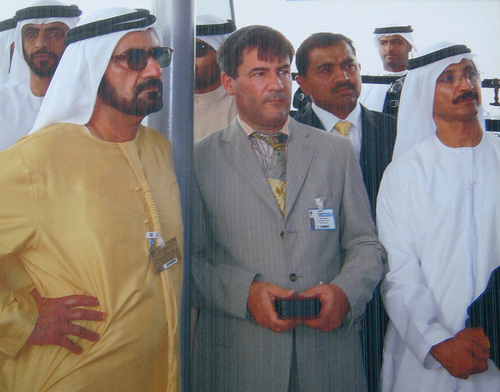
Hervé Jaubert, with Sheikh Mohammed on his right
Read, for example:
Basically, this guy supposedly came from naval school. But I imagine he must’ve skipped hydrodynamics classes. As Christophe put it upon seeing those submarines: “Apart from being utterly non-hydrodynamic, they look like grand pianos.”
We spent two weeks in sheer absurdity. What motivated us to go there? The submarines? Not really. But the emirs had lots of money—tons of it—and if we could’ve met any of them, we would’ve said: “Would you like to be the first country in the world capable of functioning entirely on solar energy?” Unfortunately, that opportunity never arose; all we could do was kill time awaiting our return flight two weeks later.
That was eight years ago.
The Emirate, working together with French oil giant Total, has now commissioned the world’s most powerful solar thermal power plant: 100 MW. We’ll discuss this later.
When we arrived in Dubai in 2005, our “boss,” Hervé Jaubert, to avoid naming him directly, brought in from some Eastern country a ground-effect ULM device, essentially a miniature version of Russian ekranoplanes (see here). The video showed that if such a tandem-seater craft was operated by a single, moderately weighted pilot, it could lift several meters above the ground while cruising at decent speed. With such stubby wings, flying such a thing at nearly 100 km/h surely seemed perilous. My reaction, as a former Supaéro student and ULM pilot, was immediate:
“If you want to kill an emir or his son every week, you’re guaranteed success!”
He filed away that project involving mini-ekranoplanes for the emirs.
Jaubert was clearly impressed by a scene in the movie “Thunderball” where James Bond, wearing a diving tank fitted with a propeller driven by an electric motor, sped through a crowd of “bad guys.” It should be noted that Sean Connery (or his stunt double) was actually pulled along by a cable at moderate speed; the footage is merely sped up during editing.
Inspired by this, Jaubert ordered the construction of a rectangular backpack apparatus incorporating a diving tank and propulsion system. Sadly, the thrust vector was offset by more than 10 cm from the diver’s center of mass, i.e., his body axis. During tests, due to this uncontrollable torque, his “suicidal” test diver ended up with his nose buried in the mud at the bottom. I suggested to Jaubert to redesign it, but 70 units had already been produced from a mold. From an engineering standpoint, nothing could be done.
Inside the entrance hall stood two models of a “submersible yacht.” One was a civilian version. Picture a decent-sized yacht, 25 meters long, complete with railings, cabins, beds, toilets, a rear beach area, and a cockpit. Since his emir wanted “a yacht capable of diving,” Jaubert promptly designed this surreal contraption. Right next to it stood the “military version,” painted khaki.
Christophe and I set to work trying to reduce its drag coefficient (“Cx”). I imagined that the front railings could be folded down to reduce resistance. But Jaubert stopped us cold: the vessel was practically finished. Indeed, just a few meters from our office, in a nearby hall, workers were still sanding its hull. Nothing could be changed anymore.
That was eight years ago.
The Emirate, partnering with Total, has now commissioned the world’s most powerful solar thermal power plant: 100 MW.

http://www.20minutes.fr/planete/1119949-20130317-emirats-entrent-plain-pied-solaire
This 100-megawatt figure is significant: it shows that solar energy can indeed meet domestic needs, even on an industrial scale. This output exceeds photovoltaic systems by one or two orders of magnitude, though it remains lower than massive nuclear plants. Solar thermal or photovoltaic tech simply boils down to investment levels.
This facility supplies 7% of the UAE’s electricity demand. However, it’s not purely solar; it’s a hybrid solar-thermal plant. The tall towers seen in photos are heat exchangers linked to gas burners. The Emirates have plenty of oil, but also natural gas; this fuels nighttime power generation and helps regulate output. It’d have been nice if press releases mentioned this detail. The term “concentration” refers to storing energy in salt deposits (sodium and potassium nitrates); I fell for that, but reports indicate that parabolic mirrors, not cylindrical ones, are used to concentrate sunlight—a trivial detail. Synthetic oil heated to 400° circulates within the system.
The Emirates are also developing another futuristic project: the city of Masdar, slated for completion in 2020, aiming to operate entirely on solar energy. Here, the problem is opposite to northern countries: temperatures can exceed 50° in the desert. Energy is spent not on heating but on cooling buildings and facilities. Part of Masdar is already built, coupled with a 10 MW photovoltaic plant; only 60% of its electricity is consumed locally; the rest is exported to Abu Dhabi via grid connections. Maintenance requires cleaning panels every two weeks to prevent efficiency loss.
Masdar also features driverless electric cars guided by underground magnets; they recharge autonomously at stations powered by photovoltaic cells. It’s worth noting that this “Palm Jumeirah” project, begun in 2002, cost billions; it includes artificial islands shaped like palm trees, each containing thousands of luxury villas. There’s also a “World Islands” project, featuring miniature replicas of continents; Dubai’s coastline is dotted with skyscrapers, golf courses, and ski slopes. A ski slope even exists in the desert!
The story of EXOMOS, however, remains bizarre. In 2005, Jaubert hired me to design mini-submarines for this firm, which employed 140 mostly Indian workers. Our two-week stay involved endless brainstorming sessions. We sketched concepts, calculated drag coefficients, and discussed propulsion systems. At night we relaxed in a giant Jacuzzi at a luxurious hotel surrounded by artificial lakes. The Emirate’s ruler, Sheikh Mohammed, owns the largest yacht worldwide; he also sponsors massive construction projects. Dubai’s infrastructure is astonishing: air-conditioned highways, desalination plants, and skyscrapers sprouting everywhere. Yet beneath all this splendor lies harsh reality: labor conditions are exploitative, salaries are pitiful, and environmental concerns are ignored.
August 9, 2005: Origins of the United Arab Emirates
This tale is dedicated to my friend Noémie, age 11.
We know that the UAE thrives on petrodollars; oil discovery dates to the early 1960s. What’s less known is how this wealth materialized. Long ago, Sultan Suleiman Ben Daoud lived in dusty Dubai with three wives and two camels; life was hard, and fish were scarce in the Gulf. One day, Allah spoke to him: “You’re foolish; I’ve granted you oil wealth!” A genie appeared, granting him riches; soon, Dubai became a playground for the ultra-rich. Today, its rulers mint coins bearing a replica of Suleiman’s lamp. Yet beneath the glitz, labor conditions remain deplorable: Indian workers earn $200/month while engineers get $1,000; many live in cramped quarters and endure grueling hours. France 2 aired a documentary exposing these horrors; one French advisor admitted: “Here, liberalism means zero social protections...”
September 26, 2005: Behind the Scenes in Dubai
France 2 broadcast a shocking exposé showing Dubai’s underbelly: slave-like labor conditions, squalid worker housing, and inhumane treatment. A French liaison officer noted: “At Dubai, there’s no social security...” Workers from India, Pakistan, and elsewhere endure grueling schedules and minimal pay; some even live in camps resembling concentration camps. Meanwhile, Emirati elites enjoy luxury yachts and ski resorts. Despite their vast wealth, they refuse to improve labor conditions, exploiting immigrants ruthlessly.
Conclusion
Dubai epitomizes modern excess: artificial islands, solar plants, and skyscrapers rise from deserts at staggering costs. Yet beneath the glamour lies systemic exploitation. For those seeking sustainable progress, the UAE offers valuable lessons: renewable energy potential is immense, but without ethical labor policies, such wealth merely fuels inequality. Let us hope that future generations learn from Dubai’s contradictions—that progress must never come at human cost.