Humour and mathematics
Humour and Mathematics
August 23, 2005
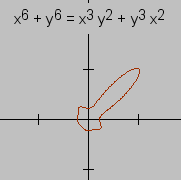
Professor Tardy stumbles by chance upon the implicit equation of the quéquette
The "Tardy bitoid"
Note the extreme simplicity of this implicit equation, of degree six. It is a purely fortuitous discovery. Tardy, in fact, had gone back to work trying to find a Holy Grail of mathematics: an implicit equation of the Boy surface that was finally well balanced. This surface was discovered by Werner Boy, just before the summer of 1902, in Göttingen. A young student at that university, he showed it to the hugely famous mathematician Hilbert, who found himself most interested and agreed with his student to reconsider the whole matter at the start of the new term. Alas, Boy disappeared without a trace. No one knows what became of him, nor knows his grave. Some had suggested, in the mathematics department of Göttingen, to pay tribute to him by creating a "tomb of the unknown mathematician."
The Palais de la Découverte exhibited for a quarter of a century a representation of this surface, which I had invented and of which I had subsequently found, with Jérôme Souriau, the son of the mathematician Jean-Marie Souriau, the first parametric representation, which appears on the last page of the Topologicon.
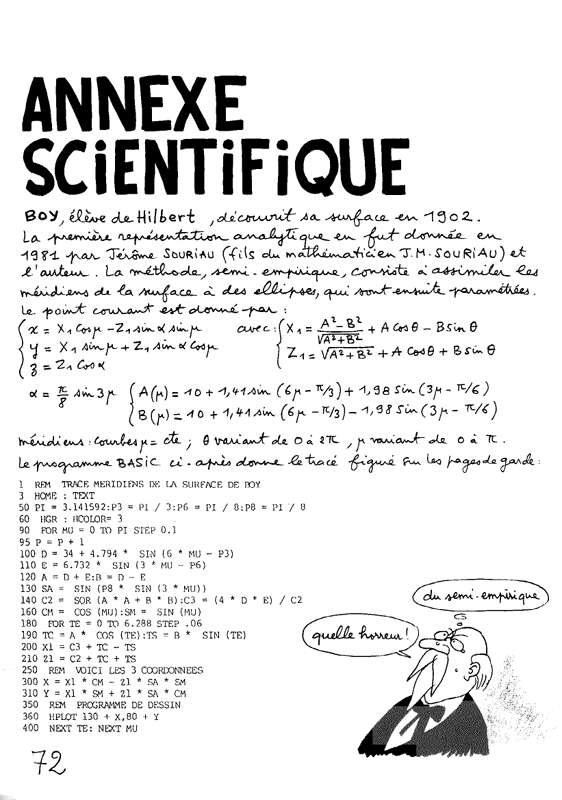
Excerpt from my comic strip "le Topologicon"
At the bottom, the program, written in BASIC, which made it possible to obtain the first computer-generated images of the object. It was Colonna (École Polytechnique) who took charge of this work, and all the computer-generated images of the Boy surface that can be found around the world start from these parametric equations. The object is recognizable by three ugly characteristic creases that surround the "pole" and that are due only to defects in the adjustment of the parameters. One day, Tardy and I will deal with this matter of false creases, when we have a minute.
When the Palais decided to withdraw this surface from the exhibition, I asked to recover it, and I now keep it at home, in a huge crate. It looks like an egg being brooded, and it intrigues visitors a great deal.
There, Christophe takes up the problem from much further back. Apéry (professor of higher mathematics, student of the blind mathematician Bernard Morin) produced an implicit equation, that is, of the type:
f ( x , y , z ) = 0
But, badly advised by his boss Morin, he took the oz axis as the axis of symmetry. As a result the equation is complicated and unattractive. Corollary: the resulting surface has ... rabbit ears. It is the "Roger Rabbit" version of the Boy surface. But, alas, it is all that is available, and it is this equation that you will find in mathematics treatises the world over. Yet an infinitely simpler equation exists. That is a certainty. Think of the equation of the sumptuous Steiner Roman surface:
x 2 y 2 + y 2 z 2+ z 2x 2 - 2 x y z = 0
whose richness one would never guess. Below, the image obtained by Tardy:
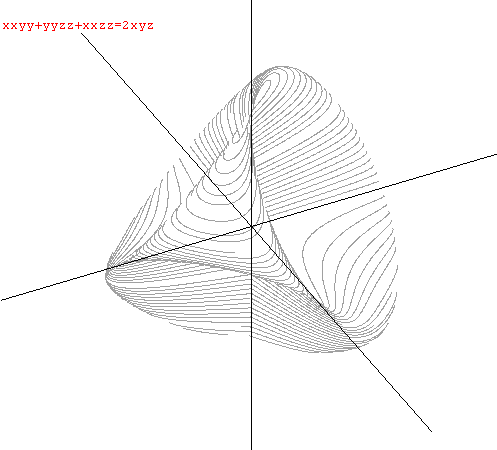
The Steiner Roman surface, plotted with Winplot. At the origin, the triple point.
On the axes, the six cuspidal points
This image was composed with the excellent software Winplot, created by Richard Paris, of Poitiers, t
Free download
See also http://www.mathcurve.com/surfaces/romaine/romaine.shtml
The Boy surface must be describable by an equally simple equation, with only a few more terms. It is of the sixth degree. It has a ternary symmetry, and it is therefore advisable to look for a representation in which the vector ( 1 , 1 , 1 ) is the axis of symmetry, which would make the equation invariant under a cyclic permutation of the variables x , y and z . Moreover, if the origin of the coordinates is placed at the triple point and the tangent planes at this point are orthogonal, the lowest-degree term is precisely x y z . ( The implicit equation x y z = 0 represents three planes intersecting at the origin ).
Tardy therefore searches in this direction, with the help of software allowing surfaces and their cross-sections to be represented. It was while making one of these that he fortuitously came upon the equation of the bitoid, given above, whose remarkable elegance and simplicity will be appreciated.
August 27, 2005: Rewriting Genesis
This discovery caused a certain stir in the world of mathematics, some female representatives, closely linked to the MLF, having protested vigorously. But as one discovery can lead to another, an American researcher, Kevin Fine, a specialist in plasma physics, became interested in the equation:
z ( y , y ) = x6 + y6 - x3 y2 - y3 x2
3d extension of the Tardy bitoid. The images, obtained with Matlab, are as follows:
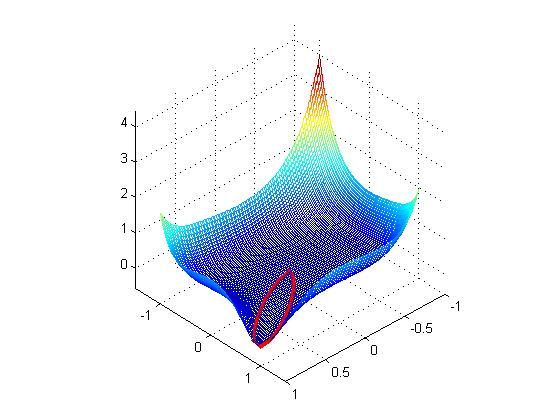
Kevin Fine's foufounoid
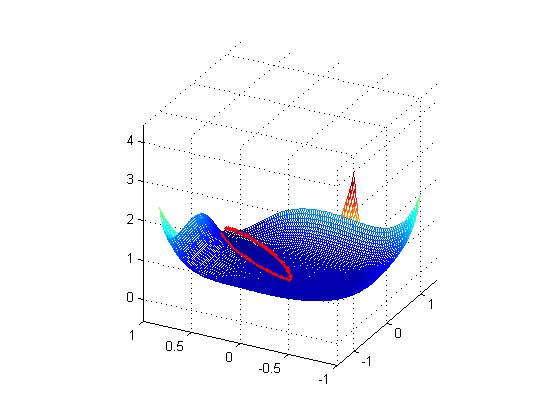
Another view of Kevin Fine's Foufounoid
The red curve ( schematic plot ) represents the intersection with the plane z = 0.
One reads in Genesis that God created woman from an element borrowed from man ( one of his ribs ). This suggests the opposite, given that according to this schema, metaphorical of course, man would be a 2d structure, whereas woman would be a 3d structure, the former being only a subset ( the intersection by the plane z = 0 ) of the latter.
Here is Kevin Fine's reaction, dated August 28, 2005:
Dear Jean Pierre
I am honored. Unfortunately I am too old (51) for a Fields Medal, but it is a great honor in itself to have your name attached to a curve. Imagine my pride in knowing that in the future a mathematician just might say, "Excuse me, but that is a Fine Foufounoide you have there."
Kevin
Translation
Dear Jean-Pierre,
I am honored. Unfortunately I am too old for a Fields Medal ( I am 51 ). That said, it remains an honor to have one's name attached to a curve. Imagine my pride that in the future a mathematician might one day say " Excuse me, but what you have before your eyes is a superb Foufounoid ".
Kevin
Dear Jean Pierre
I am honored. Unfortunately I am too old (51) for a Fields Medal, but it is a great honor in itself to have your name attached to a curve. Imagine my pride in knowing that in the future a mathematician just might say, "Excuse me, but that is a Fine Foufounoide you have there."
Kevin
Translation
:
Dear Jean-Pierre,
I am honored. Unfortunately I am too old for a Fields Medal ( I am 51 ). That said, it remains an honor to have one's name attached to a curve. Imagine my pride that in the future a mathematician might one day say " Excuse me, but what you have before your eyes is a superb Foufounoid ".
Kevin
Back to Guide Back to Home page
**Number of connections since August 24, 2005 **: