Imaginascience
Imaginascience
March 22, 2006
Here, I'd like to quickly tell you about my meeting with a personified Lanturlu.
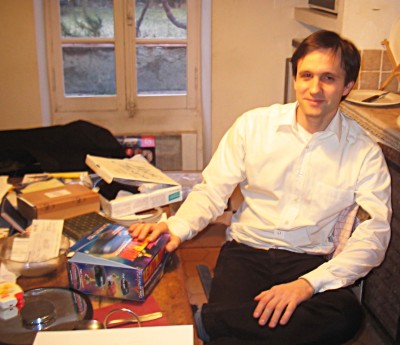
Guillaume Fabre in the kitchen of my house in Pertuis
Guillaume Fabre, this is the real-life name of this engineer, decided one fine day at the end of 2004 to share with internet enthusiasts his passion for all scientific curiosities that could illustrate scientific principles. He then set out to discover around the world the most playful, educational, and surprising objects: among them are scientific toys, gadgets, educational equipment, and decorative items. Some of his products are exclusive to France.
Gyroscopic Saucer
Recently, he came from Toulouse to demonstrate some of his discoveries to me. Some of them seem innocent and ordinary at first glance (I'm thinking of his singing rod or his resonant bowl—truly astonishing!) but when handled skillfully, they unleash their full resonant potential.
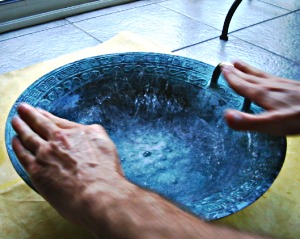
The mysterious "Chinese resonant bowl," very impressive
Among his collection are, of course, all kinds of tops (such as the fascinating Lévitron) and gyroscopes—small and large, operated via a crank and a gear reduction system.
Below is what happens when you place a magnet under a light bulb containing ferrofluid.
The ferrofluid visualizes the lines of force of the magnetic field
He also found Stirling engines, including a simple and inexpensive one using a test tube as a support, available as a kit to assemble.
The beautiful wooden bicone, a true sculpture, which climbs a slope instead of descending it.
Passionate about internet technologies as well, he created his e-commerce website "in his garage" and uses it to publish light scientific news and highly detailed popular science articles, abundantly illustrated with videos and 3D animations:
****http://www.imaginascience.com
He plans to soon enrich his site further with short interviews in the form of video podcasts. He'd also like to develop his business by designing and handcrafting certain products, such as Möbius strips and Boy's surfaces—artists reading this text, take note!
Guillaume, with the model of Boy's surface I had made, which enabled Jérôme, Souriau's son, to build the first parametric representation of this object, invented in 1902 by a young student who later disappeared without a trace.
He launched his website last December and continues discovering new objects, delighting us all. Captivated by the all-consuming passion of entrepreneurship, Guillaume, alias Lanturlu, has also launched a forum on this theme:
http://www.sp-wiki.com/forum/entreprendre/
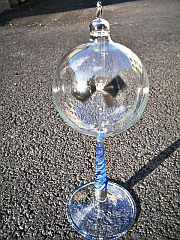
Radiometers that spin endlessly in the sunlight
So I decided to promote his site a bit on mine to help with its launch and visibility. Please don't hesitate to visit and leave him comments to help improve his website.
His email:

I think Guillaume, beyond selling these objects by mail, should create a scientific animation show. Yes, science has its "Magic Circus" side. I'd really like him to share his phone number so I can include it in this dossier.
To young "theatre freelancers" lacking paychecks, I'd say: "Create scientific clown shows for children. There are a thousand things to do."
Example: Two clowns arrive in a square during summer. One wears ice skates and has decided to practice skating. The other mocks him.
- Perfect, sir. I'm going to ice skate right before your eyes, and I'll show you!
Then, with a few liters of liquid nitrogen, he creates a thin layer of ice by pouring it onto the surface of the pond water. Then... you can imagine the result!
Another gag: A pulley, well-oiled, with a flexible and strong rope (an 8 mm diameter climbing rope). One clown asks the other:
- The boss asked you to put these books in the storage room upstairs.
The other places the books on a tray connected to the pulley by a climbing rope (sold by the meter). When he pulls the rope, surprise: he rises at the same speed and height as the books. The reason: the weight lifted is exactly equal to his own! A comedic version of the "Atwood machine." When he descends, the books do too.
Variant: The actor asks a spectator to pull the rope and asks the audience: "What do you think will happen?" He writes down the percentage of responses on a blackboard. You’d be amazed at the result—the most frequent answer being: "Nothing..."
I once performed this demonstration at the Faculty of Letters in Aix-en-Provence during a conference of epistemologists, who themselves were unable to give the correct answer (...).
Imagine the possible dialogues:
One clown knits in a corner. He's making a completely surreal sweater.
*- What are you doing?
- Me? I'm a theoretical physicist.
- You? A theoretical physicist!?
- Perfectly. I'm knitting with superstrings...*
Only Raymond Devos could fully exploit all the facets of this. I can picture Devos walking onto stage saying he has a black hole without his matchbox, and that if he hears someone laughing, he'll throw them right into the middle of the room.
Imagine actors gathered around a machine housing retrochronologists—people who live time backwards and are about to open a door.
*- No, wait, stop...
- What?
- What are you going to say to these people? They live in reverse time.
- So what?
- Well, if you open the door, you have to say "goodbye" because in their time, they're leaving.
- Oh yes...
- And that's not all.
- What else?
- When you speak to them, remember they already know everything you're about to say, while they know nothing of your previous words.*
The other removes his hand from the door and thinks:
*- This seems more complicated than we thought. But still, working with retrochronologists would be really interesting.
- Why?
- Think about it. Commercially, we'd make a fortune. They're interested in our waste, while they're trying to get rid of their raw materials.
- And they're even willing to pay for it!
- Indeed, seen from that angle.*

| Former CNRS research director seeking a theatre troupe | to create scientific shows in the style of Raymond Devos. |
|---|
| Former CNRS research director seeking a theatre troupe | to create scientific shows in the style of Raymond Devos. |
|---|
You might recall that Nikola Tesla, in a suit and bow tie, was a sensation when manipulating tubes filled with gas at low pressure, which lit up under the influence of an induced field produced by a hidden Ruhmkorff coil beneath a table, discreetly operated by an assistant. I remember when I had...