Comet Tempel 1 and the Deep Impact Mission
Deep Impact
August 31, 2005
On July 4th, it was announced that the "Deep Impact" probe had released a 410-kilogram copper projectile that collided with Comet Tempel 1, discovered in April 1867 by the Marseille astronomer E.W. Tempel, who spotted it with the naked eye.
The comet has an orbital period of 5.5 years and orbits between Mars and Jupiter. Its largest dimension is estimated at 6 kilometers. NASA therefore launched a probe with the goal of learning more about the composition and internal structure of comets by sending an impactor to collide with one of them.
Here are the orbits:
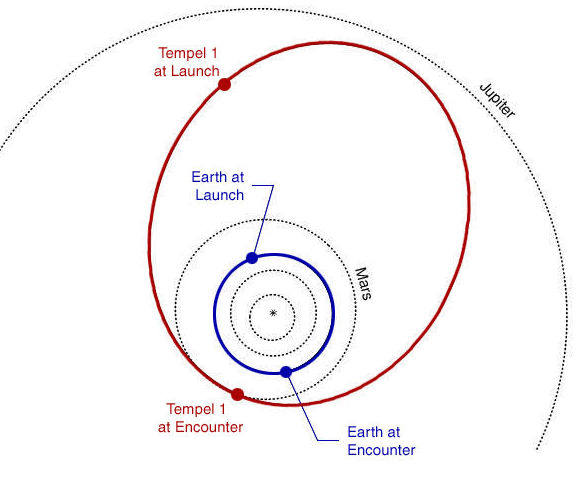
Orbit of Comet Tempel 1 between those of Mars and Jupiter. Observe, near the Sun, the non-circularity of Mercury's orbit, which is quite pronounced. At the top, along the brown orbit, the position occupied by the comet at the time of the probe's launch. The blue circular orbit is Earth's. At the top, Earth's position at the time of launch. Six months later (half of Earth's orbit), the impact. Measure the curved distances traveled by the comet and the probe over the same time interval. The comet moves faster.
A clarification regarding the impact trajectory. At the address:
http://deepimpact.umd.edu/amateur/where_is.shtml
you will find a very nice animation.
You will first see two buttons allowing you to change the "viewpoint." You'll thus observe that the comet's orbit is significantly inclined relative to the ecliptic plane.
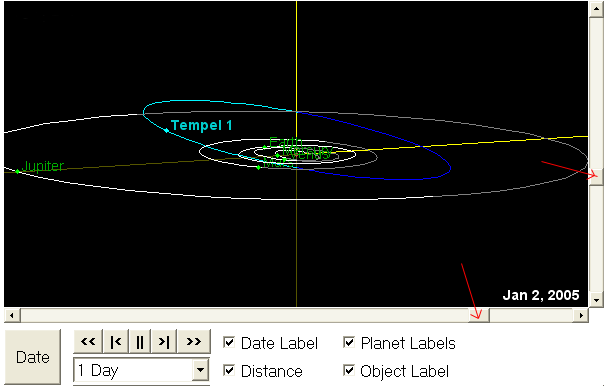
This is what allowed it to survive. There are different types of comets. Some, called "non-periodic," make a single excursion through our solar system and then vanish without a trace. In fact, we know very little about the structure of this vast "cloud," this reservoir of comets believed to lie far beyond our solar system. Where does it come from? When the solar system was young, planets formed. Several mechanisms then came into play. The simplest to understand is "cannibalism"—a head-on collision between a small object and a large one, with the latter absorbing the former into its mass. The second mechanism is the positive sling-shot effect. Mathematically speaking, this is an "encounter" (a term borrowed from kinetic theory of gases). The early solar system was "collisional." These collisions tend to produce a Maxwell-Boltzmann velocity distribution for all populations. It is a "multi-population" system. Each population tends toward thermodynamic equilibrium. When you have a mixture of two gases in thermodynamic equilibrium (for example, the plasma that makes up the Sun), the average kinetic energies of the different populations are equal. They are proportional to the inverse of their masses. Take a hydrogen plasma: electrons are 1,850 times lighter than hydrogen nuclei. Therefore, the thermal agitation velocity of electrons is √1850 times higher than that of hydrogen ions, or about 43 times higher.
A mixture of "heavy species" and "light species" tends to accelerate the light species ("grains of dirty water vapor" or "dirty ice" that will form proto-comets). Thus, the solar system ejected a myriad of small objects. Some, having reached escape velocity relative to the Sun, drifted off into interstellar space. Others remain in our "outer suburbs." Because these "encounters" work in both directions (though, overall, they accelerate small objects), there is a "negative sling-shot effect" that populates the Maxwell-Boltzmann distribution toward lower velocities. Many small objects were thus slowed down and, for example, fell into the Sun or into terrestrial planets like our own, possibly contributing to oceanic masses.
Tempel 1 is a comet with an intermediate fate. It acquired a velocity comparable to that of the planets. But it also had the luck to be placed on an inclined orbit, reducing its risk of dangerous encounters with heavier planets, which would inevitably alter its orbit. In fact, the comet's orbit has slightly changed since its discovery. See the history via Google. Why does it outgas less than Halley's Comet? A good question. We know little about outgassing, just as we know little about the internal structure of comets.
In fact, our planet also outgases, a phenomenon known as volcanism. We know that this is intensified by tidal effects (Jupiter's influence on Io, the first moon that is vigorously heated by its massive neighbor). If Io reacts so intensely to the presence of its close neighbor, it's because it rotates on its own axis. If it were tidally locked with the giant planet, such violent volcanism would not occur. Moreover, Io is very close to Jupiter.
Could comet outgassing activity be linked to their rotation period? A rotating comet is more sensitive to tidal effects caused by proximity to planets. Indeed, we observe that comets outgas when they enter inside Jupiter's orbit. Is it because they receive more solar radiation? Yes, if outgassing is simply a surface sublimation process. No, if it stems from internal eruptions. In fact, when we examine images captured by Giotto approaching Halley, we clearly see eruptive sources. Thus, it is possible that a comet's reactivation upon entering the solar system is linked to internal "churning" caused by tidal forces, especially intense if the comet rotates rapidly. Have we measured these rotation periods?
From this perspective, Tempel 1 might be relatively inactive because it rotates slowly, making it less sensitive to tidal churning, which triggers various eruptions (volcanic on Io, outgassing on comets). Ask Brahic what he thinks. Planetary science is supposedly his specialty.
You can freely position the various objects. First, here is Comet Tempel 1 approaching, after the Deep Impact probe was placed in orbit. Notice the impact date: July 4th. Americans like to mark their space achievements this way, demonstrating their mastery over probe trajectory control. This date coincides with the anniversary of their revolution, and it is no mere coincidence.
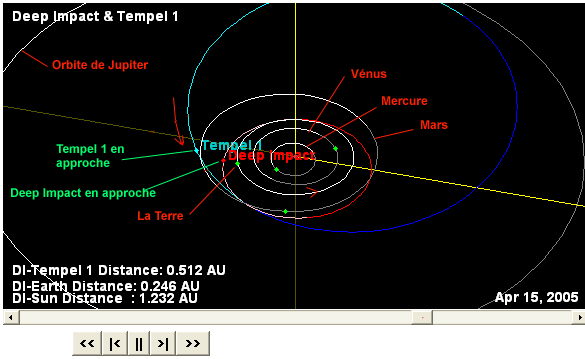
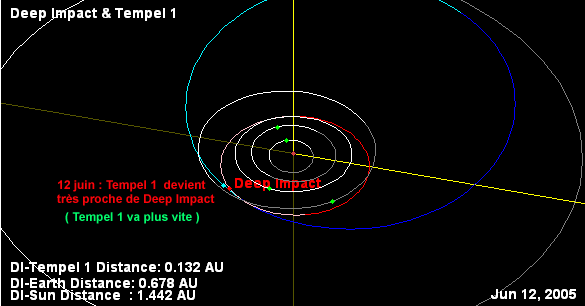
Careful observation of the animation clearly shows that Tempel 1 actually rotates faster than the probe and catches up with it. In fact, it is the comet that impacts the probe, not the other way around. But it doesn't matter much. Next image: two months later. The comet is about to collide with the probe, or at least with the object detached from it to achieve this collision.
Here is the comet, image taken five minutes before impact:
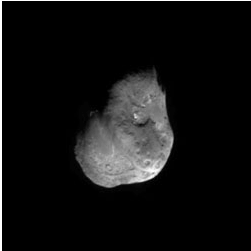
The comet. Image taken 5 minutes before impact.
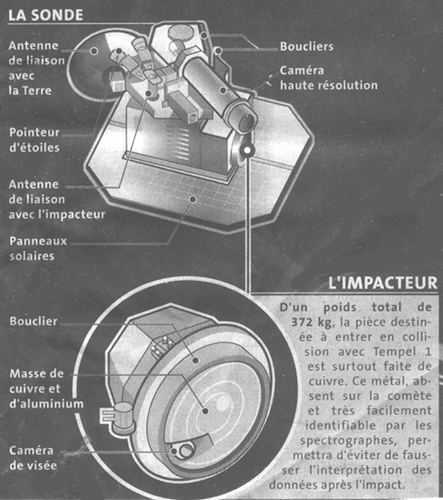
The probe and the impactor
U...