Optical Illusions
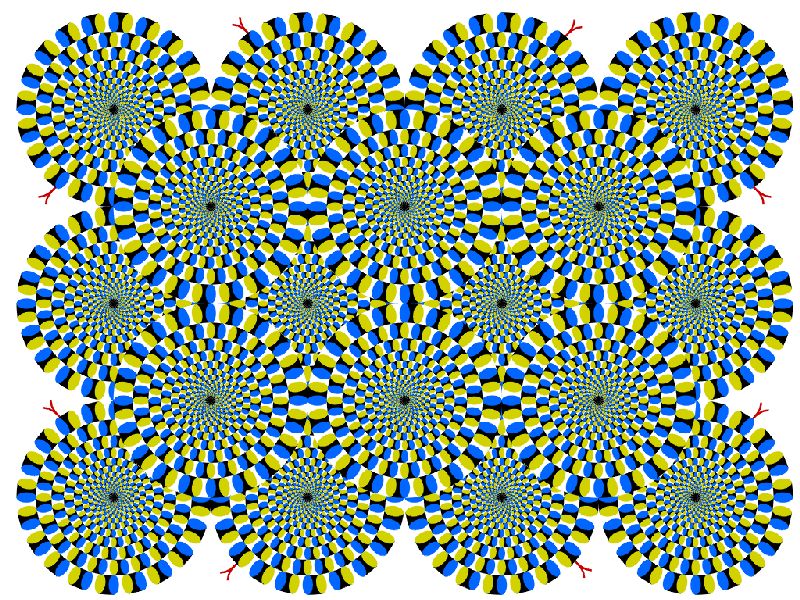
This optical illusion is the creation of Professor Kitaoka, professor of psychology at Kyoto University
See his site:
http://www.ritsumei.ac.jp/~akitaoka/index-e.html
**Found by Eric Dezoete: **
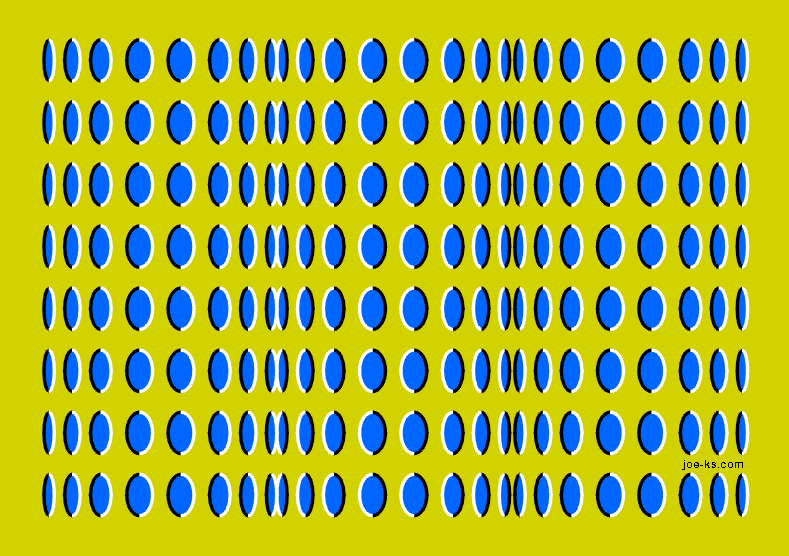
These lines are all horizontal ..... ---
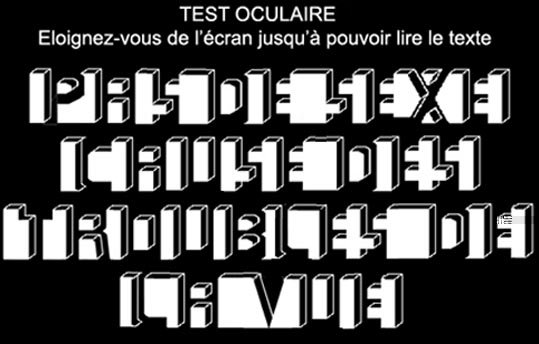
**This is a test of your visual acuity. Determine the distance from which this message becomes legible. **
*If it is not legible at any distance, consult an eye doctor. * ---
**Found by Christophe Giudicci. **
We know that when a color appears fleetingly and disappears, the complementary color takes over. But this dynamic optical illusion, whose author we do not know, is even more extraordinary. Look at this figure. Close one of your eyes and with the one that remains, stare at the cross in the center. Not only will the pink spots be fleetingly replaced by a green spot, increasingly visible, but in the end you will see only a green spot encircling on a gray background!
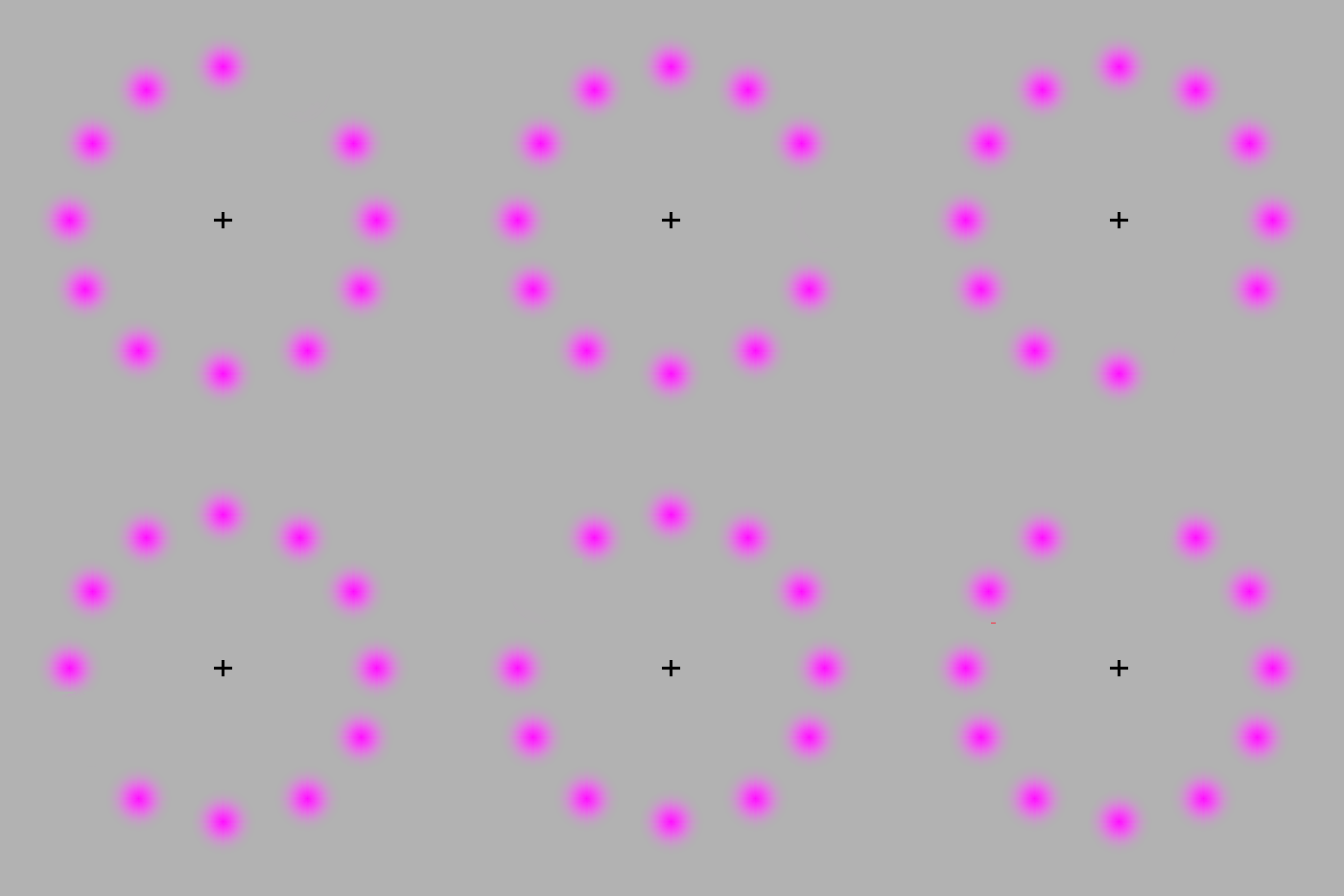
*It makes you wonder how a human brain works! *
In fact, by positioning the optical axis of one of one's eyes, the other being closed, one ends up seeing the "non-object" while the others disappear. One could sum this up by saying:
We see nothing and it still does something
**A commentary by Jérôme Bource **
The retina uses a pigment present in each neurosensory cell ..light arriving on the retina causes a chemical transformation of this pigment .This transformation is picked up by a neuron which emits a depolarization signal that is transmitted along the optic nerve ..
this transformation of the pigment is reversible and in less than a microsecond this pigment is restored to its original state ..
This phenomenon is a chemical phenomenon and therefore takes a certain time (a reaction latency) and becomes exhausted until stocks are reconstituted .
Colors are carried by cone cells especially at the center of the retina , but require a lot of light to function (day vision), each cone reacts to 1 frequency peak which correspond to the primary colors (3 cones for one color -this is the reason for complementary colors)
the exterior of the retina contains far fewer cones and rather rods which are sensitive only to light (at night we do not discern colors), they are much more sensitive.(night vision)
In the illusion by staring at the center of the image only the outer zones of the retina are functioning , poor in cones , consequently by staring at a central point one exhausts the chemical substance of certain cones especially and only the stimulations appear where the chemical substance is no longer exhausted that is to say the complementary colors ..but ultimately everything becomes exhausted and the color disappears ..
Interesting remarks. And he adds:
| It is nevertheless very astonishing
| to know that we apprehend the world , reality with senses whose very structure induces a particular "vision" of the real , the brain recreates as in a sort of "controlled" hallucination an inner universe (thought) that we nevertheless feel as the real , real to which we in fact have no direct link. Optical illusions are only ways of highlighting these sensations taken "as the real".. |
|---|
What one sees, the Anglo-Saxons call "expected signals", the signals one expects. "Reality" stems from a perceptual contract made with the world around us.
Reported by Laurent Michon, a strange illusion. Look at this image up close, then from a distance of at least four meters:
What explanation can be given? It seems to me that depending on the distance the whole "eye plus brain" does not perform the same Fourier analysis of images. The "filtering" is different. Up close the "short wavelengths" dominate. From afar it is the opposite. Look for example at the forehead of the two characters. Up close the one on the left seems furrowed by wrinkles whereas the one on the right looks more "peaceful". But at a distance the wrinkles on the left disappear whereas the eye "detects" a more pronounced furrowing on the forehead of the character on the right. Whatever it is it is quite astonishing.
A remark from a reader: At short distance the necessity of accommodation would mean that the lens, more curved, would give better resolving power. I do not know if that is the key to the matter. In any case, from afar, one sees the "details" less.
*To the specialists of "psycho exp" to enlighten us on all this. * ---
**Reported by Francis Potazman. **
That one, it is not bad either.
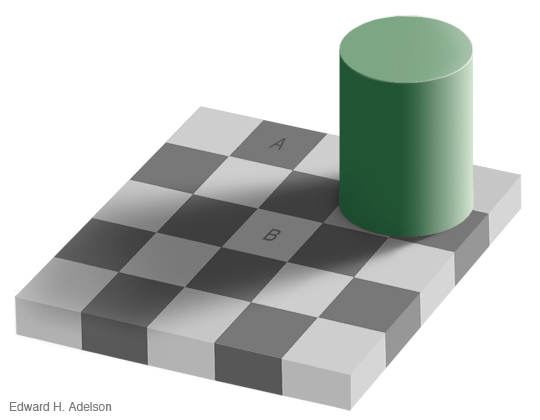
One might say that the optical illusion stems from the non-flatness of the surface on which this green cylindrical object is placed. Indeed, it looks a little twisted. But that is due to the lack of mastery of perspective. If one analyzes this drawing and compares the directions of the edges one sees that the author, if he introduced an effect of convergence on the edge at the top and on the left, did not imagine that the edge of the background could not be parallel to the one seen in the foreground:
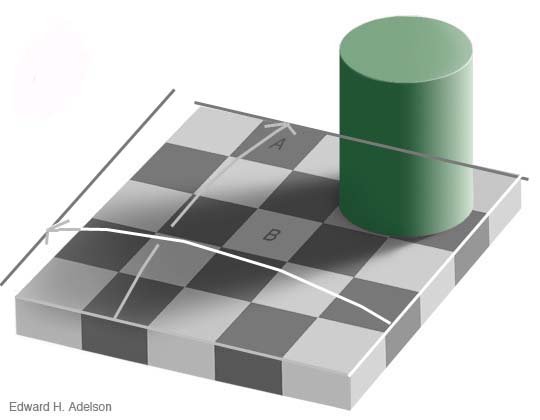
If I myself had produced this image in perspective I would have done something like this:
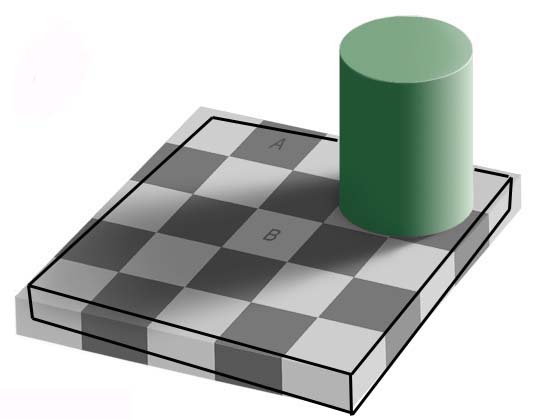
and there the plate would have seemed less twisted. But it would still not have been correct because the image of a circle placed on a horizontal plane and which is not located in the median region of the field of vision is not an ellipse with a horizontal axis. One day I will have to install on this site a drawing course that I have had in mind for many years. It is a book that does not exist. I have never seen anywhere people being explained that everything is a question of angles and not of lengths.
But let us return to this optical illusion which will stupefy you. If you transfer this image into software like Photoshop you will be able, using the "eyedropper" tool, to sample the colors covering squares A and B. Using the brush you will be able to create two neighboring spots. See drawing below:
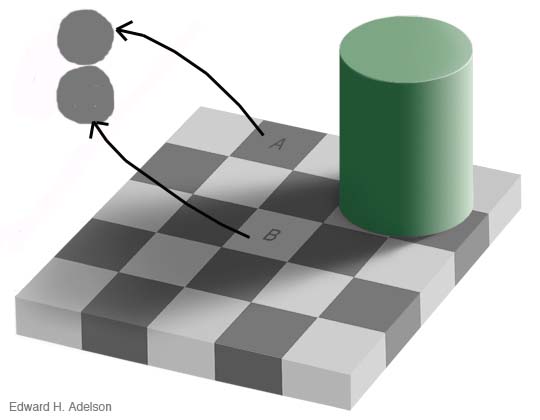
You do not believe your eyes: the bottom spot is indeed composed with the shade sampled from square A. You will be able to verify this by sampling a confetti in the spots located at the top and on the left, and by moving it onto a "layer". In the image below a monochrome bridge has been drawn:
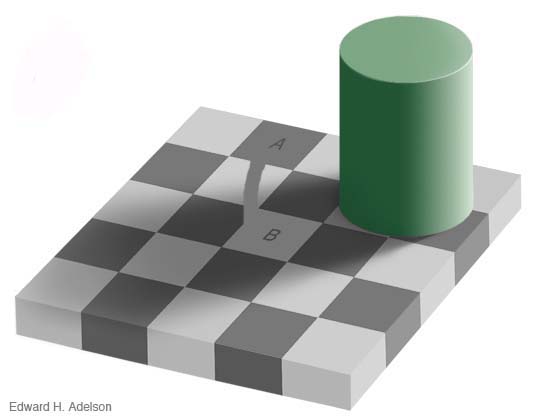
One has the impression of a gradient .. which does not exist. Everything is ... in your head.
Other optical illusions on the site:
http://www3.sympatico.ca/gauthier.roger/illusion/optico.html
**Still transmitted by Francis Potazman. **
The challenge consists only in counting how many times the letter F appears in this text
FINISHED FILES ARE THE RE-
SULT OF YEARS OF SCIENTIF-
IC STUDY COMBINED WITH
THE EXPERIENCE OF YEARS.
see the solution further below
FINISHED FILES ARE THE RE-
SULT OF YEARS OF SCIENTIF-
IC STUDY COMBINED WITH
THE EXPERIENCE OF YEARS.
see the solution further below
Answer:
Redo the test, concentrating, and note your performance. You will discover that you forgot some along the way. That being done, the solution is further below.
FINISHED FILES ARE THE RE-
SULT OF YEARS OF SCIENTIF-
IC STUDY COMBINED WITH
THE EXPERIENCE OF YEARS.
see the solution further below
FINISHED FILES ARE THE RE-
SULT OF YEARS OF SCIENTIF-
IC STUDY COMBINED WITH
THE EXPERIENCE OF YEARS.
see the solution further below
There are 6 times the letter "F".
INISHED
ILES ARE THE RE-
SULT O
YEARS O
SCIENTI
IC STUDY COMBINED WITH
THE EXPERIENCE O
YEARS.
see the solution further below
F
INISHED
F
ILES ARE THE RE-
SULT O
F
YEARS O
F
SCIENTI
F
IC STUDY COMBINED WITH
THE EXPERIENCE O
F
YEARS.
see the solution further below
A person with a sense of observation sees 3. If you saw 4, then you are above average. ( my own score ) If you saw 5, then you can disgust quite a few people. If you saw 6, then you are a genius ( I had a lot of trouble. On the second try, concentrating, I did not exceed 5 )
There is no trick. Most of the world does not see the "F"s of the "OF"s. The human brain tends to show them to us rather as "V"s than as "F"s.
One believes that there are only tactile illusions. In fact all the senses can be fooled. One can play on hearing, on movement, on the sense of balance (proprioceptive system), on the sense of smell. It makes one believe that the universe itself could be only a vast sensory illusion.
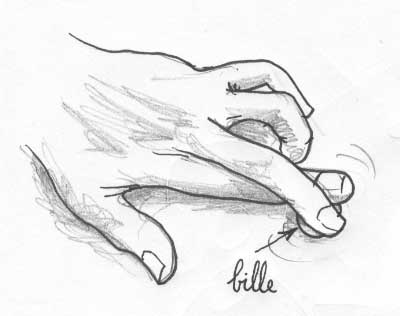
Let us take the sense of touch. You need an ordinary marble. Ask a "subject" to close their eyes, to cross their fingers then to roll the marble like this, on a support where it is not likely to slip. You can at a pinch make a very acceptable marble by kneading a piece of bread crumb.

- How many marbles are there? - Well... two! ...
You see, even the sense of touch is not reliable. All this leads us to a reflection of a philosophical order. Here, we limit ourselves to our sensory organs. Can you imagine that our conception of the world could present the same aspects? I believe that in all that has been presented to us, the most astonishing experience concerns the shades of gray in the case of the green cylinder placed on the checkerboard. There is no "explanation". We move our optical axis, concentrating the image on the part of our retina richest in receptors of all kinds. It is an angularly very restricted zone. You can realize this simply by reading. You move your optical axis over a text. If you decide, suddenly, to stop on a word you will find that your capacity to recognize neighboring words is then very weak. An experiment would consist in changing the context of a word manually, an assistant taking charge of the operation. A change which would for example modify the meaning of the sentence or simply introduce spelling mistakes. Up to what "angular deviation" would you be able to detect them.
In fact, when we use our vision, when we do shape recognition, it is as if we were moving a flashlight beam around in a dark room. By proceeding quickly we can form a certain idea of the objects we have before our eyes, although at each instant we are capable of seeing only a very small number of them, or even just one. Our optical axis jumps from one to the other, and lingers on each object until its shape has been identified, considered as recognized. Then we memorize it and move on to the next object.
Another experiment: observe a text by interposing the fingers of your hand, arranged in a fan. When this obstacle is fixed, reading is impossible. Move your hand quickly. There you go, you can read.
To improve our performance our eye muscles are the seat of a fibrillation. Our optical axis is not fixed, it "trembles". We are moreover more sensitive to variations ( of luminosity, of color ) than to their intrinsic values. When I was at Supaéro I had a classmate who was affected by an excessive, congenital tremor of his optical axis. When one looked him in the eyes it was .. stupefying. His irises trembled in a spectacular manner. Yet he managed to read very well.
Conversely, for ages an experiment has been done consisting in moving the object looked at and making it follow the angular excursions of the optical axis. It suffices to fix the subject's head and to carefully locate the position of his iris and his pupil with a camera. Then servo motors move the target so that the "aimed point" really coincides with a cross. Result: the subject becomes almost blind, because the objects become *really fixed. *
All this "worsens" in any case as soon as one moves away from the foveal spot. This is the reason why, in an experiment shown above, when one stares at the central cross, the purple spots "switch off". Because they then correspond to fixed signals.
At the retinal periphery it is important to detect the slightest movement. It is a question of survival. That is how we can avoid, when crossing a square, being run over.
All those who have done parachuting remember their first jump. When I was young one jumped from a canvas "Dragon", which is the biplane seen in an old de Funès film. We climbed onto the wing by grabbing two struts and we dived into the void, backwards, crossing our arms over the "ventral", reserve parachute which is now housed at the bottom of a single back pack. The wind of the propeller immediately made us roll onto our backs, until the pull of the SOA, of the automatic opening strap, put our nose back toward the ground.
The author about to pass through a cloud
During these first jumps one distinguishes nothing. When it is dark, one is facing the ground. When it is light blue one is on one's back and looking at the sky. It is only after a few jumps that the eye learns to fix on objects visible on the ground: a car, a cow in a meadow. Then we can reconstruct a mental image of the scenery.
Do a simple experiment. Turn around while forbidding yourself to fix your gaze on objects. You will no longer distinguish anything precise.
It is the same for our conception of the world. We have in our head a batch of expected signals. When a perception, a concept, an idea departs from what we are capable of imagining, all this does not even reach the level of our consciousness, being unconsciously classified at the level of optical illusions ( "it is not true, I am dreaming" ). We are permanently the object of a very active mental censorship.
Quite a few years ago I was in Aix en Provence with a woman whom I loved very much. Her name was Marie-Dominique, but we called her Marie-Do. You know her: she is the blonde Sophie of Anselme Lanturlu's comic strips ( minus the round-framed glasses that I had added to make it more intellectual ). She died about twenty years ago of a hepatitis contracted in the bush dispensary that she had founded, in Africa.
One evening I suggested an experiment to her: to go from her home to mine, naked. Flat out. We put our clothes in a tote bag and left her studio, located on the top floor. It must have been near midnight. We walked at a brisk pace. Thus we were visible to the people we passed only for a fairly brief lapse of time.
Immediately, we passed in the stairway a couple of neighbors returning from a dinner.
- Good evening Marie Dominique... - Good evening madam....
No cry of surprise, nothing. We looked so natural that these good people must have thought that they had doubtless eaten or drunk something that had created this hallucination and it is very probable that they did not even speak of it among themselves after having had this brief vision, for fear of passing for people affected by the beginnings of a mental illness.
Hide this breast, which I could not see
The same phenomenon was reproduced throughout the crossing of the city which, at that time and in that neighborhood was little frequented. It reminded me of a scene from the film " Little Big Man " where Dustin Hoffman takes his Indian adoptive father. They cross a field where Yankee soldiers are engaged in an abominable massacre. But, strangely, these seem not to see them. And Dustin's adoptive father, who is blind, says "it is normal, we have become invisible".
Marie-Do and I had become "invisible" because we had adopted an inconceivable behavior ( at least at the time ).
There exists a phenomenon of "intellectual blindness". If an event is too inconceivable, we reject it, quite simply.
Even if it is true, it is false, said the surrealist Picabia
I think that the events of September 11 are part of this set and I will have the opportunity to return to this by detailing the document distributed by the courageous team of Jimmy Walter. I think moreover that if human beings do not accept, quickly, this "inconceivable" set humanity will be very badly off. But, conversely, if human beings become capable of facing their own monstrosity then they will perhaps stop voting, endorsing the acts of the poor mentally ill who govern them.
I will have the opportunity to detail, sentence by sentence, the speech of the "sociologist" Pierre Lagrange, excerpted from the film " September 11 did not take place ", produced and broadcast by the Arte channel which, strangely, mixes information and disinformation. One could even say that it is its specialty. You will be astonished by the sentences that a man who calls himself a sociologist manages to pronounce.
**March 17, 2006 **
Here is a game which consists in counting the black dots of this mesh. Answer below
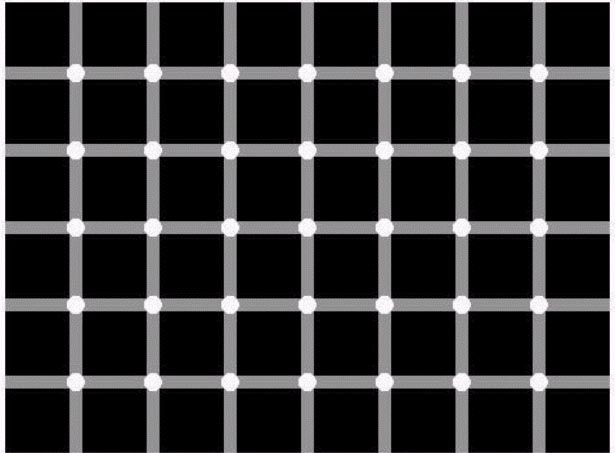

**This writing is: **
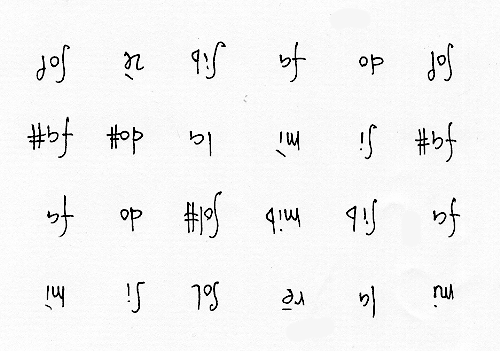
**Coptic? Balinese? Merovingian? Other? **
**Answer: **

The dancer:
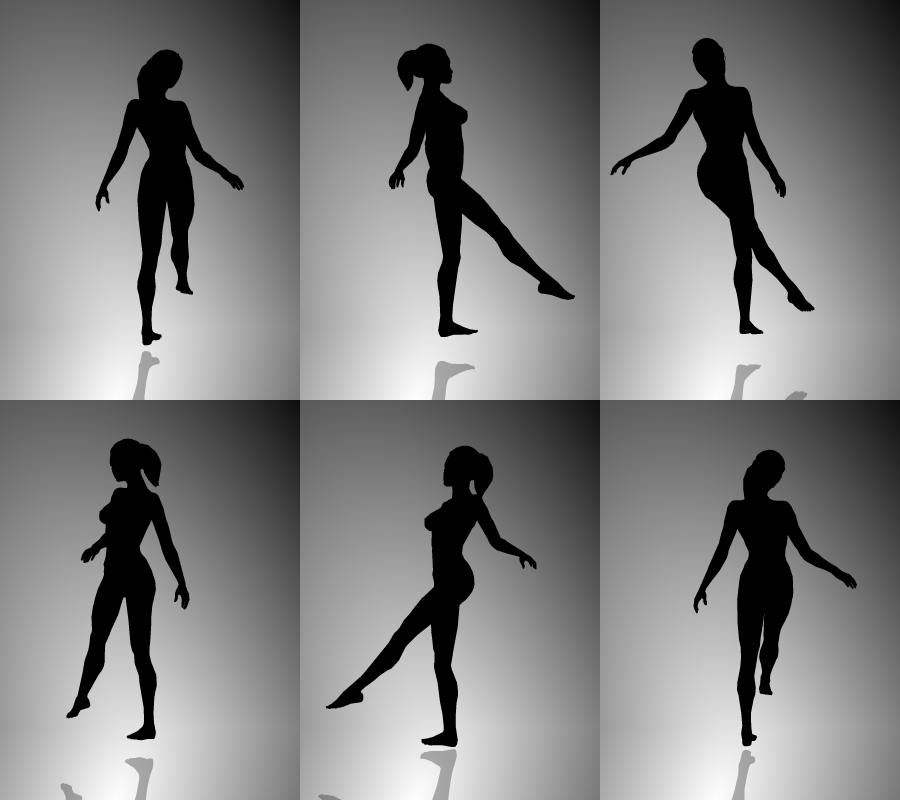
In which direction is she turning?
If you think " clockwise " you are a "right brain"
Otherwise it is the opposite....
Train yourself to perceive the movement in both directions.
**And there, these spirals are ... circles. **
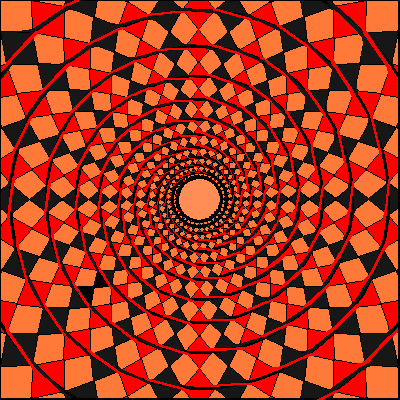
Move away. From afar, one sees the circles...
Counter initialized on February 2, 2006 . number of consultations: