The Inflatron, page 3: Debt
Debt
May 12, 2008
We saw that when "a country is not functioning well," and its balance of payments is in deficit, a solution was the devaluation of its currency. Four decades ago, when my friends and I rented the Inflatron to try to perfect and improve it, we had introduced this mechanism of improving the balance of payments through devaluation. As I said on the previous page, this illustrates the system of chain devaluations among countries that are strongly linked by their trade.
This game, with its fixed incomes, is primitive and insufficient. Someone would have to program it by introducing not fixed incomes, but profit rates for the squares. Players could then increase their investments by valuing certain squares, and by investing their profits. To do this, we have to reintroduce "the outside world," that is, "outside the game." At a certain point in the game, a player has liquid assets. We would have to introduce rules under which he could "bet on a square," a move performed by taking this money out of the game.
For example, a player bought a square for 20,000 that yields 30% (but not 30% per year!). This means that if the chance token falls on this square, it will yield a third of his investment. However, we must not forget that the probability of landing on a particular square increases with the number of turns. A turn (a year) consists of 7.5 dice rolls. On a day, there is a 7.5/26 chance of landing on a particular square, which is 0.28. By taking the inverse of this number, we find 3.5 years. This is the average time that will pass before having a "return on investment." A figure that is not so bad.
Let's go back to the case of this square bought for 20,000 that yields 30%... when it is landed on. In fact, its average annual income will be 30% divided by 3.5, which is 8.5% annually, not guaranteed!
A game thus perfected would allow investments, always with the factor of chance or misfortune, an inherent component of economic activity.
A player who has become rich can reinvest his gains by putting money back into a particular sector. We see that he is then faced with a choice. He has several profitable squares, each with different profit rates.
The "Fifth Player"
There would be, in principle, another way to improve one's productive system, by increasing investments: borrowing. We then discover the banking mechanism. A bank performs several functions.
-
It protects money from theft. A bank can thus receive money from depositors. These depositors can pay for this service by renting a safe. This deposit is then paid.
-
But a bank can perform financial operations with the money thus deposited, thanks to the flexibility provided by the amounts deposited by its savers. It will encourage them to deposit their money by rewarding these savers, who will say "my money works for me."
-
The first thing a bank can do is to lend the money deposited by some... to others. At an interest rate higher than that corresponding to the income of the savers.
-
Another function: making possible credit purchases. This is "consumer credit," which is not accounted for in the game.
-
Finally, another function: lending money to entities that wish to improve their situation, modernize a production or exploitation tool.
From this angle, we could create a "fifth player" in this game. We could then have him appear at the beginning with... empty vaults. What could encourage players to entrust their money to the "banker"? A guaranteed interest over time, for example, annually. While investing, one would have to wait on average 3.5 years for this investment to "pay off." And that is just an average figure.
This economic game is, in principle, very rich and would require development. I am not sure that a fifth player could be added to a game with 26 squares and 4 players. It's worth trying. A bank can also... go bankrupt.
A country can grant a loan to another country, setting an interest rate and a maturity. The bank intervenes to gather deposits and focus them on a specific borrower.
We have perceived, through the functioning of the Inflatron, the fundamental instability of the international monetary system. Immediately after the war, the victorious countries undertook to rebuild the international economic system. These were the 1944 Bretton Woods agreements (a meeting held at the Washington Hotel in the United States). Very quickly, these agreements led to the creation of the World Bank and the IMF (International Monetary Fund).
In principle, the World Bank is under the control of the Americans. The IMF is supposed to be managed by the Europeans (the current president is the Frenchman Strauss-Kahn). However, unless I'm mistaken, very tight constraints are imposed on it, for example, to block decisions and exercise a veto. This should be verified, but I believe that for a measure to pass, the IMF requires 85% of the votes of its member states, weighted by the "weight of each of these states," measured by their initial deposits. These member states become, in a way, "shareholders" of this "bank," if we translate "shareholder" as the ability to act. The problem is that (again, unless I'm mistaken, this should be verified) the United States "weighs" 17% of the IMF. Therefore, if other member states wanted to pass a measure against American interests, they could only gather 100 - 17 = 83% of the "weight" of this institution. With this 85% clause, the US would have a de facto veto, being able to block any decision they dislike, on their own.
I will mention in passing that the president of the World Bank was the famous one, appointed by George Bush, who had to resign following an accusation of corruption.
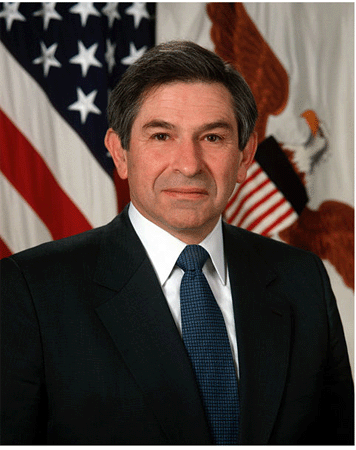
**Paul Wolfowitz, who was president of the World Bank.
Also a promoter of the "A New American Century" project **
http://fr.wikipedia.org/wiki/Affaire_Wolfowitz#R.C3.B4le_.C3.A0_la_Banque_mondiale
This set of World Bank plus IMF evokes this "fifth player." The game can simulate certain phenomena, such as the debt of poor countries.
The game can help the reader understand where "debt" comes from. A bank is not a philanthropic organization. It can behave like a predator, even on an international scale. The debt mechanism puts the debtor under the control of the creditor.
The World Bank and the IMF "help developing countries" by "lending them money." At what rate? &&&. To more informed readers, we ask you to provide us with this information. With these loans, developing countries are supposed to modernize their economy, their production tools, and improve their management. In reality, many are unable to make this transformation. They are forced to take on more debt. Often, they have to borrow to pay the interest on a debt they cannot repay. Here are the most important debts. Mexico is at the top. Why? &&&. Let a reader explain it to us.
![...]