Technological hyperspace transfer.
...But two neutron stars, forming a binary system, can merge suddenly, which would correspond to the “hard” scenario of mass transfer to the twin universe. Then the “throat” of the space bridge could extend at relativistic speeds, absorbing most of the mass and transferring it to the twin universe. Such a violent process would generate intense, short-lived gamma-ray bursts and gravitational waves. Essentially, hyperspace transfer reverses the “apparent mass.” Theoretical physicists will find justification for this in papers dealing with the geometrization of the twin universe via group theory. As demonstrated in a paper on our website, the twin universe exhibits CPT symmetry relative to our universe. As shown by J.M. Souriau in 1972 [15], T-symmetry goes hand in hand with M-symmetry. Particles traveling through “reverse time” contribute negatively to the gravitational field. However, the excess mass transferred to the twin universe remains self-attractive and can form a compact object there after transfer. ...Some residual mass might remain in our universe, now repelled by the transferred mass. This self-attractive material could be kept at bay by this newly formed “twin neutron star.” I’ve proposed that “proplyds” might be remnants of neutron stars that have transformed into twin neutron stars. Thus, the twin universe would contain two types of objects: massive proto-stars and transferred neutron stars (or gas dispersed via gentler hyperspace transfers). If this idea holds true, black holes wouldn’t exist. Some proplyds might even be cold. After a massive mass transfer resulting from the merger of two neutron stars, the remaining mass may be too small to generate any energy via contraction. Isolated, this gas would cool rapidly to reach the universal background temperature of 2.7 K. Will we ever find cold proplyds? ...One final note: after being transferred to the twin universe, this still self-attractive matter is repelled by any mass present in our universe. In cases of gentle mass transfer, the transferred gas gets expelled from the galaxy. In the case of the “hard” transfer scenario—where two neutron stars merge—the transferred mass is likewise repelled by all ordinary matter, including the cloud in which the process occurred. This means proplyds could potentially be found outside massive clouds like those in Orion.
6 – Technological hyperspace transfer.
...If the fundamental physical constants undergo significant changes due to a sharp rise in pressure (energy density), we can explore how such an increase in energy density might be achieved locally. Atoms and molecules possess metastable states; helium, for instance, has a well-known metastable state. By supplying energy to helium, we can store considerable amounts of energy in this manner.
...Similarly, atomic nuclei also have metastable levels. Imagine a spacecraft emitting a shell of gas:
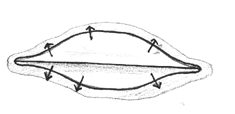
Fig.11: The spacecraft emits a shell of gas.
...Subsequently, wall-grasers emit powerful pulses of gamma rays, which are absorbed by the nuclei within the gas. If these nuclei are in a metastable state, they’re unable to dissipate this energy, thus reaching a critical threshold.
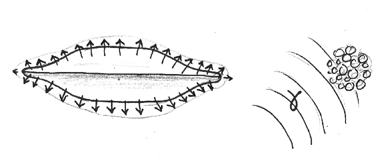
Fig.12: A wall-graser emits gamma rays; their energy is stored in the metastable states of atoms.
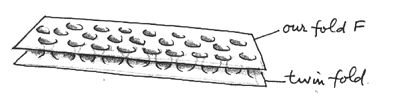
Fig.13: 2D analogy: tiny space bridges form, connecting the two “folds” F and F (our universe and the twin universe).*
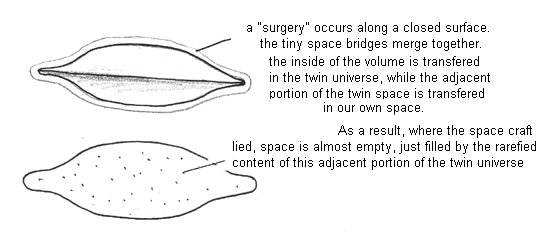
Fig.14: These tiny space bridges merge together, forming a closed surface; the contents of this volume and the adjacent volume in the twin universe are then exchanged.
...This void would quickly be filled by air. Recall that hyperspace transfer reverses the “apparent mass.” What happens to the spacecraft after it jumps into the twin universe? To its occupants, Earth has vanished (photons can’t traverse from one “fold” to another due to geometric constraints). To observers on Earth, the spacecraft appears to have disappeared as well.
...Rather than being drawn toward Earth by gravity, the spacecraft is repelled by this “invisible Earth.” If hyperspace transfer occurs repeatedly, the craft returns and falls back to Earth. Frequent alternations between hyperspace transfers would produce a “zero-gravity effect,” stemming from both motions: a descent in our universe and an ascent in the twin universe. This is my interpretation of “anti-gravity.”
...Moreover, this rapid reversal of apparent mass generates gravitational waves. Spacecraft could communicate via gravitational waves, generated simply by shifting the location of masses through localized hyperspace transfers.
...Below is a 2D analogy illustrating this concept of hyperspace transfer and the exchange of contents between the two “folds” F and F*. In this 2D world—a “flatland”—a spacecraft is represented as a closed curve (a circle, in this case).
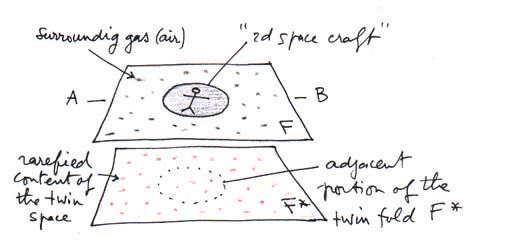
Fig.15: Schematic depiction of our universe and the twin universe, highlighting adjacent regions.
...To demonstrate curvature alterations, let’s cut the plane along the AB line:
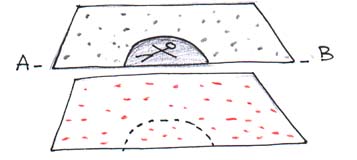
Fig.16: Cross-section of Fig.15 along the AB line.
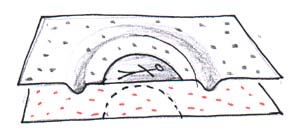
Fig.17: Space begins to curve along a closed path.
...We haven’t depicted the emitted gas, which would surround our “2D spacecraft.” Absorption of gamma-ray energy by atoms in metastable states causes space to curve accordingly. Tiny space bridges emerge:
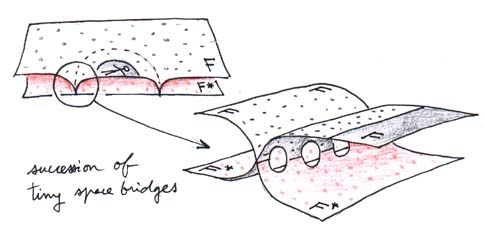
Fig.18: Tiny space bridges form.
...A “geometric surgery” occurs, radically altering connections between various surface sections.
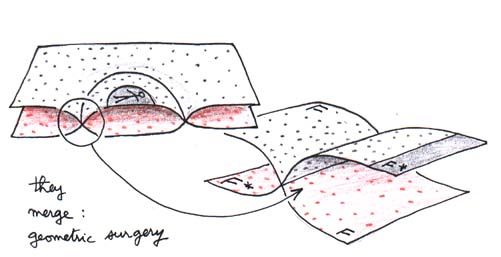
Fig.19: Post-“geometric surgery” state.
...Different colors help illustrate how twin particles (depicted in red) are transferred to fold F (representing our universe); meanwhile, the spacecraft and surrounding air now reside in the corresponding region of the twin universe:
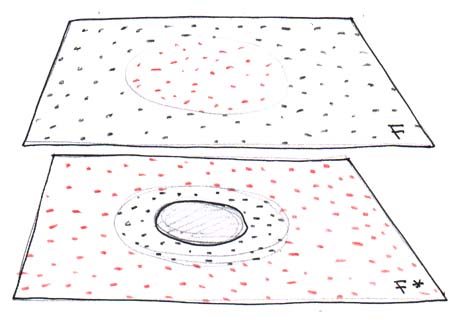
Fig.20: How the various surface sections/universes are now interconnected.
...Quickly, air molecules in our universe fill the vacant space, while those transferred to the twin universe disperse. The outcome is as follows: Top: uniform air and space; the spacecraft seemingly “vanishes.” Bottom: the transferred spacecraft travels through the sparse environment of the twin universe.
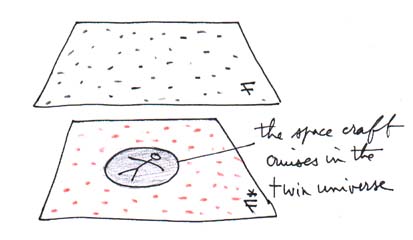
Fig.21: Twin matter and air molecules have departed from our universe; they now reside in the twin universe.
...This doesn’t resolve issues related to interstellar travel, even though light speed is significantly higher in the twin universe. It’s tricky to grasp that distances between points also change. Take two distant points A and B, observed from our universe; A’ and B’ represent corresponding points in the twin universe. Distance A’B’ is shorter than AB. Hence, aiming to travel between star systems yields dual benefits: shorter distances and higher velocities. Yet how do we accelerate? What propulsion mechanism suits our cosmic craft?
...I believe none exists.
...Energy and matter remain conserved in spacetime. This is evident in Einstein’s field equations (with zero cosmological constant). (34)
S = cT
...For any stationary mass, we can define a Compton length: (35)
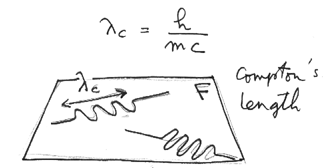
Fig.22: Compton length tied to a given mass—for instance, a proton.
...Suppose this particle forms part of our spacecraft. Transferred to a “smaller universe,” it’d experience a “Gulliver effect”: its size would appear larger to particles native to the twin universe (like hydrogen atoms, for example).
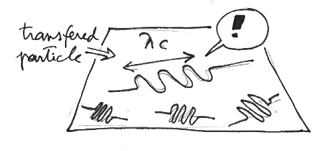
Fig.23: “Gulliver effect.”
...Such size variations indicate energy loss. Hopefully, hyperspace transfer will eventually be modeled using coupled field equations; quantum physics must also play a role here. Per Einstein’s equations, the divergence-free condition equates to energy-matter conservation. With coupled field equations (36-a)
S = c (T-T*)
(36b)
S* = c (T*-T)
this condition ensures energy-matter conservation across both universes, even during hyperspace transfers. From this, we might deduce methods for transferring particles to a “smaller” universe while maintaining their energy-matter integrity.
...Answer: Feasible if wavelengths shrink—i.e., if particles materialize in the twin universe at relativistic speeds.
...Don’t press me further; these are merely rough concepts. How to impart identical velocities to all spacecraft particles/passengers? Unknown. Perhaps manipulating spin prior to transfer?
...If this isn’t pure fantasy, a spacecraft could leap into the twin universe at relativistic speeds. Travel duration wouldn’t be nil, but considerably reduced. Planets situated 10–100 light-years away might become reachable in under a year.