7 - Possible interaction between our space and the twin space. A quasar's model ?
...We presently study possible joint metric variations. According to such an idea, the ratios of the distances, the ratio of local values of the velocity of the photons in the two universes, the ratios of all physical constants could vary over space and time. We know that only gravitational effects can be "observed" from our fold. If there is some joint metric fluctuation, we cannot experience it with some local physical experience, for the phenomenon modifies both the quantities that we would like to measure and the... instruments. A good image would be an attempt to measure the dilatation of a table made of iron, due to the variation of the temperature of the room, using a scale made of the same metal. The measured value would be unchanged.
...Extracosmological fluctuations would change the value of the "apparent masses", located in the twin space. We know (if we decide to believe in our model) that the galaxies are confined by some "invisible belt" : the surrounding and geometrically invisible twin matter, which produce a counterpressure effect on them. If a joint metric fluctuation changes the value of the surrounding matter density, two cases can occur :
-
If this density is lowered, the confinement becomes inefficient and we get an irregular galaxy.
-
If the density is raised, the confinement force is hardened. Then the mass of the galaxy undergoes a "gravitational compression". The map of the gravitational field is changed. A density wave may form in interstellar gas, ring like.
...A galaxy is a self gravitating system, in which stars and interstellar gas orbit in the gravitational field created by the whole mass distribution. According to our theory (which explains the flatness of the rotation curve of the gas at distance). We can figure it, in 2d as a fluid orbiting, circling inside some sort of flat basin :
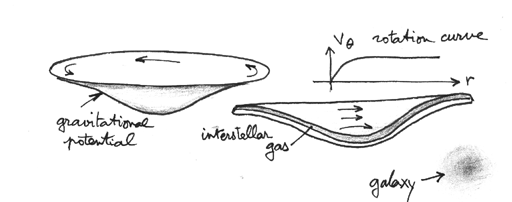
Fig.24 : A model of self-gravitating system : a fluid circling in a basin.
...A modification of the apparent mass of twin matter can be figured by a modification of the shape of the basin. If this apparent mass is lowered, due to joint metric fluctuations, we get :
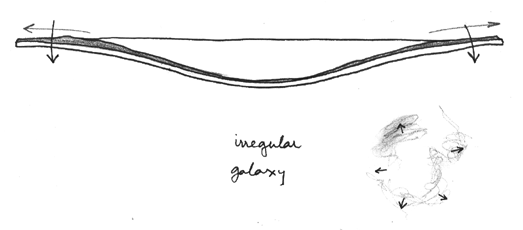
Fig.25 : Formation of an irregular galaxy
...Conversely, if the apparent mass of the twin matter is lowered, we get this :
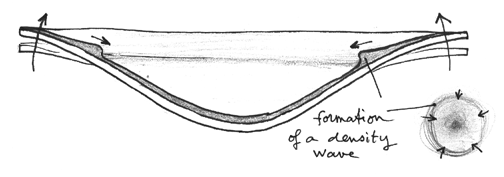
Fig.26 : Formation of a density wave, in gas, due to the "strengthening of the invisible belt", to the increase of the apparent mass of surrounding confining twin matter.
...On the next figure we suggest the convergence of this density wave towards the center of the galaxy. All around, the invisible surrounding and confining twin matter.
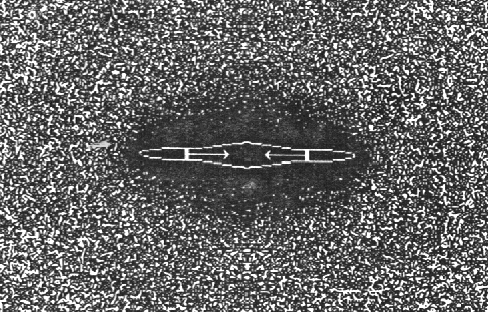
Fig.27 : Propagation of a ring-like density wave in interstellar gas.
.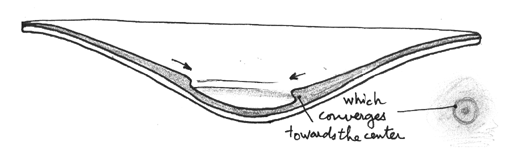
Fig.28 : Returning to the 2d hydraulic analogy : the circular breaking wave converges towards the center of the galaxy.
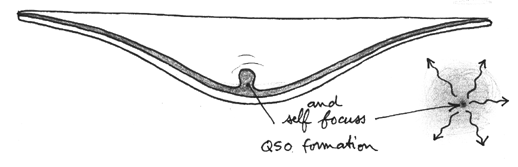
Fig.29 : The gravitational energy is now converted.
..A density wave behaves like a shock wave (for example the spiral arms of a galaxy) and trigger the birth of new stars, which emit in UV. These last ionize the surrounding interstellar gas. That's why we can observe spiral structures, where the gas reacts through fluorescence phenomenon. A galaxy owns a (weak) magnetic field. Schematically :
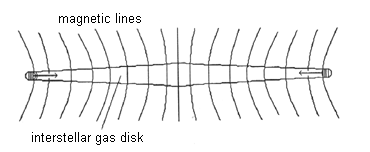
Fig.30 : Magnetic field of a galaxy. Schematic description.
...If the Reynolds magnetic number is large enough (its local value depends on the local value of the electrical conductivity of the gas) the ring of gas (the ring-like density wave) will pull the magnetic lines with it, as shown on figure 29.
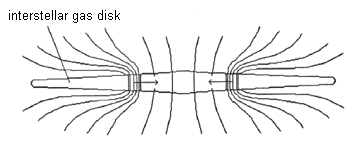
Fig.31 : The self-focussing of the ring-like density wave carries along the magnetic lines, "frozen in" the plasma.
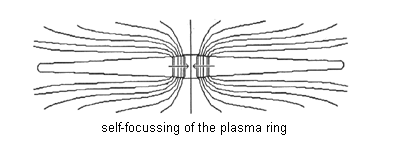
Fig.32: Here, the ring is close to focus at the center of the galaxy. The intensity of the magnetic field is reinforced.
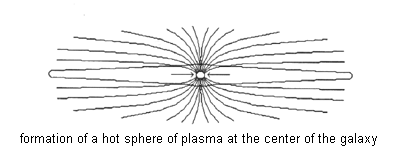
Fig.33 : The ring of plasma transforms into a hot sphere, in which the Lawson conditions are immediately reached. The gravitational energy, carried by the density wave, is now converted into thermal energy. Fusion occurs in the whole bulk of the plasma sphere.
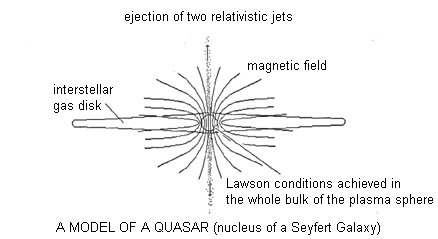
**Fig.34 :The (reinforced) magnetic dipole acts like a natural particle accelerator. Two beams form, where particles get relativistic velocities. We get a very decent model of quasar, of active galaxy's nucleus (Seyfert galaxy).
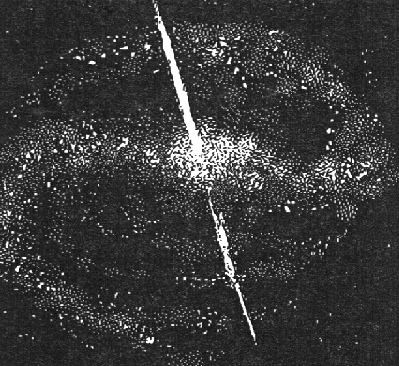
Fig.35 : How a galaxy could look like, after a QSO formation.
...There is something important to point out. Very small reinforcement of the gravitational confinement effect, due to the change of the value of the apparent mass of twin matter can create a density wave, which behaves like a shock wave, for the random velocities of the interstellar clouds (which plays the role of the sonic velocity) is small ( 1 km/s). Anyway, the involved energy is large enough to rise the temperature and the density of a sphere made of interstellar gas (as the result of the focussing of a ring-like density wave), into physical conditions corresponding to Lawson's criterium. Next : if these conditions are achieved in a sphere whose size is comparable to the size of the solar system, the emitted energy will correspond to typical QSO' energy emission.
...This is not such a stupid model for QSO, isn't it ? It implies an interaction between our universe and its twin brother, the "twin universe". What could be the observational test ? We think that this process changes the redshift value.
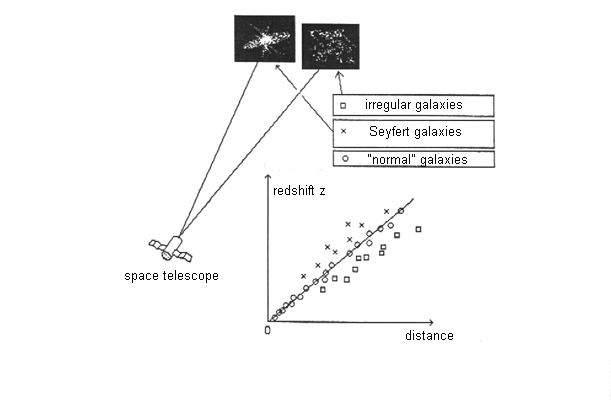
Fig.36: Conjectured relation between distance and redshift, for two populations: Irregular galaxies and Seyfert galaxies.**
...In a word, the two values of Hubble's constant, based on irregular and Seyfert galaxies would be significantly different.
...In general, as time passes, the "Hubble field" becomes less and less regular and isotropic. Turbulence arises everywhere, even if people call it "the effect of the Great Attractor", and so on. Then the question becomes:
- Does it correspond to a simple turbulence or is it the effect of a more complex machinery, involving interacting universes?
The future will bring the answer.
...What could be the effect on interstellar travels by "hyperspace transfer" and use of the twin universe as an express subway? If it is true, what would happen at large scale would hold at small scales too. Joint metric fluctuations can occur at any scales, so that, if travellers decide to use the twin universe as an express subway, they could find different physical conditions in this last, in time. At certain periods, the travel time could be shortened, at other ones, larger. If people of the Earth decide, someday, to explore neighbouring systems, through such technology, this exploration could strongly depend on some sort of "meteocosmic conditions", depending on the interaction of our universe and its twin.
7 -What is speculative and what is not?
...The reader will think: all that is very speculative. I will agree with him. But black holes, "giant", "typical" or "dwarf" are speculative too. The dark matter idea is still fully speculative. Why?
...We observe strong gravitational effects. As the observed mass, of galaxies and clusters of galaxies is too small to produce such phenomena, we conclude that this must be the absolute proof that dark matter is present in our universe and forms 90 % of its content. Notice, anyway, that twin universe theory offers an alternative interpretation [8]. ...These strong, anomalous gravitational effects were evidenced since 1985. One of the pioneers in this field is the French astronomer Meillier. With his colleague Fort (head of the Institut d'Astrophysique de Paris) he has developed a computational analysis of observed anomalous gravitational effects which is supposed to map the dark matter. Such first map, which corresponds to a square degree of the sky was presented by the two in 1999.
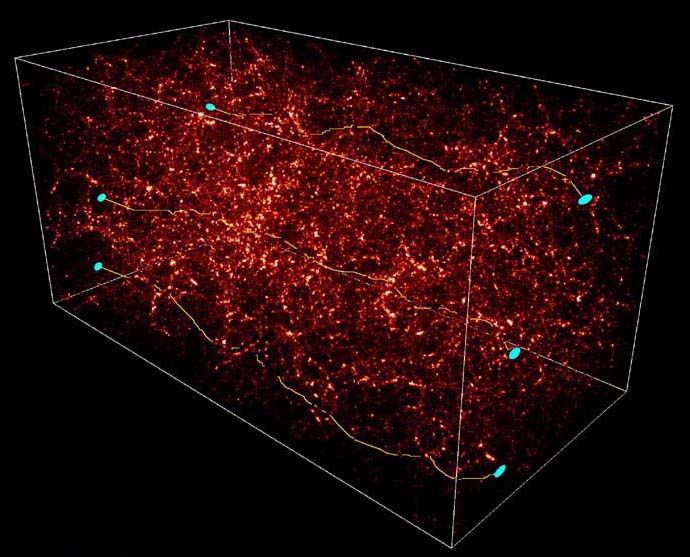
Fig.37: First 3d dark matter map, after Fort and Meillier, 1999.
...In blue, the clusters of galaxies. Red: the dark matter distribution. Yellow, the trajectory of photons. One year after Fort and Meillier revealed that their analysis arose some problems, since 1994, see the recent interview of Fort [16]. The analysis performed by Fort and Meillier revealed the existence of strong matter concentrations (up to 1014 solar masses) in completely obscure regions. One of those is shown on figure 38.
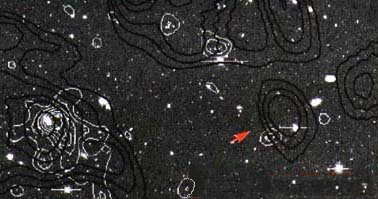
Fig.38: A "dark cluster", whose weight would be 1014 solar masses (red arrow). Left the Abell 1942 cluster of galaxies (CFHT picture.**
...Presently, Fort and Meillier have identified two "dark clusters" in a square degree portion of the sky (that's how they named these paradoxical objects). As suggested by Fort, such clusters would be composed only of "exotic matter" and he confesses how he is puzzled about the way such huge amount of matter could attract only exotic matter, no normal galaxies, nor gas, through gravitational force. If this is confirmed, the complete analysis of the sky would bring... 10,000 "dark clusters".
...As we see, the so-called theory of the dark matter is far from having been cleared up. Anyway, there are a lot of puzzling phenomena in the universe: QSO, gamma flashes, solar neutrino deficit, missing mass effect, "silent giant black holes", and so on....
..."Official" astronomy, astrophysics and cosmology have been converted into such a mess that any speculation becomes authorized. So, let's return to the twin universe theory, and "speculative" transfer of mass towards the twin universe, when a neutron star overcomes its stability limit. We said that in the case of binary neutron star collapse, the result could be a "twin neutron star", "located in the twin space" (and geometrically invisible), surrounded by remnant gas, located in our space. The dynamics of such a couple is definitively unconventional. The surrounding gas, self attracting, being repelled by the invisible central object. Far from any energy source, it would rapidly cool by radiative process, and get the temperature of the general cosmic oven (2.7 °K). Do such cold clouds exist? Good question, to be asked to astronomers.
...If they do, what could be the impact on such a cloud of joint metric fluctuations, which would modify the apparent mass of the small central object. We are presently studying that, with my colleague Pierre Midy. As far as we can see, this would cause induced electromagnetic effects in the cold gas, which would be submitted to a time dependent magnetic field. This one would polarize the filaments of solid material composing some of those cold clouds. When the magnetic field would be reversed, its value would be zero, during a relatively short time. That would make the polarization to disappear and cool abruptly the temperature of the gas bulk, close to zero Kelvin, due to nuclear magnetic resonance effect. All that could be measurable, if it occurs, of course.