Certainly, Iranian nuclear sites
Tensions with Iran
January 26, 2005
One of my readers has sent me a translation of a text regarding Iran’s response strategy.
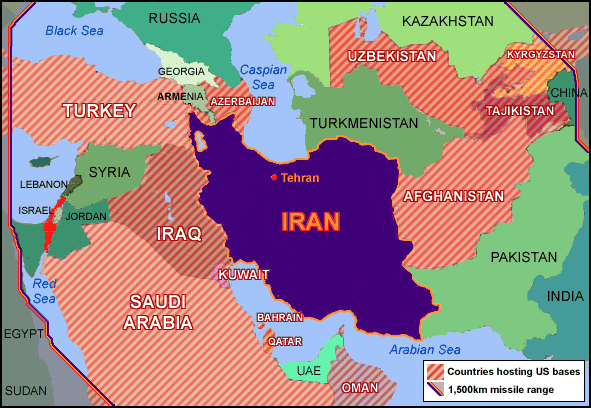
Shaded areas: countries hosting U.S. air bases
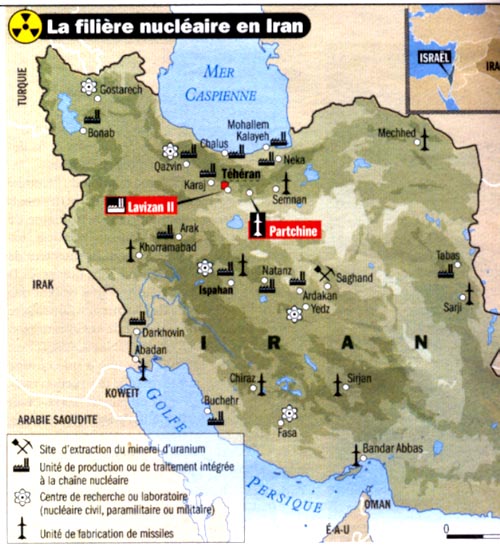
Iran's nuclear program
How Iran will respond. What an Iranian political scientist based in Tehran writes.
By Kaveh L. Afrasiabi, Professor of Political Science at the University of Tehran.
From ASIA TIMES. December 16, 2004. http://www.atimes.com/atimes/Middle_East/FL16Ak01.html
TEHRAN – While recent media reports suggest that the United States and Israel may be planning military operations against Iran, Iran is not wasting time preparing its own countermeasures in case an attack materializes.
A prolonged week-long combined land and air exercise has just concluded across five western and southern provinces of Iran, captivating foreign observers who described it as a "spectacular" display of high-tech, mobile operations, including rapid deployment forces equipped with helicopter squadrons, aerial maneuvers, missiles, as well as hundreds of tanks and tens of thousands of well-coordinated soldiers using live ammunition. Simultaneously, approximately 25,000 volunteers have already registered at newly established recruitment centers for "suicide attacks" against any potential invaders—what is commonly referred to as "asymmetric warfare."
Behind the strategy regarding a hypothetical U.S. invasion, Iran will likely recycle the scenario of the 2003 Iraq War, where a dominant force—particularly the U.S. Air Force—achieved rapid victory against a far weaker power. Iran has learned much from the 2003 Iraq War, as well as from its own valuable experiences during the 1980–88 war with Iraq and the confrontation with U.S. forces in the Persian Gulf from 1987–88. Iranians have focused on the merits of a fluid and complex defensive strategy designed to exploit certain weaknesses of American military superpower while maximizing the limited locations where they can gain advantage—such as numerical superiority in ground forces, guerrilla tactics, terrain, etc.
According to a widely circulated article in the U.S.-based Atlantic Monthly titled "Iran's War Game," the estimated cost of an attack on Iran is merely tens of millions of miserable dollars. This figure is based on a single "surgical" strike involving missile attacks, aerial bombing, and covert operations, without factoring in Iran’s strategy, which precisely aims to "expand the theater of operations" in order to impose escalating costs on the invader—such as targeting the U.S. military command structure in the Persian Gulf.
Following this Iranian version of a "follow-up" counter-strategy, the U.S. intention to conduct a limited war aimed at neutralizing Iran’s command system as a prelude to systematic attacks on key military targets would be countered by "bringing the war to them," according to the words of an Iranian military strategist who emphasized the fragility of America’s command structure in the southern Persian Gulf region. (Over the past few months, U.S. fighter jets have violated Iranian airspace in Khuzestan province several times, reportedly testing Iran’s air defense system, according to Iranian military officials.)
Iran’s proliferation of an extremely sophisticated and mobile ballistic missile system plays a crucial role in its strategy, once again drawing lessons from the Iraq wars of 1991 and 2003: in the first war over Kuwait, Iraq’s missiles played a significant role in expanding the conflict to Israel, despite the U.S. Patriot missiles failing to intercept most of the Iraqi missiles raining down on Israel and, to a lesser extent, on U.S. forces in Saudi Arabia. Moreover, as admitted by the U.S. commander in the Kuwait conflict, General Norman Schwarzkopf, tracking down Iraq’s mobile missiles consumed substantial resources of the coalition’s air strategy and was as difficult as "finding needles in a haystack."
Today, in the evolution of Iran’s military doctrine, the country relies increasingly on long-range, highly accurate missiles, such as the Shahab-3 and Fateh-110, capable of striking targets in Tel Aviv, echoing statements by Iranian Foreign Minister Kamal Kharrazi.
Chronologically, Iran produced the 50-kilometer-range Oghab artillery rocket in 1985 and developed the 120-km and 160-km range Mushak artillery rockets in 1986–87 and 1988, respectively. Iran began assembling (locally licensed) Scud-B missiles in 1988, and North Korean technical advisors converted a missile maintenance facility into a production plant in 1991. However, it does not appear that Iran has begun producing Scuds. Instead, Iran has focused on developing the Shahab-3 and Shahab-4, with ranges of 1,300 km (carrying a 1,600-pound warhead) and 2,000 km (carrying a 220-pound warhead), respectively. The Shahab-3 was tested in July 1998 and may soon be upgraded to over 2,000 km, enabling it to reach the heart of Europe.
Thanks to additional revenues from high oil prices, which constitute over 80% of the government’s annual budget, Iran is no longer constrained by the budget limitations of the early and mid-1990s, when its military spending was nearly ten times lower than that of its Arab Gulf neighbors, who are members of the Gulf Cooperation Council. Almost all Arab states possess other types of advanced missile systems—for example, Saudi Arabia’s CSS-2/DF, Yemen’s SS-21, and Iraq’s Scud-B and Frogs-7.
There are several advantages to Iran possessing a ballistic missile arsenal: first, it is relatively inexpensive and domestically produced with minimal external dependence and pressure from U.S.-imposed "missile export controls." Second, missiles are mobile and can be hidden from the enemy and third parties, offering relative advantages over jet fighters requiring fixed air bases. Fourth, missiles are considered highly effective weapons that can be launched with little warning, especially the solid-fuel Fatah-110 missiles, which require only a few short minutes to prepare for firing. Fifth, missiles are weapons of confusion and disruption; a single launch capability can undermine even the best military plans, as seen in how Iraqi missile attacks...