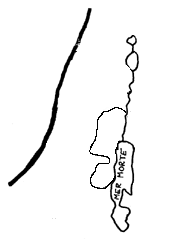
About the Gaza Evacuation
August 18, 2005
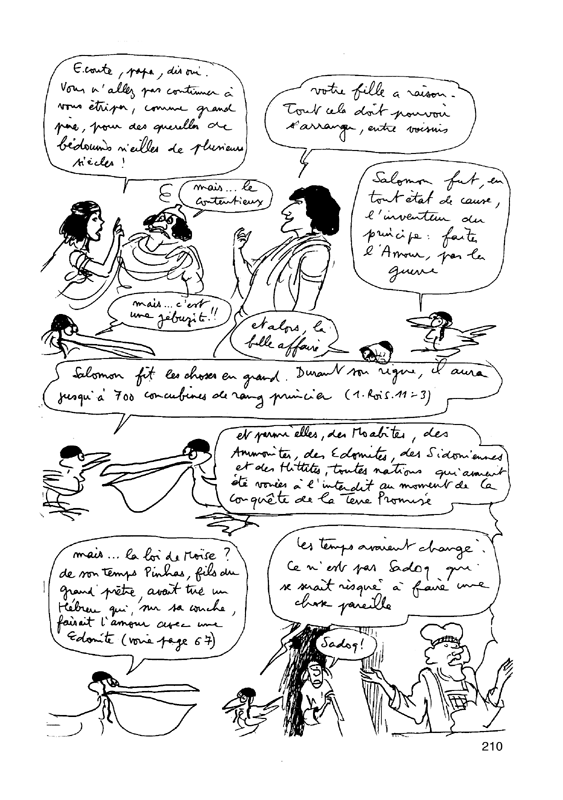
- page 4 - You remember that I had suggested to solve the Israeli-Palestinian problems: to sponsor mixed couples. I believe King Solomon would have been exactly of this opinion. The main quality of this great king was tolerance (which did not exclude firmness, but a deterrent firmness... which he never had to exercise )
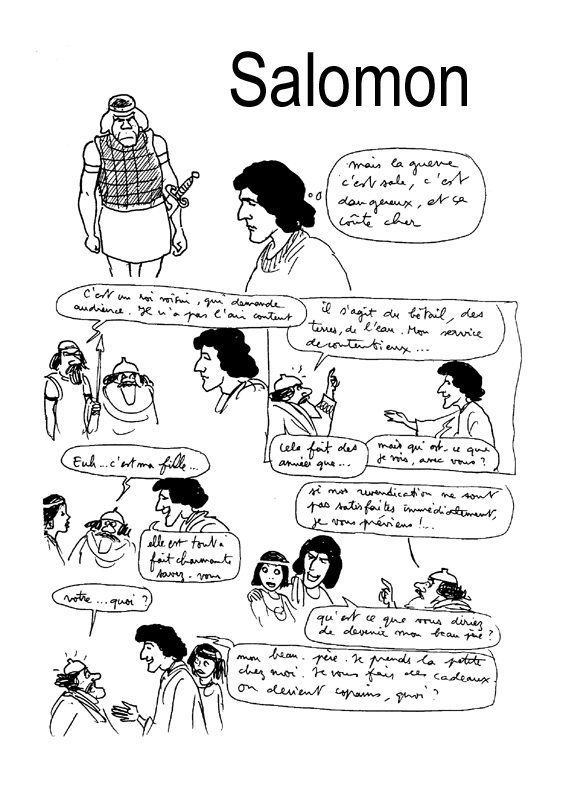
High Priest Zadok, remembering that Solomon had firmly put his predecessor, who had conspired against him, in his place, kept carefully in check, knowing well that his king was "a iron hand in a velvet glove".
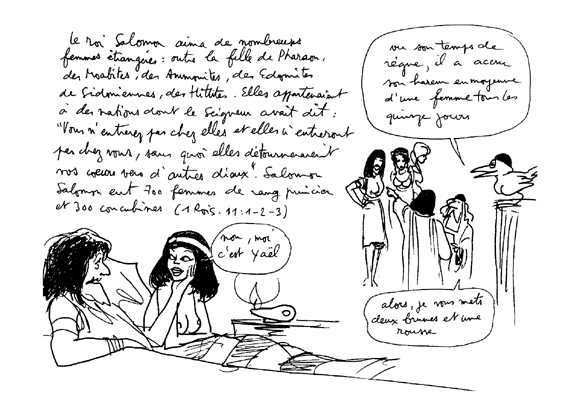
Solomon traded with all his neighbors. He imported metal arts from Phoenicia, married a princess from Sidon, a people who worshipped the goddess Astarte. He received with great ceremony the Queen of Sheba (who apparently lived in Yemen), established solid relations with Hiram, king of Tyre, whom he made his best friend. This one provided him with wood and foundry works.
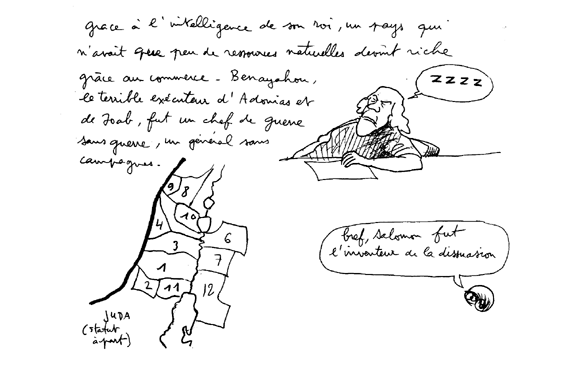
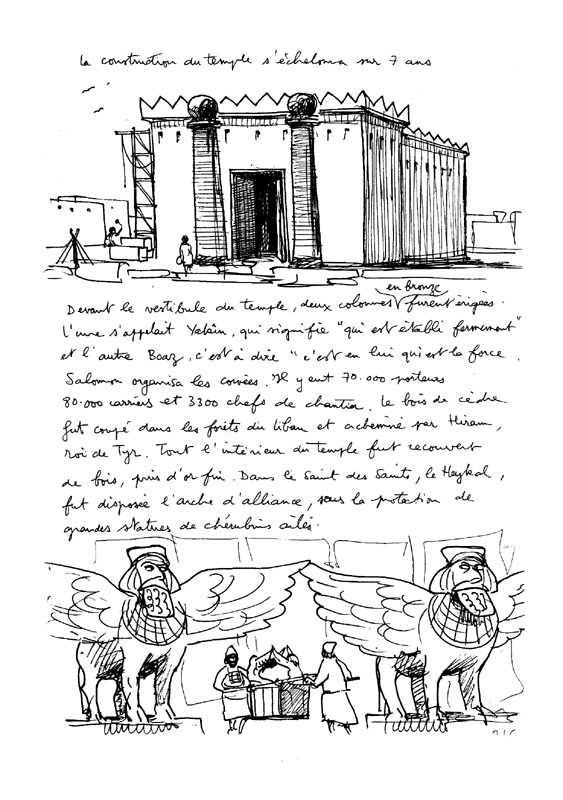
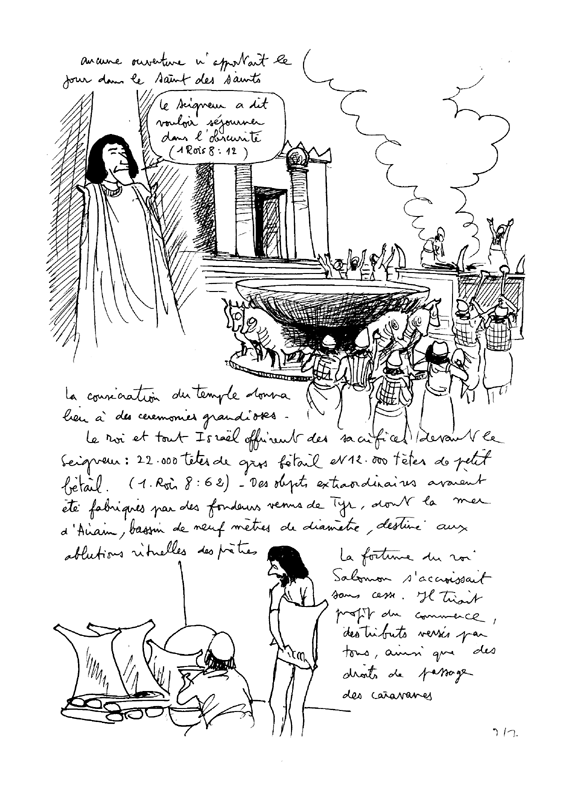
Additionally, Solomon carried out a political redrawing of the country, not taking traditional territoriality into account, so that the tribal leaders would leave him in peace. He sacrificed to the religious custom by building a magnificent temple that left a mark on all memories and where spectacular ceremonies could be held.
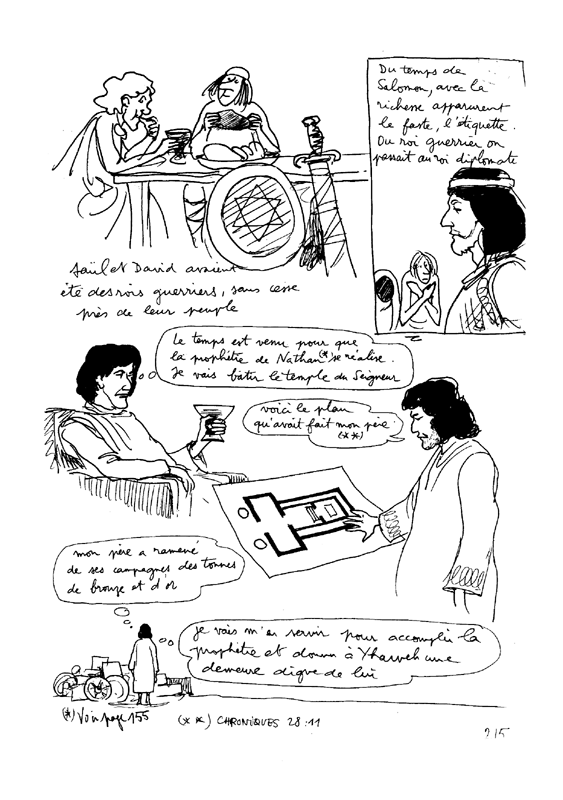
Of course, all this was not very in line with the Law of Moses, but it must be acknowledged that Solomon's reign, which lasted thirty-seven years (from 970 to 933 BC), was one of the most peaceful in world history. All this was at the expense of religious orthodoxy.
Solomon allowed many foreign cults to be practiced in Jerusalem itself.
If Solomon were king of Israel today, he would consider and propose a project as absurd as seeing coexist on "the Temple Mount", formerly the Jewish temple of Herod the Great, mosques and a rebuilt Jewish temple. This would even impose itself as an obvious solution for him, to bring peace to the country.
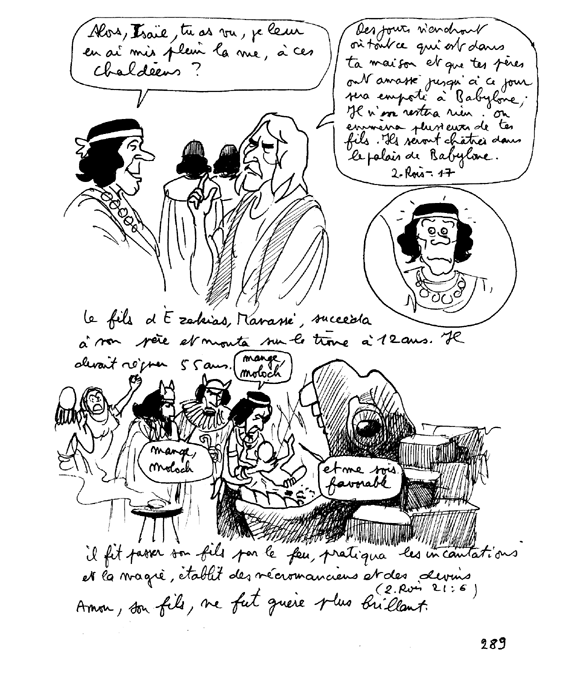
Asa died and everything collapsed into complete chaos. The kingdom of Israel even split into "Israel-North" and "Israel-South". You will read in the following of the Bible the innumerable convulsions of this kingdom of Israel, which experienced many deviations. Some of its successive kings even engaged in ... human sacrifices, like Manasseh, son of Ezekias, who reigned 55 years (Bible, 2 Kings: 21,6) image b289.
Historical deviations, religious, palace intrigues, two deportations to Babylon. Return, re-taking control. In the end, Rome conquers the world. Israel falls under its yoke, attempts a last revolt, in 72, and then in 132 after Jesus Christ. This will be the definitive diaspora, the Romans even changing the name of Jerusalem to Aelia Capitolina, after having razed the immense temple built by Herod the Great, in 50 BC (whose remains, do you know, today constitute "the Temple Mount", the Omar mosque having been built on the very site of the Jewish sanctuary).
The history of Palestine then merges with that of the Muslim Empire. After the war of 39-45, Jews from all countries urgently asked to recover a land that could become for them a refuge, an asylum that would protect them from pogroms, holocausts like the one attempted by the Nazis in their horrible "final solution". I have traced in another file the modern history of Palestine, a country created from scratch in 1947 by the UN. Among the initial measures adopted, Jerusalem became an international territory, which had its logic since three religions have their foundations there: Jewish, Christian, Muslim). An enclave that would have then been administered by the United Nations.
But the project failed immediately. The Arab countries, lacking realism and underestimating the tenacity of the Israelis, tried several times to push them back to the sea. Not only were these operations failures, but they plunged the Israelis into complete paranoia (comprehensible) and led them to annex and control increasingly larger territories.
One knows the rest. It is now necessary to build a solution to catch up with this real historical disaster. It starts with the evacuation of the Gaza Strip. The rest will be a matter of negotiations between the two parties, outside of any religious fanaticism. If I have put this file together, it is to remind that according to the Jewish tradition itself, the territory of Gaza, former land of the Philistines, was only integrated into the Jewish world during the time of the "Great Israel", that is, during the reign of Solomon. Some Orthodox Jews advocate for Israel to be restored to these borders, and for this, an intensive colonization has been pushed "for so-called religious reasons". What they forget to mention in passing is that Solomon, while maintaining the most complete peace for thirty-seven years, practiced the most unrestrained ecumenism, allowing the most exotic cults to have their own temples and cults in Jerusalem itself.
Is religion a factor of unity or of disunion, of disorder? One is entitled to ask the question.
It is a fact. At the current time, many religious currents are systematically radicalizing. This is true for the Muslim religion, but it is also true for the Jewish religion, as well as for the Roman Catholic religion (cf the personality of the new Pope, Benedict XVI, whose broad-mindedness is not immediately evident) and the evolution of the fundamentalist Protestant movement in the United States (Methodist, Baptist, Pentecostal branches, among others). One can consider this, within the peoples (in the political spheres it is another matter) as a kind of desperate response to the absence of moral and political values. Nations are disgraced, political classes reveal more and more their cynicism and corruption. Elsewhere, the most primitive tribalism is unleashed. The ruling classes can no longer hide their fundamental selfishness. On national flags, bloodstains reappear, the stories, under the facts of war, reveal their hidden vices. Under the words "Liberty" and "Democracy", powerful countries try to impose neo-colonial regimes without shame. Moral values are drifting. Famine prevails. Childhood is insulted. The concept of family is disintegrating. The invasion of the planet by wild capitalism evokes the resurgence of the worship of the Golden Calf.
The faithful retreat, cling to what they can. Unfortunately, history has always shown that fundamentalism, intolerance, fanaticism have always led to the bloodiest conflicts. Palestine is the scene of a political problem of major importance for the future of the planet. To confuse it with a religious problem only aggravates the situation. This remark applies to Palestinians as well as to Israelis.
The Bible in Comic Strip, by J.P. PETIT
August 25, 2005
:
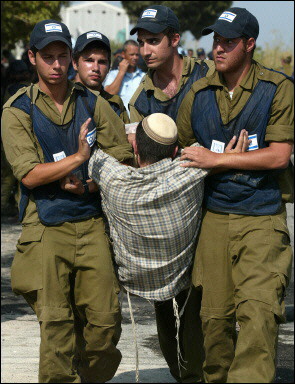
The Israeli government is carrying out new expulsions of settlers, of Jewish settlements established this time in the West Bank, not without difficulty
.
Expulsion of a settler by the Israeli police from a settlement in the West Bank
An essential reminder.
In 1947 the UN created the State of Israel:
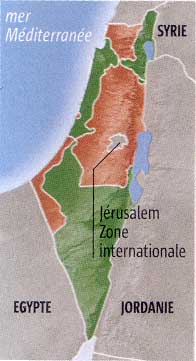
Israel in 1947
You will note that Jerusalem was then "an international zone". Arab countries refused this creation of a state. First attempt to expel the Jews from the region: the war of 1948-1949. The Jews were simultaneously attacked by Syrian, Iraqi and Egyptian troops
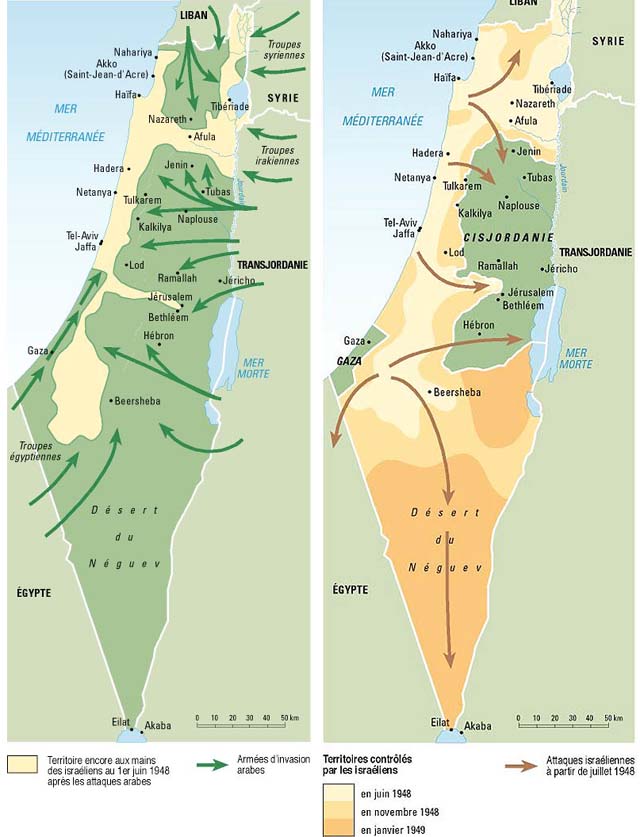
The 1948 war. On the left, the Arab attack, on the right, the Israeli retaliation.
Complete failure. The Israelis expelled 80,000 Palestinians and extended their control over additional territories.
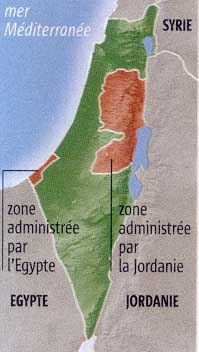
Israel in 1949. The West Bank, in the center, is administered by Jordan.
To the west the "Gaza Strip"
1967:
The Arabs tried again. Egypt, led by the "Raïs" Gamal Abdel Nasser, spearhead of pan-Arabism, tried to invade Israel. Egypt was strongly armed. Tanks, Soviet fighter planes. The war lasted only ... six days. The brave Egyptian troops abandoned their equipment in the Sinai (soldiers even abandoned their ... shoes to be able to run better!). Israel then extended its control over new territories. For the Palestinians, it was a catastrophe.
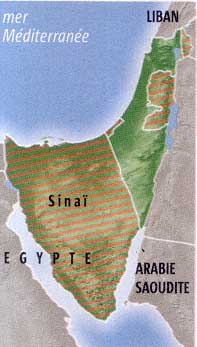
Territories controlled by Israel after the Six-Day War, 1967
You can see that the West Bank has passed under Israeli control. Over the years, Jewish settlements have been established in the West Bank, in a more or less anarchic way. Two hundred and fifty thousand Jews among three million Palestinians.
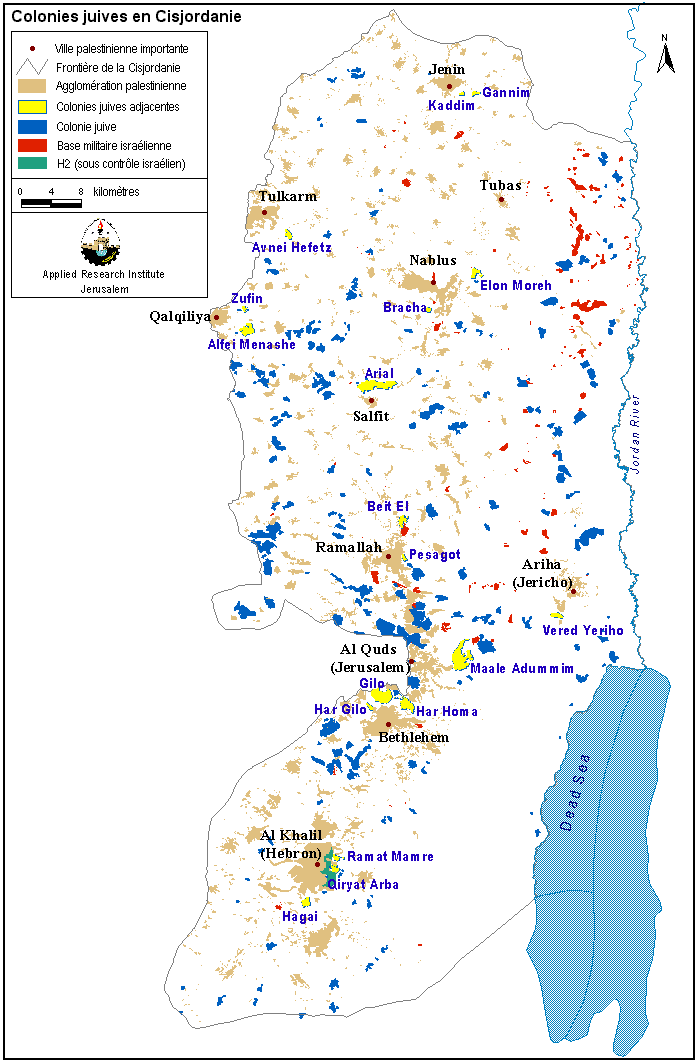
The Jewish settlements in the West Bank
One can compare the contours of the West Bank with the lands granted by Yahweh to his people, to this portion of the Promised Land.
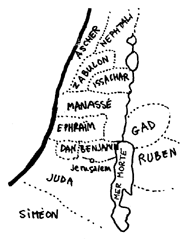
Left, the Promised Land, right, the West Bank
All the religious people immediately pushed for the repopulation of the lands of Manasseh, Ephraim and Benjamin by "their former owners". The motivations for the settlements are diverse. The military consider that a grid of the West Bank favors the control of the country. Politically, by turning the West Bank into a "Swiss cheese", this policy compromises the possible creation of a Palestinian state. For decades, successive governments have favored these settlements by circumventing laws and creating funding methods, either open or secret. The result is ... what it is. The rest is known.
Returning to this Six-Day War and Nasser's bravado, one would be tempted to say "when one launches an operation of reconquest, either one succeeds, or one stays at home". The result of the brilliant operation of the Raïs was the occupation of the West Bank and the development, quite understandable, of a mentality bordering on paranoia among Israelis. Conversely, the frustration of the Palestinian people has increased, up to the current state of despair.
In March 2000, Prince Saud Abdulaziz proposed the recognition of the State of Israel by Arab countries in exchange for a withdrawal from the territories occupied in 1967 (Six-Day War). But it was a bit late to consider this recognition. The hatreds have deeply rooted.
What will happen? The future will tell. Unfortunately, one cannot run time backwards and find oneself, for example, in a situation where, before 1967, Arab states could have decided to recognize the State of Israel, showing a minimum of political realism and where a Palestinian state could have been created, however poorly. Instead, the country is prey to the unleashing of all violence.
Counter initialized on August 19, 2005. Number of consultations since that day
: