August 2005
Page 1
The history of Palestine is identified with that of the Jewish people when we look back thousands of years. This history is called the Old Testament. Many things can be clarified if one knows this document, a bit bulky. Two thousand five hundred pages, as far as I remember, in a pocket edition, inexpensive, in two volumes. There is a Jewish-Christian version and a condensed version, represented by fragments of the Quran. There are some differences between the two. We will leave the readers of both documents to discover them. More than ten years ago I had undertaken a personal work on the Bible, including both the Old and New Testaments. The starting point had been a television program I had attended, where religious people had fiercely confronted each other, precisely about Palestine. I had not quite grasped their respective arguments, but one thing remained with me. These men had parted, each exclaiming "Everything is in The Book!". Which book, or which books, were these people talking about? I felt the need to find out. I tried to make this Bible

readable,
using the technique of the comic strip, according to the way I had perceived these texts, of course. But, very quickly, I realized that a good idea was to reproduce excerpts of texts in full, most often in "bubbles", with references. This comic strip can be read while holding the original document, the true biblical text or at least one of its translations (but they actually differ quite little from each other). I remember that at the time I had conflicts with practicing Jews and it was for me an opportunity to realize that they knew their "basic texts" very poorly. The same goes for Catholics or Protestants. After being warmly welcomed by the monks of the Saint John of Malta convent in Aix, as long as it had been about the Old Testament, I was rather coldly received once I brought up certain passages from the Acts and Epistles (totally unknown to most Christians). Later on, I heard a pastor on television reading a psalm. To my great surprise, he skipped some verses. When I called him on the phone, he said quite naturally, "but we are not obliged to read everything!". Religion is therefore a "à la carte" system and things get complicated when the text itself can be interpreted, which becomes clearly apparent when one looks at the different French translations available, which can even contradict each other completely.
It all begins with the journey of a certain Abraham who, living in a region corresponding to the east of present-day Iraq, suddenly receives divine messages. He is ordered to set out. He first travels to Haran (see map below) and then goes down to present-day Palestine.
These "first Palestinians" had, one can imagine, little to do with those who occupy the country today, just as we have little to do with the ancient Gauls who populated France or the Tunisians of Carthage have little to do with the Phoenicians. They were Canaanites, Moabites, different tribes forming a rather disparate patchwork.
Jews and Muslims refer to a common patriarch, Abraham (Ibraïm in Arabic). He is said to have had two sons, Ishmael first (from his servant Hagar) and then Isaac, from his wife Sarah. Isaac will be the progenitor, thus starting the entire Jewish people. As for Ishmael, he is the patriarch of the Muslims. At this point, the stories differ. Take a Bible in one hand and the Quran in the other and... figure it out for yourself. I will not venture into such a... explosive terrain.
The Old Testament recounts in great detail the various conflicts that have agitated this territory for millennia. In a schematic way, Moses is first raised by the ruling Egyptian family, then becomes aware that he is of Jewish descent and, obeying the orders of the Jewish god, Yahweh, leads his people out of Egypt towards "the Promised Land" (to Abraham). He will not enter it, but Joshua will ensure this bloody military conquest of the territory, against the Canaanites, who disappear from history after a series of genocides, where the Hebrews kill men, women, children, and the elderly. In the Bible, although very explicit about the nature of the act, a city thus erased from the map, like Jericho, is "devoted by ban". I find it regrettable that this expression is not replaced by "condemned to genocide".
Larousse. Genocide
: Crime committed with the intention of destroying a human group, national, ethnic, racial or religious.
The conquest of the Promised Land
passes through a complete
ethnic cleansing
. You will quickly find the names of the peoples that must disappear.
In my comic strip, I have reproduced quite a few maps, found here and there. The one that follows corresponds to the first division of the Promised Land, after two centuries of conquest. The division is made between the different tribes of Israel.
Solomon finds a very effective solution to quell inter-ethnic conflicts. He marries the daughters of his neighbors in succession, starting with that of the pharaoh, his powerful neighbor.
He also shows a fairly relaxed attitude towards worship, silences the priestly caste and even allows foreign worship (those of his many wives) to have temples in the country, to the dismay of fundamentalists. Inside the country, he reorganizes the parcels to avoid any conflict between neighboring tribes.
Let's make a big jump in history. The goal is not to tell you the Bible. In 50 BC, the Roman Pompey takes Jerusalem. The Jewish king of the time, Herod the Great, then plays the card of collaboration with the occupant. As compensation, he is allowed to rebuild the temple in a grand manner (whose remains constitute "the esplanade of the mosques" and "the wall of lamentations"). The drawing below, taken from my comic strip, shows the gigantic size of this temple, compared to the city itself.
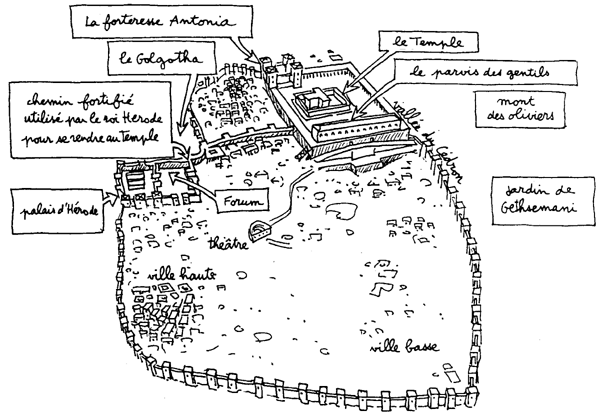
This is the setting of the Christian tragedy. Golgotha and the Garden of Gethsemane are located here. The fortified path that Herod used to go to the Temple is also visible. Having made a pact with the Romans, he constantly feared being assassinated. To build this temple, the very one that the fanatical Jews want to rebuild, see this
document
, he had to accept placing an image of the Roman eagle at the entrance of the "Holy of Holies". It was that or nothing.
The film by Zeffirelli "Jesus of Nazareth", well documented, shows quite well what this monumental place could have looked like. The Romans, having a large barracks: the Antonia fortress, adjacent to the temple, kept watch on the high walls surrounding "the Court of the Gentiles" where pilgrims could particularly buy the animals for the offerings.
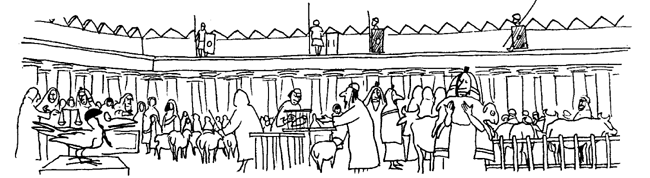
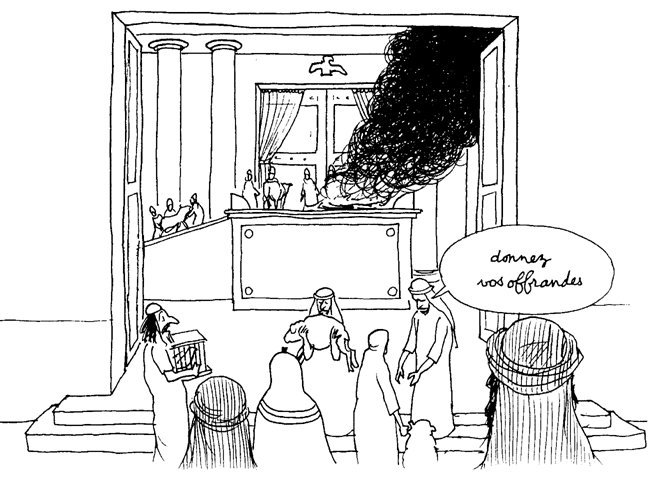
On the previous drawing, one can see the enclosed space representing the temple's enclosure, forbidden to non-Jews under penalty of death. The "non-Jewish" coins were also not allowed to enter. Only shekels could be brought into this place. Hence the presence of "money changers" on the Court of the Gentiles. In the following drawing, here is what the entrance to the temple could have looked like. The Levites, the priests, were in charge of the offerings of the faithful. A monumental altar allowed the sacrifice of victims of all sizes. One can see in the background the door of the temple leading to the "Holy of Holies" where only the High Priest could enter once a year. Above the door, the Roman eagle, supreme demonstration of the Jews' allegiance to the occupiers, the Jewish religion forbidding any human or animal representation. Rome had therefore imposed the presence of an idol above the door leading to the Holy of Holies.
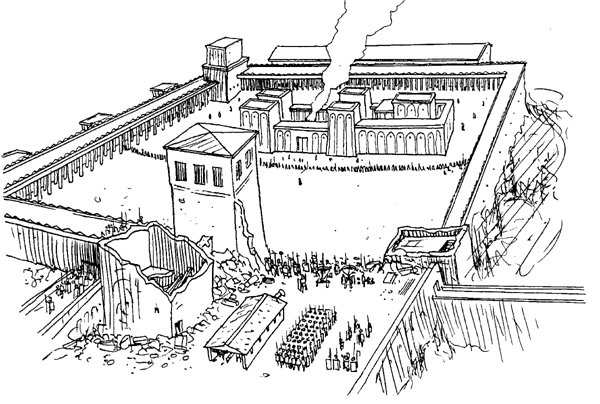
After the death of Herod the Great, another Herod, called "Herod Antipas", succeeds him. Again, we will skip the years. Jewish revolt in 72 AD. The Romans intervene. The last stronghold is the temple, where the most fanatical Jews, forming the sect called the Zealots, have taken refuge. To overcome this stronghold, the Romans "go around the back" and choose to demolish the Antonia fortress, their own barracks. They then find themselves at ground level. On the drawing, in the background, the temple, where the priests make final sacrifices. In front: the human wall formed by the Zealots, quickly pushed aside by the legionnaires.
The Romans were formidable finishers. The Zealots had taken refuge in a fortress reputed to be impregnable, built near the Dead Sea: Masada. It had been built on a rocky plateau, a "mesa". All around: steep slopes over 100 meters high. The Romans began by surrounding the place with a "circumvallation wall", forbidding any escape. They crucified all the Jews who tried to escape. The fate of the occupants of the citadel was clear: they would all end up in this way, men, women or children. But the water and food reserves of Masada could allow the besieged to hold for several years. The Romans then began the construction of a ramp half a kilometer long, an unprecedented work. On the following drawing, one can see its starting point. The workers were protected from arrow fire and interlaced trunks and rubble.
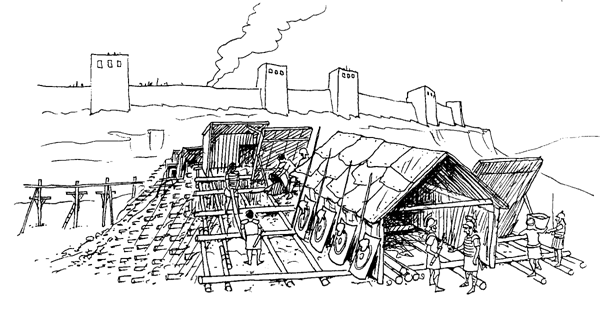
When the work was completed, this ramp allowed the Romans to bring their battering rams against the walls. The thousands of Zealots who had taken refuge inside the walls then committed suicide. They were found, on site, the fragments of pottery on which they had engraved their names in order to draw lots for those who would be charged with executing their brothers, their wives and their children.
In 132 AD, the last of the Jewish revolts, due to the fact that a Roman emperor, Hadrian, wanted to build a temple in honor of Jupiter on the very ruins of the Jewish temple. The Hebrews were once again crushed and this time were forbidden to enter Palestine. Jerusalem was renamed Aelia Capitolina.
History of Palestine: next page
Back to "Israel and Palestine"
Back to the table of contents of Divers
Back to the home page


