Mathematics geometry surface topology
How to transform a Cross Cap surface
into a Boy surface (right or left, as you choose)
passing through the Roman surface of Steiner.
Italian: Andrea Sambusetti, University of Rome
**27 September - 25 October 2003 **
**Page 2 **
Here is a "Cross Cap surface" (as you would have discovered it in the virtual reality images). It has two cuspidal points that are vertices of a self-intersection line. You can build it by pinching a balloon with hair clips. But you can also build polyhedral representations. The one below will particularly interest us.
In Table 4 is the hardest thing to learn. I find it impossible that someone can understand these objects well just by looking at the figures. Build models. In short, you pull the cuspidal point C2 towards "inside the surface" (which, by the way, makes no sense since, as you have surely noticed immediately, the Cross Cap surface is one-sided: it has no outer and inner face). By persisting, the surface "self-intersects", and the self-intersection set is completed, by rounding things a bit, with an 8-shaped curve. Incidentally, a triple point T has been created.
The surface becomes more understandable in its polyhedral form, and below, we have enlarged certain elements to show what leads us to transform this object into the Roman surface of Steiner (see the virtual reality simulation), whose simplest polyhedral form consists of assembling four cubes (here only three are visible).
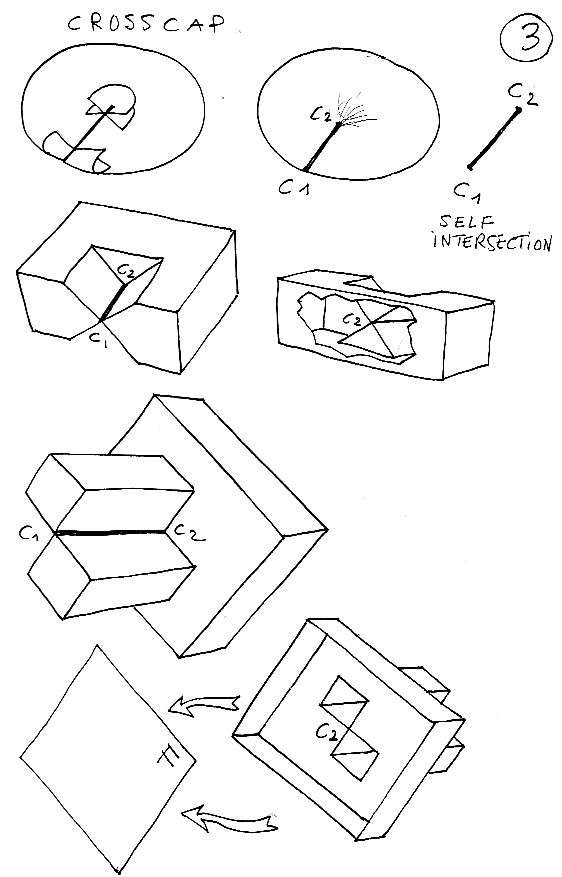
Table 5: polyhedral version on the left, round on the right. The arrow passes through the point we are going to "squeeze". Below, the beginning of the squeezing operation.
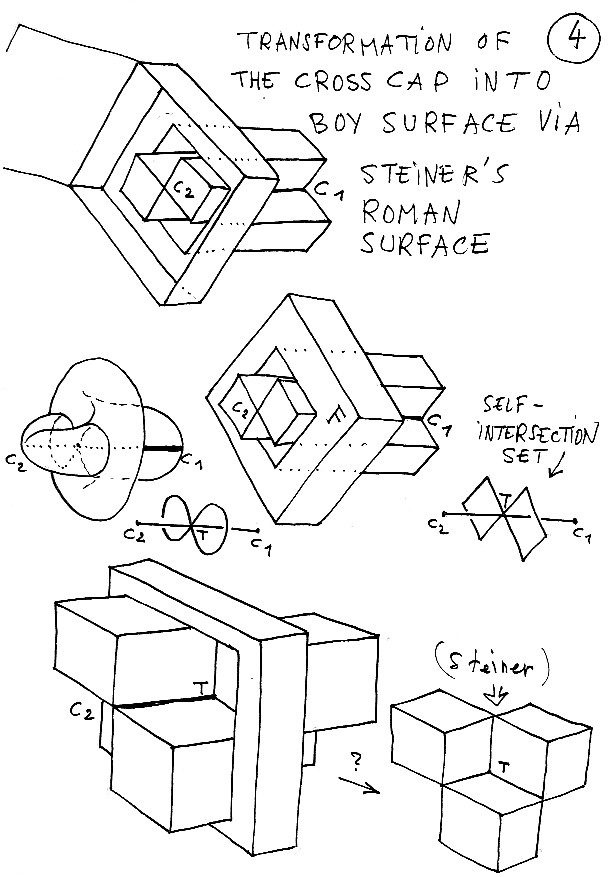
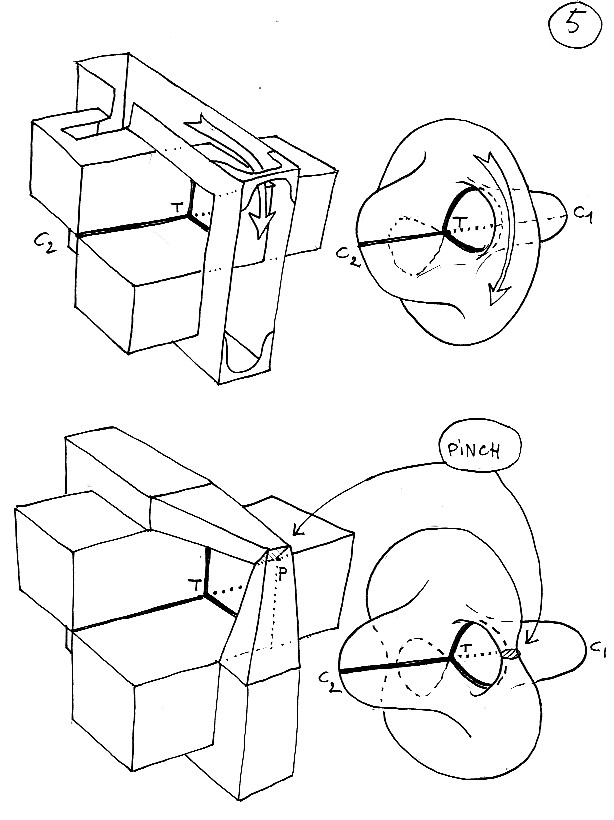
Table 6: the squeezing is performed and creates a singular point B. In fact, since we squeeze it from both sides (to save time), two singular points S1 and S1 are formed, then two cuspidal points. At this point, without cardboard, scissors and tape, you are in trouble.
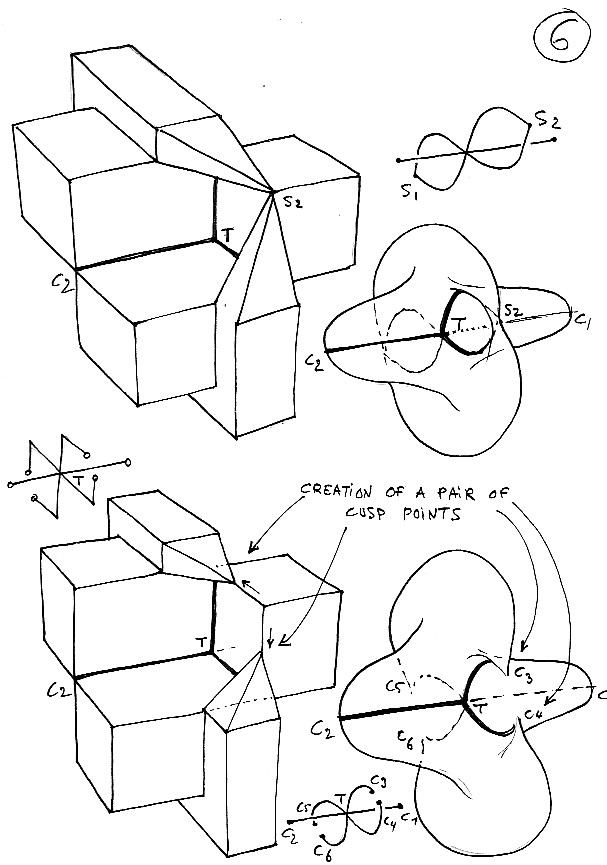
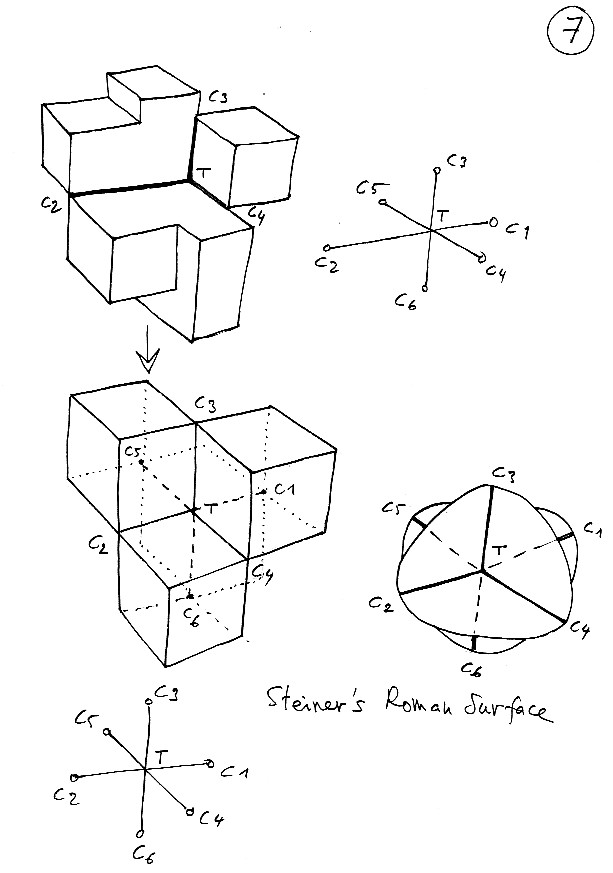
Table 7: here we have simply moved the different cuspidal points. If point C2 is "obvious", you will certainly have more difficulty identifying points C3 and C4 as cuspidal. Yet they are there, at the ends of a self-intersection line. Above point C3 is simply what I have called a "posicono", that is, a point where positive curvature is concentrated (I call a point where negative curvature is concentrated a "negacono"). By slightly deforming this object, we arrive at the polyhedral form of the Roman surface of Steiner (invented by Steiner in Rome; see his illustration in virtual reality).
So the game is done. There are various types of surfaces, depending on the rules one imposes. Surfaces that do not self-intersect are called "embeddings" (of the sphere, or the torus in R3). When they do self-intersect but the tangent plane varies continuously without degenerating, they are called immersions. For example: the Klein bottle, in its classic representation. In R3, there is no embedding representation of the Klein bottle: it necessarily self-intersects. Immersions have self-intersection sets without cuspidal points. These sets are continuous curves, but they can cross at double or triple points. Observation: the sphere can be realized as an immersion (which is not an embedding) by making it self-intersect. It is actually the way through which it can be turned inside out (cf. the method of A. Phillips, 1967, which has as its central step the double covering of a Boy surface; see also B. Morin and J.P. Petit, 1979, in which the central model is the "four-ear" model of Morin, of which you can see a polyhedral representation I invented about ten years ago).
Assembly plan of this object with paper and scissors
If we extend the rules of the game by accepting that these objects can also have cuspidal points, we obtain summersions (the Cross Cap, the Roman surface of Steiner). I don't know if "summersion" is the correct term, but since I haven't found any mathematician who can clarify my ideas on this, I found it amusing to invent one, provisionally at least, until an expert geometer comes forward. Thus, the Cross Cap surface and the Roman surface of Steiner would be summersions of the "projective plane".
To tell you the truth, after twenty-five years of activity and my disappointments in Magnetohydrodynamics, I had started these works because they seemed the furthest possible from any military application. But, as my old friend Mihn pointed out, the term "summersion" could be misleading and give the impression to the Navy that through these researches I was trying to hide progress in submarine propulsion.
The rule of "creation-annihilation" of pairs of cuspidal points allows one to pass from one summersion of an object to another, and that is what we have just done, showing that the Cross Cap and the Roman surface of Steiner are two summersions of the same object, known as the projective plane. Don't try to imagine a "projective plane". This object can only be understood through various different representations. As for the term "projective", it is just one among the thousand invented by mathematicians to mislead those who want to penetrate their closed circle. Zanichelli will be of no help to you in mathematics.
We still have to see how to go to the Boy surface, which is an immersion of the projective plane
Back to the index "Transforming a Cross Cap into Boy "
Back to the section News Back to the section Guide Back to the Main Page
Number of visits since 25 October 2003 :