Topological sphere mathematical models
Italian: Andrea Sambusetti, University of Rome
Clicca qui to display the 1:1 scale drawing of the model, to print and cut out.
By photocopying four copies on two different colored Bristol cardboard, you can build the model yourself, following the instructions for assembling it
You have certainly seen a strange object rotating endlessly on the left side of the home page of this site. What is it?
One day, when I find the time, I will install on this site a description of the sphere eversion, as I had illustrated it in the January 1979 issue of Pour la Science, that is... 22 years ago! This will require many details and an introduction. What does it mean to "turn a sphere inside out"? A sphere does not have the same meaning for the common person and for the mathematician-geometer. For the common person, it is simply the set of points in space located at a distance R from a fixed point O. A geometer will continue to call "sphere" even an object that corresponds to a "deformed sphere", like a potato for example. To better understand these concepts, get the Lanturlu CD containing the comic "Topologicon". But the mathematician goes even further. A surface is called "regular" when a tangent plane can be defined at each of its points. This already allows to think of an infinite number of regular deformations of the sphere, in the infinite possible forms of a potato, varying furthermore arbitrarily the area of such a surface. Having said that, in our physical universe, a person trying to turn the sphere (i.e., bring its inner surface to the outside) would face the impossibility of being able to self-intersect its surface. When assuming this hypothesis, i.e., prohibiting the surface from self-intersecting or even just touching, the mathematician speaks of an embedding of the sphere S2. But a mathematician is always allowed to do anything. A sphere is, for him, a "virtual" object and not material, where the crossing of a surface is considered possible. The sequence of drawings below shows a sphere that self-intersects. A representation that allows such self-intersections is called an immersion.
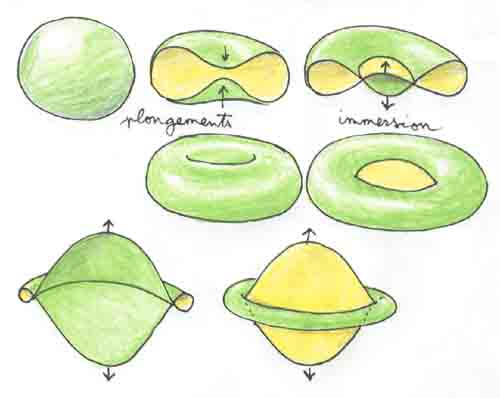
An immersion therefore has a set of self-intersections (here it is a simple circular curve). However, the tangent plane must vary continuously. With that in mind, when looking at the drawing above, it is clear that the operation brings part of the inner surface (represented in green) to the outside. To complete the eversion, one would have to flatten this kind of equatorial tube. Here seems to be a problem: this flattening would destroy the continuity of the tangent plane, and such a transformation would therefore contain a step that is not an immersion.
One day, an American mathematician, Stephen Smale, proved that "the sphere S2 has only one class of immersions". This cryptic sentence had as a corollary the fact that one should be able to pass, through a transformation that contains only true immersions, from the "standard" sphere to its "antipodal" representation, i.e., in which each point is exchanged with its antipodal: in other words... a turned sphere. Raoul Bott was Smale's supervisor. Although the formal proof of this fact seemed correct, no one seemed able to actually carry out this eversion operation. Bott kept asking Smale "show me how you would proceed"; to which Smale, notoriously without any hesitation, replied "I have no idea at all". Smale later received the Fields Medal, the equivalent of the Nobel Prize for mathematics. By the way, you might wonder why there is no Nobel Prize for mathematics. The answer is simple: his wife ran off with a mathematician.
Things remained like that for many years, until an American mathematician named Anthony Phillips published in 1967, in Scientific American, a first version of this eversion, extremely complicated. The second one was invented in the early 1970s by the French mathematician (blind) Bernard Morin. I was the first to draw the sequence of transformations, which will be the subject, as I have announced, of a forthcoming article on this site, which is already quite abundant. Anyway, all this leads us to a consideration. Surfaces can be represented in polyhedral form. A cube or a tetrahedron can be considered as polyhedral representations of the sphere, in the sense that these objects have the same topology. On this point, consult my Topologicon. Moreover, it is understood that if it is possible to turn the sphere, it will also be possible to turn a cube. The transformation invented by Bernard Morin (which I illustrated in the January 1979 article in Pour la Science) goes through a central model. There is a symmetry in this sequence. It is what I call the "central model with four ears". I am anticipating things. Anyway, as the sphere lends itself to polyhedral representations, so do the subsequent steps of this transformation. What you see rotating on my home page is the polyhedral version of the central model of the sphere eversion, which I invented about ten years ago. The interest of such polyhedral models lies in the fact that they can be built with flat surfaces. They can also be built with paper and scissors. Take a look at the drawing below (I thank in parentheses my friend Christophe Tardy, who produced the elements of the correct size).
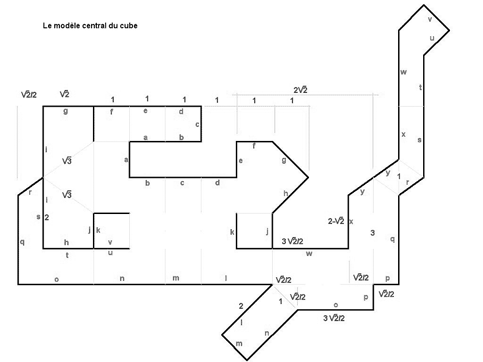
It is an assembly plan, here is a general view. But for printing, it is preferable to go to the cutting page. Print it. Then, with this printed copy on the usual paper of your printer, photocopy four identical copies, two on green Bristol cardboard, and two on yellow. You will be able to build the central model of the cube eversion with these cut-out sheets.
On the elements to be cut out there are pairs of letters: a, b, c, d, e, f, etc. It is sufficient to fold the sheet so that the same letters coincide, and then fix the faces with transparent tape. The following drawings show how to assemble one of the four pieces. Here is first how to begin to fold one of the four elements:
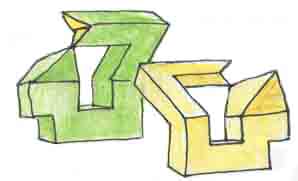
Here are two of the four elements, viewed from different angles.
They are then arranged to form an object with four-fold symmetry, alternating green and yellow elements. To see it in 3D, look at Tardy's realization, in the "virtual reality" section. The central model is assembled and also realized in "vrml" in this section. Here it is reproduced from various viewpoints:
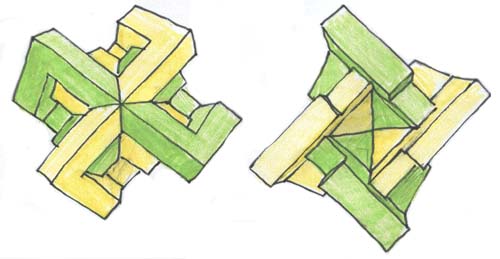
It cannot be said that one viewpoint corresponds to the "top" and the other to the "bottom", since these denominations are perfectly arbitrary. In the left image, the "central" point corresponds to the "double point" (in c...