ITER: a 15-billion-euro experiment.
ITER:
a 15-billion-euro experiment
The fusion reactor: dangerous
On May 16, 2011, a delegation from the European Parliament visited the King René Hotel in Aix-en-Provence, where they listened to several presentations by project ITER managers. I was able to hand 40 copies of a document I had printed at home—essentially a condensed version of what you will read below—to Member of Parliament Michele Rivasi. She distributed them among the other delegates.
Approximately 200 anti-nuclear demonstrators had gathered outside the hotel. There were few, given what is at stake, and I was the only scientist, even the only engineer or technician present. The demonstrators were typical grassroots anti-nuclear activists.
Indeed, people like me were awakened after the Fukushima incident served as a painful reminder. But this awareness—my own realization of how deadly nuclear technology can be—is definitive. I had never seriously asked myself this question before. In the past, early environmental activists suffered physical blows from police forces, tear gas grenades, or defensive grenades that killed Michalon, an anti-nuclear protester against the Creys-Malville super-reactor installation on July 31, 1977, when one of these grenades exploded in his chest.
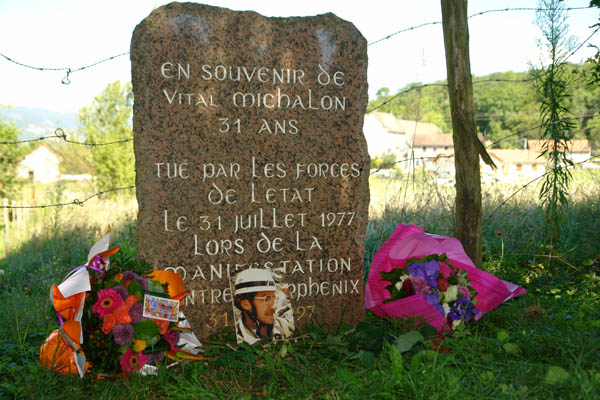
Even today, people still chain themselves to train tracks through which convoys carrying radioactive waste pass en route to the "La Hague reprocessing center" (in fact, a plutonium extraction facility producing French-made MOX nuclear fuel used in 20 reactors in France, reactor number 3 at Fukushima, and exported abroad). The chained protesters are usually forcibly removed, many are injured, and they fight so that we and our children can enjoy health and avoid the profit-driven schemes of nuclear industrialists.
The deadly convoy must pass, at any cost.
I admit I feel ashamed for having reacted so late, and I feel like vomiting when I see none of my fellow scientists or engineers joining this legitimate protest. The realization of the madness of nuclear technology is only now taking hold, spurred by the Fukushima disaster, despite the media blackout orchestrated by the atomic barons.
But before that, those who opposed nuclear power were dismissed as marginal, dreamers—when in fact they had a clearer and earlier vision of reality than we did.
As we will see below, things are far worse than anyone could have imagined.
Until now, arguments against the ITER project have mainly been environmental or landscape-related. I’ve just seen a grotesque, shocking video taken from an ITER project presentation, where the guide claims they delicately relocated bats to encourage them to nest elsewhere. They’ve also taken into account protected flora.
But what a colossal nonsense, when you consider what comes next.
We know about tritium’s radio-toxicity—this radioactive substance has a half-life of 12.3 years. Yes, the problem is real. Tritium is a hydrogen isotope whose nucleus contains one proton and two neutrons, unlike the nucleus of light hydrogen (a single proton) or deuterium (one proton and one neutron). All three are accompanied by a single electron. This electron constitutes the atom’s "electron shell," determining the substance’s chemical properties.
Thus, from a chemical standpoint, light hydrogen and its two isotopes, deuterium and tritium, have nearly identical properties.
When "heavy" hydrogen combines with oxygen, it produces a molecule called heavy water. All combinations of these three nuclei with oxygen are possible, including molecules containing one or two tritium atoms.
This tritium-rich water will be radioactive.
Opponents of the ITER program argue that since tritium behaves like hydrogen, it is extremely difficult to contain safely. The tiny molecules of light hydrogen can pass through valves and seals. Even worse, hydrogen can penetrate solid walls! Tritium is a champion of escape, passing through seals and most polymer materials.
From a biological standpoint, there is no danger from light hydrogen or deuterium. With tritium, it’s a different story. The hydrogen atom has the ability to combine with a wide variety of other atoms, forming a vast number of molecules in both the mineral and biochemical realms.
Thus, this tritium could enter food chains and even integrate into DNA.
ITER supporters may reply that a release or leak of tritium—during machine testing or its descendants’ operation—would only result in negligible pollution, "posing no public health risk."
We’ve been hearing this from nuclear officials for decades.
Another argument advanced by ITER’s defenders: the human body contains what are known as “water cycles.” If the body absorbs tritiated water, it would quickly release it into nature. Its “biological half-life” (one to twelve months) is shorter than its “radiological half-life.” (Wikipedia)
http://fr.wikipedia.org/wiki/tritio#Fixation_biologique_du_tritio
http://fr.wikipedia.org/wiki/tritio#Cin.C3.A9tique_dans_l.27organisme
But things would be different if tritium atoms were bound, for example, to DNA molecules. Here we touch on the long-term effects of low-dose contamination.
And here, ITER supporters would shrug and say that tritium quantities are so minuscule they’d go unnoticed... etc...
In conclusion, one might say there are no effective criticisms in this area.
Of course, there is the project’s cost, which has already exploded and tripled—only a pale beginning, as we’ll see later, along with schedule delays. The crucial, painful question:
- When will the electricity be produced?
The technical-scientific aspects we’ll discuss below make it impossible to predict future budgets or timelines, and simply in terms of feasibility and profitability.
Let’s begin by exploring the origins of the ITER project
http://www.iter.org/proj/iterhistory
We read that this project emerged from discussions between Gorbachev and Reagan during their meeting in Geneva in 1985, at the end of the Cold War.
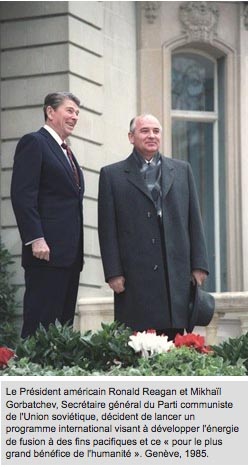
Reagan and Gorbachev in Geneva, 1985
The massive reduction of nuclear weapons and missiles left the atom with a completely negative image, only slightly softened by the positive connotation of civil nuclear energy. Indeed, we know that a civilian reactor can be converted into a plutonium-producing reactor capable of manufacturing the explosive material used in fission bombs: plutonium.
-
The Chernobyl disaster showed us that this so-called peaceful atom, which we once dreamed could bring prosperity to humanity, could destroy its environment indefinitely—beyond the lifespan of our species—and simultaneously harm human health and the human genetic capital. These arguments cannot be ignored.
-
If we include the intractable problems related to waste storage and reactor decommissioning, about which we have no idea how to proceed.
-
We must also consider the inevitable spread of nuclear weapons.
We add that one year after this meeting came Chernobyl.
The urgent need arises to find a “peaceful atom” that cannot be used to create new weapons, whose waste consists of an innocuous gas—helium—that cannot lead to the proliferation of “sensitive materials.”
Immediately, one thinks of deuterium-tritium fusion reactors, credited with all kinds of virtues.
An unlimited energy source, we’d say. And consider the phenomenal quantities of deuterium and tritium (or lithium, from which tritium can be produced) contained in ocean water.
Fusion energy is first and foremost a powerful myth—the “beneficent atom,” safe, peaceful, and providing “unlimited energy.”
We include an image that speaks to the human imagination: a “sun in a test tube.”
Humanity has always associated great natural phenomena with mythological constructions. Rain from the sky enables good harvests. Pre-Columbian civilizations prayed to the heavens for this vital liquid—rain. But water is also the flood, destruction, death.
The same applies to the Sun. For ancient Egyptians, gods were nothing but manifestations of the central solar deity. Ra was the beneficent sun bringing good harvests, while his brother Seth, the terrible desert sun god, dried up crops and caused travelers to die of thirst.
There is a myth of the atom. When Oppenheimer, who could read Sanskrit, first witnessed the nuclear fire before his eyes, he instinctively recited an Indian verse from the Bhagavad Gita (verse 33, Chapter 11), ending with:
I am death, the destroyer of all worlds.
http://en.wikipedia.org/wiki/Bhagavad_Gita
The atom began to enter history, taking a place in human imagination as a terrible god comparable to Jupiter’s lightning or Thor’s hammer, with biblical connotations of the Apocalypse and the end of the world.
Then came the era of the peaceful atom, dispensing comfort and improving quality of life. An atom that heats homes, powers high-speed trains transporting us comfortably and quickly.
But the tragedies of Chernobyl and Fukushima stand as brutal, violent wake-up calls. Then the atom becomes something like a white plague—invisible, odorless, slowly deadly.
- Not everyone will die, but everyone has been touched...
Even when reactor operations appear to proceed without problems, health incidents have been observed among employees working at these facilities. A study conducted by INSERM (the French National Institute of Health and Medical Research) shows twice as many cancer cases among these workers, even though dosimeters indicate doses below the arbitrarily set nuclear safety authority limits.
Here we see civil nuclear power, despite the powerful lobbying by nuclear barons, taking on an unsettling form.
So why not promote this “sun in a test tube,” this atom that is once again beneficial, risk-free? If an airplane crashes into a tokamak, or a terrorist sabotages it with explosives, there would be no problem! What would the consequences be? A little deuterium, tritium, lithium, and helium escaping into the air—no big deal, we’d say—and by the next day, the incident would be water under the bridge.
With fusion, we see the myth of the "risk-free, waste-free atom" emerge.
As one can imagine, this is not entirely true. Deuterium-tritium fusion produces neutrons that in turn contaminate all reactor structures. These would become radioactive through “activation,” due to transmutations occurring in all materials exposed to a strong neutron flux. Thus, decommissioning a