The Z-Machine Reaches Two Billion Degrees
Why the ITER Project Must Be Stopped
March 23, 2006
http://www.univers-nature.com/inf/inf_actualite1.cgi?id=4218
May 13, 2010, four years later:
ITER, the nuclear fusion project, is exploding its costs. ITER, the reactor based in Cadarache in the South of France, which promises nuclear fusion on Earth for nearly unlimited energy production (1), sees its bill literally explode, with construction costs expected to be at least twice the initially proposed 4.57 billion euros (2).
While China, South Korea, the United States, India, Japan, and the Russian Federation are part of the project, the European Union is the main economic contributor. As such, its share is expected to rise from 2.7 to 7.2 billion euros over the ten years dedicated to construction. For the European Commission, two possibilities are being considered to address this: increasing contributions from member states or raising the dedicated share in the EU budget.
Without even mentioning the current withdrawal of the United States from financing ITER, this cost inflation is notably due to the complexity of the project and a profound evolution of its current design (2001) to align with today's technological possibilities.
Furthermore, over ten years, the cost of raw materials has continued to rise, also contributing to the overall increase in ITER's bill.
For the record, let us recall that ITER is not intended to produce energy commercially, but to demonstrate the feasibility of fusion on Earth by producing, in the space of 6 minutes, some 500 million watts (MW) of heat from 50 MW of "injected energy."
Once this stage is completed, a first nuclear fusion reactor, DEMO, is expected to emerge in Japan to prove the industrial feasibility of the concept by the horizon of 2050.
In the context of the economic crisis we know, will the governments concerned open their wallets again? This is not certain, and lacking financing commensurate with their hopes, scientists might be called upon to scale down the project.
Pascal Farcy 1- ITER, the International Thermonuclear Experimental Reactor, aims to bring humanity closer to the sun's energy production model during the second half of the 21st century.
2- In 2007, the total budget was broken down into 4.57 billion euros for construction (10 years), 4.8 billion euros for operation (20 years), and 0.53 billion euros for decommissioning (10 to 15 years).
My 2006 text:
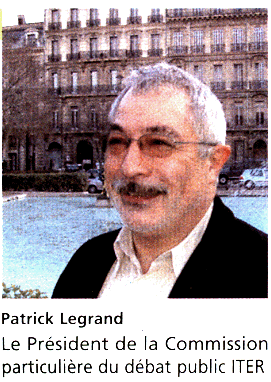
When I attended a so-called "debate" held in Pertuis on March 16th, the anti-nuclear activists were there. They put on their white masks and shouted slogans, facing the smiles of the CEA people, led by Patrick Legrand, who wrote in a brochure that "The debate has found its footing."
"The debate has found its footing"
People were extremely surprised to discover the content of my intervention. Legrand finally said to me, with a big smile:
- Well, there you go, calm down. We will pass you a microphone. You will be able to ask your question and we will answer you.
But my question was:
- How do the people involved in this project plan to combat the powerful radiative cooling caused by bremsstrahlung radiation following the stripping of heavy nuclei from the wall?
And then, suddenly, there was no one left. Legrand, jaw dropped, was making gestures of denial. The same for the project's administrative manager or for an environmental specialist who came to explain to us that "in this project for society" they would be keen to protect flowers and beetles.
We finally found an engineer, sitting next to me, who stammered:
- Hmm... that's a good question.....
Indeed, it is the million-dollar question, one not to be asked under any circumstances. The fastest hydrogen atoms will always manage to cross the magnetic barrier and, striking the wall, will strip atoms that will immediately become fully ionized. Now, the loss due to bremsstrahlung radiation linked to interaction with free electrons varies as the square of the electric charge. The plasma will become polluted, it will cool down. The ITER boiler will suffocate....
In Culham, the British obtained one second of fusion. ITER will produce ten, perhaps twenty, in 20 to 40 years. No one has simply planned how to negotiate this problem of extinguishing the boiler, except by saying "there is a scale factor." Radiative losses are relatively lower in increasingly larger machines. When we have obtained x tens of seconds of fusion, they will say "we must build a super-ITER, more expensive, and this time, it will work."
One does not start a project of this magnitude, at such a cost, when one does not have, ready-made, the solutions to serious, inevitable problems.
Unless ITER is merely an expensive toy or a "project for society," as I heard and read in Pertuis.
ITER is above all an example of the total lack of imagination of our scientists, the equivalent in the experimental sphere of superstrings in the theoretical domain. Fusion with the Tokamak solution has been struggling for half a century. We are asked for 30 to 40 additional years of patience, whereas by then our physics may have simply changed. As I said upon leaving the room:
ITER is the steam engine of the 3rd millennium.
Tore-Supra, the French tokamak, launched twenty-five years ago (with the same Blablatron song: "the sun in the laboratory," etc...) did not keep its promises. Fusion: zero. Very limited temperature increases. But "the superconducting magnet works." Big deal! 25 years to build a superconducting magnet giving 4 teslas: a technology perfectly mastered in all bubble chambers of particle accelerators around the world. But in France, we are quick to congratulate ourselves on failures.
The people present remembered the last exchange with the specialist, the one who had said "good question."
- Do we, nowadays, have the means to pay for such a "dancer"? - Oh, it seems like a lot of money, but as a percentage of GNP, it is much less.....
Well, let's see.
Before leaving the room, I explained my point of view. It is not no to fusion, but no to a fusion that is to "real fusion" what the steam engine is to the internal combustion engine. The comparison is apt. In ITER, we are trying to operate continuously, at too low a temperature, with a polluting reaction, which will activate the surrounding structures, causing new radioactive waste to accumulate, whereas the future is:
clean fusion: Boron 11, Hydrogen 1, in pulsed mode, with a billion degrees.
or:
Lithium 7 + Hydrogen 1: 500 million degrees.
The next day, as if by coincidence, the Sandia laboratory, New Mexico, announced the results of its Z-machine (type "z machine" in Google).
Sources:
http://www.sandia.gov/media/z290.htm
http://www.sandia.gov/news-center/news-releases/2003/nuclear-power/Zneutrons.html
http://www.futura-sciences.com/news-z-machine-depasse-deux-milliards-degres_8419.php
Content of the Futura-science article:
The Z-machine has produced temperatures comfortably exceeding two billion degrees!
(Credits: Randy Montoya)
Usually, the Z-Machine operates as follows: 20 million amperes pass through a network of tungsten wires the width of a hair. In a core, the size of a ball of wool, the wires instantly dissolve to generate plasma, which is then compressed at high speed by an intense magnetic field, until it occupies the thickness of a pencil lead. Once compressed, the ions and electrons have nowhere to go ("stagnation point") and, like a racing car thrown at full speed against a wall, they stop abruptly, dissipating a considerable amount of energy in the form of X-rays. Thus, the Z Machine was designed to generate temperatures of several million degrees, close to those of solar flares.
The "stagnation point" is an incorrect translation of "stagnation point" which means "stopping point." The stopping point designates the point where a gas flow sees its velocity reduced to zero. Take, for example, the nose of a space shuttle. The stagnation point is the point on the nose where the gas velocity is zero. Logically, in this setup, one should speak of a "stagnation line" since the plasma converges towards the axis of the system. If we decode this text, it seems that this plasma then, at the end of compression, when the speed cancels out, has the shape and volume of a "pencil lead."
But scientists would never have thought that by replacing the tungsten wires with wider cylindrical steel wires, they could reach temperatures exceeding a billion degrees: "At first, we didn't want to believe it. We repeated the manipulation many times, to be sure it wasn't an error," explains project leader Chris Deeney.
But then, what really happened in the Sandia laboratory? In an article published this month in Physical Review Letters, Malcolm Haines, a consultant for Sandia, hypothesizes that this surprising temperature is due to the appearance of numerous instabilities at the "stagnation point," which would generate the conversion of a considerable amount of magnetic energy into thermal energy, and this in the space of a few nanoseconds.
We will have to dig up this article to try to see exactly what it entails.
Research is currently underway to learn more about this phenomenon. In any case, according to Malcolm Haines, obtaining such temperatures could prove very useful: it would facilitate the study of solar flares,
and could also allow for the construction of more compact and less expensive nuclear power plants.
Content of the Futura-science article:
The Z-machine has produced temperatures comfortably exceeding two billion degrees!
(Credits: Randy Montoya)
Usually, the Z-Machine operates as follows: 20 million amperes pass through a network of tungsten wires the width of a hair. In a core, the size of a ball of wool, the wires instantly dissolve to generate plasma, which is then compressed at high speed by an intense magnetic field, until it occupies the thickness of a pencil lead. Once compressed, the ions and electrons have nowhere to go ("stagnation point") and, like a racing car thrown at full speed against a wall, they stop abruptly, dissipating a considerable amount of energy in the form of X-rays. Thus, the Z Machine was designed to generate temperatures of several million degrees, close to those of solar flares.
JPP
:
The "stagnation point" is an incorrect translation of "stagnation point" which means "stopping point." The stopping point designates the point where a gas flow sees its velocity reduced to zero. Take, for example, the nose of a space shuttle. The stagnation point is the point on the nose where the gas velocity is zero. Logically, in this setup, one should speak of a "stagnation line" since the plasma converges towards the axis of the system. If we decode this text, it seems that this plasma then, at the end of compression, when the speed cancels out, has the shape and volume of a "pencil lead."
But scientists would never have thought that by replacing the tungsten wires with wider cylindrical steel wires, they could reach temperatures exceeding a billion degrees: "At first, we didn't want to believe it. We repeated the manipulation many times, to be sure it wasn't an error," explains project leader Chris Deeney.
But then, what really happened in the Sandia laboratory? In an article published this month in Physical Review Letters, Malcolm Haines, a consultant for Sandia, hypothesizes that this surprising temperature is due to the appearance of numerous instabilities at the "stagnation point," which would generate the conversion of a considerable amount of magnetic energy into thermal energy, and this in the space of a few nanoseconds.
JPP
:
We will have to dig up this article to try to see exactly what it entails.
Research is currently underway to learn more about this phenomenon. In any case, according to Malcolm Haines, obtaining such temperatures could prove very useful: it would facilitate the study of solar flares,
and could also allow for the construction of more compact and less expensive nuclear power plants.
At the head of this project is Gerald Yonas, whom I met in '76 at Sandia (see my book "Children of the Devil"). Look at the creature. It was .. thirty years ago. Source: Pour la Science, January 1979, pages 52-53 (you will also find there the paper on the inversion of the sphere that I co-signed with the mathematician Bernard Morin).
Yonas's experiment, Sandia 1976. Electron beams on a target "the size of a pigeon's egg"
Old Gerald is therefore not a beginner in matters of high electric currents. The principle of the "Z-machine" is quite simple. Yonas sends twenty million amperes in total into an assembly of wires each having one-tenth the diameter of a hair. These wires are arranged to form a cylindrical structure:
**The arrangement of the metal wires through which the current is sent.
Each turns into plasma and this system ultimately gives a sort of plasma curtain that implodes towards the axis of the system.**
This resembles the fragmentation of a cylindrical sheet. A fragmentation into a whole series of conductors, to obtain a more homogeneous current distribution and avoid instabilities.
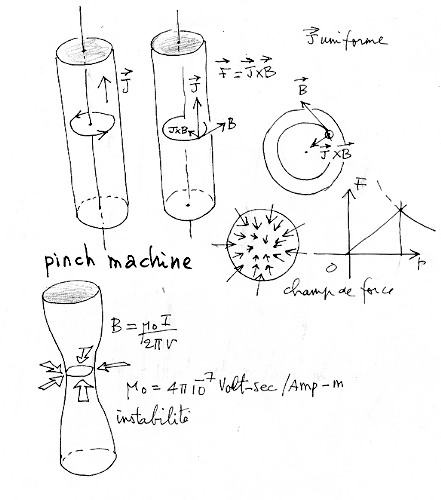
This current therefore creates a magnetic field that gives rise to Laplace forces J x B which act on the medium, instantly transformed into plasma. In 1976, these systems were called "pinch machines." Pinch means "to squeeze." But pinch machines were based on a discharge in a gas column that turned into plasma. The implosion was then unstable. Yonas's wire sheet evokes a "hollow tube" fragmented into a large quantity of "wires." When the discharge occurs, all these wires turn into plasma columns that mix and end up behaving like what would happen to a hollow tube through which current is passed. The difference is that this "fragmentation" ultimately gives a more regular current sheet. In any case, the result is an implosion of this plasma sheet towards the axis with an "inertial compression."
Initially, Yonas wanted to use these systems as X-ray sources. It seems clear (I will try to analyze the papers in more detail as soon as possible) that the goal of these experiments was primarily military. The aim was to obtain an X-ray source powerful enough to fuse a target (placed, I imagine, along the central axis), thus to simulate the operation of a bomb without having to use an A-bomb as a source.
It seems that Yonas interposed between the target (located along the axis) and the curtain of wires turning into plasma in a state of implosion, acting as a compressor, a "foam." The stability of this compression system was a priori incalculable. We know that in laser fusion, this is the key problem. We do not know how to compress in spherical symmetry. That is why Megajoule, located in Le Barp, near Bordeaux, another kind of ITER, is another expensive and very risky project. Another "toy" for military personnel and polytechnicians.
Yonas compresses along an axis. And there, surprise, the temperature increases are spectacular, even unexpected. Below are the powers emitted by the system, as an X-ray source.
**On the way to fusion?
Sandia researchers continue to increase the power emitted by their machine in the form of X-rays. **A substantial progress was made using an assembly of wires arranged on a cylindrical surface. **When the discharge is triggered, this system turns into plasma in a state of implosion. This system allowed for an increased gain in output power (up to 290 TW). **
Here is the machine in operation. The small reproduced images do not allow one to realize what is happening.
**The Z machine: here we go! **
What you are seeing are electric arcs, shooting in all directions. Yonas is the Nikola Tesla of our time.
Some quick notes on what seems to be the operating principle of this Z-machine. Let's first show the principle of the "theta-pinch."
A powerful current is passed parallel to the generators of the cylinder (gaseous). The created magnetic field is accompanied by Laplace forces that tend to compress this plasma cylinder along the axis. The system is unstable. If it pinches somewhere, the current density increases and so do the JxB forces.
Principle of the Z-machine:
Take two wires carrying parallel currents. They tend to attract each other. Same for a system of "caged wires." In the initial experiment, Yonas sought to obtain the collapse of these wires, which turn into a "plasma curtain," along the axis of the system. Some quick grocer's calculations with a cage of one hundred wires and 20 million amperes in total. The initial field would be 2 teslas. When the wires turn into a plasma curtain, one could estimate the current density at 3 10 12 amperes per square meter. I will have to ask Yonas for confirmation. It is only rough and indicative. I find 60 megabars as initial, centripetal pressure, which should propel this plasma at 5 km/s towards the axis. As it stands, this plasma made of metal atoms heats up and I imagine this is a solution imagined by Yonas to produce a hail of X-rays.
By roughly estimating the volume of the plasma cylinder before implosion and concluding that it compresses along the axis into an object the diameter of a pencil lead (2 mm), one obtains impressive compression factors. Recall that in laser fusion, we seek to compress a target of heavy hydrogen, liquefied, and we aim for a reduction in radius by a factor of 10. That would be enough to obtain the Lawson conditions in the target. Compressing a liquid entails a serious temperature rise. With my grocer's calculations (chickzalés, as some Xs would say), I find a compression factor of the order of 40. So if the material were a fusion mixture, it could work.
Note in passing that Yonas's concerns are not civilian. These are military researches. Imagine that instead of passing the current through tungsten (high melting point, to keep the solid state as long as possible and preserve symmetry), we use Plutonium. By compressing it along the axis: boom.....
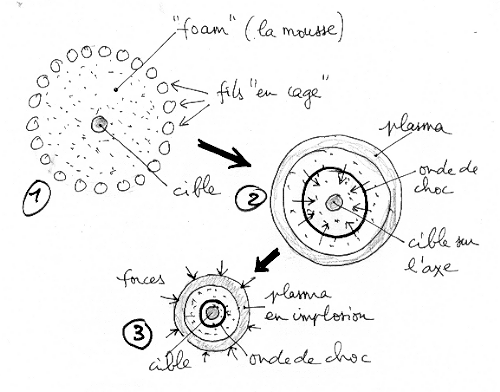
But, in a second phase, he opts, it seems, for a more sophisticated experiment. Tungsten, steel, are not my fusion mixtures. Yonas therefore uses a three-component setup, apparently.
The Z-machine for fusion
These are cross-sections. In 1, the cage made of wires. In the center, along the axis, a target of fusion mixture. Between the two, a "foam," of undisclosed composition. When the sauce is sent, the cylinder of metal wires (which turns into plasma) creates a compression pulse. In my opinion, this should trigger the start of a cylindrical, centripetal shock wave, traveling through this "foam," this "mousse," also turned into plasma downstream by this "blast wave." The wave carries away some of the energy. It travels in a medium where the magnetic field is zero. Hence possible absence of instabilities. There is much to think about to try to understand what this famous "foam" could be composed of.
The temperatures reached are such that very important radiative processes accompany the process. One must then play on the reabsorption length of this radiation. Yonas says he tried by adding argon and that the temperature rise did not occur. Probably because the argon heats up too much. In this inertial confinement experiment, one must increase the density and speed at impact, on the axis of the system where the target is located, delaying the heating as much as possible, so that this heating only occurs at maximum compression, on the "stagnation line."
The new idea is that an axisymmetric implosion seems stable, or at least much more stable than a spherical one. In laser fusion, the problem is that the laser impacts must be perfectly synchronous on the "pusher," the layer surrounding the target of liquefied heavy hydrogen. That is equivalent to firing 25 revolver bullets (or more) at a marble hoping that they will all give the same pressure impulse.
There, Yonas manages to have a pressure impulse as axisymmetric as possible thanks to his system of wires arranged like a cage. He initially used tungsten so that his wires would "last" as long as possible, imposing axisymmetry. Later, he switched to simple stainless steel wires. The regularity of the compression wave allowed for a spectacular temperature rise to 2 billion degrees!
For fusion, the problem is not the quantity of energy, it is the focusing. The idea is diametrically opposed to the central theme of ITER where we seek continuous fusion, in a huge volume, with all the mega-technological problems that this poses. I am for this idea of pulsed fusion with energy focusing by shock wave. And I even say that the temperatures reached can allow aiming for non-polluting fusions, without neutron emission, like Li-H or B-H (500 million degrees or a billion degrees).
If you speak of such temperatures to an ITER guy, he hits the ceiling. The machine does not allow reaching that.
We have seen that this process of energy focusing by shock wave allowed melting bronze in cold water (cavitation phenomenon, discovered in 1905), then creating plasmas at 10,000 ° by ultrasound (sonoluminescence).
These are outsider pathways, compared to these hyper-heavy pathways like the Tokamak (ITER) which carries decades of technological problems (past and ... future) extremely costly. I am among those who think that there is a way to achieve fusion, by relatively light means. I do not exclude that Yonas might reach temperatures even higher than his 2 billion degrees (...) since the final performance does not rest on the quantity of energy but on the efficiency of the focusing (nature of the foam, geometry).
At a time when "physics is in free fall" in France, I see here a mountain of thesis subjects and relatively cheap experiments, fascinating numerical simulations. But in France, we have bet everything on the Tokamak and it is out of the question ... to change horses in mid-stream. People would not be ready to say:
- Well, we have wasted our time and a lot of money for half a century.
Who could say such a thing? This explains the stubbornness on this type of machine and fusion pathway.
As early as April 7, 2003, Yonas's machine had produced its first and authentic fusion neutrons. But very recently another threshold was reached.
The Z machine has allowed producing two billion degrees
This means that Boron 11 - Hydrogen 1 fusion becomes feasible. Now this is a clean fusion, without radioactivity (! ...) which does not emit neutrons, which does not make the surrounding structures radioactive, which emits only simple helium nuclei, electrically charged. Not only can these be magnetically confined, but by compressing this magnetic field they transform the whole into an MHD generator. Ultimately, one would obtain a "two-stroke fusion engine" (which I had already described in my 1976 Science et Vie article). These two billion degrees, no tokamak will ever be able to reach them.
The conclusion is that the ITER project should be put on standby immediately.
It seems we have another pathway, which could lead to "clean fusion." We will have to analyze this work in detail. A priori, Yonas's Z-machine could allow obtaining the fusion of a mixture, with production of alpha, helium nuclei. These would constitute an expanding plasma. If this expansion were carried out in a magnetic field, as the system is in a state of high magnetic Reynolds number (close link between magnetic field lines and ionized medium), it results in a strong induced current in the solenoids. The machine then transforms into an impulsive MHD generator. Part of this energy could allow recharging a capacitor, ready for the next discharge. Hence the concept of a "two-stroke" fusion engine.
All this needs to be reviewed in detail, but it seems a priori very interesting. In any case, these are infinitely less expensive and less complicated researches than this true "gasworks" that is the ITER project.