Pentagogo. If you think no plane crashed into the Pentagon, you will change your mind.
May 14, 2004: Following the online publication of my file on the events of September 11, 2001 relating to the Pentagon, I was strongly questioned by Mr. Jean Sylvain Delroux, an IT specialist
e-mail: contact2035 bigfoot.com
Very quickly, he told me "that my analysis was very superficial, that I had not seen essential things that were clearly visible on high-resolution photos". Therefore, I proposed that he write down his reflections and analyses, which he did, signing strangely "Pentagugus". I suppose I must be the "intergalactic specialist of plasma pataphysics". Here is therefore this "counter-counter-investigation", with some comments from me, in red. By principle, in the name of the right to free expression, I accepted to include this file in my columns. The reader will appreciate.

| Pentagugus | (Jean-Sylvain Delroux) | presents: |
|---|
Pentagogo: a counter-counter-investigation.
Investigation into the Pentagate counter-investigation
Thierry Meyssan's book, which claims that no plane crashed into the Pentagon, has caused a lot of ink to flow. From the acne-prone teenager to the intergalactic specialist of plasma pataphysics, many have adhered to the incredible fraud, in the name of the quest for truth. There are no longer any laymen or experts who have not contributed water to the mill of this journalist who has suddenly become both rich and appreciated by Arab princes, great "defenders", as everyone knows, of human rights, democracy and freedom, and the only guarantors of a world finally rid of the "intolerant obscurantist dictatorship" of America... The author of this page has also decided to waste his time analyzing some elements of this Pentagon affair. Not with the intention of convincing anyone, but just to try to perhaps, possibly, awaken the remnants of critical spirit that might still be sleeping in some of the staunch supporters of the Meyssanic theory.
Prerequisites
In order to easily follow the reasoning that will follow, it is necessary to have some prerequisites in aeronautics, material resistance, reading and psychology. These various prerequisites, very brief, are exposed below.
Aeronautics: A commercial airplane is heavy (several tens of tons) but... it is capable of flying at over 300 km/h, and over 300 km/h is VERY FAST! The prerequisite in aeronautics is very brief, but some people forget this elementary fact, so it was necessary to recall it.
Material resistance: Can you plant straw in concrete? No, of course not. Straw is the most fragile thing, it is impossible to plant a single straw in concrete, it is obvious. End of the prerequisite in material resistance (this makes you smile? "He who laughs last laughs best," says the proverb...)
Reading: Before defending tooth and nail what someone has written, it is necessary to READ ALL what he has written in order to detect, among other things, any signs of manipulation of the reader. One should only defend a thesis if this thesis is completely free of manipulation, or if this manipulation is clearly explained later. Any writer who manipulates his readers at some point, without later explaining his manipulation, must be regarded as potentially capable of systematically manipulating his readers, and therefore one must be wary of what he writes. It's a bit like with wasps: any wasp that stings you, without explaining or apologizing later, whatever its reasons, must be regarded as potentially capable of stinging you systematically, and therefore one must be wary of it systematically!
Psychology: In his page TOTALITARISM AND GROUP DYNAMICS, Jan Groenveld exposes the behavioral aberrations of certain people who are no longer psychologically able to analyze contradictions. He concludes: « Be on the alert, especially if you are a bright, intelligent, and idealistic person. The person who will most likely be caught in this type of behavioral system is the one who says: "I won't get caught. It will never happen to me. I'm too smart for this kind of thing."» (again, you are warned!)
Now that we have all the necessary tools for our analysis, let's analyze the Pentagate.
Psychology: According to the principle explained above, the best supporters of the Meyssanic conspiracy theory will be, on one hand, the idiots (those are always supporters of all conspiracy theories) and on the other hand... the brilliant, intelligent, and idealistic people. We will assume, to spare the readers' sensitivity, that all the Internet users who adhere to Thierry Meyssan's conspiracy theory are brilliant, intelligent, and idealistic people.
Reading: Can we find in what Thierry Meyssan has written a clearly manipulative passage whose nature is not at all explained? Take the following passage: "the researchers therefore assumed that « the Boeing » arrived horizontally, skimming the ground. It is possible that such an airplane skims the ground in this way, this is called landing. But for that, it needs a clear area over several hundred meters (a runway is between 2000 and 2500 meters long. According to the manufacturer, a Boeing 757-200 needs 1500 meters to land under these conditions). « The plane » did not have such a runway in front of the Pentagon. The building is indeed located in a hilly area, built with residential buildings and crossed by highways and interchanges." (source: http://www.reseauvoltaire.net/article8737.html) Let's analyze this statement by Thierry Meyssan: It is possible that such an airplane skims the ground in this way, this is called landing.: well, no, it's not called landing, it's called "low flying", and it means exactly what it says: flying so close to the ground that it brushes the tufts of grass! Landing is slowing down the plane as much as possible in flight to approach the ground and touch it at the lowest possible speed, but without stalling, in order to roll and stop without causing damage to the aircraft or the passengers, that is, to land gently. The supposed pirates at the controls of the supposed plane had no intention of landing gently? No! They had the opposite intention of crashing the plane with full throttle into the building. From there, all the arguments, true, about the need for a clear area and the necessary length for landing are manipulative arguments. It is true that « The plane » did not have such a runway in front of the Pentagon, it is true that it could not land... it is true that The building is indeed located in a hilly area, built with residential buildings and crossed by highways and interchanges, except that, precisely, the plane did NOT land, it therefore did NOT need an area equivalent to a runway, it just needed a clear area... like a large lawn preceded by a highway, a type of terrain where the only obstacles are street lamps, that is, compared to the mass of a Boeing in flight, matches.
This is perfectly compatible with the official version which indicates the following trajectory:
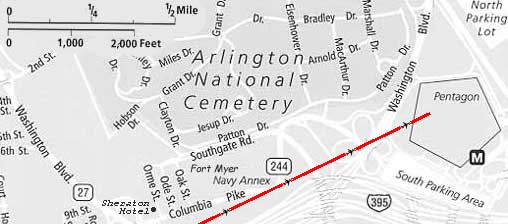
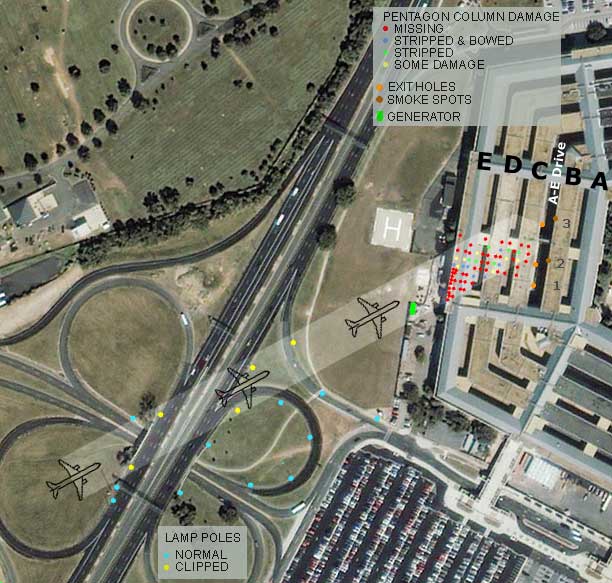 Source of these images: http://www.jp-petit.com/Divers/PENTAGATE/Pentagate3.htm
My comment: It is unlikely, if it had been a commercial plane impact, that it would have approached with its flaps extended. With flaps retracted, the minimum approach speed of a 757 would have been, not 300 km/h, but 600. Asked, professional commercial pilots doubt that amateur pilots, with such a basic training, could have hit their target with such precision, flying low, without their engines catching on the grass.
It therefore appears that Thierry Meyssan is capable of using manipulative arguments, without ever justifying them, and therefore he must be regarded as capable of systematically manipulating his readers. In this regard, it is necessary to systematically doubt his claims, not by asking whether what he says is true or not (it is true that a Boeing 757-200 needs 1500 meters to land...) but whether what he says is true (the verifiable facts) is of the order of demonstration or manipulation. So, let's observe another of his statements on the same page: "They completely ignored the fact that a Boeing 757-200, with a wingspan of 38 meters and a height of 12 meters, cannot enter through an opening of 5 to 6 meters wide without the wings, engines, or tail causing any impact marks." What does Thierry Meyssan, undoubtedly, affirm as true? That a Boeing 757-200 that collides with a facade must necessarily damage this facade with its wings, tail, and engines. This is indeed the least one can assume. He also claims that, in the case of the supposed crash on the Pentagon, there are no traces of damage caused by the wings, engines, or tail. To prove his claim, he shows photos of the Pentagon where he asks the reader to note that there are indeed no traces of damage caused by the wings, engines, or tail. These photos come from the internet, and they can be found at http://www.asile.org/citoyens/numero13/pentagone/erreurs_en.htm
A first photo analyzed "in the Meyssan way" is the following:
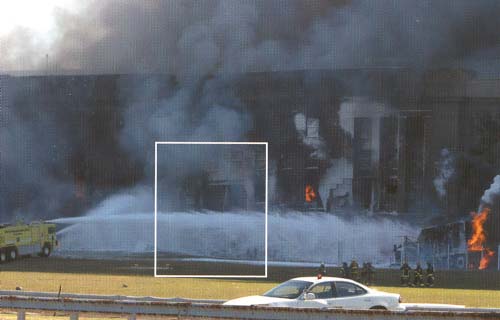
Meyssanic conclusion on this photo: there are no traces of the tail (rudder) impact. We have previously seen that Thierry Meyssan is capable of manipulating his readers. It is therefore necessary to assume that his statement about the facade could also be a manipulation and go further than a simple glance at what appears to be a nearly intact facade.


In your opinion, what is the black hole indicated by the arrow and framed by two small vertical white segments? Answer: it is the vertical hole formed by the rudder that hit between two pillars of the building. Above this hole caused by the rudder impact, we can see that the roof has started to collapse. (The area has been reworked in contrast and a white V-shaped line indicates the collapse). We do not see the entire vertical hole because it is partially hidden by smoke, but it does exist and is visible, even on this low-resolution photo. It is also visible on another photo, taken from another angle:

The fact is that the rudder hit in a vertical alignment of windows, which therefore caused little damage since only under the window supports, the entire rudder entered without hitting the glass, which offered no more resistance than a tracing paper.
My comment: Mr. Delroux points out what he believes to be the mark of the tail impact. It should be recalled that such a tail has a longeron. As it hits the facade with such a high speed, it should have created significant damage, as the author seems to notice with better eyes than ours. If he refers to the rest of his study, he discovers in another photo the mark of the impact of the left wing on the facade, as well as the hole created by the impact of the left engine. The wing also has a strong longeron. If there was an impact, the elements of the wing did not penetrate into the building (the window supports are still in place). According to the hypothesis advanced by the author, the left wing would have hit the facade, leaving a horizontal mark at a distance of about one meter from the ground. Mr. Delroux is not unaware that the engines of commercial airplanes are located under the wings, suspended by what are called "pods". The impact of the engine, which he places in the continuation of what he interprets as the mark of the wing impact, cannot be at the same height. If the wing had hit the facade as he says, the left engine would have hit the ground, leaving a mark, or would have simply disintegrated, projecting debris around, at least many turbine blade debris. Moreover, one must not forget that the fuel of a commercial airplane is mainly located in the wing tanks. What happened to the kerosene contained in the portion of the wing he is interested in? Would it have had the good idea of entering through the broken windows, as well as all the elements of this structure, longeron, struts, flaps, tank elements; wiring, piping, flight controls. All of this is a miracle. Here is a wing that leaves its mark, at 600 km/h, on a facade, and at the same time completely disappears, while there is no trace (on the lawn) of the kerosene it was supposed to contain. At the very least, since it did not catch fire immediately, it should have splashed the lawn. One could have expected to find wing panels, wiring elements, tubes, since, in this hypothesis or these elements would have remained outside, nothing would have burned. It is a physics that, I confess, somewhat perplexes me. But Mr. Delroux may have technical skills that escape me.
With this story "of absence" of damage on the facade, we are here in the presence of a second manipulation.
The staunch supporters of the Meyssanic theory will ignore the previous photos and claim "Rudder marks or not, there are no marks of the wings, which are much larger than the rudder!" This is indeed what Thierry Meyssan claims, that there are no marks of the wings, and this is what we will now look at more closely.
If we observe the Pentagon after the collapse, we can see that this collapse seems indeed to be localized on a width that is actually narrower than the wingspan of a Boeing scaled to the building's size.

EXCEPT... that in the area of the wings of the supposed Boeing, we can see that the pillars of the facade on the ground floor are damaged, and they are much more damaged on the left than on the right:

Note in passing that this would correspond to the position of the Boeing in the official explanations, where the Boeing did not hit the facade perpendicularly, unlike the positioning above, but at an angle:
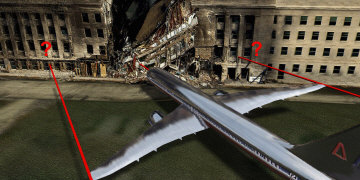
Source of this image: http://www.jp-petit.com/Divers/PENTAGATE/Pentagate3.htm
The question posed by the above image is symbolized by the two question marks: how come there are no damages where the wings are supposed to have hit? Before answering this question, it is necessary to check whether there are or are not damages. For this, it is sufficient to go to the Pentagon's website where the official images of the attack are available in high resolution (> 2 Mo): http://www.defenselink.mil/photos/Sep2001/010914-F-8006R-002.html Here is what can be seen on the left ground floor facade:

Those who were looking for damage caused by the engines will be happy since we can clearly see the nice round hole of the left engine, as well as the damage caused by the resistance of the left wing's attachment (to the right of the engine) and the lesser damage caused along the entire wing, less resistant than the attachment, to the left of the engine:

Two pillars were completely destroyed by the impact of the entire wing and attachment, they are replaced by a temporary support (outlined in white below) and the facade above these two destroyed pillars is supported by two metal braces (highlighted with a white line below) to prevent its collapse:

Conclusion: The claim that the wings and engines did not cause damage is FALSE, it is a manipulation. Those who extrapolated from this false conclusion that it was not a Boeing but a missile since there were no damages caused by the wings and engines were manipulated.
The staunch supporters of the Meyssanic theory will ignore the previous photos and claim "Engine impact marks or not, a Boeing is just chocolate paper and cannot penetrate several rings of the Pentagon, a concrete building designed to withstand bombardments!" This is indeed what Thierry Meyssan claims, and others, to support the theory not of a Boeing but of a missile fired by the Americans themselves, and this is what we will now look at more closely.
We have seen that Thierry Meyssan has manipulated his readers on at least two points, detailed above (the impossibility of "landing" and the "absence" of damage on the facade). These two manipulations could be verified by examining documents. In the case of the possibility, or impossibility, for an airplane to penetrate, or not, several rings of the Pentagon, a concrete building designed to withstand bombardments, Thierry Meyssan relies only on common sense. Given that he has manipulated his readers on (at least) two points, it is necessary to check whether the "common sense" of Thierry Meyssan might also be a manipulation. It seems obvious that a Boeing, which is ultimately just chocolate paper, cannot penetrate several rings of the Pentagon, a concrete building. Just as it is obvious that one cannot plant a straw in reinforced concrete.
EXCEPT THAT... it is perfectly possible to plant a straw in reinforced concrete!
Yes, during tornadoes, one finds straws stuck in reinforced concrete walls. It is the wind speed, of the order of 300-400 km/h in some tornadoes, that makes possible what seems impossible at first glance, namely making something hard (concrete) suddenly soft in relation to something fragile (a straw). Those who do not believe a word of this straw and concrete story (and they are right) can either
- watch FRANCE 5 and wait for a documentary on tornadoes to show a straw planted in concrete
- or try an experimental simulation that will show that indeed the speed changes the whole behavior of two materials.
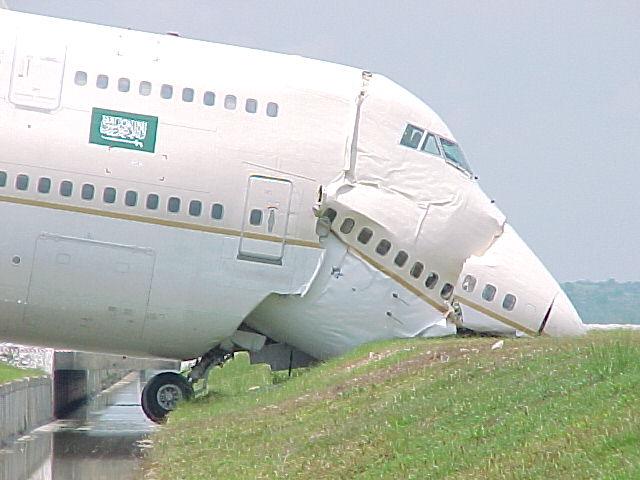
The FRANCE 5 solution risking to be a bit long, we will choose the experimental simulation. We will simulate the straw with a plastic straw (for drinking, without the "accordion" part) and the reinforced concrete with a potato. The low hardness of the potato is perfectly suited to the low speed that we can give to the straw in the context of a "hand" simulation of a tornado. Press the straw against the potato, with the straw straight and pressing firmly in the axis of the straw, in order to pierce the potato using the straw as a corer. You can try this in all ways, you will always end up with the same result: the straw will bend and will not pierce the potato. You could therefore be tempted to think: "common sense and experience show that a straw cannot pierce a potato. Anyone claiming the opposite can only be a liar". We are in the case of the plane that bumps its nose during a low-speed runway departure, which gives this:
http://www.jp-petit.com/Divers/PENTAGATE/Pentagate3.htm
Source of this image:
Hello, control? Bobo!
Incidentally, one will notice on the fuselage the flag of Saudi Arabia, a country whose princes greatly like Thierry Meyssan. This flag is the only one in the world to contain a religious slogan
(There is no god but Allah and Muhammad is his prophet)
and...
A weapon
(a sword...)
By all accounts, the reality seems to demonstrate, both by the experience of our straw on its potato and by that of a Boeing on (or rather off) its runway, that a thin tubular structure (straw or airplane fuselage) is "soft" in front of a hard structure, and absolutely cannot pierce a hard structure.
Really? Let's change the way of doing and add this time the parameter "speed" to the experiment, as in the case of a tornado.
Hold the straw firmly like a dagger and the potato in the other hand (between two fingers, not in the palm of the hand, otherwise you risk injuring yourself in the palm of the hand with the straw... you are warned!). Strike the potato with a quick, as fast as possible blow: the straw pierces the potato as if it were butter! You have not reached (and far from it) the 300 km/h in your striking speed (hence the choice of a potato and not a piece of concrete) but yet, a low human speed is capable of producing an effect that "common sense" deemed totally "impossible" beforehand, because "common sense" can only reason in terms of "testable" speed, therefore relatively slow. One can imagine (or more precisely, one does not imagine!) what a superhuman (mechanical) speed can produce... Let's just retain for now that the "fragile" can be more "hard" than the "hard" when speed comes into play.
Aeronautics: At what speed is the supposed Boeing of the Pentagon supposed to have hit the Pentagon? At high speed, clearly more than 300 km/h, maybe 400, which perfectly corresponds to the speeds of our straw in a tornado, a straw that is planted in reinforced concrete, hence an airplane perfectly capable of piercing a building that is not a solid block of reinforced concrete, but a structure made essentially of pillars, therefore "full of empty space".
My comment: As can be seen on the photo above, the front part of the fuselage of a commercial airplane is the sum of two elements.
- The "straw"
- The front part, the cockpit, and the nose of the aircraft.
I did not know this possibility for a commercial airplane to cut through a concrete wall with a sheet of 2.5 mm thickness, simply by the effect of kinetic energy. The way the airplane, just before the impact, gets rid of its nose, in order to be more incisive, is not specified. I asked my colleague and friend, director of the "structures" department of the National School of Aeronautics, from which we both come, and he confessed that he did not know this kind of phenomenon. Facing this extremely simple simulator, made up of a straw and a potato, he promised to think about this phenomenon, suggesting, until everything is clarified, to call it "the Delroux effect".
The staunch supporters of the Meyssanic theory will ignore the previous experience and claim "straw or airplane, potato or concrete, it remains only a comparison: to know if a Boeing can really behave like a straw, there is only one solution, make a full-scale simulation with a real Boeing that hits a real building!" The argument of the full-scale simulation is indeed the last stronghold of the conspiracy theorists (uh, sorry: the last stronghold of those who seek the truth!). We will therefore now examine the images of a full-scale simulation of the impact of a Boeing hitting a building.
Full-scale simulation:
Here are two images taken from a film showing the impact of a Boeing (similar to the one supposed to have crashed into the Pentagon) with a building.
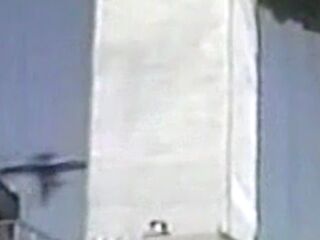

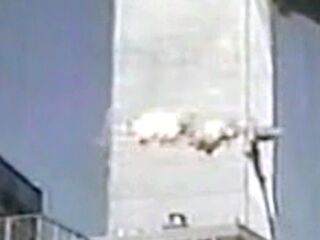
One can see that the airplane, coming from the left, enters the tower and exits from the fuselage, and this before the kerosene is spilled and catches fire. This full-scale simulation confirms what material resistance allowed to predict: a Boeing fuselage at high speed is capable of penetrating a structure much harder than itself. The building of the simulation (a tower of the World Trade Center) is essentially made of steel beams. We are in the case "straw against potato".
My comment: I don't think that's the case. The twin towers are made of floors, which are relatively light structures, attached to a central cage made of a concrete envelope containing steel beams, the whole serving as a "spine". As it presents itself at the moment of the impact, the fuselage of the aircraft passes next to this central structure and then only encounters glass walls and non-load-bearing light partitions. Mechanically, the appropriate simulator would be rather "straw against shaving foam".
The case of the Pentagon is "straw against concrete", but we have seen that in such a case, the straw is planted in the concrete, that is, it is capable of piercing the concrete to a certain depth and is stopped. In the case of a Boeing fuselage, in metal, we are no longer at the scale of a "microscopic" phenomenon like that of a straw, but we are at the scale of a "macroscopic" phenomenon like that of a Boeing fuselage, infinitely heavier than a straw.
My comment: in terms of simulation, I would rather say the opposite. The wall of a commercial airplane is relatively thin, it carries very little kinetic energy. It is not "massive". I believe that Mr. Delroux has a somewhat wrong idea of the impact dynamics of a commercial airplane. But it is true that sometimes simple analogical images can anchor in the heads of non-technicians certainties that are embedded in their brains more deeply than a straw in a potato.
In this case, the heat generated by the kinetic energy at the impact is such that the metal melts. Any gunner will confirm that if you pick up a bullet (metal) that has just crashed into a wall, you will burn yourself. A bullet, although very fast, has very little mass, infinitely less than that of an airplane.
My God....
By combining the "tube" effect and mass, we get successively: - a beautiful penetration by the "tube" effect of the fuselage (the Delroux effect) - a giant heating that melts the thinnest metal parts, turning all the sheets into a mass of high-energy molten metal: this is the principle of the "hollow charge".
My comment: We are here in the presence of a "Delroux bis" effect. I try to understand his reasoning. The giant heating would therefore be related to the impact energy of the fuselage (whose mass, he says, is infinitely greater than that of a bullet). The metal would therefore melt. It may be the reason why no really significant elements of the wings of the aircraft have been found. Carried away by their formidable kinetic energy, they would have somehow ... vaporized, but curiously, without causing the ignition of the kerosene they contained (a Delroux ter effect). While the wing spar vaporizes due to the "giant heating", the engine, curiously, does not vaporize and passes through the outer wall. The fuselage, obviously, pierces the wall by virtue of the Delroux 1 effect.
Hollow charge shells, especially those against tank armor, pierce holes whose diameter is INFERIOR to their caliber.

My comment: Here, it becomes quite complicated and I admit I get a bit lost. Variant of the Delroux effect 1 (the straw on the potato), this fuselage, after cleanly shearing the concrete wall, continues its course through successive perforations of smaller diameter, by "hollow charge effect". We are dealing with a "Delroux effect IV".

It is this "hollow charge" effect that explains the perforation of several rings of the pentagon and that the exit hole (which adorns the cover of Meyssan's book) is of a smaller diameter than the fuselage of the Boeing.
The facade of the pentagon was perforated by a "tube" effect and the rest of the rings by a "hollow charge" effect.
Psychology again: At this stage of the analysis, we see that the elements advanced by Thierry Meyssan to instill doubt fall one by one when one takes the trouble to examine the available documents in the light of some technical knowledge, knowledge that for the most part does not belong to the general public's background.
I confess with great shame that I also lack this technical knowledge, as well as my colleague, head of the "structures" department at ENSA. But we are all ready to learn.
All these elements can be refuted, but of course it would be extremely tedious and in any case would not convince the conspiracy theorists: for each element refuted, the conspiracy theorists take no account of it, except to invent another element to refute. And this, infinitely, to avoid, unconsciously, having to face an unpleasant reality: they have been manipulated. The psychological reversal usually occurs at this stage: those who refute the arguments of the conspiracy theory are accused of being unable to see that they are being manipulated...
It is also sufficient that one of the technical knowledge necessary to understand the most disturbing effects observed on the pentagon is missing from the background of a great scientist (I suppose it refers to me...) for, carried away by his intelligence, our great scientist to scientifically turn his great intelligence... on false trails, leading to great intelligent but... wrong conclusions. The psychological reasons have a logic that reason does not know, and the brain of our great scientist will, psychologically, become blind to ALL the elements that show, as big as a fire truck with all sirens wailing, that he has gone in the wrong direction. While remaining perfectly honest, our great scientist, unconsciously, no longer sees, can no longer see, the elements that scream "Stooooop, this undermines ALL your theory". For example, he will assert that an airplane fuselage cannot penetrate concrete, he will even demonstrate, with photos, testimonies, highlighting his qualifications in aeronautics, etc., that it is IMPOSSIBLE for an airplane fuselage to penetrate a building. But, conversely, he will use the photo of a Boeing penetrating a tower of the World Trade Center to support the conspiracy theory that a black box, located at the front of the aircraft, disappeared and exited the building as shown in the photo of the plane penetrating the tower!
As mentioned above, it is not the same materials.
These two facts will be perfectly compatible in his logic: an airplane cannot penetrate a building, therefore (!) an image showing an airplane penetrating a building proves (!) that there is a conspiracy...
And the more a victim of manipulation has committed, the more he has publicly stated his position, the more he has opposed those who tried to open his eyes to his pathological blindness, the more difficult it is for the victim of manipulation to admit that he was wrong: the emotional, time, and sometimes financial investment is too great to be conceivable to retreat. From a certain stage onward, going back is not only impossible but going forward becomes OBLIGATORY, to avoid being caught by reality. Therefore, the only option left is to keep moving forward: inventing new elements to refute, even if it means sinking into the most perfect ridicule, in good faith, in psychological dead ends. Once in these dead ends, these people blame journalists for not answering their questions. Except that journalists know, precisely because it is their profession, on one hand that one cannot show a person what this person cannot or does not want to see, and on the other hand, that it is more effective to MANIPULATE than to DEMONSTRATE. By manipulating, one can convince the masses, all kinds of people, INCLUDING those who do not want to see the demonstrations. The disadvantage is simply that it makes brilliant and intelligent people suspicious of journalists. But brilliant and intelligent people are only a tiny minority, and they are finally a negligible quantity.
Number of views since May 14, 2004: