Alien science fiction films E.T
The end of E.T.
October 19, 2002
The Thing from Another World (1950)
Films play an important role in shaping the collective unconscious of the population. They complement the corrosive influence of television. No one would deny this. It is therefore interesting to look at films, old or recently released, to see what is conveyed, related to the theme of alien visits.
You will only find "The Thing from Another World" in film archives, a must for a film that will make you shiver with fear, dating from the 1950s. The scene takes place in the Canadian North during a blizzard, in a weather station inhabited by scientists. One night a flying saucer crashes, detected visually and by radar. Since it is hot, it melts the ice and sinks under its surface (it is a frozen lake in Labrador). Then the water freezes again and then a dark and blurry shape can be seen by pilots sent to the area from their cockpit. A detachment is sent to the site. What is very strong cinematographically is that nothing is seen until the very last images of the film. When the ski-equipped DC3 lands next to the ship, its passengers are invited to form a circle to assess its dimensions. They take their places slowly, then the camera zooms back and, without seeing anything under the layer of ice, the arrangement of the men allows one to imagine a circular ship about thirty meters in diameter. Shortly after, a man discovers the extraterrestrial passenger that he claims to see under the layer of ice. This creature is not seen, but they decide to cut the block and take it to the nearby weather station. This block of ice three meters long and more than a meter thick is then placed under a tarp in a heated shed, waiting for it to thaw and release its contents.
The suspense begins. Outside, a violent snowstorm rises, completely isolating the half dozen men in the station from the rest of the world. In the shed, the ice begins to melt drop by drop. A large puddle forms on the floor, growing over the hours. Next to the tarp, a man, smiling, reads comic books while chewing gum, an image of a good-natured America. One can then guess that the creature is not dead, that something is going to happen. The tarp begins to move. Then we move to an adjacent room where the other men hear a terrible scream. They rush and discover the table on which the block of ice had been placed, empty. Obviously, the creature has taken the man with it into the polar night. Through the open door, only the whirlwinds of the blizzard can be seen. The men close the door and barricade themselves. End of this first part.
Second act: the huskies, tied up outside, seem to be engaged in an extremely violent battle a few hours later. One hears their barks and their cries of pain. Again, nothing is seen. In terms of special effects, people's imagination is the best. The pale polar day rises. Taking advantage of a temporary lull, the men risk going outside. All the dogs are dead. Some have been devoured alive, but one of them managed to cut off one of the creature's hands, which lies on the ground. The scientists bring it inside and examine it. This anatomical piece is obviously "diabolized" to the extreme. Crooked nails, scales. The team's biologist performs a cytoscopic examination and discovers an extraordinary fact: these are plant cells! He then plants the hand of this alien in soil and a few days later it... starts to move again. Moreover, it has "reproduced," meaning that sprouts have developed around it. This is how the creature reproduces at an astonishing speed: through "surgeons."
Third act: The biologist, fascinated by his extraordinary discovery, tries to steal his specimens from his companions, but fortunately they manage to destroy them in an acid bath. You don't mess around with things from outer space, as is well known. They shoot first, then think. It remains to get rid of the creature. The men then set a trap for it by leaving the entrance corridor door open. It appears. One can barely see it, but immediately the station's members trigger their trap: they electrocute it. Briefly, the visitor from outer space goes to the electric chair and finally collapses, charred.
Epilogue: The good weather has returned. They sweep the floor, removing the ashes representing the remains of the creature. An intellectual, the meteorologist of the station, announces by radio that they have lost a man but that everything is fine. Then he turns directly to the viewer and says with a serious look:
- Now, believe me. Look out to the sky! (Now, guys, believe me. Watch the sky!)
There will be several films of this kind. The War of the Worlds, in color, will show machines landing from cylinders (one must be wary not only of flying saucers but also of cylinders). These move with a whistling sound, hovering close to the ground. Two brave American farmers go to meet them:
- Hey, hey guys .....
The machine has a kind of snake, equipped with three "eyes." Obviously, the pilots are observing the farmers with this pedunculated eye. Then the response comes, sharp. The head of the snake emits a ray that instantly carbonizes the two men.
The news being known, panic spreads among the population. The American National Guard tries to oppose the invasion with submachine guns, jeeps and rocket launchers. The alien ships, in addition, are protected by a "shield," and continue their systematic destruction. It's really bad for the Earthlings. But, as in H.G. Wells' book, these invaders are suddenly struck down by the microbe of whooping cough. Their ships fall to the ground. The door opens and only a tentacle, agitated by the last convulsions of death, can be seen. The viewer breathes.
There will be no end to such films, showing and re-showing aliens that are not at all special. It will take the film of Spielberg, "E.T.," to discover a kind alien, a biologist and a bit distracted, accidentally abandoned on a foreign planet for him: Earth. Hunted by nasty scientists who want to "study" him, he will be protected for a time by children. He has powers that could be called paranormal and the "green hand." It is an ecological alien who, learning some rudiments of the terrestrial language, manages to formulate his request, engraved in everyone's memory:
- Home phone....
The brave E.T. makes do with the means at his disposal to set up a system to call his friends. But, on the night he sends his message, accompanied by a little boy (with whom he has obviously established a telepathic connection), he catches a cold and gets a bad flu.
Meanwhile, the "special services" discover the creature's refuge. They invade the house and put this being from space "under a incubator." E.T., sick and dying, will eventually recover his health and, taken by his friends, escape the pursuit of the CIA, the MJ-12, etc.
That's Spielberg's vision, already a bit more sympathetic than that of the two previous films. But it won't last and today we see remarkable nonsense, like "Independence Day" and "Mars Attacks." I don't want to go into these scenarios, which are at the level of the average American from the Midwest eating his popcorn in front of the screen. After seeing "The Invaders" who slip into the skin of Earthlings, or the series "V" (same thing: under fresh faces hide abominable reptilian creatures), we are treated in "Independence Day" to slimy monsters coming to plunder the Earth's resources, like locusts. The brave President of the United States goes down to the depths of the famous Area 51 where he discovers the existence of a UFO wreck, the traces of intense scientific activity as well as the hideous bodies of three extraterrestres preserved in formalin. In a glass-walled box is a fourth creature, still alive, which turns out to be the pilot of an extraterrestrial ship that has just been shot down by an Air Force ace. Trying to negotiate, the President asks his extraterrestrial visitor:
- What should we do?
The latter answers:
- Die!
There is no choice left. Fortunately, the Americans will save the world through the sacrifice of one of their own, a brave alcoholic veteran who manages to slip inside a giant ship with his fighter and missiles.
The film Signs, with Mel Gibson (October 2002)
Image and comment extracted from Télé Obs :

More than half a century after "The Thing from Another World," we are given its remake, straight up. The script is absolutely poor. I'll summarize the thing. Evil aliens come to Earth to eat us. You won't see, in computer-generated images, huge ships flying over cities, like in Independence Day. There are no special effects. I don't know if this film will make money, but its budget is limited to the strict minimum.
Cast: A single star, Mel Gibson, who seems to be bored to death. He is flanked by his brother (ex-Roman emperor in the film Gladiator). You add two kids: Gibson's children. The son, ten years old, the daughter, five. Plus a few brief shots where a police woman has a few lines to say. Two other characters: a drunk, whose performance lasts forty seconds (whose role is actually played by the writer-director-producer Night Shyamalan. There are no small savings). Add Gibson's wife, who speaks to him before dying in a single flashback shot: one minute. Oh, I forgot. There are two wolves, one of whom dies at the beginning of the film. They may have taken the same one to save money. It's not impossible.
Sets: Gibson's house with a cornfield in front, with some flattened shots. Finally, some flashbacks scenes, on a road, with an ambulance and two police cars with sirens. That's all. You say to yourself: "Pinch me, I'm dreaming."
Script: Mel Gibson, in his fifties, is an ex-pastor who apparently lost his faith after his wife was killed by a drunk driver while walking on a road. He has turned to agriculture and grows corn in front of his house, lives with his two children. The son, asthmatic, is ten years old and his little sister, five. Gibson's younger brother, who lives with them, is apparently twenty-five or thirty. One morning Gibson no longer sees his children. He finds them in his cornfield. In front of them a circle of flattened corn thirty meters in diameter. Gibson looks, puzzled. A police woman comes to see. One of the wolves suddenly becomes furious, attacks Gibson's daughter, but fortunately his brother stabs it and it dies.
The explanation is quickly provided by the TV. Image of Gibson sitting on a couch with his brother and his two kids. Voice over: "Lights appeared above several cities." A shot on the television screen. It's a still image. No special effects, nothing. The contact with the outside world will be managed by this brave TV. Everything goes quite quickly. In a few days, we learn "they are here, they are hostile, they attack people, they kill them with gas, etc." In short, "they" have come to take possession of the Earth, we know it right away.
Gibson, an ex-pastor, is obviously not prepared for this kind of news and it is his son, who spends his time snorting in his nose to relieve his asthma, who briefs him with an illustrated book that shows the face of the extraterrestrials and a flying saucer burning a house with a ray.
- Dad, this house looks like ours.
Gibson, tangled in a poor script, short on lines, tries to compose a face full of gravity. But, if you are observant enough, you will see that he is bored to death. The elements of the script are set up one after the other. There is no coincidence, repeats mechanically Gibson's brother. This one, an amateur baseball player, keeps his bat on a wall, associated with a plaque saying that he made the fastest throw in the state. However, if he didn't become professional, it's because he missed balls. Keep this element in mind, it is one of the keys to the resolution.
Second element: Gibson's wife, comfortably stuck in metal after the accident (she doesn't seem to be in much pain and seems to have just come from her hairdresser) says to her pastor husband "remember, you have to see and strike hard." The film indicates that the author of this film is also the director and producer. The accident of Mel's wife is not shown. If you look closely, you even don't see any crumpled metal. The accident is simply suggested: on a road, police cars with sirens, the police woman. You don't even see a extra. The simplicity of the staging is quite remarkable.
The days pass, punctuated by news coming from the television.
- Dad, they say there are lights like that in four hundred cities.
We show the still image visible on the screen with voice over. Gibson goes to the drunk who killed his wife, an Indian (played by the film's producer-writer-director) who is about to leave in his car and says, before speeding off:
- They're there, in my house!
Gibson enters it and glimpses a terrible clawed hand for a moment. He understands, he's not dumb, that the aliens will soon attack his own house. With his brother, they barricade themselves by nailing planks over the doors and windows. A long wait begins. Noises outside, various growls. A clawed hand trying to get in and grab the door handle. Gibson and his family retreat to the basement. The situation is dramatized by the fact that the adults have forgotten the child's asthma medication, on the ground floor of the house. The child has an asthma attack and his father says "no, don't die." Note the extreme richness of the dialogue. The alien (we will only see one, due to budget) eventually manages to enter the house. Although having traveled light-years with a ship, it apparently takes him fifteen hours to get through a board nailed shut.
Final scene. Gibson and his brother face each other. Finally, the terrible alien is seen, in back light.
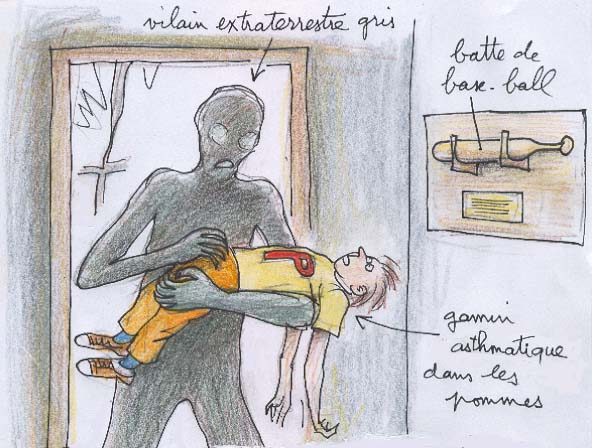
It has Gibson's son in its arms and apparently threatens to kill him with a kind of spike that comes out of its wrist. Mel then remembers the phrase spoken by his wife just before she died. Addressing his brother, he shouts:
- The bat, kill it with the bat! Hit as hard as you can!
No, you're not dreaming. Gibson's brother attacks the alien with a baseball bat. The latter activates its gas to kill the child, but the child, who has fainted, is practically not breathing because of his asthma and that is what saves him (you now understand why the child had to be asthmatic).
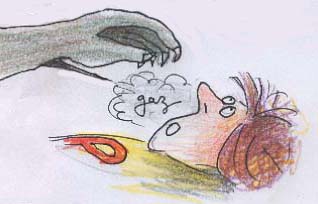
Suddenly, the alien gets a splash of water from a bottle on a shelf, which falls over. And there, a piece of information that Gibson's son had read in his book "The aliens are afraid of water, it kills them." Indeed, the creature dies quickly.
Everything returns to normal. Thanks to God, the aliens are soluble in water. The TV tells us that all over the world, the Earthlings have managed to overcome hordes of invaders in a similar way. Final image of Gibson who has put on his pastor's costume. There it is, he has regained his faith.
Ah, last question, why the crop circles? The justification is in one sentence:
*- They use these marks to navigate. *
Close the curtain.
This film strongly links the "crop circles" with the most naive, the most ridiculous alien threat. But the bigger it is, the more it works. Think of Independence Day. When people have this in their heads, it will prevent them from thinking about possible microwave weapon tests carried out since 1981 by the Anglo-Americans. Currently, more and more people are beginning to ask questions about the crop circles, the cattle mutilations (2800 cases in the USA so far), and the mysterious grid-like trails, the "chemtrails," appearing in the American sky and corresponding to aerial spraying done by planes without registration signs.
-
Do the crop circles correspond (which I am convinced) to microwave weapon tests, implemented from space or from high-flying planes?
-
Do the cattle mutilations (2800 cases in the USA so far) correspond to cancer-inducing weapon tests?
-
Do the "chemtrails", these grids created in the atmosphere, correspond to the assessment of the effects of climate weapons?
The innocent era of E.T. is over. The military now need the media and the film industry to cover up increasingly obvious activities. This would also explain why Antenne II did not specifically want me to be on the set of the show "C'est au programme" on October 11th, which was devoted to both the crop circle issue and the release of the film "Signes."
The film with Gibson is there to divert the public's attention. Perhaps the next one will deal with cattle mutilations in the same way.
Cast: Mel Gibson, his brother, his two kids, a sheriff and two dogs. You would say, let's say, five cows. Set: the farm, a neighboring field. Equipment: a 4x4 and an old truck.
Script: Mel Gibson is a defrocked pastor, who has returned to farming, living with his two young children and his younger brother. His wife died from a bad fall (thus saving the scene with the drunk driver). One morning he no longer sees his children, goes to look for them and finds them in the neighboring field. A repulsive sight awaits him. His dairy cow, Daisy, has been mutilated during the night. They have removed her tongue, udder and genital parts, plus one of her ears and completely drained her blood. The cow's bell has disappeared (a detail that will only be clarified in the final scenes of the film). Mel Gibson is stunned. In the days that follow, the television shows images of lights appearing above "four hundred cities" (always in a still shot). We learn that the phenomenon is planetary. In France, Normandy is particularly affected. In North Africa, we are told, camels have been mutilated in the same way. Following the messages on television as well as reading books full of lessons, the horrifying reality emerges: it is the aliens who eat these anatomical parts of the cows and camels. But, quite quickly, it is discovered that human beings are also found without tongues and without genital parts, operated with a scalpel and completely drained of their blood. Mel Gibson goes to the sheriff and finds him also without a tongue, with his pants open, hanging by his feet on his suspension. It's horror. Gibson decides to barricade himself with his family. That night, the aliens attack. The dog's howls eventually stop. In the morning, the door is blown open, an alien having finally managed to get through after ten hours of effort. It ends up in the living room with a vampire-like head and long fangs. But at the last moment, Mel Gibson remembers the last words of his wife, dying:
- Forward the music!
In Mel Gibson's head, things suddenly become clear: rock music kills aliens. He manages to turn on an old record player and play a record by Elvis Presley. The alien dies before their eyes, in terrible convulsions. Final image: everything has returned to normal on the planet thanks to the discovery of this alien-killer weapon, typically terrestrial, and we see Mel Gibson, having finally found peace of mind, putting on his pastor's costume.
October 20, 2002: One of my readers, Emmanuel Yohann, informs me that you can find in the press some really negative reactions, like that of "TéléObs":
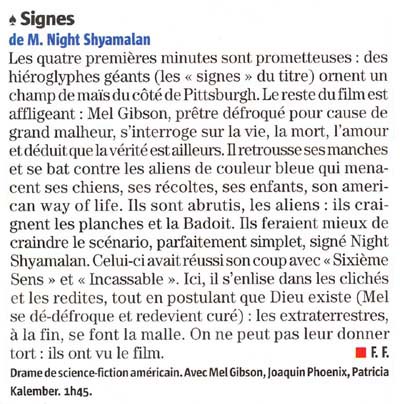
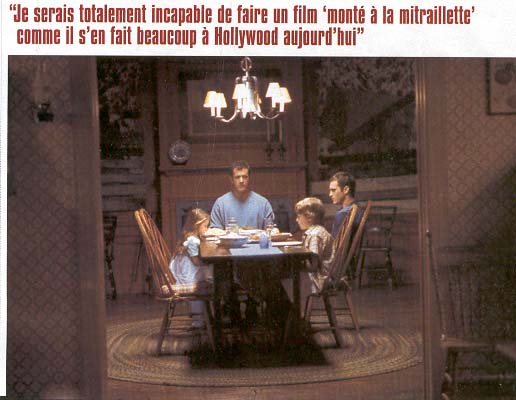
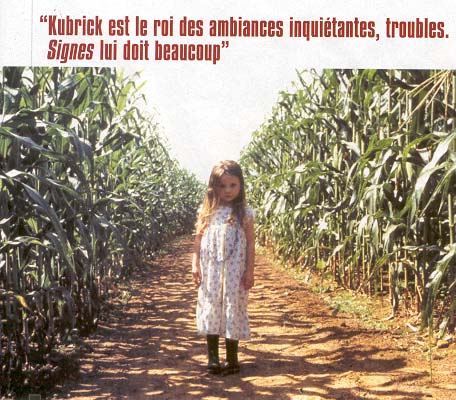
To be completely honest, some media like "Ciné Live" have praised this film as a work of great quality, dedicating its cover and a 9-page article titled "The Mystery of Creation according to Mr. Night Shyamalan," which is qualified as a "master of supernatural suspense," "a reference in the field of fantasy." Below are some images as well as quotes from the author-director:
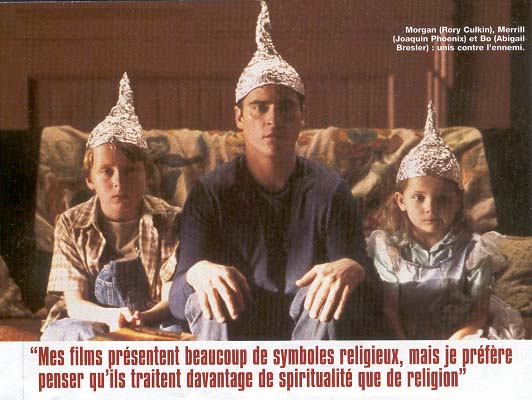
In this scene, the three characters inform themselves by watching television. In this article, one grasps the simplicity of the film's cinematic writing. In every shot, nothing is left to chance. The apparent banality of the decor, the simplicity of the shot are actually there to make us appreciate, in a backhanded way, the weight of the atmosphere that Shyamalan manages to create with a remarkable economy of means.
This shows that to equal authors like Stanley Kubrick, it is not necessary to have considerable special effects. With a simple cornfield, Shyamalan manages to create an anxiety that is barely bearable.
Return to Guide Return to Homepage
Number of visits to this page since October 19, 2002 :