Deprived of the right to present evidence
How can one be
"deprived of the right to present evidence"?
Here is the text cited by the judge:
Article 55: When the defendant wishes to be allowed to prove the truth of the allegedly defamatory facts, in accordance with the provisions of Article 35 of this law, he must, within ten days after being served with the summons—whether summoned by one party or the other—submit:
- The facts specifically stated and qualified in the summons, which he intends to prove;
- Copies of the documents;
- The names, professions, and addresses of the witnesses by whom he intends to prove them.
This service must include appointment of a domicile before the correctional court, under penalty of being deprived of the right to present evidence.
The mechanism underlying the conviction I received is based on the text mentioned on page 8 of the judgment:
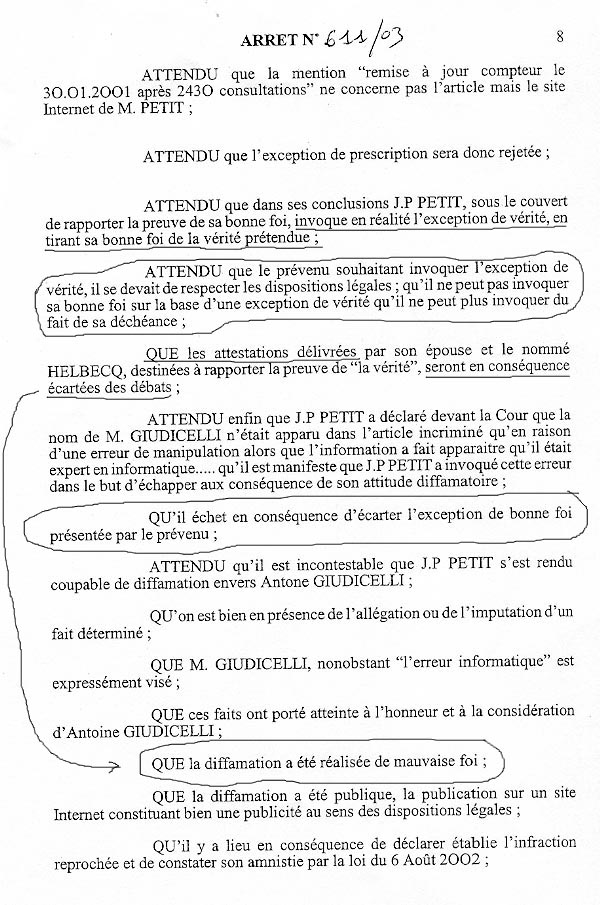
Here is how this text should be interpreted.
When accused of defamation, one has two possible defenses. One may choose only one of the two.
-
Either one pleads the exception of truth. In this case, one is required to provide evidence proving that the alleged facts are true. This means saying, for example: "I heard Mr. Antoine Giudicelli tell me that underground nuclear tests had taken place in France, and I can provide proof that this actually occurred." If this option is chosen, all documents must be submitted to the court within ten days of being served with the summons.
-
Or one pleads the exception of good faith. In this case, one does not attempt to prove that the alleged facts actually occurred, but instead provides evidence showing that the allegations are not absurd, and especially offers witness testimonies in support. This means saying: "I cannot prove that France actually conducted underground nuclear tests on its own territory, but I can provide two testimonies from individuals who confirm that Mr. Giudicelli indeed told me such things."
Clearly, in both the first instance and appeal proceedings, we had positioned ourselves within the second framework. The documents and the two testimonies confirming my statements verbatim were thus provided to the court at first instance. They were also submitted during the appeal. However, this time the court ruled that my defense should have been based on the exception of truth. Since the documents had not been submitted properly—within ten days of being served, as required—the court considered that my two testimonies, as well as any other documents submitted, were "excluded from the proceedings." I was then "deprived of the right to present evidence," as if I had submitted nothing to support my defense, and sentenced to pay Mr. Giudicelli 5,500 euros in damages and interest.
A simple observation: Although the press and environmental organizations such as Greenpeace and Criirad (Center for Independent Research on Radioactivity, established after Chernobyl) were present at the first instance trial, no one deemed it necessary to attend the appeal trial or react after the verdict was announced, despite Paris correspondents making every effort to draw attention to the case. From Greenpeace, I received only "an offer to subscribe to a newsletter."
During the trial, within the framework of a defense based on the exception of good faith, I presented arguments regarding the plausibility of Giudicelli’s claims, relying on a U.S. Geological Survey report detailing all relevant techniques. This document demonstrates how easily clandestine nuclear tests can be concealed—the seismic signature of explosions in cavities 20 to 25 meters in diameter blending in with routine mining operations (450 kg of TNT, magnitude 3). My lawyer submitted this report to the court. Yet neither this key document nor the discussion it generated was mentioned in the judgment’s reasoning. The American report.
Back to Guide Back to Home Page
Number of visits to this page since July 8, 2003: