Kursk submarine collision repair
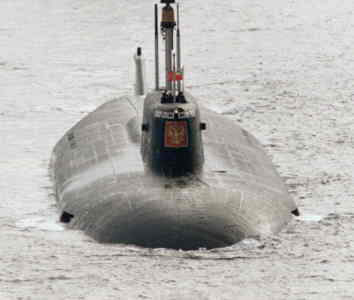
| In memory of the crew of the | nuclear powered submarine Kursk |
|---|
Is the Los Angeles responsible for diverting the Kursk?
The Russian and American authorities have agreed to hide the truth about this disaster.
The version
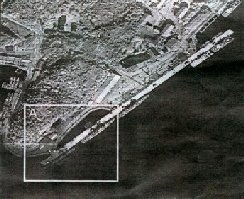
Dmitry Filimonov
This photo was taken by the Russian intelligence satellite on August 19, 2000 from an altitude of 40,000 meters. It shows the Norwegian naval base Haakonsvern, located on the coast of the Grimstad fiord in the province of Hordaland, nine kilometers to the southwest of Bergen. The geographical coordinates of the base are 60°20'20" N, 5°13'53" E, ? = +20°. The naval base Haakonsvern is used by small and medium-sized ships - up to frigate class, but not by submarines.
On August 19, a Los Angeles-class nuclear submarine entered Haakonsvern and moored at the piers near an Oslo-class frigate. The submarine was moored at the piers rather than in the dry dock, as the dry docks in Haakonsvern, we must reiterate, are not intended for submarines, particularly nuclear ones. We assume the name of this ship is Memphis or Toledo; both belong to the Los Angeles class. These submarines are 109.7 meters long, 10.1 meters high, and 9.9 meters wide, with a displacement of 6,000 tons.
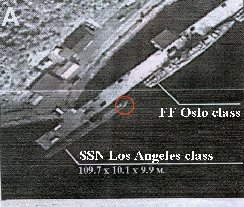
The ship arriving for repairs had significant damage to the bow, captured by optical-electronic reconnaissance. The thick rubber-ceramic hull of the submarine had been torn off, like the peel of a banana. It is evident that the internal steel structure had also been damaged.
The ship was repaired in eight days. On August 27, in the afternoon, it left the base and headed towards the British coast. The submarine circumnavigated the British Isles to the east, entered Southampton on the south coast of England, and went into a closed dry dock for major repairs.
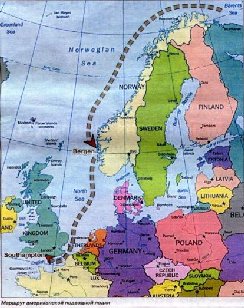
The collision with the Kursk in the Barents Sea occurred on August 12. The damaged Los Angeles-class submarine entered Haakonsvern on August 19, one week after the Kursk accident. It is therefore necessary to reconsider the media reports that appeared after the official announcement of the accident in the Barents Sea. The Interfax agency published, without paying attention, a statement indicating that, according to Russian intelligence services, a certain underwater object weighing up to 9,000 tons was drifting from the Barents Sea towards the Norwegian coast. Another statement reported that the director of the CIA had traveled to Moscow. These two facts are closely related.
On August 12, the Kursk and an American Los Angeles-class submarine collided. This collision caused the explosion of ammunition in the forward compartment of the Kursk. The Russian ship sank. As it is known, a Russian surveillance satellite detected, near it, an object resembling a submarine of smaller displacement. Soon after, according to news agencies, this object disappeared. After the collision, the crew of the American submarine managed to evacuate the ship from the accident area. The ship required emergency repairs due to the serious damage it had suffered. A decision was made to opt for operational repairs at the Norwegian base of Haakonsvern, even though this base is not equipped to accommodate submarines. However, due to the damage, the speed of the ship was very low: it took seven days to travel the distance between the accident area in the Barents Sea and the Norwegian coast, while the normal journey takes two days. It was therefore indeed the American submarine that "drifted" towards Norway. The operational repair lasted eight days. Afterwards, the submarine quickly returned to sea towards Southampton, in order to undergo major repairs in an adapted dry dock.
The director of the CIA traveled to Moscow to suppress the conflict and prevent a possible war. Therefore, the Russian authorities knew the truth about the accident. On August 19, the published photo was given to the Russian Minister of Defense and to the Commander-in-Chief, who was on vacation in Sochi. Once again, Russia and the United States found themselves on the brink of an armed conflict. The agreement of both parties to hide the truth prevented the conflict. Photos of the Haakonsvern naval base and the damaged submarine moored at the pier became Top Secret.
Of course, this is only one version. However, taking into account the above information, it is of great importance.
We publish this photo of the "Kursk killer" not to inflame tensions, but because the public must know the truth - both in Russia and in the United States.
Number of views since October 6, 2003 :
****kurskmem@murman.ru | To contact
| the relatives of the Kursk sailors, if you can | E-mail: |
|---|