kursk
The truth about the Kursk disaster
September 25, 2003
http://leweb2zero.tv/video/abe_11470fc3e0bb949
http://leweb2zero.tv/video/abe_60470fde94cb7e4
November 16, 2007
: Michel Carré's film can now be seen:
A submarine in troubled waters, in two parts:
Part 1:
Part 2:
Today (2003), an article signed by Dimitry Filmonov has just been published. You can retrieve it on the URL:
http://www.murman.ru/kurskmem/articles/norwaye.htm
Here is the French translation, but you can find the original text in English here.
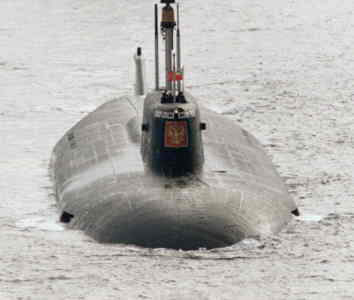
| In memory of the crew of the nuclear submarine
| Kursk |
|---|
Could a Los Angeles-class submarine be responsible for the disappearance of the Kursk?
Russian and American authorities have agreed to hide the truth.
The version
Dmitry Filimonov
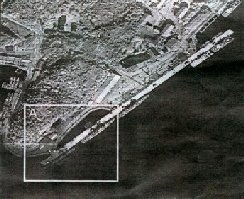
This photo was taken by a Russian spy satellite on August 19, 2000, from an altitude of 40 kilometers. It shows the Norwegian base of Haakonsvern, located on the coast of the Grimstad fjord, in the province of Hordaland, nine kilometers south of Bergen. The geographical coordinates of this base are: 60-20-20 N, 5-13-53 E, ? = +20?. This base is capable of receiving small ships, such as frigates, not submarines.
On August 19, a Los Angeles-class submarine docked at Haakon svern, near an Oslo-class frigate. The submarine moored on the quay and not in the dock since, we repeat, this base was not designed to accommodate submarines, and especially not nuclear submarines. It is assumed that the name of this submarine is Memphis or Toledo. These two are Los Angeles-class submarines, which are 109.7 meters long and 10.1 meters wide and displace 6000 tons.
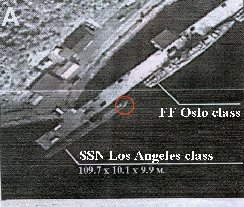
The ship had come for repairs, its bow having suffered considerable damage. These informations were obtained via an electro-optical camera (image converter). The submarine's coating, a mixture of rubber and ceramic, was torn off and "peeled like a banana's skin". The steel hull underneath this coating had also been damaged. The repair lasted 8 days. In the afternoon of the 27th, the ship left this mooring and headed south of England, passing the English islands from the east. It then reached the English coast, Southampton, and benefited from further repairs in a closed dock.
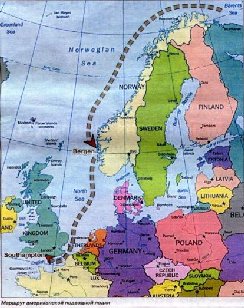
**The route taken by the submarine. **
The collision with the Kursk occurred on August 12 in the Barents Sea. The damaged Los Angeles-class submarine reached Haakonsvern on August 19, one week later. It is now necessary to refer to the press reports that were issued after the official information regarding this incident in the Barents Sea. An Interfax agency mentioned, based on information from Russian intelligence services, which was not noticed at the time, that an underwater object weighing 9000 tons was moving towards northern Norway. Another report from the CIA's direction arrived in Moscow, confirming the facts.
Thus, the Kursk and a Los Angeles-class submarine collided on August 12. The impact caused the detonation of ammunition located in the bow compartment of the Russian submarine, which sank. We know, and it was recorded by one of our reconnaissance satellites that was near, there was an object resembling a submarine moving at reduced speed. After this collision, the crew of the American submarine maneuvered to move away from the accident site. The submarine had to move quickly given the severe damage it had suffered. The decision was made to perform emergency repairs at the Norwegian base of Haakonsvern, even though this base was not suitable for submarine repairs. Due to the damage sustained, the submarine's speed remained very limited, which is why it took 7 days to travel from the accident site, in the Barents Sea, to the Norwegian coast. After 8 days of repairs, the submarine was able to reach the Southampton base at full speed, where repairs could be completed in a closed dock.
The CIA director arrived in Moscow to suppress the matter and prevent a possible war (...). (Wherefore) ? Russian authorities knew the truth about the accident. On August 19, the published photo was transmitted to the Russian Minister of Defense and the commander-in-chief who were on vacation in Sochi. Once again, Russians and Americans seemed on the brink of an armed conflict (...). The two parties agreed to hide the truth and thus prevent any escalation of the situation. The photographs concerning the Haakonsverne naval base were classified "Top Secret".
Of course, this is only one version of the affair, but considering what has been established above, we can consider this as important. We are not publishing this photo of the "Kursk killer" to trigger a conflict. We simply think the public should be informed, both in Russia and the USA.
****kurskmem@murman.ru| To contact
| the relatives of the Kursk sailors, if you can | E-mail: |
|---|
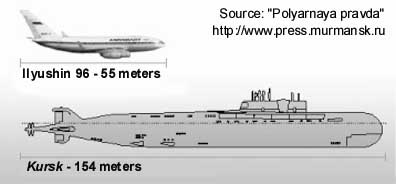
Date of the disaster: August 2000
Was it simply a collision? Who would believe such a thing? The Barents Sea is shallow (maximum 170 meters). It is free of features that could provide false echoes. It is understandable that when a major power like Russia carries out maneuvers near its own territory, outside its territorial waters, other nations tend to send their own units to try to gather some information. But to consider a simple collision between two such giants is a big step.
In 2002, a French journalist, Michel C., contacted me. He wanted to conduct an investigation on the Kursk, whose wreck had been raised after cutting off its entire front part. The Russians were apparently in agreement for this investigation to be carried out by a foreign television. Michel C., wanting my opinion, shared the information he had.
-
Collision marks, scraping, had been observed on the Kursk's hull, which had been blown open by an explosion that had originated from inside, given the way the plates were bent outward.
-
Two explosions were felt at the time of the disaster, two minutes apart, the second one being much stronger. The explosions were recorded by a Norwegian seismographic station.
-
The Admiral Peter the Great, a nuclear-powered Kirov-class cruiser, when the Kursk sank (quickly), instead of approaching the site of the disaster, moved away from it.
-
(If my memory is correct, to be verified): instead of the wreck, the depth was 117 meters. Given the height of the submarine, this placed the upper part of its hull at 90 meters from the surface.
-
The submarine was unable to send distress signals by radio (in such cases, a beacon is automatically dropped, which rises to the surface). This beacon would have been found, drifting.
-
The presence of survivors was not in doubt. Signals corresponding to blows against the hull by the sailors were perceived for days.
-
A mini-submarine tried to approach the Kursk, apparently to attach itself to it.
-
The Kursk was equipped with "Granit" missiles.
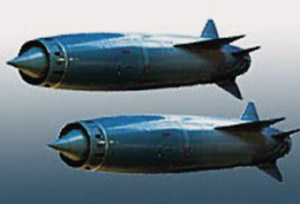
These missiles are ten meters long, 0.85 meters in diameter, and weigh 3 tons. Their range is 550 km. Cruising altitude: 20,000. It is an anti-ship missile. It is initially propelled by solid-fuel boosters, which it then discards.
August 2004: a photo that is supposed to show the extraction of one of the Granit missiles from the Kursk wreck.
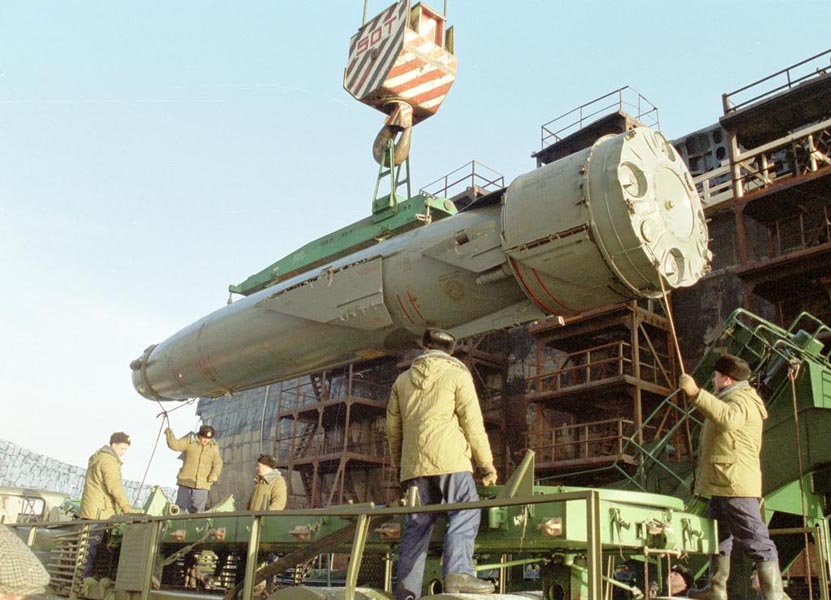
The image comes from a Russian site: http://airbase.uka.ru/cache/users/muxel/files/1024x768/granit_kursk.jpg

This photo seems plausible. At the back, something that looks like a four-tube solid-fuel booster, capable of bringing the supersonic cruise missile to a sufficient speed for its flight engine to take over. On the sides, according to this, the wings and tail in a folded position. It seems that we can also distinguish, on what we identify as a booster, a stabilizer fin element, also in a folded position.
Below, an unusual hole, visible on the starboard front part, just before the torpedo compartment cut:
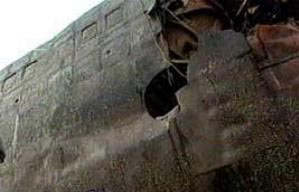
**Hole located on the starboard front. Notice the indentation of the hull. **
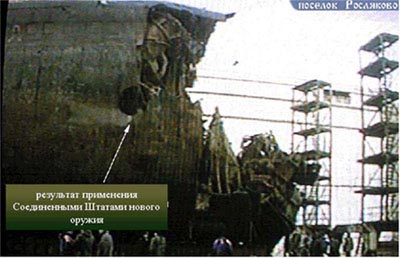
The same hole. The Russian text mentions a diameter of one meter and "plates bent inward"
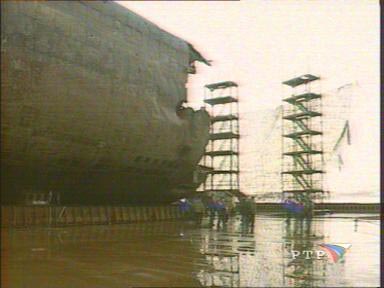
**Another view of the hole, where the indentation of the hull is clearly visible.
It is located halfway up the hull**
Source: http://www.oag.ru/views/kursk1.html
The text on the site where these photographic documents were found states that the hull plate is bent inward. These images support the theory of a "contact shot" carried out by a specially equipped submarine, presumably American. A shot with a high penetration power, possibly a hollow charge, introducing an explosive charge into the torpedo compartment, timed. Note the indentation of the hull near the hole, not circular (these two indicators suggesting an oblique hit). This would explain the two signals detected by the seismograph, the first corresponding to the contact shot and the second to the explosion of the timed charge, causing the submarine to sink.
The information provided by Michel C. had some strange aspects. It was said that an atomic engineer who had worked on the Kursk (from the Rubine shipyards) had been murdered and "found cut into pieces". It was also said that a mutiny had occurred on board the Kursk and that when the investigators entered the raised hull, they found the officer in charge of guarding the armory, with a bullet in his head.
The technique of the contact shot
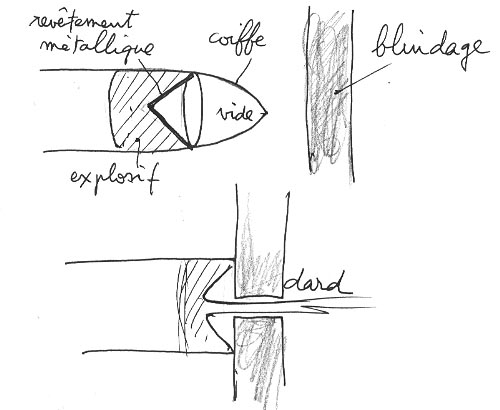
Readers have been surprised by the large diameter of the opening observed in the Kursk's hull, as well as its regularity, as if it had been made by a "cookie cutter". In fact, this is exactly how the contact shot is practiced. The effectiveness of the hollow charge has been known for a long time. See the figure below. The shell, or missile, needs a certain shaping to make its way through the air. It is then given a light cover that houses an explosive charge with a conical recess. At impact, the cover is crushed. The charge is ignited by a detonating material where the chemical reaction propagates at high velocity. It is therefore the conical surface that produces a shock wave, also conical. This concentrates the energy in the form of a dart that is projected forward at very high speed. It is this that pierces the armor. Normally, a charge corresponding to a caliber of diameter D produces a dart of much smaller diameter, capable of penetrating an armor of thickness e = D.
In the contact shot, the system does not need to be shaped. The attacking submarine approaches its target, bringing its bow into a position perpendicular to the target's wall. This attack is the modern version of "boarding". The impact is cushioned by a large rubbery bumper (this is the one that had partially detached, which was photographed when the American submarine had to flee to a base in Norway). The following drawings are presumably sufficiently explicit. The explosive charge of the "cookie cutter" is arranged to present a kind of groove whose sides are truncated cones.
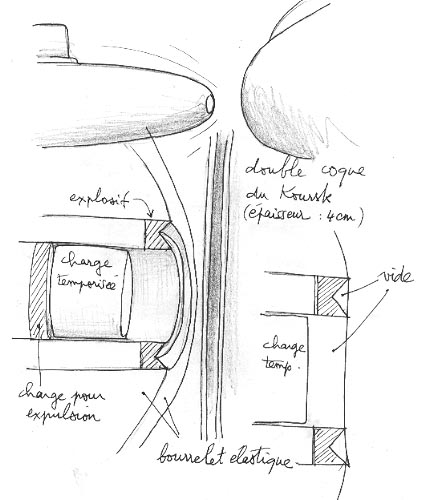
When contact is established, the charge is ignited on this conical surface, covered with metal. A shock wave is then created that does not affect the shape of a dart but of a cylindrical surface. The wave front is a simple circle. The hull penetration is then easily achieved. In tank battles, hollow charges easily penetrate armor exceeding 10 cm.
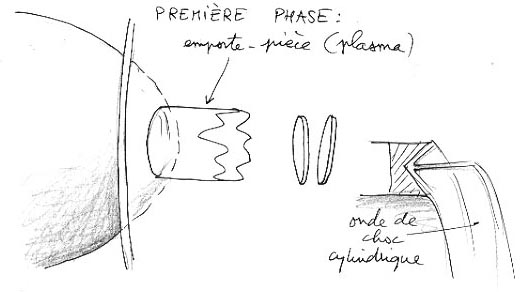
Immediately after this penetration, the timed charge is injected into the submarine.
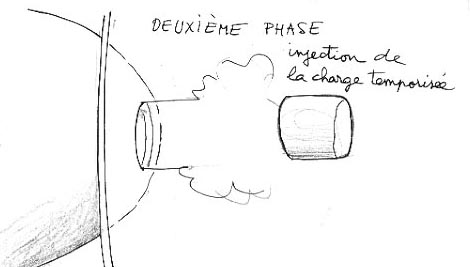
While the attacking submarine retreats and flees, the target's compartment fills with water. Shortly after, the timed charge explodes.
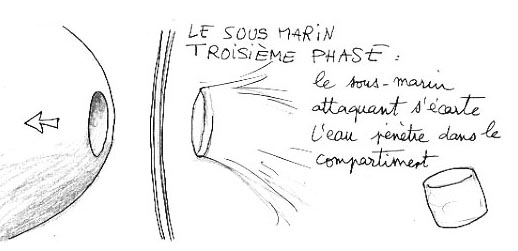
We remember that during the events, the press repeatedly bombarded us with a recurring theme:
- It seems that the Russians do not have the appropriate means to rescue the crew of the Kursk, which sank in the Barents Sea. Different nations have offered to participate in the rescue operations, but for now the Russians do not seem to be willing to accept these offers.
This is an extraordinary nonsense. All submarines today are equipped with individual equipment allowing evacuation from damaged submarines, functioning up to a depth of 180 meters. These equipment are traditionally manufactured by the English company Beaufort.
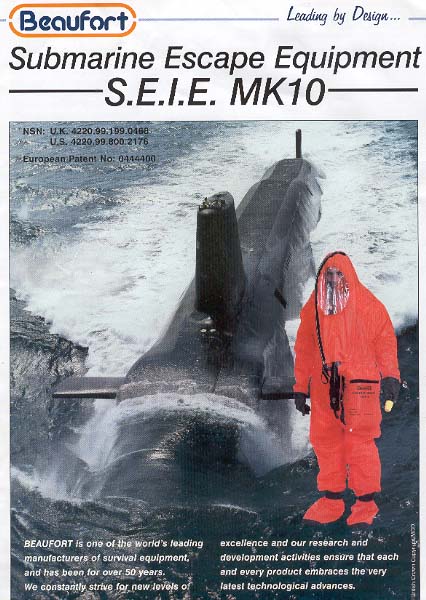
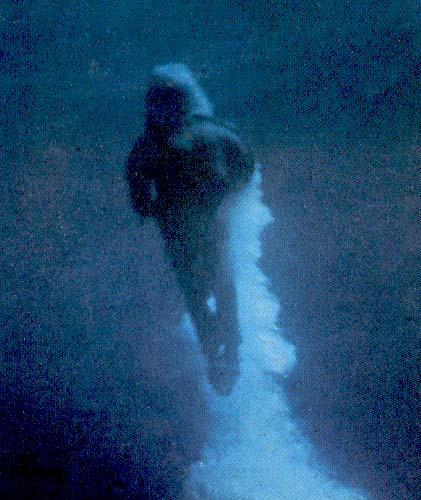
| Ascent at three meters per second (see the bubble trail) |
|---|

Here are sketches, accompanied by a description of the evacuation maneuver.
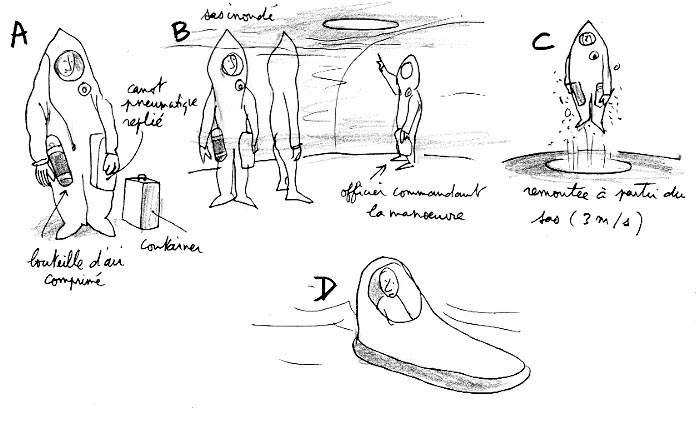
In A, the sailor has put on his nylon suit, which gives him a bit of the look of Father Abu. On one of his thighs, a bottle for inflation. On the other, an individual inflatable raft, folded. All fits in a container the size of a briefcase. The officer in charge of the evacuation maneuver begins by pressurizing the compartment (in the case of the Kursk, under ten bars). The sailors, equipped, admit a little air into their suits, with slightly weighted shoes. This air gathers in the upper part, making them look like spermatozoa. This facilitates their standing upright. A valve allows them, if they go to the ceiling, to adjust their buoyancy. In B, the officer indicates the hatch opening, which is open. One by one, they position themselves just below and open the air fully. This inflates (image C), the Archimedes' force then carries them quickly to the surface. The speed can reach three meters per second (so one and a half minutes to evacuate the Kursk and reach the surface.
At the surface, the sailor deploys an inflatable raft where he can then take his place: image D.
As soon as the evacuation compartment is pressurized, the blood of those present begins to be saturated with nitrogen. But everything happens in a few minutes, if these people are fast enough. As soon as the sailor leaves the deep water, the nitrogen absorption stops. At worst, there would be some decompression incidents. At the surface, the ships have chambers where the men can be recompressed immediately.
Have you heard a journalist mention the existence of such equipment? No. These people just repeat like parrots the press releases they are given.
It should be noted that ninety meters, for a submarine stranded on the seabed, is nothing. At the limit, if I had been in a compartment, without evacuation equipment, rather than dying slowly from suffocation, I would have preferred, taking the risk, to tie myself to any air-filled can, acting as a float and trying to evacuate on breath-hold. It is enough that this can be open, so that it does not explode when rising, and it is also enough to release the air contained in the lungs. From a depth of ninety meters, it would expand by a factor of ten. I myself, when I was young, did a "balloon ascent" from a depth of 45 meters, without a Mae West (my suit failed). You just spit air everywhere, that's all. It is simply not recommended to hold it: the overpressure would immediately burst the fragile alveoli. But one can assume that all the sailors of the Kursk were trained in such a maneuver.
I remember, by the way, having made a dive in the full bay of Saint-Tropez in 1959 or 1960 "in the blue", on a sandy bottom of 45 meters; There, in a totally accidental way, I came across a French submarine lying on the bottom. The submariners, in maneuver, had probably simply decided to stop to have a snack. Upon contact I could hear the engines turning and even the voices of the sailors. I then used my tank to hit the hull. Stunned silence. I moved away to avoid being sucked in by the propellers in case the submarine had started its engines.
Remember Jacques Mayol, our national Blue Giant (who committed suicide last Christmas by hanging himself in his villa on the island of Elba) and who invited so many kids in Besson's film to kill themselves by trying to imitate him (including my own son). It was not ninety meters that they were covering underwater on breath-hold but two hundred. One hundred to descend, attached to a line, and one hundred to ascend, using a small balloon. Any diver who practices diving is capable, after a good ventilation, of holding one and a half to two minutes without breathing, before passing out, at least. I would have tried it without hesitation. All proportions considered, these press releases were like being told:
- A submarine has just run aground at fifty meters depth in the bay of Saint-Tropez. Rescue is awaited....
These are not journalists we have, but simple parrots, on the lookout for images.
- We are still waiting for the images.....
To be precise, the Kursk was super-equipped in terms of evacuation. At the back of its cockpit were two small submarines capable of accommodating the entire crew and bringing them safely up from 600 meters depth. Was this system jammed due to the explosion of the front compartment? Possible, let's assume. But I refuse to believe that the explosion could have damaged the sumps located at the back of the submarine.
Let's continue the reasoning. Ninety meters is a depth that divers can reach simply by diving on air. It is borderline, but when it comes to saving lives, it is manageable. If there was a jammed hatch, it would have been possible to unjam it by pulling it from the outside. All navies have simple bags that can be filled with air and, thanks to Archimedes' force, can exert considerable pulling forces. I myself have pulled off bulkheads on a sunken cargo ship at 54 meters depth using simple 200-liter cans, lowered to the bottom and filled with air.
There were countless ships of all nationalities around the Kursk, starting with Russian units. How many divers capable of intervening on the wreck, how many equipment, including helium diving systems allowing deeper dives? Hundreds? Who will convince me that the Russians are so bad at diving? But no one tried anything, no one approached.
Michel C., the journalist, continues to present the results of his investigation.
- The torpedo tubes of the Kursk would have undergone significant modifications before these maneuvers, to fire a completely special device. Code name: "The Big One".
*Note: The Kursk is supposed to have eight torpedo tubes capable of firing several devices using 650 mm diameter tubes. Two types of devices could then be fired. Conventional, light torpedoes, with a speed of 30 knots and a range of 15 km and "Veder" devices capable of exiting the water, propelled by solid-fuel boosters, then dropping into the sea, slowed by a parachute to then search for their target. The range would then be 50 km. * - There were present at the time of the wreck, on board the submarine a Chinese and two Arabs.
Those who have read my last book know that the Americans developed since the mid-1970s a hypervelocity MHD torpedo, which in 1980 reached a speed of 2000 km/h. Such a device is of strategic importance. Indeed, the most dangerous weapon in case of a nuclear conflict is the nuclear submarine, which, hidden near the enemy's coast, can fire missiles that will reach their targets in four to five minutes. Destroying these underwater launch platforms would constitute the initial act of war for any attacking power. With these MHD torpedoes, the Americans (whose submarines constantly follow those of "the opposing team") can reach their targets in five to six seconds.
And the Russians? Were they not the leaders in MHD since the 1950s? The Americans even had the luxury of mentioning their mastery in underwater MHD propulsion by producing a film "The Hunt for Red October" with Sean Connery. Do you know who is Putin's scientific advisor for all military matters?
E. Vélikhov.
And do you know who Vélikhov is, the inventor in 1964 of the MHD instability that bears his name? The Russian leader in this field.
At this stage, one could speculate and this is what I did in a dossier that I placed on my site for a morning in 2002. Readers protested, saying that it was only pure speculation. I had suggested that the presence of a Chinese on board could be explained if the Russians wanted, during these maneuvers, to demonstrate the capabilities of "The Big One", an MHD torpedo. The economic situation of the USSR is catastrophic and the Chinese would probably pay for these torpedoes in gold, after having acquired some "Sqwal", already outdated.
The online publication of this dossier had an unexpected consequence: a call from the DGSE (French secret services). These people proposed a meeting that took place in Paris. My book had not yet been published and I had not yet released everything I had learned in Brighton. What interested them was this Russian MHD torpedo.
Give and take (as in England, by the way). This is what I could learn from these honorable correspondents who claimed to have information from a branch of the KGB hostile to Putin.
-
The Chinese on board the Kursk had the rank of general. We do not know the nationality of the two Arabs also present on board. They joined the submarine by helicopter, after it had moved far enough from its base. It was indeed a question of firing a MHD torpedo in front of these people. But the American secret services were aware. An American submarine then approached the Kursk and ordered it by sonar to surface and hand over its three VIPs. The Russian commander did not obey the order. The Americans then sank the Kursk, using a well-practiced but little-known technique to the public.
-
Which one?
-
The contact shot. This is practiced since the early 1960s, between submarines. The attacking submarine approaches its adversary. A special thick rubber coating serves as a buffer. The attacker then fires a penetrating device, a simple shell, with a delay. This gives him time to get away before the device is fired. By aiming at the torpedo room, it causes considerable damage, but as no sonar signal indicating the movement of a torpedo could be detected, it can be attributed to a "simple accident", to a collision.
-
So, submarine warfare is a reality?
-
Absolutely, especially when it comes to technological transfers with strategic impact.
-
Well, the American submarine sinks the Kursk and gets away. And then?
-
The Russians fear only one thing: that the international opinion learns about the presence of this Chinese general and these two Arabs on board. Additionally, that the existence of these famous MHD torpedoes, considered Top Secret, is discovered. The Admiral Peter the Great then issues a sonar order that locks all the exits of the Kursk remotely, disables its evacuation and communication devices. Then the cruiser sends a message to all those navigating in the Barents Sea: "The first one who approaches the Kursk, we will sink it." The Peter Legrand moves away from the site of the wreck. There was then an attempt to recover the VIPs using a mini-submarine. For this, the Russians bring a ship equipped with two of these devices on its deck. We have satellite images of all this, including when they had launched one of the mini-submersibles into the water.
-
Result of the operation?
-
These devices could only evacuate eight people. It is known that it could not be done and that there was indeed a mutiny. The mini-submarine moved away.
-
And Putin let these people die.
-
Exactly. As for the recovery of the wreck "for humanitarian reasons", it made everyone smile. It is not for technical reasons that the front part was cut off. There must have remained in the remains of this torpedo compartment some tubes still loaded with their MHD torpedoes.
-
By the way, the Big One, what diameter?
-
One meter.
**October 4, 2003 **: Following the publication of this article, some readers expressed their skepticism about so much brutality and cynicism. However, a few days ago I was able to see the report broadcast, showing the conditions of this invasion of a large theater in Moscow by the "forces of order" following a hostage-taking by the Chechens. There was an image that struck me where a doctor, with a syringe in hand, administered the life-saving antidote. And the commentator added, "there was enough antidote but not enough doctors". In this operation, which was quite well conducted, with an anesthetic gas, it seems nothing was planned to recover the unconscious people. It would have been necessary to have a team of doctors, or even simple military nurses, ready to intervene immediately, including to remove the bodies. We see soldiers pulling unconscious people by the arms, while any first aider knows that it is easy to carry a person of considerable weight on one's shoulders (few seem to know this basic gesture). The people have their heads back. They are abandoned anywhere. The commentator says, "many are probably dead from suffocation, swallowing their tongue or vomiting". It seems that in this affair, a human life does not count. With minimal first aid organization, all these people could have been saved, since thanks to the gas it was avoided that they were killed by those who had taken them hostage.
The Russians, as we saw, had well prepared their operation by gaining time, with the promise that the Chechens could meet the general commanding the operations in their country. During these hours, it would have been easy for them to gather a handful of doctors and military nurses capable of coordinating the actions to be taken on the ground: first aid, immediate administration of an antidote to everyone. However, buses took people condemned to die, without this life-saving injection. They landed here and there, in civilian hospitals where the doctors, not having this antidote, did not know what to do.
It is clearly the main thing to clean up the scene: "Move along, there's nothing to see anymore".
Machiavellian, Putin, yes. Human? I would not go that far.
But he is not the only one. In almost all countries in the world, similar things happen. With the "case of the clandestine underground nuclear tests", the French can sweep in front of their door.
October 6, 2002: To be more precise, a couple of collisions would have occurred between Russian and American submarines since 1960. For example, on October 30, 1986, an American Los Angeles-class submarine collided with a Russian K-219 submarine in the middle of the Atlantic. The collision caused a fire on board, which sank it. A similar "incident" occurred in August 2000.
At the time when the Russian maneuvers were taking place in the Barents Sea, at least three American submarines were present on site. The Memphis, the Toledo and the Sprendid. The Memphis, of the Los Angeles-class, had been modified to "serve as a test bed for advanced weapons".
The hypothesis of a boarding was clearly raised in a late August 2000 issue of the Russian magazine Zvatra, close to the intelligence circles. It is said that some American submarine units had icebreaker protections, increased speed, making them capable of performing boardings at high angles without suffering damage.
German Review SCHOLIEREN, 5 October 2003 :
MOSCOW, (AFP) - The results of the investigation into the exact circumstances of the torpedo explosion that caused the sinking of the Russian nuclear submarine Kursk have been 'classified as secret', said the daily Kommersant on Monday, citing sources from the investigation commission. The investigation commission, led by Minister of Science and Industry Ilia Klebanov, met for the last time on Saturday, but no public statement was made on this occasion. Some excerpts from the document drawn up during this meeting have been classified as secret," confirmed an official from the Russian Ministry of Science and Industry, speaking to AFP under anonymity. He refused to provide any other information. The full text of the document will be made public 'in 20 or 25 years', according to an official from the investigation commission, cited under anonymity by Kommersant.
October 6, 2003: About the theory of the torpedo explosion on board. Newspapers, and in particular French newspapers (the more serious ones...), quickly adopted the theory that was provided to them. In France, journalists do not try to think for themselves, they repeat like parrots. It was then reported that a torpedo, out of date, propelled by a fuel-oxidizer mixture (an oxidizer such as hydrogen peroxide) had exploded. A description of the Kursk as setting out to sea with outdated equipment, poorly maintained, etc. followed. It is a fact that Russia has difficulty maintaining its military potential. But from there to imagine that all the equipment on the Kursk was faulty, it is a big step (it is recalled that it was not an old submarine, but the "flower of the Soviet fleet", manned by an elite crew and not by young novice sailors). This would mean that the submarine would have set out to sea without rescue equipment, with a radio buoy (or buoys, in a 154-meter vessel) out of order. That all the communication doors of this double-hull submarine would have been left open during navigation (...) which would have allowed "all the compartments to be flooded at once, as announced by the Russian Navy quite quickly, which thus announced "that there was little chance of finding anyone alive among the 117 men trapped in the hull. That the submarine, lying on the seabed, had no means of communication of any kind, on such a weak seabed, except for the knocks made by the crew that many ships, Russian or non-Russian, recorded during the days following the sinking. It would have been necessary that the two evacuation submarines located in the turret were disabled by the explosion, but that, 100 meters back, the shock could have blocked all the exits (...), damaged the buoy release system. It would also have been necessary that this flower of the Russian Navy set out to sea with torpedoes not exceeding 120 kilometers per hour, extremely dangerous, obsolete for 30 years, abandoned by all navies (including in France).
It should be known that when a submarine sinks, it can release drifting radio buoys, which then emit immediately (what happened to these buoys, what became of them?). From the seabed, it can also send a buoy connected by a cable on which a surface ship could then connect ... a simple telephone. If these buoys are missing, divers coming from the surface can connect to the stranded submarine a socket ensuring communication with the surface. Do not tell me that the Kursk was "difficult to locate". It is nonsense, in a sea with a relatively flat seabed. We are not "in the middle of the Atlantic". Imagine, for one reason or another, that the Kursk was lost, it would have been sufficient for a quick mission of an aircraft like the US "Orion" or French "Neptune" to find such a metal mass using their magnetometer. The Kursk is not "a needle in a haystack". The Russians have such devices. I have even seen photos of them. If the Russians, the poor things, had all their equipment out of order, the Westerners could have done this service for them (there were even mentions of two "unplanned" US Orion missions on site on the day of the sinking). Once the Kursk was located or "re-located" (in less than an hour), divers are immediately sent to it, regardless of the sea conditions. A diver can be launched into the water even in bad weather. I have this long-term experience. Everyone has in mind the procedure for dropping combat divers who fall backwards from a speedboat (I have not been a combat diver, but I have almost equivalent experience. The goal, in those years, was different: to avoid signaling to observers on land the location of the wrecks on which we were diving). When it resurfaces, even in rough seas, the diver is recoverable, possibly with a helicopter that hovers and locates it by its radio and light signals. Well equipped, a diver can stay in wait for hours. A helicopter is a very stable recovery platform, even in bad weather, because its rotor gives it excellent gyroscopic stability. I know, I have piloted them in bad weather. Add that when it comes to rescuing 117 comrades-in-arms, one can accept to risk one's life.
In this official theory about the Kursk, everything is there... without depth. If it had run aground on a 400-meter seabed, it would have been out of reach of divers, etc. The public must have access to these well-known technical data and not just, like journalists, go from one press release to another, from one "expert" statement to another. If journalists would think a bit for themselves, things would go better. But are they capable of it, and do they have the right? The French press has the principle (or order) of immediately turning to "accredited experts", as was the case for this story about the Chernobyl cloud which "stopped at our borders".
Back to the torpedo story. France has two types of torpedoes. It first has batteries activated by pouring an electrolyte into them before firing, which excludes any premature firing. Seven meters, electric propulsion under four hundred amperes, 55 cm in diameter (if my memory is correct); speed 100 kilometers per hour. Propelled by two contra-rotating, canted propellers. These are the torpedoes that equip our nuclear submarines and our attack submarines. They reach their targets in ... several minutes, at best. The French also have torpedoes whose propellers are driven by gas turbines. So fuel-oxidizer mixture. But these are too dangerous to be embarked on submarines and are fired from helicopters. They are a bit faster: 120 km/h. Dropped by a helicopter in radio contact with sonar detectors it previously dropped to locate the submarine sinking underwater and transmitting, using a buoy remaining on the surface, any sonar signals possibly captured. This makes the helicopter an effective submarine hunter. Guided by the signals transmitted by its buoys, the helicopter can then launch its torpedo at a relatively short distance from its target.
The reader may think "but how does he know all this?" In this specific case, the information comes from a torpedo test engineer who was my neighbor during a cruise on the Nile in January 2001. When introductions were made, he told me what he did and I replied that I was a representative for women's lingerie. He obviously believed me. Honestly, do I have a look of a military engineer? By the way, I remember my visit to the Sandia laboratory, a high-tech military site, and my meeting with Gerald Yonas, head of the electron beam fusion project. I made a noticeable entrance in an old pink Cadillac driven by the charming barmaid of the hotel where I was staying. At one point, one of Yonas' collaborators exclaimed, "Wait, stop! This guy is not a journalist from Science and Vie. He understands what you're saying too well!"
The Russians, among others, have torpedoes that behave like the Exocet fish. They perform part of their journey in the air, propelled by a rocket. But for thirty years, the propulsion type of torpedoes has been rocket. I think I can say that in 2001, the French Navy simply did not know that a torpedo could be propelled by a rocket. The complement of this rocket propulsion consists of surrounding the device with a gas envelope in which it can travel at four to five hundred kilometers per hour, this gas mantle, secreted at the front by a rocket-type gas generator, significantly reducing friction. These devices, in Russia and the United States, have been operational for 30 years. The British are developing their own, called the "Espadon" (spearfish). The French..... The American device is called "Supercav". Cav for "cavitation" (the boiling of seawater due to a depression, for example on propeller blades). This is what led the young journalist Larousserie to write in Sciences et Avenir "that they were torpedoes that worked by cavitation". As if it were enough to fire torpedoes into seawater at high speed (where it is then as hard as concrete) for this vapor cloud to form on its own. No, it is the heat released by the gas generator that creates this water vapor, which is ejected at the front. The Russian device is called Sqwal.
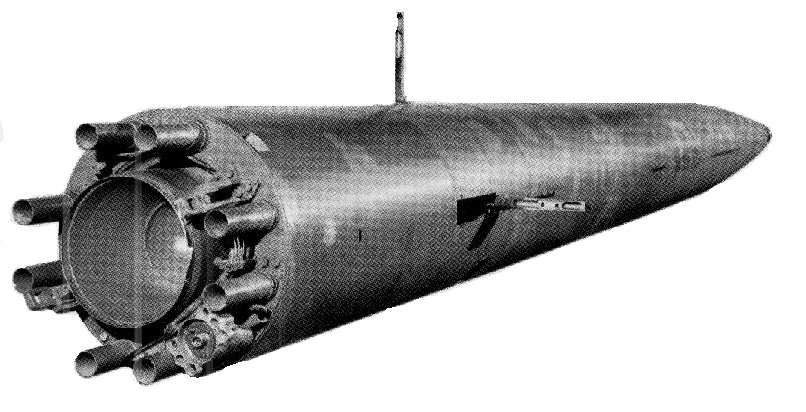
The deployment of its guidance system gives an idea of the extent of the cloud, a mixture of burned gas and water vapor surrounding the device as it heads toward its target. A set of tubes also ejecting gas surrounds the "cowl" of the solid-fuel propeller. These devices are thirty years old but, given their speed (four to five hundred kilometers per hour), it is hard to see how they would not have replaced the propeller torpedoes, real underwater dinosaurs, on modern Russian submarines.
In any case, torpedoes driven by turbines coupled to their propellers are very dangerous. They caused the loss of an English submarine. The details were provided by Mr. H. Allorant (his e-mail: allorant defint.net). The accident occurred on the morning of June 16, 1955, in Portland Bay. The destroyed English submarine was the HTM Sidon, built during the war; The torpedo in question was of the "Fancy" type, operating on HTP fuel. The explosion of such a torpedo on board immediately caused the loss of the submarine. They have been banned on board French submarines as well as on those of all the world's navies (which fire them, like the French, from helicopters or airplanes). It is hard to see the Russians having such bombs in the holds of the "flower of their Navy". It doesn't hold up. As for the explosion of a torpedo following a fall from its cradle during a mishandling: another fable invented by so-called experts or simply by journalists. Finally, let's mention one last point: submarines are armed with strategic missiles which are expelled from their chambers by compressed air. The propellant is then ignited outside the submarine. The same applies to torpedoes propelled by rockets or to the boosters of the "Granit" sea-to-sea or sea-to-land missiles that equipped the Kursk (and the Peter the Great cruiser). The ignition of solid-fuel rockets can prove problematic. Remember the accident of the American space shuttle Challenger. I specify that I was a solid-fuel rocket test engineer at the former SEPR in 1965-1966, when its test center was in Istres, Bouches du Rhône. Large solid-fuel propellers are assembled in blocks, fixed together by a substance called "inhibitor". This relatively elastic substance allows for some management of expansions. But a defect in the bonding or a crack in a block (a manufacturing defect or "cold shock") can lead to a fire, increasing the combustion surface, thus the pressure in the chamber and finally an explosion (in the case of the space shuttle Challenger accident, it was a fire in a defect of the inhibitor bonding, at the time of assembly or due to the retraction of the blocks on the launch pad, due to a temperature drop). Therefore, it would be excluded to ignite a solid-fuel missile inside its launch tube. When not ignited, a solid-fuel propeller is not dangerous. This brief overview makes one doubt the theory of the accidental explosion of a torpedo in the Kursk's firing compartment. There were two explosions, detected and recorded by a Norwegian seismological station, two minutes apart. The official theory is that of an accidental torpedo explosion during handling, followed by a fire, then a stronger explosion (that of the torpedo's charge or of one or more torpedoes on board. But we will never know exactly what happened, the Russian authorities having considered that the results of the investigation on the wreck fell under state secrets.
You will find in this translation of an article published in the WorldDailyNews on September 17, 2003, a confirmation of the suspicion of Chinese observers on board the Kursk. Except for those who frequent it regularly, they will interest no one. All this simply shows the extremely relative character of what is called "the truth" and the doubt that can hover over anything that calls itself "information".
Michel C., apparently, did not make his film. Life goes on.
I think back to the film showing the beginning of the investigation on the Kursk wreck. One could see the prosecutor kneeling and praying for the victims. The parents could not see them right away. For some, it may have been necessary to hide the bullet impacts.
What lies can be told on this planet, damn it....
I found on the web page that had been pointed out to me and which refers to the collision an e-mail.
We tried to send the English text, below, to this address, without success. We then suggested to readers, whoever they were, to pass this text to Russia. Twenty four hours later it was done. Could someone translate this text into Russian and pass it there with my signature. I assume the risks. One cannot lie forever. I leave this kind of cowardice to our journalists.
France, September 26th
Dear Sir,
I am a French scientist, astrophysicist. I am 66. I belong to the French CNRS (but retired in April 2003). To contact me. Many years ago I worked on MHD power plants (magnetohydrodynamics). I knew personally E. Velikhov, who became Poutine's collaborator for military affairs (...). I still have an old good friend in Moscow, Prof. Golubev, who works on lasers (but perhaps he is retired too). I give you this information to convince you that I am serious and not a joker. I know all the truth about the Kursk "accident". I have two sources.
- A French journalist, Michel C., who tried to make a TV documentary about the affair. He obtained a lot of information.
- I had a contact with French secret service who were in contact with an 'anti-Poutine faction of the Russian secret service'
If you want to put this on your website immediately, you can do so.
Title : THE TRUTH ABOUT THE KOURSK
Author : Jean-Pierre Petit, France, Senior Researcher, specialist in Magnetohydrodynamics (MGD in Russian).
Two years ago a French journalist, Michel C., visited me. He wanted to make a TV documentary about the Kursk. He was aware of my knowledge and experience in deep sea skin-diving. He showed me some documents. From the original version a torpedo seemed to have exploded in the front room of the submarine. But there were two s, the first being weaker. An explanation will be given.
The Barents sea is not too deep. The Kursk sank at a moderate depth. Considering its height the upper door of rescue chamber should be only 90 meters below the surface. All the submarine's crew men have individual rescue suits. In Europe, these suits are designed by the Beaufort Company, UK. They can be packed as small luggage. I can provide colour pictures of such suits. The seaman can put it on and inflate it, moderately. Then the officer who runs the evacuation operation increases the pressure in the rescue chamber and opens the door filling it with sea water. Each member of the crew gets into place just below the rescue door and fills the suit completely with air. Then Archimedes force acts. He climbs at 3 m/s. In the case of the Kursk : 30 seconds to reach the surface.
There, the man can inflate a small rubber boat, climb in and wait. This system can be operated up to 500 feet deep.
It is extremely surprising that no one on the Kursk used this system. It is impossible that such rescue systems were not on board. In addition, the Kursk possessed a sophisticated rescue system : two small submarines, able to hold the whole crew and to ensure their rescue at 2000 feet deep. But these two submarines were docked in the turret, the cockpit of the ship. So that this rescue system may have been blocked by the of the torpedo room. In any case, I cannot believe that the could have blocked all the rescue doors.
According to Michel C. the nuclear admiral Ship "Peter the First", did not come on the site of the wreck after the drama but moved away several miles.
The international press said that "Russians did not possess specialized devices to rescue the crew from the submarine". If the Kursk had sunk at a depth of 2000 feet, this would be plausible, not at such moderate depth. There must be another explanation.
Discussing the cause of the wreck, the press talked immediately after of "a collision with another submarine". We knew that a western submarine was docked in Norway for repairs.
Some other information from Michel C.
-
The diameter of the torpedo tubes was enlarged before the maneuvers in the Barents sea. These tubes were designed to fire a new torpedo called "la Grosse" (in French). In English "The Big One" or "The Fat One".
-
A mutiny took place in the Kursk. Some members of the crew were killed. The officer who kept the arms on board was found dead with a bullet in his head after the Kursk rescue.
-
Three men were in the KURSK : a Chinese, and two Arabs.
-
A paper was found in the pocket of a Kursk seaman. He wrote (in obscurity, he said) : "We are in the rescue chamber. Two officers are trying to handle the door. The said they know the system very well. But it seems to be locked.
Now we have to cross two new stories. In January 2001 I went to a scientific meeting in Brighton, England. There I met a specialist of MHD, in charge of special projects for NASA. He said he worked 20 years ago on a high velocity MHD torpedo. I was surprised, for I thought that MHD had been abandoned all over the world at the beginning of the seventies. But he said that a considerable effort on military MHD had continued in secret in the US and USSR.
The technical data are the following. For 30 years the Americans and Russians have rocket propelled torpedoes. The Russian model is the "Sqwal" and the American one is called "Supercav". The drag in water is much more important than in the air. The Sqwal and the Supercav blow hot gas, provided by a secondary rocket. This gas is injected in the water just in front of the torpedo. The heat of this gas vapourises the sea water allowing the torpedo to move in such a bubble of vapor at higher velocities, up to 1500 knots.
MHD torpedoes work differently. They are also propelled by a solid propellant rocket. On the "divergent" of this rocket, a MHD generator transforms the kinetic energy of the gas into electricity. The system uses a wall MHD converter. I can give the complete design of the torpedo, if desired.
This electricity is sent to the linear electrodes of a MHD wall accelerator which sucks the water backwards very strongly canceling the friction drag. According to the American specialist I met, in 1980, the velocity of the torpedo was about 6000 knots.
In 2002 I put some information about Kursk on my website. Then I was immediately contacted by a man working for the French DGSE (counter intelligence). We wanted more information about this MHD torpedo. We met in Paris and "exchanged information".
The person from the DGSE said his information came from a faction of the KGB who were against Poutine. He confirmed that a Chinese and two Arabs were on board. He said they were brought on board by helicopter and that the Chinese was a general. Although he confirmed the presence of the two Arabs he said he did not know more about them. According to him, the Russians had planned to demonstrate their MHD torpedo in action in order to sell it to Chinese.
These high velocity torpedoes are very important for strategic purposes as one can use them to destroy the enemy's nuclear submarine before they could launch their missiles. Without such torpedoes nobody can start a nuclear attack.
According to this man, the diameter of the torpedo was 1 meter. But the American Secret Service was aware of all that. Then a western submarine approached the Kursk and ordered it by sonar to break surface and hand them over the Chinese VIP. The Russians did not answer. As a consequence, the decision to sink the Kursk was taken.
Many submarines have been sunk since 1960 through "collisions". The attacking submarine does not fire a torpedo. It gets in close contact with its target and fires a shell, which punctures the submarine's hull. That was the first noise. Then the attacking submarine can escape. Shortly after (the second noise) the weapon explodes inside the submarine which sinks immediately.
But only the torpedo room was destroyed making it possible to explain the "accident" in terms of an accidental explosion of a torpedo.
The Russians did not want people to know what was going on aboard the Kursk, before the "accident". According to the man from the French secret services a sonar order was sent by the Admiral ship "Peter the First", which locked all doors of the submarine. A similar order canceled all possibilities for communication with the surface.
The Admiral ship said to all ships located around :
- The first to approach the Kursk, will be sunk !
Then the Russians tried to pick up their VIP on board. A specialized Russian ship approached the Kursk with two small submarines aboard. One was put at sea and reached the wreck. Only 8 men could come aboard. The idea was to pick up the VIP. But the crew of the Kursk did not believe they would come back to save them. A riot occurred. Men were killed. The small submarine went back to the mother ship.
Then Poutine decided to let the crew of the Kursk die. Secret affair.
Later the wreck was recovered, not to recover the corpses but to hide this story. The torpedo chamber, with its 1 m large tubes was destroyed down deep. The MHD torpedoes were recovered. Many devices were recovered, including the propellers and the precious Granit supersonic missiles. The man from the DGSE said that the Kursk was equipped with very secret weapons used to destroy attacking torpedoes at a distance.
I hope you will publish this. The truth must be known.
J.P.Petit
**13 January - 14 March 2006. Kursk: the (credible) hypothesis of the most horrifying epilogue. **
A reader, whose name I unfortunately forgot, advanced a complementary hypothesis. I had been sent the translation of the proceedings orchestrated by the Russian power. I still have it but I did not have time to attach this document to the whole. It is indeed revealing of lies and bad faith. It is known that the bodies of the sailors, recovered from the wreck, were not returned to the families for a long time, simply because many of them had bullet wounds. There is no doubt that a mutiny occurred in the submarine, among the many survivors. There was first a attempt to approach a rescue submarine whose mission was above all to save the Chinese general who was on board, as well as possibly other foreign personalities. But this rescue submarine could obviously not take the entire crew, to whom they promised ... to return. Was the Chinese man saved? We will never know. What happened next?
Everything points to the fact that Putin decided to abandon the sailors to death after the escape hatches of the Kursk had been locked from the outside, by a sonar or radio signal. This video (attention: 34 Mo!) is taken from the film by Michel Carré. It shows how the Russians countered the attempts of foreign navies to intervene. It also shows how easily divers equipped with tanks could reach the hatch opening (at 90 meters from the surface), which they opened in ... twenty small minutes. A slight plume of bubbles and ... nothing. When the hatch opens, you can see that the compartment is completely flooded. It is difficult to think that this compartment was not opened. Why would the Russians not have tried a rescue of the sailors by mooring a simple diving bell nearby? Just send them as they are, attached to balloons, sliding along a cable. They would have been recovered on the surface without even having time to die of cold or drowning. Everything could have been done, except to wait without doing anything, pretending that the hatch door was stuck.
I remember the face of Christine Okrent, serious, repeating day after day "that the sailors of the Kursk were still waiting to be rescued". It's like saying to the 8 o'clock news:
- A submarine has sunk at thirty meters depth in the bay of Saint Tropez. We are waiting for the rescue....
Nonsense!
The comment of the diver chief indicates that this door was not at all stuck, as the Russians had claimed. So, if the divers maneuvered this door so easily, with a simple key, as seen on the film, why couldn't the sailors locked inside do the same? A free ascent, "in a balloon", of 90 meters depth is entirely feasible, even without equipment. It would simply be necessary to attach oneself to an object like a jerrican, open mouth (to prevent it from bursting) and let it pull you to the surface, without effort. Between dying drowned in this chamber and trying everything, what would you have chosen? To die, better on the surface, from decompression sickness or cold, rather than in such an atrocious way, suffocated.
Personally, I had to make an ascent of 47 meters from inside a wreck. Entering it, I had unknowingly lowered my reserve lever. At the end of the dive, I found myself out of air. I could exit and ascend to the surface simply by releasing my lead belt, expelling air through all the hatches (it is necessary to avoid retaining this air, otherwise it could cause pulmonary alveolar rupture, but this is something all submariners learn during training).
How come seawater ended up entering this compartment, by itself, so easily, at such a shallow depth? If this theory is followed, then leaving a submarine anchored would risk it filling itself.
It is possible that during another mission a small submarine, carrying divers (90 meters is a very moderate depth these days), had unlocked the hatch and deliberately flooded the men. The hypothesis advanced by the reader, which is worthy of one of the most horrifying thrillers, is that the sailors, desperate, then took control of the Granit missiles (nuclear) threatening to fire if they were not rescued. Hence the body of the firing officer, found in the wreck, mortally wounded. Faced with such a threat, the Russian authorities would have chosen the most abominable solution: to kill the sailors.
A reader objected to me that missiles could not be fired without data being communicated from surface units. I think he confuses it with land-based firing stations. Communication with submarines is very delicate, as electromagnetic waves do not propagate well underwater. During a conflict, it can happen that a submarine is left to its own devices, including with nuclear weapons. This was the case during the Cuban crisis, where we later learned that Soviet submarines were armed with thermonuclear warheads perfectly operational. If these weapons were not fired it is because the captain of the submarine made the decision not to do so. He admitted that during all that time he had been unable to communicate with his superiors and had therefore been completely on his own. He, or rather two men, the captain and his second, each holding "half of the key to activate the weapons".
The reader also objected that the missiles could not be fired without data being communicated from surface units. I think he confuses it with land-based firing stations. Communication with submarines is very delicate, as electromagnetic waves do not propagate well underwater. During a conflict, it can happen that a submarine is left to its own devices, including with nuclear weapons. This was the case during the Cuban crisis, where we later learned that Soviet submarines were armed with thermonuclear warheads perfectly operational. If these weapons were not fired it is because the captain of the submarine made the decision not to do so. He admitted that during all that time he had been unable to communicate with his superiors and had therefore been completely on his own. He, or rather two men, the captain and his second, each holding "half of the key to activate the weapons".
At any moment, a conflict could erupt and a submarine could be left without any instructions. The high command could have been destroyed by a nuclear strike. Radio communications could have become impossible. Thus, the submarine would be deprived of any possibility to use its weapons if it were necessary to possess a key transmitted by radio, issued from a central command. The nuclear weapon, deployed from submarines, as a deterrent system, would then be nonsensical. Therefore, it is absolutely not unthinkable that the Kursk was "nuclearly operational," obviously with coordination between the two crew members who held the missile armament codes equipped with thermonuclear warheads.
At worst, the supersonic cruise missiles Granit would have been equipped with inert heads ( ? ... ) or non-nuclear, unarmed heads ( ? ... ), but they would have anyway been able to be fired, which would not have gone unnoticed. Everything could not have been locked in this ship. One remembers that the official theory stated that during the collision, at the front, everything had been damaged, including the maneuvering system of the airlock, located at the back. Who would believe this fable?
Therefore, the theory of the physical elimination of the crew by drowning cannot be dismissed a priori. Politics is often abominable, and we know it very well. And the Russians, in this matter, have nothing to envy other nations in terms of cynicism. Remember the way they let the SS exterminate the Polish resistance in Warsaw, after the uprising of the population, even forbidding allied forces to supply the insurgents.
I remember the face of the plump Russian prosecutor, perfectly fake and insincere, who conducted the investigation, kneeling before the wreck to pay homage to the victims, while obviously, if there was a man who knew everything about the affair, it was him.