koursk michel carre
After its broadcast on 1/7/05, my comments on the 70 minutes film by Michel Carré about the Koursk disaster
January 14, 2005
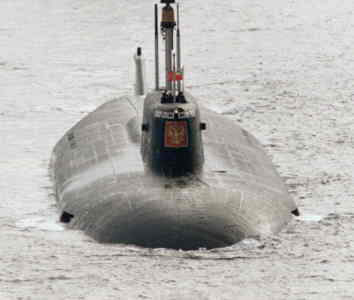
The film by director Michel Carré "A submarine in troubled waters", dedicated to the Koursk disaster, "as big as a football field", which occurred in August 2000 in the Barents Sea, was broadcast on France 2 on January 7, 2005. Some of my readers were very pleased to see my name listed in the credits, as a scientific advisor, alongside that of Jean-René Germain, former editor-in-chief of Science and Vie. They thought that I had followed the entire production of the documentary and that my relations with the press had improved.
The reality is very different.
Carré contacted me at the end of 2002, asking me to come to Paris to view some video documents he had collected while starting an investigation into the Russian leviathan's sinking. We met for a total of two hours. I offered my services as a scientist and expert (free of charge) for underwater diving questions. I suggested that I accompany his filming team to Murmansk, appearing "as a designer". I even suggested that he send me to Moscow with a journalist to meet Vélikhov, Putin's military advisor and vice president of the Russian Academy of Sciences. Vélikhov, a student of Sakharov, was one of the pioneers of MHD. I told Carré that by connecting Vélikhov to the question of hypersonic aircraft (the Aurora in the USA and the Ajax project in Russia), I might perhaps learn a bit more, in passing, about the Russian underwater MHD. I knew Vélikhov well in the past, in 1965-67. All of this for free, of course. But Carré did not follow up on any of these proposals. Before discussing the details of what was exchanged during our conversation, some clarifications on the timeline of these exchanges.
In 2003, a colleague of Carré called me on the phone and said:
- Michel Carré would like you to provide us with the list of questions that the filming team should ask the British experts we will soon meet at the Maritime Museum in London, where the filming will be done. - Would it not be more useful if I joined your filming team and asked these questions myself. These are quite specific issues, you know, and even if I provided a list of questions, it is not certain that the team members would correctly interpret the answers they received. My performance would be free of charge. - It's that ... we don't have a budget to have you come up there ... - You know, I can come up to Dover by train, and I pay half price because of my age. There would only be an extra hotel room needed in London. *
No follow-up.
Meanwhile, I tried to get in touch with Jean-René Germain, whom I knew had already started playing the role of expert for the preparation of the film. No response. Normal. Germain was part of the "UFO-anti" team of Science and Vie.
At the end of November, Carré called me on the phone:
- I'm beginning to wonder if you're right. The show was scheduled for France 2 on December 10. It has just been canceled. I thought it was because of what was said about Putin. But it seems that the channel was sensitive to American pressures. - Will the film be shown? - It's a seventy minutes. I will send you a VHS copy. Anyway, I will organize a preview screening in front of journalist colleagues. I know people and it won't happen like that (this screening actually took place on December 10 in Paris). I am in talks with the channel. They are not in agreement with certain technical aspects ... - Would you like me to intervene? You just have to add a short interview. I can come to Paris whenever you want. Tomorrow if you want. - I'll keep you informed (...)*
No follow-up. However, a few days later I actually received a VHS copy of the film, which I watched. I noticed a lot of incorrect and even outright false things, like the idea that the Koursk's nuclear reactor was "identical to that of Chernobyl". I called Carré again, reiterating my proposal to intervene in the form of an interview that could be added to the film. No follow-up to this proposal.
There is the story of the Koursk, which will keep many points in shadow, and there is "the story within the story", that is, the information collected by Carré and mentioned during our first phone call, confirmed by other sources, but eliminated during the film's editing. There is an unbelievable meeting with DGSE correspondents in a Parisian restaurant, then what emerged over the months, transmitted by correspondents via e-mail, some information even directly from Russia.
Before telling all this and making criticisms, a hat tip to Carré. His film kept us on the edge of our seats for 70 minutes. It is very well made, very well edited, cinematographically speaking. Girodeau's voice is well placed, the sentences well turned. Carré managed to get hold of exceptional shocking images. It starts with "Putin's coronation", who, at 1.68 meters, crowds the red carpet of the Kremlin by passing through gilded doors, which evoke a Walt Disney cartoon. It then shows a pro-Putin clip where two beautiful creatures praise his ... virility. We owe the team of Michel Carré some hallucinating, touching scenes, one of which shows a sailor's wife, anesthetized by a civilian doctor, with a syringe in her hand, at the moment she invectives a government official who came "to hear the families". Carré has chosen his images very well. I think of the face of the prosecutor in charge of the case after the submarine was raised, with his small blue eyes and his fake brother's face, which gives a chill. A round-faced man I had seen in a previous film, kneeling emphatically before the wreck of the Koursk before starting his investigation, as a sign of respect for the victims. A man who will calmly announce that the loss of the submarine was due to "the accidental explosion of a test torpedo". Carré also brought out a sentence from the engineer of the Rubine company, who designed the Koursk, who simply said "for an inexplicable reason, the Koursk's data recording system was not activated."
Well, of course...
Even if there is something to criticize about Carré's film, it remains a bomb, a real document. I regret that certain technical aspects, which I considered important, were ignored, but what emerges from the film is the enormity of the state lie and the evidence of an American intervention, hidden through secret negotiations.
Let's get to the history. During our only meeting in Paris, Carré told me in one go what he had learned from various sources. There were two explosions, perfectly recorded, including by a Norwegian seismographic station. The second one was much stronger. There would have been a Chinese general on board. Before the Barents Sea naval maneuvers, the torpedo room of the Koursk would have been modified to accommodate larger diameter torpedoes (a detail that Carré did not mention in his film). SOS signals struck on the hull would have been heard for days.
Another detail, much more intriguing, mentioned by Carré, which he will not talk about in his film: A bill, scribbled with a pencil, was found on one of the dead sailors, where the man had written "We are in the evacuation chamber located at the back." Two non-commissioned officers who are familiar with the evacuation hatch maneuver vainly try to operate it. For a reason they do not understand, it seems completely blocked." Carré also talks about an approach by a mini-submarine that vainly tried to dock on the hull of the wreck. After the submarine was raised, the officer in charge of guarding the magazine was found dead with a bullet in his head and the door wide open. The Russian Navy refused to let the families see the bodies, which were only returned to them 400 days after the death, as mentioned in the film. Carré says he learned that the Russians claimed to have lost the wreck for dozens of hours (which he will mention in his film), while it is easy to locate such a mass in such a shallow seabed simply by flying an aircraft of the Lookeed Neptune type (equipped with a magnetometer detecting metal masses and equipped on the Royale, in France. All the navies of the world have equivalent devices). According to Carré (which he mentions in his film), when the flagship "Peter the Great", commanded by Admiral Popov, was informed of the sinking, instead of going to the site, it moved away from it!
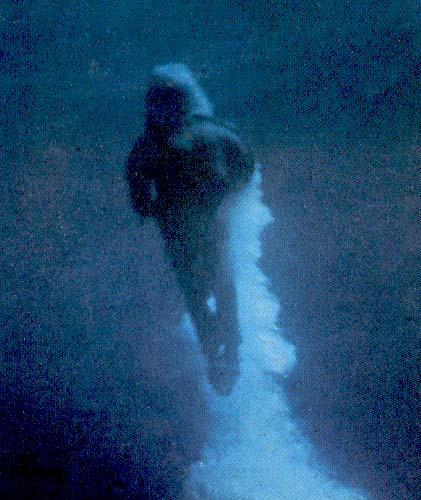
All these pieces of information are more than enough for me to start thinking. Several details are off. The depth at which the Koursk is resting is ridiculously low: 108 meters. Given its height, the upper deck is at 80 meters from the surface. I asked a submarine specialist, whom I know. During the war of 39-45, evacuations at 60-80 meters depth were common, with very simple individual systems. Today, all submarines are equipped with individual equipment that allows the evacuation of a submarine at depths reaching 600 meters. In England, these systems are manufactured by the company Beaufort. I quickly obtained documentation:
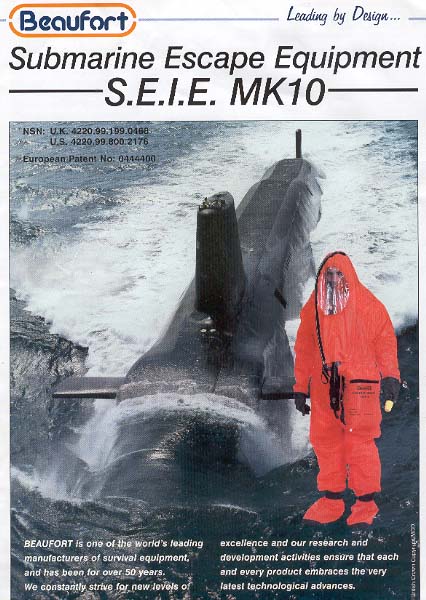
| Ascent at three meters per second
| (see the bubble trail) |
|---|
The details of the evacuation procedure have been described in the file I installed on the subject for two years. In August 2000, while Christine Okhrent was reading the notes she was given, which said "that help was expected", any journalist who knew a little about underwater diving would have been able to realize the absurdity of this "excited waiting" staged by the journalists. One can then wonder:
- If they are that incompetent - If they are complicit or carefully avoid saying what is not explicitly asked to be spread.
It is probably a mix of both. Everything is absurd in the disaster. I can't imagine that a double-hulled submarine (in fact, structurally speaking, two nuclear submarines joined together. The Koursk is propelled not by a nuclear reactor, but by two, and they are not "identical to that of Chernobyl". The reactors equipping submarines are fundamentally different from those equipping power plants. I am skeptical about the fact that a submarine of this size has only one evacuation hatch. There would be at least two, since it is made of two joined hulls, or more. Moreover, a German newspaper will reproduce ( &&& if someone has these images! ) the interior layout of the Koursk. It is a unit worthy of a Jules Verne novel. According to my memory, the huge cockpit would contain two evacuation submarines, self-propelled by an electric motor-battery set, placed side by side, which would be able to accommodate the entire crew and allow rescues at depths reaching a thousand meters (the operating depth of the Koursk). According to the official thesis "the explosion of the torpedo room was so violent that it would have ... blocked all the exits". But how to imagine that an explosion in the front part, on this 154-meter-long submarine, could block the locking of the (or the) evacuation hatch located at the back.
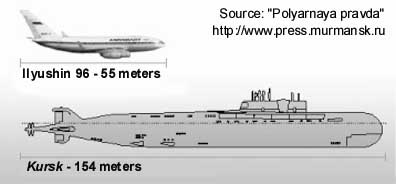
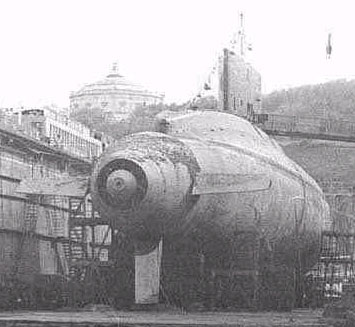
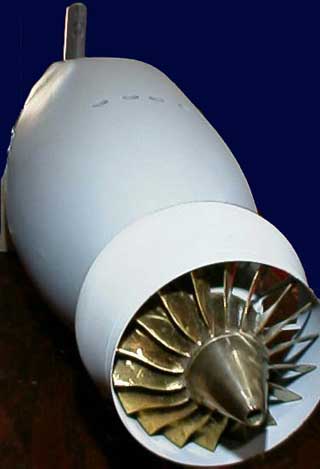
A simple remark in passing: On this image, the Koursk does not have cavitating propellers. When the wreck is raised, its propulsion system has been removed, at the bottom. I am skeptical about the fact that this machine was not equipped with cavitating propellers, which are less noisy. It is not a state secret. Go to the Marine Museum at Trocadéro and ask to see the model of the last French submarine launched. It is equipped. This is to remind that one should not take for granted any document that comes to you, from wherever it comes.
Above a submarine model with a cavitating propeller
A real-size cavitating propeller, origin unknown
Two views of a "Seawolf" showing its cavitating propeller
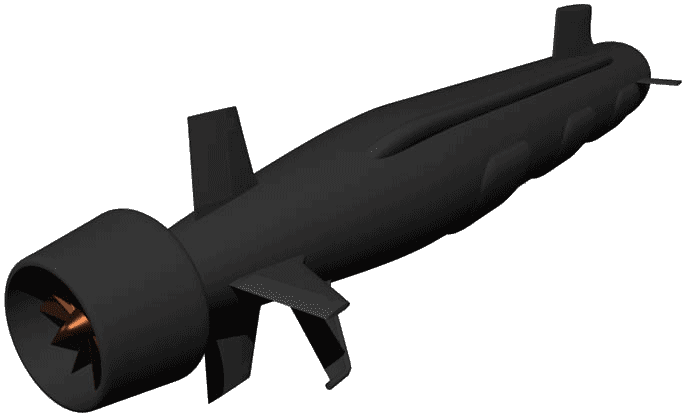
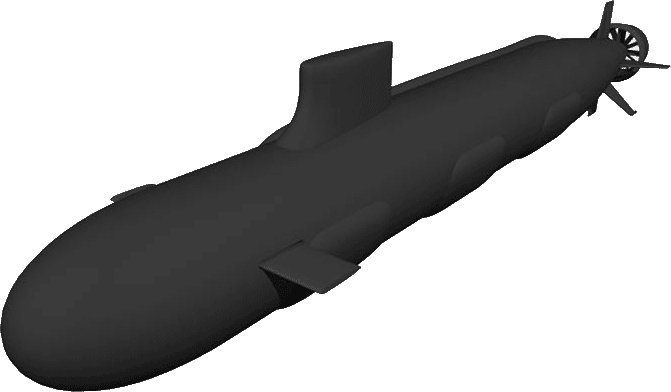
On the site where I retrieved these images, even systems with "vector propulsion" can be seen, where the entire cavitating propeller can rotate, thus giving the submarine (a submarine hunter) exceptional maneuverability. Aircraft have long been equipped with rotating nozzles, capable of directing the jet, with the resulting increase in maneuverability. By the way, this control system allows, at any speed, to do without a tail.
Addition dated January 19, 2005: **Sent by a reader, Nicolas Huber. The cavitating propellers of a Russian Typhoon (appreciate the size). **
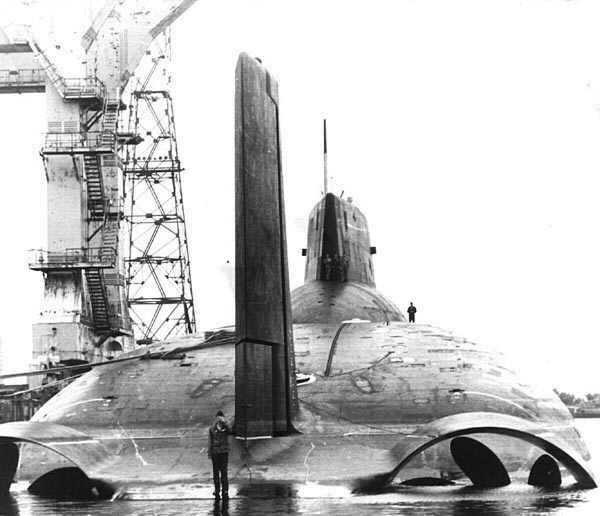
**Russian submarine Typhoon from the rear, showing the cavitating propeller housings (increase in efficiency and reduction of noise) ** ---
The Koursk affair interests me. In early 2003, I installed on my site, for a morning, for two hours at most, a file pointing out some inconsistencies and where I mentioned, a thesis that Carré will take up in his film, the idea that the Koursk, having gone into periscope immersion, was about to perform in front of Chinese observers tests of a high-speed torpedo. I even raised the idea that this torpedo could be the equivalent of one I learned about in January 2001, during a conference held in an English seaside resort, from the mouth of an American specialist, that is, an MHD torpedo. Some readers told me "what proof do you have? Don't you think you are taking risks by advancing such speculations?"
I decided to remove the file from my site. Immediately, I received an e-mail from the ... DGSE. Simply, clearly. These people asked me to call them on a mobile number.
I want to clarify that I have neither the habit of meeting this kind of people, nor a strong taste for this kind of environment, towards which I have rather developed over the years an intense allergy. I like adventure, but not at any price. There are ways to live it that I don't appreciate. Moreover, I have been sufficiently troubled by "spies linked to services" in my professional activities that I don't have a good memory of the actions of this kind of people. But this time, I don't know why, I decided to make an exception to my principles. I picked up the phone, I called:
- We have contacted you because we agree with you. We would like to exchange information. Can you come to Paris?
I decided to accept the meeting that these people offered me. The meeting was set in a café-restaurant in Montparnasse. Two men arrived. Forty, forty-five years old. They were sent by Alliot-Marie, the defense minister, whom they said "has been spending a lot of time lately with her nose glued to my site". Obviously, between the microwave weapons, the weather weapons, the seismic weapons and the rest, she has plenty to do (the scene took place in early 2003). It's clear, they want tips on the Russian MHD torpedo. In exchange, they are ready to release some other information. It's a give and take. It can be interesting. Anyway, Alliot-Marie may not know, but the data relating to this torpedo are in my comic strip "The Adventures of Anselme Lanturlu", titled "The Wall of Silence" since ... 1983. The rest is in my book "UFOs and American secret weapons. Seeing these two guys I think of the Shingouz from the Valérian comics and the meetings taking place at the "Central Point".
I provided them with the details of the torpedo's operation and some figures, which they noted. The best is to reproduce, from memory, elements of this conversation. Let's denote by HCDSE what would translate as "Honorable correspondent of the DGSE".
JPP - You confirm that there were indeed Chinese on board the Kursk? HCDSE - Yes, they had joined the submarine by helicopter after its departure from Murmansk. One of them was a general. We confirm the information given by Michel Carré. There were also, it seems, Arabs, but we don't know what nationality they were. JPP - How do you know that? HCDSE - You know, in Russia, there is a pro-Putin KGB and an anti-Putin KGB. We exchange information with the second service. JPP - Okay. So there were observers who had been brought on board to witness the effectiveness of a high-speed MHD torpedo, "La Grosse". HCDSE - How do you know that the codename of this torpedo is "La Grosse"!?! JPP - Listen, you have your sources, I have mine. We know that's why the front torpedo tubes of the Kursk had been modified and that's also why, not only were foreign divers told they were not allowed to go to the front of the submarine, but that's also why "for technical reasons" they later cut off the entire front before raising the wreck and that these remains were later dynamited (which Carré shows in his film) HCDSE - Correct. JPP - You will probably tell me what diameter the torpedo tubes were increased to. HCDSE - One meter. JPP - There is one thing I don't understand. When the Kursk sank, the Admiral Peter the Great cruiser moved away instead of immediately going to the site of the sinking. That's what Carré told me. But ... why? HCDSE - The presence of the Chinese on board became an issue of state. It must not be known at all. The Peter the Great cruiser then sent a coded order to the Kursk, by ultrasound, which locked all its exits. JPP - Do you mean that the commander of the Kursk was not even informed? *HCDSE - No. He died with the rest of the crew. JPP - Carré told me about the attempt to dock a mini-submarine on the hull of the Kursk. It wouldn't have worked, because of the current.... HCDSE - Ah, that explains why there was only one mini-submarine left on the boat's deck, which had two the day before, and which had arrived on the scene. JPP - What ship? HCDSE - We have satellite images. At one point the Russians brought a ship that carried two mini-submarines on its deck. Then, the next day, there was only one left. * *JPP - They must have put it in the water during the night, I suppose. HCDSE - That's the only explanation. After that, they recovered it, always with night maneuvers. JPP - One can imagine that this submarine would have docked with the Kursk. But it couldn't have evacuated the entire crew. HCDSE - No, these vehicles can carry up to ten or twelve people. JPP - One can imagine that the docking took place and that the commander of the Kursk said to his men: "we will evacuate the Chinese, then we will come to get you after". But they didn't agree. This would explain the bullet wounds mentioned by Carré and his sources (only mentioned in the first contact with Carré. In his film he didn't say a word about it). A mutiny with bullet wounds ... HCDSE - Maybe. * JPP - That doesn't explain how the Kursk sank. The hydrogen peroxide torpedo (with oxygenated water as oxidizer, mentioned by Carré in his film) *I don't believe in it. It was removed from all submarines more than thirty years ago. An accidental explosion of a test torpedo, I don't believe in it either. I don't believe in SQWAL torpedo tests either. HCDSE - The SQWAL is over thirty years old. JPP - And it has its equivalent in the USA: the "Surpercav". Let's go back to the Kursk sinking. HCDSE - You know, we may tell you something, but since the sixties, the Americans and the Russians have been engaged in a very active submarine war. There have been a lot of ships sent to the bottom, generally Russian, and it was attributed to "collisions". JPP - Why this secret war? * HCDSE - *The Americans fear only one thing now: that the Russians will equip the Chinese with advanced technologies, accelerating their development. They are quite active in intelligence. When things need to be transported, it's by submarine. When the Americans want to counter this, they sink the Russian submarine, straight up. JPP - But how? They torpedo it? HCDSE - It seems that it is by boarding, or a particular boarding technique. No signal has ever been recorded corresponding to the run of a torpedo. JPP - Let's go back to the Kursk. It would have been sunk by boarding, by an American submarine. And that's why in the first statements they even spoke of a collision with an American submarine. I remember. HCDSE - There were several on the maneuver site. JPP - But why two explosions, a relatively weak one and a stronger one. HCDSE - We know no more than you. JPP - And the fate of the Kursk sailors? HCDSE - They let them die. The Peter the Great issued a warning: "the first one who approaches the Kursk, we will sink it". * *JPP - And the distress beacon, the messages? HCDSE - With their sonar order, the Russians made the Kursk a wreck. The guys had no way to communicate with the outside. JPP - Except by knocking on the walls. HCDSE - Except by knocking on the walls ... JPP - Then it would have been easy to intervene on the wreck, accessible by autonomous divers, with oxygen-helium mix scuba gear, which all today's warship intervention teams have. . HCDSE - Of course. *
We parted after exchanging a few words on other subjects. In this meeting there was more than just a simple contact attempt. My book had just been published. The French High Commands now knew that the army had missed the MHD train. Clumsily, the French were trying to get some teams back. I knew they wouldn't go far, not only because they had lost a whole lot of precious knowledge over thirty years but also because between their projects and their realization stood obstacles they didn't even suspect. It was excluded, and still is, that I would participate in any MHD military project. There is no civilian MHD. It's a word that has no meaning. It's like civilian nuclear energy. Eventually, a country that enters the atomic club will have its bombs. Energy is just an excuse. In France, there is even not the pretext of a civilian MHD application. I told these gentlemen when I left:
- Ah, I suppose you will make a report to Alliot-Marie. I don't know if there was a move or not. But, in case, here is my answer. - And what is it? - You will give her a big kiss from me. *
They laughed and with that we parted.
It is regrettable that Carré did not believe me about the MHD torpedo. I think he must have trusted the opinion of Jean-René Germain, who has not forgotten the MHD-UFO link, which was first revealed in 1975 in ... Science and Vie, which even made it its cover with the title "A Plasma Engine for UFOs". That month, the journal doubled its sales. Unless Carré listened to the advice of his foreign experts. The SQWAL torpedo is an old model, dating from 30 years. Carré presents it as a cutting-edge armament and suggests that the Americans do not have this type of armament. Whereas they not only have the equivalent of the SQWAL (their Supercav torpedo, which is also 30 years old) but they also have MHD torpedoes, as fast as the Russian ones. What they feared in this story was not being outclassed but seeing the Russians sell this technology to tomorrow's enemies: the Chinese.
The image creator of Carré produced very suggestive sequences. Neither of them understood that the vapor surrounding this rocket was produced by a high-temperature gas emission at the front. These are "beautiful images", nothing more. It's really what you can call "virtual reality".
When Carré moves to his hypothesis on the destruction of the Kursk, which is his own, it becomes a bit of anything. The climax is the shot that would have been fired by one of the American submarines on the Kursk. A rocket propelled by powder is seen. The commentary mentions an American MK-48 model, while, upon checking, the MK-48 is an ancient model, with a propeller. It is impossible that the Kursk was sunk by a powder torpedo, simply because the infernal noise made by these weapons before impact, when they spew high-temperature, turbulent gas into the water, has not been recorded. In the first version of his 70 minutes, trying to explain the round hole with clean edges observed on the starboard side of the wreck, one meter in diameter, Carré started by talking about a torpedo equipped "with a depleted uranium head". I told him, on the phone, during our exchange at the end of November 2005, that this hole could only have been made using a hollow charge system, described in my file. I offered to explain this in front of his camera, with a pencil in hand. A technique related to the "contact shot", practiced by American submarines. In hollow charge systems, a surface made of copper is moved very quickly by an explosive and becomes a shock wave. In the system I suggested and described, the copper layer, in the form of a groove, becomes a cylindrical shock wave acting like a "can opener". Instead of taking my diagrams, Carré asked his image creator to make a nozzle with a depleted uranium tip and a "copper ring". It became ... anything. But he still had the merit of instilling the idea that the Kursk disaster, presented as an accident, was actually the result of an American attack aimed at dissuading the Russians from exporting advanced technologies to China.
The essential thing is that his film was shown. I hope that those who saw it have been able to take a little more awareness of the general lie that currently dominates the planet and of the huge distance that separates the real facts from what can be served to them by the media, from journalists who are complicit, manipulated, stupid, incompetent or all at once.
A word at the end about the Granit missiles (six on each side of the Kursk's turret, inclined at 45°). What follows will show you that the Russians are far from being left behind in the field of military high technology. These are supersonic cruise missiles. They are seen here after having been extracted from their cylindrical housing.
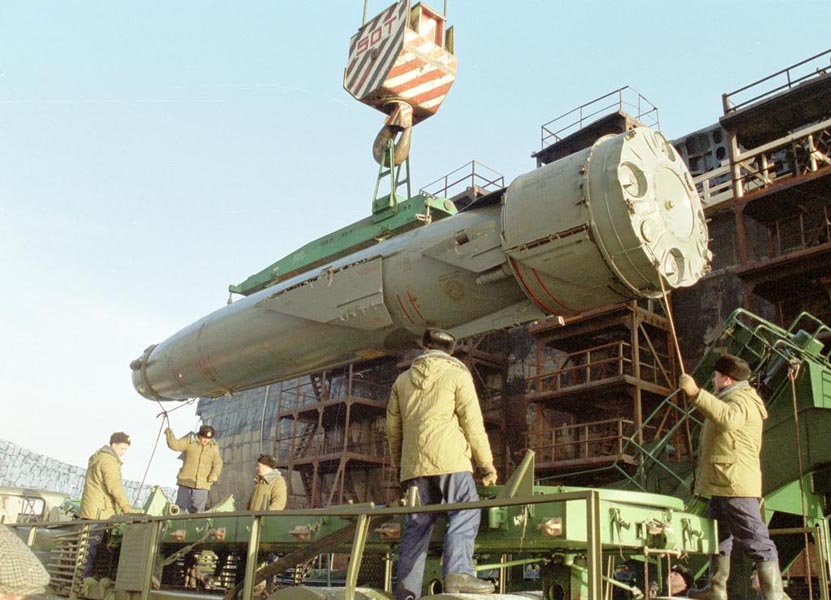
They are propelled by a booster located at the back, on the right in the photo, for a few seconds. The front, on the left, has a cover, which hides the air intake of a turbojet. The wings and tail are ... folded on the sides. It's really "The Secret of the Espadon", for fans of comic strips.
When it is in flight configuration, this is what you get:
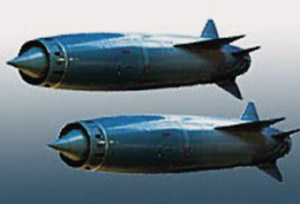
The Granit cruise missile
They call the Kursk the "aircraft carrier killer". The Granit is part of its arsenal of ultra-modern weapons (which obviously includes the MHD torpedoes capable of traveling at two or three thousand kilometers per hour). The Granit is a cruise missile capable of traveling at Mach 2. In dense air and at Mach 2, the wave drag is very strong. No aircraft at these altitudes exceeds Mach 1.2. The Granit consumes its fuel at a very high speed. Its range must be limited. Two hundred kilometers, maybe. It's low for a cruise missile. It's a sea-to-sea missile. When the satellites inform the Kursk of the presence of the enemy fleet, it can fire its Granit missiles in immersion. These know the position of their targets. They can approach them by adopting pre-programmed trajectories that no aircraft could follow and even practically no missile (they go as fast as conventional missiles!). There remain the ultimate defenses of the aircraft carriers, the main targets, their directed energy weapons. but these are still not very effective in dense air. It is reserved for space defense and is implemented in rarefied air from converted 747s.
Equipped with a flux compression electromagnetic system, the Granit can saturate ship detection systems. Moving close to the water, it evades radar until it appears above the horizon and its echo can be distinguished from that emitted by waves. Moreover, if the information provided by Carré is accurate, "its charge would be equivalent to 50 times Hiroshima," that is, more than half a megaton per missile. At this rate, there is no need to explode on contact. The Granit can be launched remotely. All of this makes it hard to see how, currently, an aircraft carrier could counter an attack combining "satellite detection - submarine approach - bisonic missile flying close to the water."
One thing comes back to my mind. When I discussed with Carré at the end of 2002, he mentioned all the work that had been done after the Kursk wreck was raised. As he clearly highlighted in his film, it was not humanitarian considerations that led the Russians to raise the Kursk. They had to recover the Granit missiles and their thermonuclear charges, even if some, intended for test firings, might have had inert warheads. There were also the MHD torpedoes and the launch tubes, widened to a meter in diameter. But a correspondent of Carré also mentioned "the dismantling of the lasers." What could lasers on a submarine be used for? One could think of systems installed on the turret, intended to protect the submarine against aerial attacks, or even to carry out surface strikes on targets. But one could also think of something else. A laser is a system where any body, gaseous, solid or even liquid, can store energy in the form of metastable excitation, and then release it in a very short time. There are lasers operating in the visible spectrum, as well as X-ray lasers. One could theoretically design "grasers," emitting gamma rays, using metastable neutron excitation levels in certain nuclei. But "ultrasonic lasers" are also conceivable. Advantage: destroy enemy torpedoes at a distance before they reach you. Just speculation.
For the record, when I left my job as a stone and copper engraver, which I couldn't make a living from, and decided to become a test engineer, I found a position in 1965 at SEPR, the Reaction Propulsion Society.
**Miscalculation. JPP, missile test engineer for a few months, in Istres, 1965. **
That's just a small explosion. The MSBS (four-tube missile for nuclear submarines) carried ten tons of powder. When I saw these devices operating, at 200 bricks per test, I had the impression of seeing five-hundred-dollar bills coming out of the nozzle.
End of December 2004. **Source: The Voltaire Network Journal. **
CONFIRMATION OF THE SINO-RUSSIAN MILITARY CLOSING
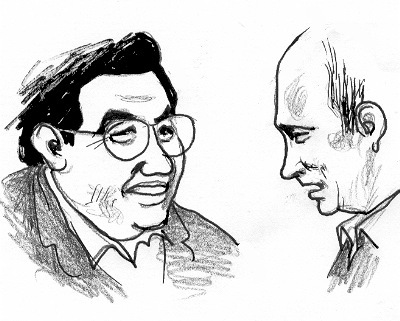
On the occasion of the visit to Beijing by the Russian Minister of Defense, Sergei Ivanov, President Hu Jintao announced that China and the Russian Federation will hold their first joint military exercises in 2005. The exercise will take place on Chinese soil, but its exact location, the units participating, and its scale have not been specified. The two great powers, often rivals during the Cold War, intend to strengthen their military ties to face a potential confrontation with the United States in the next decade. In 2001, they jointly created the Shanghai Cooperation Organization, and three months ago, President Hu Jintao urged the People's Liberation Army to prepare for war.
Let's take a step back. At a certain point in its history, Gorbachev decided to lower the USSR's shield, to unilaterally disarm. Of course, one could say, the USSR was out of steam. The United States were winning an unrelenting economic war that had been going on since the end of the war. Forced to maintain strategic parity, the Soviet Union was nothing more than a huge military-industrial complex. Beyond the Urals, butter and cannons, it was not possible. Gorbachev understood this well. Then came the collapse. The Berlin Wall was torn down. The Empire exploded into a multitude of ethnic conflicts. At that time, the United States could have played the card of openness, considering a super Marshall Plan, the beneficiaries of which would have been the Eastern countries. But that didn't happen, for a variety of reasons, not least because the Empire was not capable of making such a turn. The inertia was too great. One does not go from a prehistoric bureaucracy to a liberal economy without a phase where corruption leads the game. In another context, Algeria was unable to succeed in its revolution for somewhat similar reasons (lack of intelligent management, explosive birth rate, corruption). We will dedicate a dossier to this subject.
After Gorbachev came Yeltsin, the vodka sponge. In the country, corruption is exposed. Currently (2004), it is estimated in the East that between 500,000 and 5 million children and adolescents live "in the wild," without a fixed home, without social coverage, anywhere, outside, in squats, in basements. The Moscow station is the hub of all traffic, day and night, starting with that of prostitution and drugs. This is how, by tearing down the Berlin Wall, the West brought "democracy" to the East. And this is exactly what will happen in Cuba the day the Americans restore "democracy" on the island and the mafia can reestablish itself in peace. Cuba will not take long to become what it was during the time of Batista: the brothel of America.
The Russians don't know where to turn. After the KGB, the police state: poverty and chaos. Let's try to understand Putin. He is an ex-KGB. He has no illusions about the people of his own country and about the intentions of the Americans. Depending on the choice you make, you can call it realism or cynicism. People from different countries are beginning to understand that the American humanism, the time of generous ideas, those of a Lincoln, is over. Today it is J.R. Ewing who is in charge. The state of mind in a country can change over the decades. Peaceful regions can become battlegrounds. Rich countries can fall into poverty. Fanaticism can ignite millions of men. Today, everywhere in the world it is "each for himself and God for all," except that the god is not the same everywhere. In the USA, the golden calf tries to resemble a revised Christianity. God bless America. "God bless America."
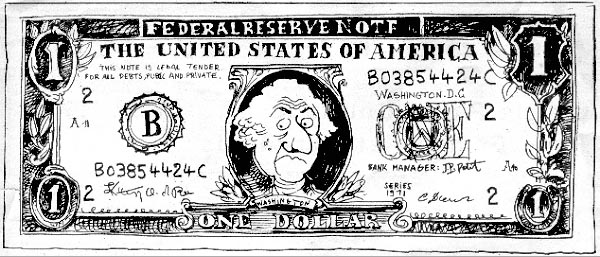
In gold we trust....
So the great states are looking for allies. The USSR having lived, Russia knows that she is not strong enough to match the American colossus. On the other hand, China is waking up from its millennia-long sleep, with its billion people. The agreement is taking shape:
*- I bring you my considerable labor force, my human power and you bring me your know-how and your high technology as well as ... your oil and raw materials. *
America dominates the world with its technology, especially in the field of arms. But it is a colossus with feet of clay. The Europeans today form a group of twenty-five countries. It is not only productivity, there is also the monetary aspect. After the war of 1939-45, the different countries of the world decided to index their currency on gold, the "reference standard." But in the early 1970s, Nixon managed to impose the dollar. What does this mean?
What is money for? To carry out exchanges between people. It can be compared to blood flowing in the arteries. Take a human being. At any stage of his life, during his growth, he has a certain volume of blood to ensure his exchanges, to transport his nutrients, to oxygenate his tissues. As the body grows, the blood volume increases in the same proportion. It is the same with money. A country that experiences a real economic boom, with a tangible increase in its production, consumption, and "economic metabolism," must increase the money supply in circulation. Conversely, if its economy collapses, its currency depreciates. This was the case with the German mark after the war. Monetary problems evoke a strange cybernetic problem, with numerous feedback loops.
Unless you are "the" country whose currency is chosen as the reference currency, the currencies of other countries have only a fiduciary value. They have only the value that is given to them. The more a currency is sought after, the higher its value, and vice versa. Before the emergence of the euro, European currencies, like all currencies in the world, could experience fluctuations. What does "reference currency" mean? It is simply the currency in which invoices are issued in international trade. Until a recent date, invoices were systematically issued "in dollars," because the dollar was ... stable. Why had the dollar managed to impose itself in this way? Because a reference currency is needed. Speculating against the dollar would have been like sawing the branch on which everyone was sitting. Moreover, the economic power represented by America allowed it to better withstand the attacks of speculators.
How can a currency get into trouble? It's like in the stock market: because people lose confidence in it. The more transactions were carried out based on the dollar, the more it stabilized this currency, on a simple fiduciary basis.
The profits from monetary speculation only benefited the speculators. The Europeans eventually ended up with a "monetary snake," that is, a kind of reserve currency mass, in all possible currencies, ready to come to the aid of a failing currency, in case it suffered an attack by speculators. Speculating against a currency like the lira was asking for a large number of liras to be exchanged for a counterpart in francs, pounds, dollars, marks, etc., except ... liras. Then confidence in the lira wavered, like for stocks on the stock market. The monetary snake somewhat reduced these fluctuations, by making it impossible to speculate on a daily basis with the possibility of mass purchasing the flow of the "circulating" currency. The measure proved to be deterrent. Speculating can bring big profits, but if the operation fails, the speculator pays his bill, including the transaction costs.
Europe is a patchwork. It is above all the Europe of big capital, without faith, without law, without borders. It is the Europe of "offshoring," the poisoned fruit of liberalism. Day by day, employees of companies in the "rich" European countries find themselves one day facing empty premises, the production tool having flown abroad, where the workforce is cheaper.
Serge Dassault, in a recent interview, which I did not want to reproduce, raises an alarm. Socialism, according to this good son of a wealthy family who has never walked on anything other than thick carpets, is the sure ruin. If France wants to survive, it must eliminate disproportionate social benefits. If French workers do not show reasonableness and do not accept wages aligned with those of the Poles, "we will head for certain ruin." It's touching. Between such speeches, Serge will go to inspect the new models of his private jets, trying out the immaculate leather seats, inspecting the fittings and accessories that give his company competitiveness and dynamism. Know this: the future of the market is the new rich. The new poor, on the other hand, have no money and present no interest. All of this is common sense. The future is the luxury industry. I have even seen a report showing the fantastic growth of a French company producing 30-meter yachts with 300 orders. It had, in a few months, doubled its staff. Those who talk about an employment crisis do not know where to look. On the luxury side, it's the boom.
Beyond this redistribution of cards (of work), there is the monetary aspect. With the euro, all the countries making up this very disparate Europe have made a common currency. One can no longer speculate against the franc, or the lira, the mark, since these currencies have ceased to exist. De facto, all European currencies have become solidary, since they have merged into a single currency: the euro. Money reflects the state of an economy. When Europe was fragmented, some currencies flamed, while others declined, the system was turbulent. There, the euro represents, by simple ... inertia, a monetary strike force comparable to that of the dollar. With a population double that of the United States, European activities, very diverse, begin to match those of the USA.
Consequence:
People, and even entire countries, are increasingly inclined to "invoice in euros," due to the stability of this new currency, now a "strong currency." Consequently: confidence in the dollar is declining. An important piece of information (source: Voltaire Network): Before the United States launched its police operation against Iraq, to "dismantle sites where weapons of mass destruction were being developed," which later turned out to be a complete farce, *this country had begun to invoice its oil deliveries in ... euros! *It should be known that the United States, concerned about not overextending their reserves, import about 75% of their oil consumption. If all the exporting countries start to invoice in euros and if confidence begins to melt, the dollar begins to fall, it would affect the US balance of payments. In short, our planet is the scene of a monetary war, since the dollar has, de facto, ceased to be the reference currency.
The monetary mechanisms are complex and I will dedicate a future comic strip to them. Having a depreciating currency means that export prices are lower. The depreciation of the dollar therefore has the effect of reviving American exports, while slowing down those of the Europeans. But this monetary weakness has not only advantages. Moreover, wars are expensive, not least in terms of oil.
Being the reference currency has allowed the USA to practice an inflationary policy with impunity, that is, to print green bills and thus buy all sorts of things around the world with ... paper. The inflation of the money supply, relative to a given currency, has the effect of depreciating that currency, relative to the goods themselves (in the long term: price increases, expressed in this currency) and relative to other currencies (in the long term: devaluation). This has been the rule for decades, except for the dollar. Depreciating the dollar would have created too much instability, monetary and economic, and the United States played on this fully. Since the emergence of the euro, these good days are over. The American economy, the American currency, have become vulnerable. And wars have been fought for less than that. Moreover, in subsequent analyses, it is often concluded that economic and monetary problems were at the root of the outbreak of major conflicts.
The Eastern bloc, circling in a closed system through an autarkic economic system, the COMECOM, long remained outside the planetary monetary currents and turbulence. In other words: the ruble was not convertible, nor quoted. The economies of the USSR and the "satellite" countries were planned and prices were imposed. Today, all the Eastern countries open up to the outside world, to the market economy, as does China. For the world economy to function, a reference currency is needed. Previously, groups of countries formed their own enclaves, called "zones." There was the "dollar zone." Today, the economy is globalized and the logic dictates that one single currency should take the lead. On this point, the euro constitutes a threat to the dollar, which becomes "a paper tiger."
The global situation is strange. America is the most powerful country in the world. Strategically, it is capable of erasing entire nations from the map, with weapons whose existence we are only beginning to suspect (antimatter weapons, politely called "fourth-generation nuclear weapons"). Diplomatically, the United States have achieved something unprecedented: to have the entire world against them, except for Tony Blair and a few members of his entourage. The only ally of America is God. Bush says so. If that is true, it would not be negligible. This Russia-China rapprochement, if it intensifies, is a phenomenon to watch. If currently no country could stand up to the United States, the Russia-China tandem could do so in a decade. The planetary game could be schematized as follows:
- The USA, with a strong technological advantage, but having succeeded in making the whole world its enemy.
- Russia, momentarily destabilized by the fall of the Empire, but looking for a new ally: China.
- China, with a phenomenal potential, capable of surpassing Japan in terms of economic growth. Unlimited ambitions.
- Europe, aging but strong with the "union" of its twenty-five components. A lot of people, diverse activities, and ... a strong currency.
- Japan, recovering from an economic crisis it had not prepared for.
- Arab countries, which hold large oil reserves and now have a new type of strategic force: their infallible kamikazes.
Change the subject: I watched the series "Taken" by Spielberg again. I saw a scene where a scientist is called before Pentagon experts who tell him, "the people sitting around this table spend 23.5 billion dollars a year on their projects." One of the officials says that astronauts in charge of placing a nuclear generator in orbit, intended to power directed energy systems, had been mysteriously robbed. The man then says this sentence:
This generator was essential to power the lasers and electrothermal systems.
This word, I have not heard since 1967. It has a very precise meaning in plasma physics and MHD, but I am not sure the French remember it anymore. The Vélikov instability, one of the keys to mastering cold, bitemperature plasmas, is an electrothermal instability.
As the bald singer would say: how strange, how unusual and what a coincidence!
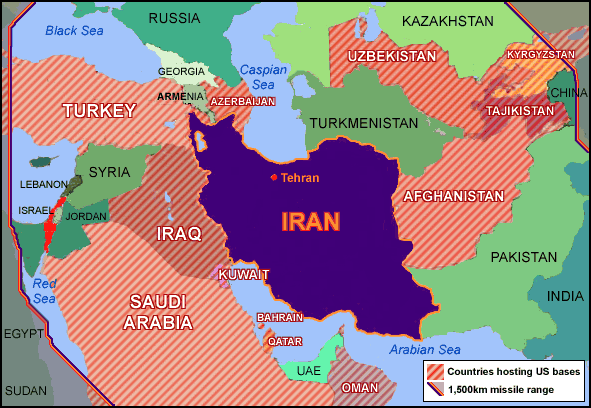
We are not done having fun, apparently. I learned that the Israelis have postponed their plan to strike Iran by two weeks. It would be in mid-March 2005 and not February 2005. So we have time to go skiing. If you read the December issue of Courrier International, you will see that this raid is problematic because it requires an in-flight refueling, unless the Israelis are willing to lose their aircraft and pilots.
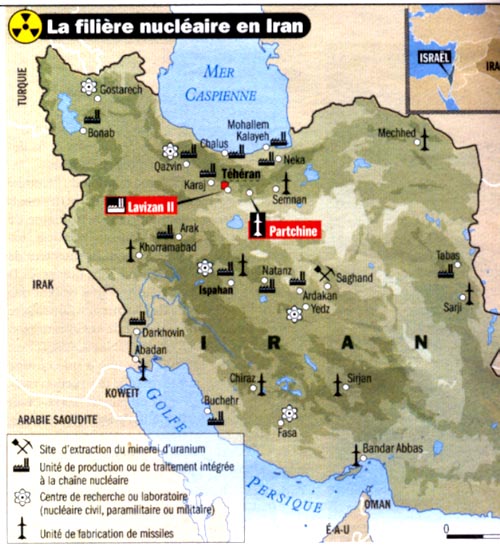
Two possible routes, passing over Saudi Arabia or Iraq, the latter option implying that the Americans would support the strike (intermediate solution: follow the border between the two countries). A journalist attended a "wargame" in the United States where prominent Pentagon specialists gathered in a sort of brainstorming to study a possible action against Iran. Their conclusion: "We don't do it like in Iraq. We carry out a rapid raid from aircraft carriers. We depose the current government. We replace it with others, we destroy the Iranian nuclear installations and we go home."
A simple thing, what.
****Kursk File
Back to Guide Back to Home Page
Number of consultations since January 14, 2005 :