La Hague: Suicide Manual
The Hague: Suicide Manual
May 5, 2011
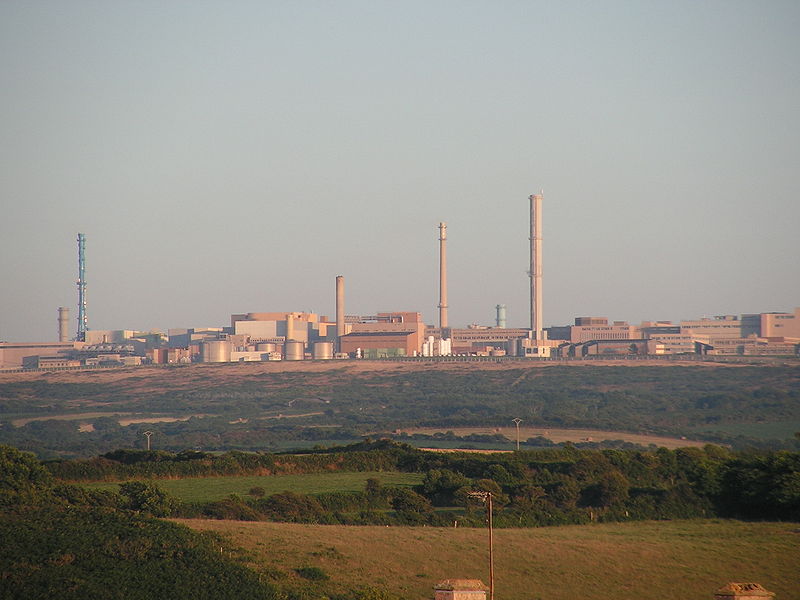
The La Hague plant, on the northern coast of France
There is a page on Wikipedia, which provides some information on the website of the La Hague "reprocessing center" located in Cotentin, on the northern coast of France.
http://en.wikipedia.org/wiki/COGEMA_La_Hague_sitehttp://fr.wikipedia.org/wiki/Usine_de_retraitement_de_la_Hague
You will learn that this plant, the dirtiest in the world in terms of nuclear discharges, was commissioned in 1961, half a century ago (...).
The La Hague plant has been recovering for decades the "waste" from various French and foreign plants, and "retires" this material.
In fact, this reprocessing is entirely focused on the extraction, by chemical means, of 1% of the plutonium produced by fission in nuclear reactors from uranium by fast neutron capture by the nuclei of non-fissile uranium 238. This pure plutonium is then packed in small packages and shipped to MELOX in Marcoule, in the Gard, in the south of France. There, this plutonium is diluted, up to 7% in uranium-238, and this mixture constitutes a new "nuclear fuel," called MOX (mixed oxide).
This MOX fuel can in turn be used in consumer countries to extract plutonium for military purposes. Why bother, as the Iranians do by enriching uranium through costly centrifugation, when it is sufficient to buy MOX and extract plutonium 239 through a purely chemical technique, to make an explosive fission bomb?
This method is considered by Americans as "proliferation."
This means that this technique will eventually allow all countries of the world to have their own atomic bombs.
This fuel is currently used in 20 of the 58 reactors in operation in France. The construction of the EPR generalizes its use (they were designed for this).
We have long ignored that the introduction of MOX reflected a subtle shift from the fission of uranium 235 to a process based on the fission of plutonium 238.
Everyone is beginning to realize the extreme danger of this substance, which has a strong tendency to bind to human tissues after inhalation or ingestion of dust. The human body is then unable to eliminate them: the characteristic time for its elimination by human tissues is 50 years. These particles are highly (100%) carcinogenic; it is not irradiation, but biological contamination, undetectable by a measuring instrument.
This contamination could occur in the event of a nuclear accident causing the release of debris from the fuel assemblies.
This has happened, and continues to happen, since the explosion of reactor number 3 of Fukushima, which was loaded with MOX.
Plutonium dust has been found in the United States.
The impact has spread across the planet, and some experts claim it could lead to a million cancers.
To stop this release from reactor number 3, it would be necessary to extract its fuel rods and, at a minimum, submerge them in a pool specially designed for this purpose.
However, access to these elements is impossible, and it is not clear when such access could become possible, in the short or long term.
It is necessary to continue to cool the "shut down" reactor fuel elements, whose core is largely melted, and which releases several tens of megawatts of thermal energy. A closed-loop water circulation, coupled with a heat exchanger, could help to dissipate this heat. However, the deteriorated condition of the reactor makes this impossible.
The Japanese are forced to apply an open-loop cooling system, by injection or spraying of fresh water.
This water, circulating in the damaged core, is responsible for the release of debris from the fuel elements that have escaped from the zirconium cladding that contained them and have melted. This water is filled with plutonium particles and a wide range of highly toxic radionuclides. It is partially transformed into steam, which escapes into the atmosphere. The rest accumulates in a series of cracks, impossible to locate and seal, due to the earthquake in the galleries located in the basement of the reactor. The company TEPCO then pumps this water, which has so far been stored in tanks.
When these are full to the brim, TEPCO has simply poured the highly radioactive water into the nearby ocean, apologizing to the residents and fishermen.
This process will continue until a closed-loop cooling system can be established. ....
We do not see how the reactor could remain inaccessible due to the high radioactivity present in the surrounding area.
Two companies are directly responsible for this deadly dispersion:
- The Japanese company TEPCO
- The French company AREVA, which produces and markets the new plutonium fuel through its MELOX plant.

TEPCO's apology responses. When will the leaders of AREVA apologize?
But there is much more serious.
Over five decades of operation, the center of La Hague, which is not a "recycling center" but a conditioning center following the extraction and sale of plutonium fuel at Marcoule, has accumulated a stock that defies imagination, and whose importance is not specified on the Wikipedia page.
Sixty tons of plutonium
The assemblies containing this plutonium are currently stored in four pools located in La Hague, in buildings whose roofs are not armored, but made of a thin protective layer (...)
The Devil's Kitchen
Plutonium is denser than lead (19 kg per liter). These calculations mean that the sixty tons of plutonium correspond to 3.15 cubic meters, which could be contained in a cube of 1m46 in size.
The La Hague plant is a reprocessing center, recovering the most dangerous and toxic substance in the world. Considering what is happening in Fukushima, a logical reaction would have been to stop the production of MOX fuel, close MELOX in Marcoule, and stop the reprocessing of the devil's ashes at the La Hague plant. La Hague is not a treatment center, but rather a dump, a "nuclear garbage can."
It is a safety
I propose a small problem, level certificate.
A manufacturer has a stock of 60 tons of plutonium. The barrel of oil has a capacity of 160 liters. A barrel of oil has a capacity of 160 liters.
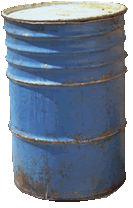
Barrel of oil
One gram of plutonium releases as much energy as one ton of oil. Oil also has an average density of 0.88 kg per liter. Its average price on the market is around 100 dollars, or 73 euros. Calculate the number of oil equivalent barrels corresponding to a cube of plutonium of 1m46 in size. Calculate the euro value of the stock of plutonium currently stored at La Hague.
60 tons = 60,000,000 grams = 60 billion, sixty billion kilograms of oil equivalent.
Divide by 140 pounds, which corresponds to the weight of a barrel.
We get
428 million barrels.
At 73 euros per barrel, this makes
31.2 billion euros
The La Hague plant has the capacity to process 1,700 tonnes of "spent fuel" per year. It currently processes about 1,000 tonnes per year. Keep this figure. In this mass, 1% of plutonium can be recovered, i.e., 10 tonnes per year.
What is the load of 1,428 atomic bombs.
If we do not take into account the cost of reprocessing (chemical), this contribution represents an annual turnover of:
**
5.2 billion euros per year** ---