Start of MHD4
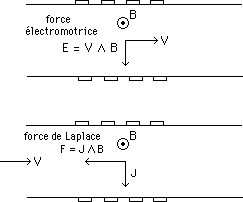
...For example, if such a model were immersed in a gas using only a single pair of electrodes—the central pair—and this pair were short-circuited, a current would flow, looping through the gas, thereby strongly slowing it down:
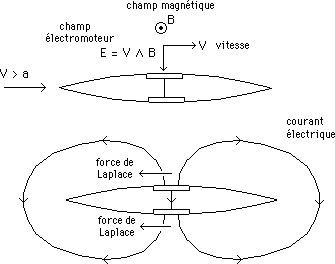
...Such an airfoil immersed in a highly electrically conductive gas (or made conductive) behaves like a high-power "MHD generator." It is a "direct MHD converter." Where does the energy come from? Simply from the kinetic energy of the fluid. The extracted power corresponds to a loss of kinetic energy in the fluid, resulting in its natural deceleration.
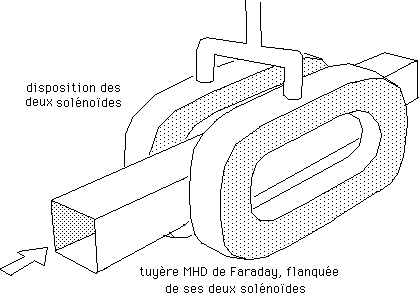
...In 1965, we were implementing MHD electrical generators operating a direct conversion of the kinetic energy of a fluid into electricity via a "Faraday-type MHD channel." The geometry differs, but the principle remains the same. Below is a diagram of a Faraday MHD generator with its square-section channel.
...Next image: solenoids removed, showing the arrangement of "segmented" electrodes (to achieve better current distribution across the channel).
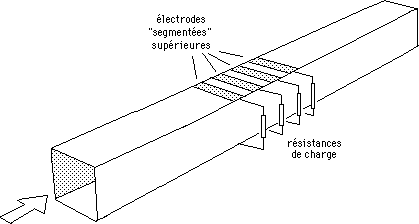
...In experiments conducted in the 1960s at the Marseille Institute of Fluid Mechanics, we injected argon gas at 10,000 K into this channel under a pressure of one bar, entering at a speed of 2,500 meters per second. With a magnetic field reaching 2 teslas, the electromotive field thus amounted to:
2,500 × 2 = 5,000 volts per meter
...Given that the distance between opposing electrode pairs was 5 cm, the voltage difference was 250 volts. Subtracting 40 volts (due to wall phenomena near the electrodes), we obtained 210 volts.
...The electrical conductivity of argon at such a temperature being 3,500 mhos per meter, the current density was J = σE = σV × B = 735,000 amperes per square meter—equivalent to 73.5 amperes per square centimeter. For a channel length of 10 cm and width of 5 cm (50 cm²), this yielded a maximum current in short circuit of 3,675 amperes.
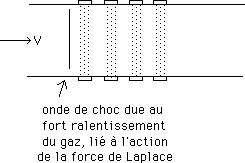
...When the electrodes were short-circuited, the current was maximal, and as experiments showed, the resulting Laplace force was intense enough to slow the gas sufficiently to generate a normal shock wave—achieved without any physical obstacle, solely through electromagnetic force.
...Thus, a supersonic gas flow impinging on a lens-shaped airfoil carries its own energy, which can be harnessed. The energy required to eliminate shock waves was therefore less than the energy used to accelerate the gas near the leading and trailing edges, minus the energy recovered through deceleration caused by the central electrode pair.
...This result was extremely interesting because it showed that the energy needed to suppress these shocks was lower than one might have initially expected. The main loss occurred via Joule heating. In the case of a flying machine moving through cold air, one would also need to account for the energy required to ionize the gas using microwaves—energy we had also calculated.
...How do Laplace forces act on the slope of Mach waves?
...It's very simple. When the MHD channel operates, for example, as a generator (slowing down the fluid), here is how Mach waves evolve within the channel:
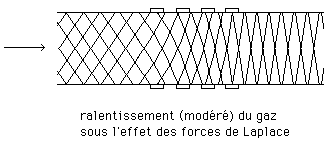
...This represents moderate fluid deceleration. The waves appear to compress like the bellows of an accordion. The electrodes are "loaded," limiting current density. This illustrates how stronger deceleration can lead to a shock wave: when velocity drops low enough that the gas tends to become subsonic. Mach waves then concentrate, like an accordion, accumulating pressure disturbances. A shock wave forms and rapidly migrates toward the channel inlet, stabilizing in front of the first "streamer" (a spiral electric current jet emerging from the first electrode pair), as if this streamer acted like an invisible obstacle.
...Conversely, if electrical power is injected into the system, the channel behaves as a Faraday-type MHD accelerator. Mach waves tend to flatten:
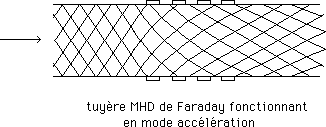
...This MHD acceleration was also demonstrated in the 1960s in the laboratory where I worked. It proved highly effective. With an inlet velocity of 2,500 m/s, we achieved outlet velocities exceeding 8,000 meters per second—representing a speed gain of over five kilometers per second over a distance of just ten centimeters.
...These experiments demonstrate the extreme efficiency of MHD action on a gas when it possesses sufficient ionization. For information, such electrical conductivity (3,500 mhos/m) in argon corresponds to an ionization rate of 10⁻³ (one atom per thousand is ionized).
...In cold air, artificial ionization would be required—for example, by exposing the surrounding gas to a microwave flux at three gigahertz, which would strip electrons from the most easily ionizable component: nitrogen oxide (NO). Alternatively, one could consider introducing an alkali metal with low ionization potential, such as cesium or sodium.
...Lebrun and I had performed all these calculations within the framework of a doctoral thesis funded by the CNRS in the 1980s. Computer simulations yielded a completely "regularized" flow, free of shock waves. The figure below shows the two families of Mach waves.
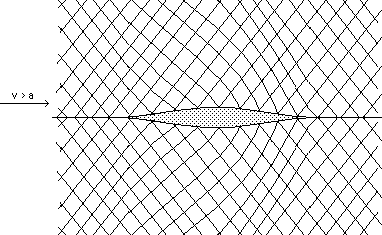
...This theoretical work was complemented by hydraulic analogy experiments, again using the three-electrode system. Bow and stern waves could be eliminated. Since the electrical conductivity of acidified water is too low, it was not feasible to use fluid energy to improve the energy balance. The result was identical to what was presented above: a flow where the fluid remains "flat."
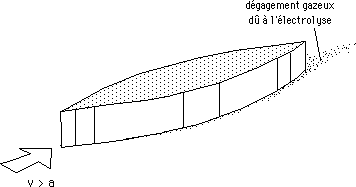
...Interested readers may find some of these elements in my comic strip "The Wall of Silence" (see CD-ROM Lanturlu).
How to implement these research findings.
...These ideas are compelling. They open up a new field of supersonic fluid mechanics, where instead of enduring shock waves as unavoidable phenomena, one can actively avoid them.
...The challenge of MHD lies in working with a gas having sufficient electrical conductivity. Over twenty years of work, we naturally explored all these issues. In 1966, I became the first to achieve stable operation of a "bitemperature" MHD generator.
...We also conducted numerous experiments in rarefied environments (air at a pressure of 10⁻¹ mm Hg).
- Parietal confinement of a plasma
- Guidance of "streamers" (spiral electric currents)
- Elimination of the Vélikhov instability (presentation at the Moscow MHD Conference)
- Study of air ionization by HF (1 MHz)
...I will explain these various experiments and prospects in detail on the website at a later time. For now, let's examine how the experiment of eliminating shock waves around a lens-shaped profile could be realized.
...To do so, one must have a wind tunnel delivering a high-temperature gas flow (argon at 10,000 K). This is possible using a device developed shortly after World War II (though now obsolete): the "shock tube."
...What is it?
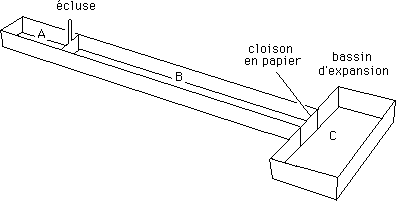
...To explain how this "shock wave wind tunnel" works, we once again resort to hydraulic analogy. Imagine constructing a straight, constant-width channel from plywood—10 cm wide, several meters long. Here is the schematic:
../../../bons_commande/bon_global.htm