Start of MHD5
...In hydraulic analogy, the propagation of a straight shock wave will be equivalent to that of a "breaking wave." How will we create this? Simply by placing a small water height in section B and a larger water height in section A. In the expansion tank: nothing at all, no water whatsoever. In cross-section:
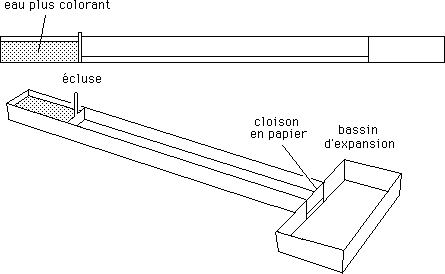
...All is ready for the test. The lock's barrier is removed very quickly. The colored water mass (for example, using fluorescein) bursts into the downstream channel. This is what we obtain:
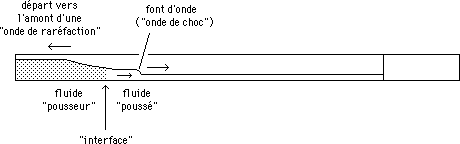
...What do we observe? The emergence of a breaking wave, a liquid wave front, which sets the clear water into motion. But the wave front moves faster than the water itself.
...Downstream, a rarefaction wave begins, but much "softer." This is not a shock wave.
...Shortly afterward, the situation is as follows:
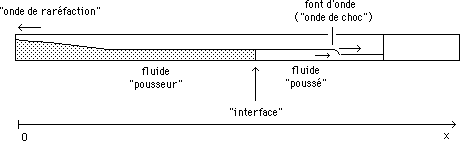
...The rarefaction wave reaches the bottom of the "tank." The distance between the clear water "pushed" and accelerated, and the interface has increased. We therefore have a usable "gust," where clean water has been set in motion, thus increasing the height (hydraulic analogue of pressure in a gas). We can therefore "work" on this gust. Later, the rarefaction wave reflects off the tank bottom and quickly catches up with the entire interface-wave front.
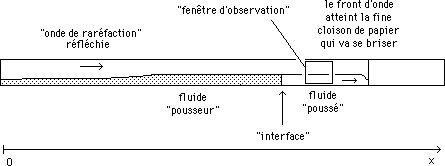
...We see that if we had installed an "observation window" in the wall, we would have seen this mass of clean water moving through during the "gust duration." The whole process can be read on an "x,t" diagram:
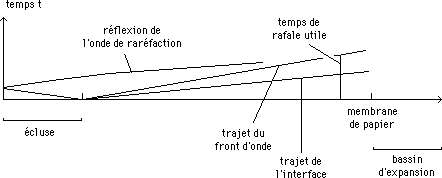
...Here we have a faithfully analogous image of the operation of a "shock tube." It suffices to replace the lock with a "high-pressure chamber." The lock's barrier, manually operated, becomes a copper diaphragm that opens when the pressure reached (using a combustion chamber) is sufficient. The test section becomes a test tube with constant cross-section, initially filled with argon at low pressure (13 mm Hg). As for the expansion tank, it is simply a vacuum reservoir of any shape. The paper barrier is replaced by a mylar membrane, which ruptures when the shock wave reaches it. Below is a schematic outline of the setup:
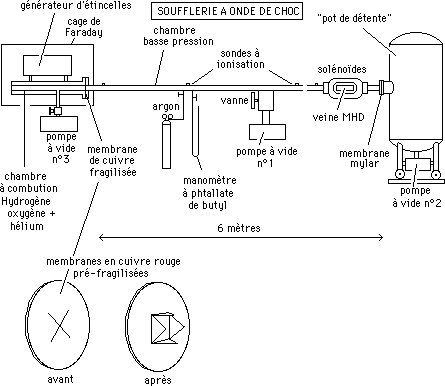
...Length of the high-pressure chamber: 1.4 meters. Diameter (same as the test section): 5.6 cm. Length of the test section: 6 meters. At the bottom, the red copper membrane, weakened by grooves, opens into four petals, allowing the hot gas to pass freely. The high-pressure chamber is filled with a H2 + 1/2 O2 mixture, with helium as a diluent. The expansion tank is simply a sturdy canister capable of sustaining a vacuum. The installation is completed with various rotary vacuum pumps, easily found second-hand, capable of achieving a vacuum below 10-2 mm Hg (10-2 torr), along with vacuum-tight valves. Add a battery of bottles supplying hydrogen, oxygen, helium, and of course argon.
...The combustible gas mixture is ignited by a system of spark plugs connected to a high-voltage source. Since this system generates electromagnetic interference, the entire high-pressure assembly is enclosed in a Faraday cage (wooden frame and copper mesh, 1 mm mesh). Rustic, but effective. The six meters of low-pressure argon instantly become a compressed gas "plug" (1 bar, 10,000 K) about twenty centimeters long. This is immediately followed by the "burned gases," i.e., a mixture of water vapor and helium.
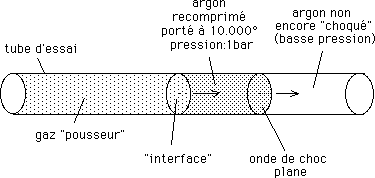
...That concludes the "hot-gust wind tunnel" part.
...In the test section where measurements are made and the actual MHD experiment is conducted, the cross-section is square (5 cm by 5 cm). Therefore, a carefully machined piece must be inserted to transition from a circular to a square cross-section:
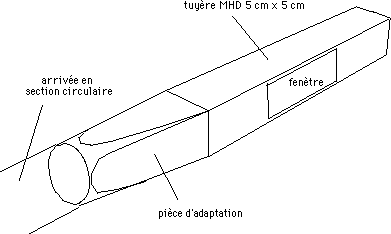
...The "MHD nozzles" can be made of plexiglass (with glued parts) or laminated plastic (for strength), and equipped with a high-quality optical window. Although the argon temperature is high, it does not damage the nozzle components due to the brevity of the gust (eighty millionths of a second).
...To generate a transverse magnetic field, two solenoids will be used, arranged as shown below:
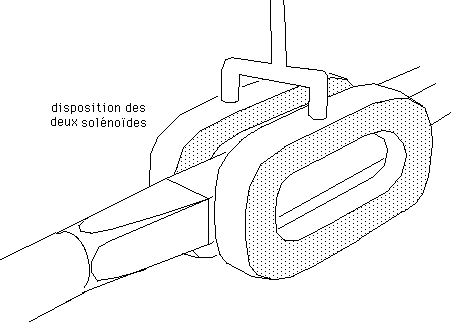
...In the next drawing, one of the solenoids has been removed to show the placement of the model (lens-shaped airfoil):
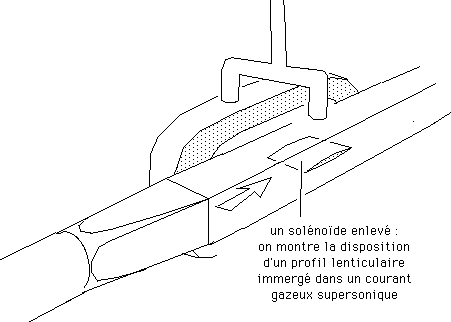
...The MHD nozzle volume, including its overall size, is on the order of one liter, and the magnetic field to be generated must reach 20,000 gauss (2 teslas). Therefore, a very high current (50,000 amperes) must pass through the solenoid windings. Such a current tends to explode the solenoids—not due to Joule heating, but simply because of the J × B forces acting within the windings themselves. The copper windings must therefore be reinforced with a kind of "corset," for example, made of fiberglass embedded in araldite.
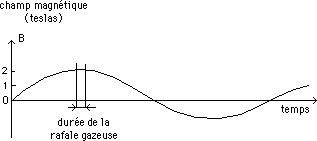
...Since the actual MHD interaction experiment is of very short duration, an economical solution to generate such high currents is to use a bank of capacitors discharged into this inductor (oscillatory discharge). It is sufficient to synchronize everything so that the experiment (at the moment the hot argon gust passes) occurs when the magnetic field B is nearly stationary (discharge period: 5 milliseconds).
...Next drawing: the shock wave wind tunnel, equipped for MHD experiments, as it appeared in my laboratory in the mid-1960s.
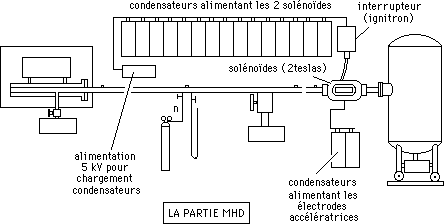
...The capacitors were charged to 5 kV. A smaller bank of capacitors then powers the test model's electrodes.
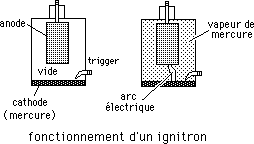
...Problem: how to switch 50,000 amperes. Solution: using an old electric locomotive ignitron (designed to switch 2,000 amperes, but robust enough to withstand hundreds of tests at 25 times that current). Ignitrons are well known to power electronics specialists.
../../../bons_commande/bon_global.htm