The Russian MHD of the 1950s, and today
1 - The basic principles of MHD machines
2 - The frantic resumption of the arms race
June 13, 2006
Reported by a reader, a good recent article in Wikipedia
http://fr.wikipedia.org/wiki/Z_machine
June 15, 2006: Predictable consequence: the frantic resumption of the arms race
I say it and I repeat it: at a time when the planet's fate seems to become more and more problematic every day, and when the most pessimistic visions tell us "we are heading straight for the wall", another way of speaking about what others once called "Apocalypse" this breakthrough at Sandia seems to me to represent a final hope and to present itself, without fear of the words, as the most important invention of mankind since ... the discovery of fire. This non-radioactive, non-polluting fusion is "the nuclear fire", the real one, usable, potentially beneficial, free of any negative fallout, for those who have the wisdom not to use it to create the most deadly weapons ever to appear on Earth, leaving behind the existing nuclear arsenal ( alas, as I reread this sentence, the next day the machine is already running ).
It is an idea that I will try to convey over the months, knowing that:
*- For the nuclear barons, nuclear power ( reactors, fast breeder reactors, laser fusion or in tokamaks ) indicates the narrow limits of their imagination and is nothing more than the expression of a powerful lobby. *
*- For the ecologists, the manipulation of the atom remains fundamentally tied to poisoned words like "long-term radioactive waste", alteration of the habitat through the birth of human monsters. *
So pay attention to what I am about to tell you, because it may be our planet's last chance not to sink into disorders that could result in the establishment of inhumane powers, built on billions of corpses and the remains of a planet's habitat dramatically damaged by its turbulent inhabitants. These early signs are already there. Doomsayers predict, for example, an inevitable US-China conflict, the stakes being control over the planet's energy and raw material resources. In my opinion, these future wars are quietly taking shape. I think of the book "Silent weapons for quiet wars" ( "Silent weapons for quiet wars").
There is already a form of war in place: economic war. This is how the USA managed, in a few decades, to bring down the Soviet Empire, which could not afford both "butter and guns" and finally collapsed in a few years, like a house of cards, in a way that was as spectacular as unexpected. Currently, China is doing its best to hide the invasion it is carrying out on a global scale, followed closely by India, operations of "silent" infiltration where the weapon of these formidable opponents lies in the weakness of their wage costs. Impeccable. In the face of this situation, the behavior of our French politicians resembles a pitiful display, even if our "future iron lady", seduced by the British mirage, intelligent and maneuverable, suddenly takes the lead in the polls by stealing the fruits of her main opponent's security policy, creating confusion within a herd of unimaginative elephants.
Soon, "RFID" will invade the entire world, and our daily lives. Inventory management, distribution channels will throw millions of salespeople and shopkeepers onto the "unemployment market", a subject that was mentioned and quickly silenced by our media "Pangloss", François de Closets, who advocates "that everything is for the best in the best possible world". Many other professions will be severely affected. All that I had predicted is coming true. Nanotechnology is already producing "chips" invisible to the naked eye, although equipped with memory, true "mouchards" that will be located in any object of your daily life. Under the pretext of "security", the privacy of men will be shattered, but
Why worry, if you have nothing to hide, would say de Closets
By creating the "MINITEC" pole in Grenoble, France "places itself in the race for RFID" against which a tiny handful of dissenters recently tried to rise, violently repressed by a police state power that clearly denies the French the right to demonstrate. But is not this a rear-guard battle, a last stand of the few individuals who are somewhat aware of what is being set in motion on a planetary scale, the ultimate choice being:
*- Do you prefer to be invaded by chips made in France or by those made elsewhere? *
I could go on and on, as I have done for years, listing all the announced catastrophes. In the face of this, a form of response suddenly emerges and can be summarized by the incredible formula:
Energy in abundance, for all humans, everywhere, without negative consequences, and on a scale of less than a decade
All of this resembles the great contemporary myths of "free energy", "energy of the void", "cold fusion", etc... But in fact, this new recipe is part of classical physics, long mastered, that of non-polluting fusion, whose classic "hydrogen bombs", exploiting the reaction:
Lithium7 + Hydrogen1 ----> two Helium4 nuclei and ... no neutrons
are just a difficult to control illustration.
Which politician will take up this idea as his battle horse?
I remain confined within the narrow framework of my website, even though my audience is quite large. I have been banned from the media for years as a thinker in circles, moving on the margins of "scientifically correct". I would not waste my time sending articles on non-polluting fusion to magazines like "Pour la Science" or "La Recherche" or even "Science et Vie". These submissions would not be followed by any echo, especially since their control by lobbies such as the CEA, the army, the arms trade ( Lagardère group, Dassault group, etc.) would ensure the futility of such an approach and explain an odd silence that has lasted for more than three months.
Therefore, I can only try to raise the awareness of as large a public as possible, by delivering speeches at different levels and starting here with the level I hope is the most accessible.
What I am about to tell you has been neglected for thirty long years by the civil scientific sector ( it is MHD ). However, there are qualified interlocutors in the hexagon, not our usual spokespeople, but ... military engineers, still in service or retired ( which allows the latter to speak more freely ). These people are the counterparts of scientists like Chris Deeney, the mastermind of the Sandia Z-machine. Like him, they did not aim for "pure fusion" ( which bypasses the intermediate of fission ) but the development of strong X-ray sources, required by the managers of our strike force. Sources whose function was to test the resistance of warheads to antimissile weapons ( see previous page ). Even though many of these researchers believed, in their hearts, in the possibilities of this other branch ( by electromagnetic inertial confinement ), they had to refrain from advancing such ideas, which would have immediately overshadowed the two dominant projects, Megajoule and Iter".
Machines were therefore built, tests were carried out and theses were defended, in a tightly controlled framework in this "closed environment" that is the Gramat center, located in the Lot. If politicians want to find the scientific backing they are entitled to demand, they must turn to these people, still in service, and only these, linked to this center of gravity of such military research or, working in subcontracting sectors while remaining linked to this "mother company" they must turn to.
This whole story began in the early 1950s, from the mind of Andrei Sakharov, father of all modern MHD ( E.P. Velikhov was his student ). Here are the founding texts, published in France by the publishing house Anthropos.
In these papers you will find the principle of the flux compression generator, called MK1, giving large values of magnetic field and using explosives. You will also find, always operated with explosives, the first description of the "helical" MHD generator. In the first case, the magnetic field is trapped in a copper cylinder that the pressure of an explosive placed outside will compress near its axis. In the second case, a copper cylinder containing an explosive will expand, short-circuiting the coils of a solenoid. In both cases, this conducting material cylinder ( copper or aluminum ) receives a name. It is now called a
liner
Remember this name well.
In internal combustion engines, gases are compressed by a piston. It is also the pressure acting on this piston that will allow the conversion of thermal energy into mechanical energy.
There is another more recent text ( 1996 ), in English, of an acceptable level of popularization, published by the Los Alamos American Research Center. This 23-page text is a summary of the fruit of the collaboration of a Los Alamos laboratory with the "city laboratory" Russian Arzamas-16, whose existence was long ignored by the West. For those who read English, here is this document, in pdf:
During the following, I will take elements from both Sakharov's articles and this report published by the Los Alamos center.
**Principle of flux compression. **
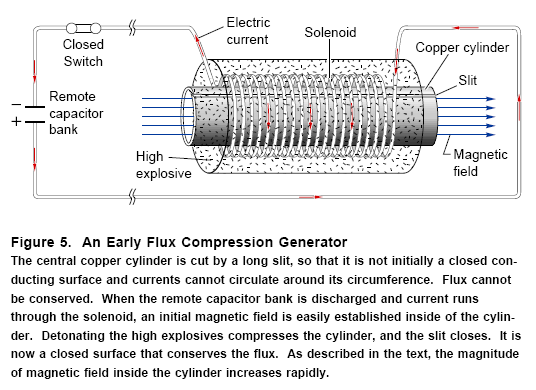
First, here is the excellent illustration taken from the Los Alamos report, page 54.
Below, the same figure with comments in French:
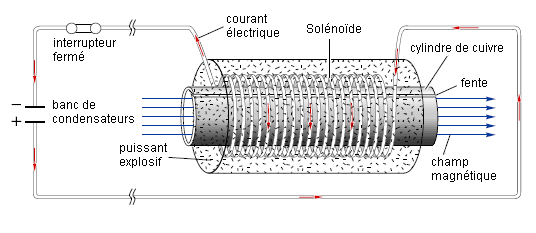
A first generation flux compression generator ( type model MK1 of Sakharov
In the central part, a copper cylinder, with a slit running along one of its generators. This cylinder is located inside a solenoid, whose coils are distinguishable. The electric current, in the figure, is indicated by a red arrow. When the switch is closed, the capacitor bank powers the solenoid and a current passes, creating a magnetic field. The reader is then entitled to ask "what is the purpose of this slit in the copper cylinder?" . It is necessary to remember that according to the equations of electromagnetism, the equations of Maxwell, any variation of the magnetic field in a medium results in the appearance of an electric field (induced) within it. The result gives what is called Lenz's law. This induced current leads to the passage of a current, if the medium is conductive, obviously. This current is associated with a magnetic field (also called "induced") that opposes this variation of the field (inducing). Imagine that the copper tube is not provided with this slit. If the magnetic field is created by the passage of the current "slowly enough", the magnetic field will eventually establish itself in all the available volume, both outside and inside the copper tube. But if this current is "applied abruptly", by the rapid discharge of a capacitor, the magnetic field will grow within the copper tube, which will be the site of induced currents. Then, current loops will appear in this tube, similar to the coils of the solenoid creating the inducing field, but where the current will circulate
in the opposite direction
. The resulting magnetic field will oppose the rise of this field B within this copper material. Since copper is highly electrically conductive, this effect will be intense and during the entire rise of the inductive magnetic field, linked to the growth of the discharge current, the induced current will be such:
-
That the magnetic field remains zero within the body of the copper tube
-
That this field also remains zero inside it.
With regard to these rapid variations of the magnetic field, a continuous copper tube would behave "like an impermeable barrier", preventing the establishment of a magnetic field inside this cylinder.
By cutting the tube along its entire length, the formation of current loops is prevented. There appears a system of induced currents in the copper, which maintains the magnetic field within this material at a value close to zero, but it seems "as if this field managed to infiltrate through the slit". It is a very good thing to start considering the magnetic field as ... a gas, associated with a pressure, called magnetic pressure, which is written:
with B in teslas ( one tesla equals 10,000 Gauss ) and
It is entirely legitimate to acquire the mental image according to which "the magnetic field will infiltrate through the slit made in the copper and thus establish itself inside the cylinder as if this copper conductor did not exist".
The device above shows the presence of an explosive surrounding the solenoid. When it is fired, what will happen? Intuitively, one would tend to answer: the explosion will compress the copper cylinder ( called LINER ) and at first the slit will close.
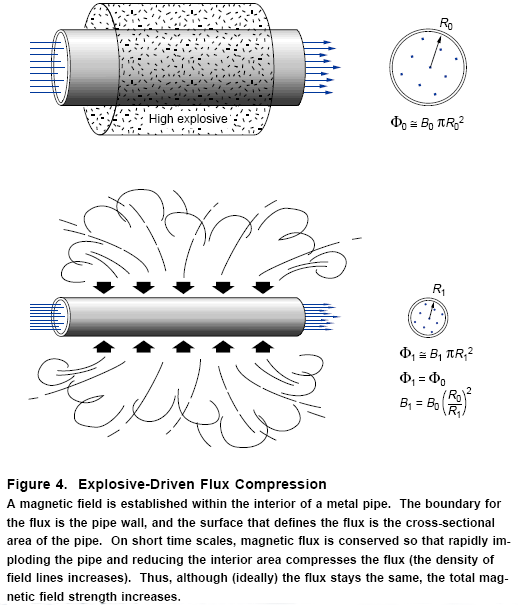
Moving on to the next figure, still taken from the Los Alamos report:
The same figure, with its comment in French:
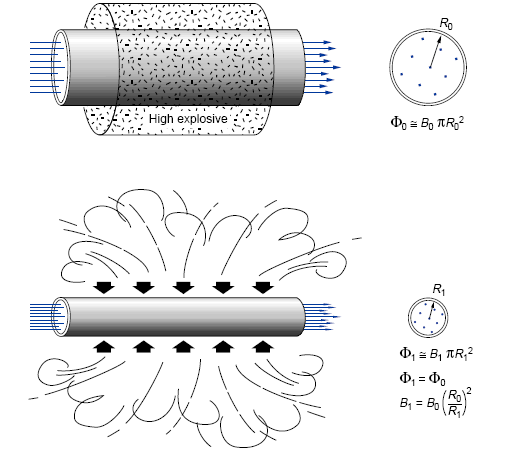
At the top, the device just after the firing of the explosive. The slit in the copper tube has disappeared. The magnetic field lines inside are represented by blue lines ( schematically ). Under the effect of the pressure developed by the explosion, the "liner" of copper begins its implosion movement, which, if the system maintains its initial symmetry, will bring it near the axis of the system. Keep in mind that all this happens in an unsteady state. At the moment the implosion begins, the magnetic field has a certain value, outside the copper, inside this liner, but it is zero ( or very weak ) in the copper, due to Lenz's law, which gave rise to induced currents that opposed any variation ( increase ) of the magnetic field within this copper material.
The slit has closed, which has led to a modification of the distribution of the electric current in this copper tube, the result being that the magnetic field within it is still zero or very weak.
It is known that when an electric conductor is moved in a magnetic field, eddy currents ( another consequence of Maxwell's equations ) appear within it. Here, the rapid implosion of the copper tube causes each parcel of the tube, moving at velocity V in the field B created by the solenoid ( not visible ), to be subjected to an electromotive field V B. Hence, a new current due not to the variation of B in time, but to the movement of the conductor "copper" in space. This current "induced by the movement" ( eddy current, which appears in the form of current loops circulating along the "generators" of this cylindrical liner ) will create a magnetic field. Inside the tube, this will result in an enhancement of the field.
The physics student will deduce all these aspects from Maxwell's equations. For the non-scientist, it will be sufficient to say that once again "everything seems to happen as if this surface made up of a highly conductive material ( copper ) behaves like an "impermeable" object with respect to the magnetic field. The field lines cannot pass through it and, as indicated in the figure above, "they will be compressed", which will correspond to a local enhancement of the field's intensity.
Once again, the student will easily restore the fact that "the magnetic flux is conserved"; that is, the product of the magnetic field intensity B by the area of the cross-section of the tube. Bo being the initial value of the magnetic field, for example 2.5 teslas, if the radius of the liner decreases by a factor of ten, the intensity of the magnetic field will be multiplied by 100, that is, the field, in this liner, will reach 250 teslas. The corresponding magnetic pressure, calculated using the formula given above, will then be 250,000 atmospheres inside the liner.
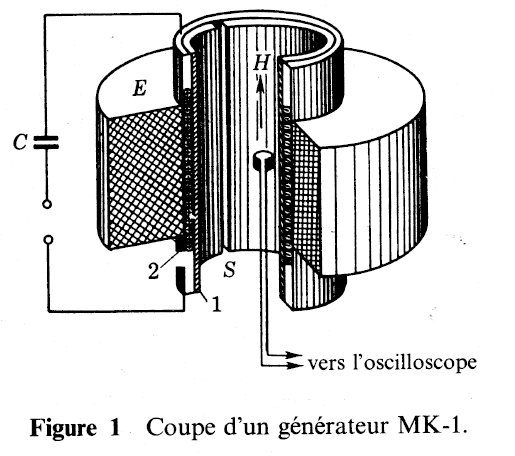
In 1951, Andrei Sakharov used a system called MK1 ( diagram below ). At the end of the implosion, the diameter of the liner was 4mm. The magnetic field then reached 2500 teslas, which corresponds to a magnetic pressure value of 25 million atmospheres. The intensity of the magnetic field was measured using a simple loop, located near the axis, with a diameter of 1.5 mm.
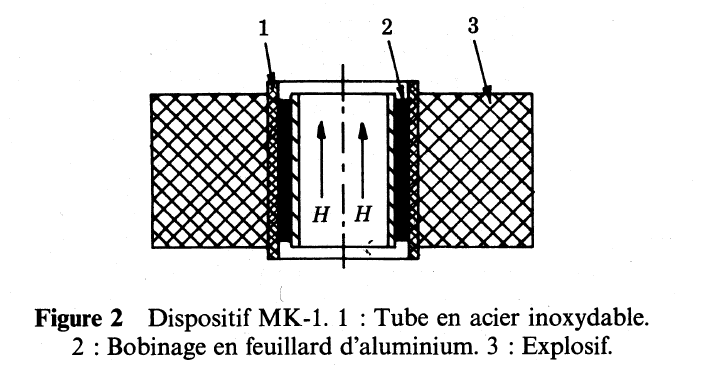
Below is a cross-section of the MK1 generator, showing both the slotted liner and the central coil, connected to an oscilloscope ( vacuum tubes ), measuring the intensity of the B field reached by recording the induced current ( in the coil ).
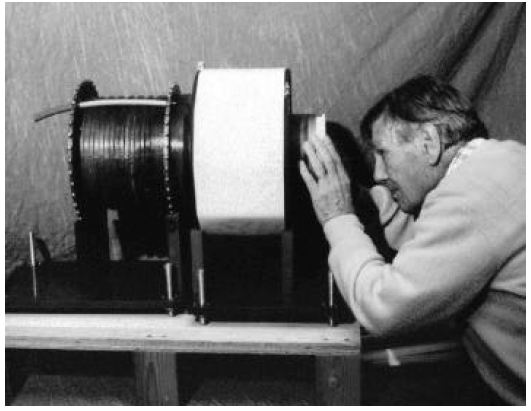
The American Fowler, from Los Alamos, inspecting an MK1 generator at Arzamas-16, Russia
In white: the explosive casing
It is hoped, through this simplest example, the MK1 generator ( flux compression ), that the reader, even non-scientific, has begun to become familiar with this fundamental concept of "liner" surface made up of a highly conductive material that behaves like "an impermeable wall" with respect to a rapidly varying magnetic field. The reader will intuitively understand that things can vary in both directions. In the MK1 setup, "the magnetic field is compressed by moving a liner using an explosive. The papers of Sakharov mention implosion speeds of the liner of 10 to 20 km/s. If the diameter of the liner was 20 cm, this would correspond to an implosion time of the order of a microsecond.
Revisiting the French document referring to the work of A. Sakharov and his colleagues, we will refer to the plasma cannon he invented, still in the early 1950s. Again, we will compress this "strange gas" that is the magnetic field by deforming a liner, always using an explosive. Through all these examples, we see that MHD is infinitely rich, allowing the imagination of researchers to exercise. Andrei Sakharov's imagination was legendary.
Before considering this strange "plasma cannon", we will consider a simple hunting rifle, firing lead pellets, or a simple bullet. Classically, the exit velocity is subsonic. Let's say 200 meters per second ( I am not a hunter. Those who are will eventually provide more accurate figures ). Imagine a man one day says:
*- With a cartridge consisting of a lead projectile and a charge of powder, I reach a velocity of 200 meters per second. Remove the lead or the bullets. I should then obtain an incomparably higher exit velocity. *
In reality, this is not what happens, for several reasons, not least because the expelled gas rapidly loses its speed by interacting with the ambient air. The bullet, on the other hand, maintains its compactness and penetration power. But even if our man had fired "blank" in the vacuum ( one could imagine that he is a "space hunter" making a sortie in space ), he would have been surprised to find that the speed gain would have been less than he had imagined, simply because the burned gases have their own inertia. Their mass is not zero.
Is it possible to use a propellant gas that, equipped with a pressure, has a ... zero mass? The question seems absurd, yet there is a positive answer, provided one considers the magnetic field ( even reigning in the vacuum ) as ... a gas with zero density. Beyond that, our "space hunter" would say, what gain if I could propel projectiles with this gas of zero mass! Thus all his energy would be transferred to the projectile.
Thus was born the idea of the plasma cannon, or "plasmoïdes", as a space weapon. The first time I heard about it was in the office of Gerold Yonas, in 1976, at Sandia. The term "star wars" had not yet been invented but it was already that.
Passionate about his work, Yonas was very talkative. The conversation was interrupted by one of his collaborators, present, who said:
*- Boss, stop talking like that. This guy understands too well what you're saying. He is not, as he claims, a journalist! *( sent to the USA at the time by Science et Vie ).
But let's go back to this first plasma cannon. Here is the diagram, extracted from the document available through the link given above.
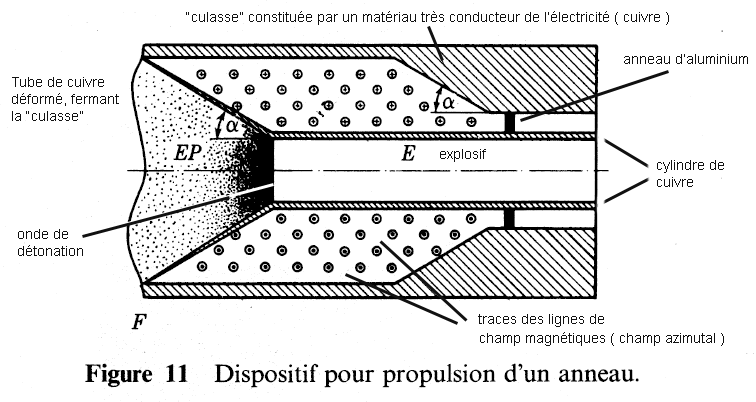
In large hatching: the breech, of revolution. It opens into a narrower tube, serving as a "barrel". Along the axis of the system, a "liner" of copper, a cylinder, filled with explosive. The explosive is ignited at the left end of the tube. The copper, ductile, then expands, taking the shape of a cone ( which Sakharov calls "the vase" ). This conical deformation propagates quickly, to the right ( at the detonation speed of the explosive )
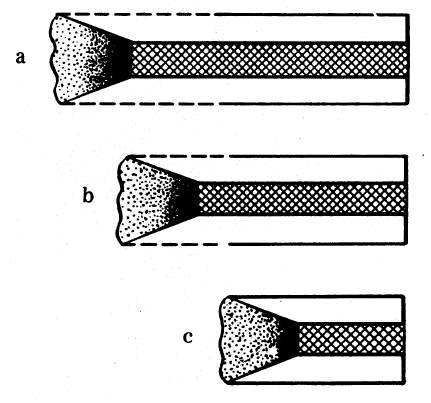
**Propagation of the conical deformation. In double hatching: the explosive contained in the copper liner. **
Before firing, a capacitor is discharged and the setup looks like this. A magnetic field is created in the "breech", with field lines as coaxial circles.
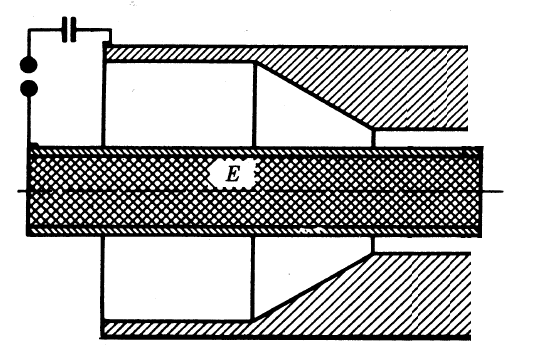
The liner deforms, begins to close the breech, thus trapping the magnetic field in a closed enclosure, whose volume decreases. As I told you, the magnetic field can be treated "like a gas". This one "trying to escape" has no other way out of the space between the "barrel" core, in copper, and the liner, this space being "blocked" by an aluminum ring ( also a good conductor of electricity ). With this type of cannon, Sakharov manages to communicate to a 2-gram ring a speed of 100 km/s, still in the 1950s.
As I said, one can do without reflecting on Maxwell's equations, the law of Lenz and all the hassle, by simply treating the magnetic field as a gas and the conductive elements as sets that are either a cylinder, a breech, or a piston or a projectile, but for those who want to have fun with this little game, everything can be treated in terms of induced currents. For example, the induced current appearing in the aluminum ring that both volatilizes it, propels it and, at the end of its course, after being ejected into the vacuum of space, ensures its self-confinement. One can then compare it to a "smoke ring".
The Russians, often unable to solve their problems with rubles, are forced to use their imagination. This is an illustration, but we will see later that their creativity, which amazed the Los Alamos researchers in 1995, is far from exhausted.
According to the few French specialists who have met these Russians, and up to a very recent date, it seems that I am for them "the man who, in the early 1980s, managed to annihilate the Velikhov instability in a 16-square-meter good room, with recovered equipment". This is entirely true. These works were later presented at the VIIIth International MHD Conference in Moscow, where I went at my own expense, feeding myself for a week, morning, noon and night, with pastries collected from a self-service breakfast at the National Hotel, unable to afford the cost of full board in this luxury hotel, imposed at the time by the Soviets on all visiting researchers in the country ( to bring in foreign currency ). After this last trick, I definitively gave up participating in such conferences. The last opportunity came in 1987 when the selection committee of the IXth International Conference in Tsukuba, Japan, accepted my article on the suppression of shock waves. I then submitted a formal request for funds to the CNRS, which granted me 4000F ( the simple round-trip ticket to Japan cost 7000 ). I remember my conversation with a secretary at the headquarters:
- So, Mr. Petit, for this conference in Japan, what do you decide? - Well, Miss, I found a used deriver for sale. I think I will equip myself with water jugs and cat food boxes. If I have a good wind, I should be able to arrive on time. For the return, I will ask the French embassy for a medical repatriation. - I beg your pardon? .....
As one always has to draw some benefit from an adventure, whatever it may be, the reader can find it in the form of a fiction:
This misadventure made me decide that it was useless to request a mission credit after the acceptance of the following paper at the MHD conference in Beijing.
If we except these few MHD military works, hiding their ideas behind the project of creating a powerful X-ray source, through experiments conducted at the Gramat center, all these researches were abandoned thirty years ago, the responsible being:
*- René Pellat, polytechnician, deceased. First director of research at CNRS, then president of CNES, he ended as high commissioner for atomic energy. Specialist in lasers, he was a fervent defender of the Megajoule project. Strongly opposed to the continuation of any research in MHD. - Gilbert Payan, polytechnician. Not a specialist in anything, he consistently advocated for his specialty. - Hubert Curien. Director of CNRS then of CNES, then Minister of Research and Industry. He managed the feat of climbing all the ranks of the hierarchy until his death without ever taking any decision of any importance. *
Back to these terrible Russians and their inexhaustible ideas.
Sakharov, using his "pyro-magnetic" chamber, invents a kind of "magnetic compressor":
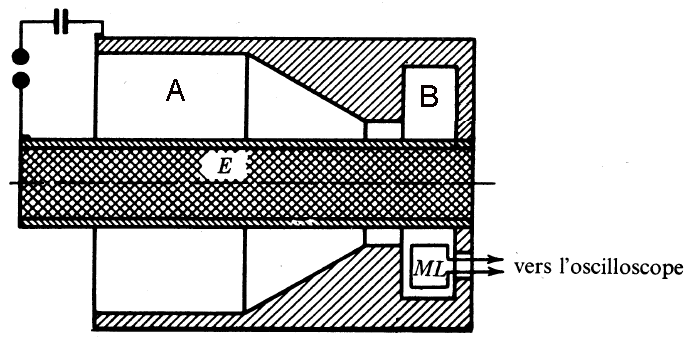
**Sakharov's magnetic compressor, before firing **
The capacitor first creates an azimuthal magnetic field in cavity A. The firing of the contents of the "liner" is always carried out at the left end. The liner expands, closing the chamber. The "magnetic gas" has no way to escape this time. It "invades" the only "available space B ( the conductive walls behave for it like impassable barriers ). The expansion of the liner, after pressing against the wall of cavity A, continues in volume B, causing the strengthening of the magnetic field.
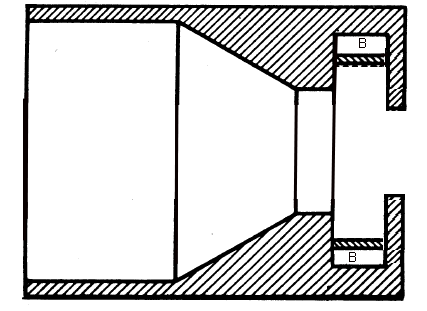
Sakharov's magnetic compressor, final phase
These diagrams lend themselves to infinite variations, some of which have been the subject of research initiated at Gramat, then alas left abandoned.
Still in the 1950s, Sakharov invents the helical generator. When he publishes these works in the West, nearly ten years later, he notices that no one in the West had this idea. In fact, the Russian policy is:
Tricks, always tricks, more tricks
To follow the American line, replace the word tricks with dollars.
When discharging the energy
1/2 C V2
stored in a capacitor into an inductance L, if the circuit resistance is low, this energy is converted into
1/2 L I 2
All high school students know the method called "crowbar" ( "pincer" in English ). You switch the capacitor and the inductor, connected in series, initiating a sequence of oscillating discharge of period LC. Then you short-circuit the inductor. It then plays the role of a current generator, according to an aperiodic discharge with a time constant L/R ( where R is the resistance of this circuit ).
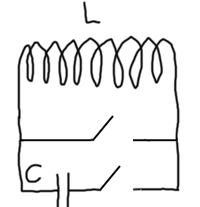
Crowbar setup. Initial configuration: the capacitor is charged
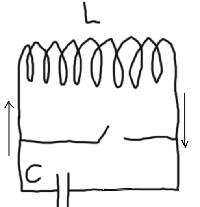
Crowbar setup. Commutation is the start of an oscillating damped discharge
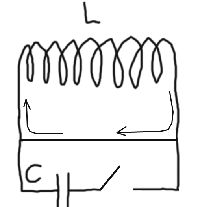
Crowbar setup. The capacitor is disconnected. The inductor discharges through the resistance of the assembly
Seeing this, Sakharov thought, "why not put a copper liner filled with explosive inside the solenoid. When it explodes, it will short-circuit the solenoid's turns one after another, making its inductance tend towards zero. He then imagined the following setup, called MK2 and tested as early as 1952.
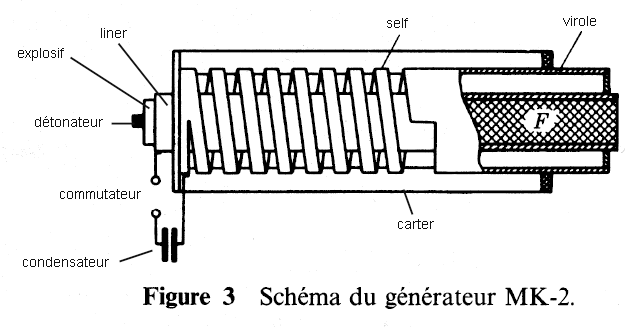
As can be seen, the solenoid is completed by a ring. When the expanding liner touches this ring, it traps the magnetic field in a closed chamber.
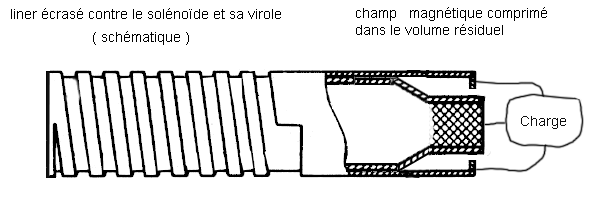
**At the end of operation, the MK2 generator's liner has short-circuited all the turns.
Crashing against the ring, it reduces the available volume for the magnetic field and it is then that the current directed towards the load is maximum. **
The helical generator is designed to be reusable.
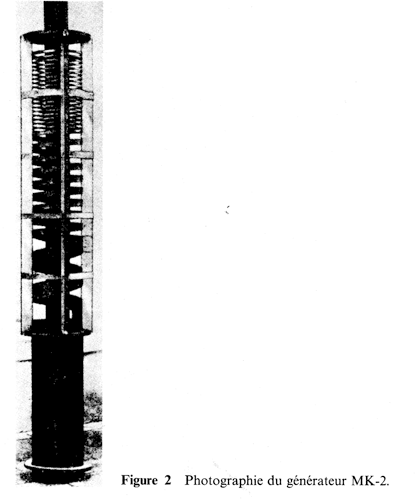
As can be seen, Sakharov introduced a variable-pitch solenoid. The performance of the device (length: one meter) is astonishing. In 1953, an MK2 loaded with 150 kilograms of explosive (10 megajoules) delivered currents of hundreds of millions of amperes and Sakharov noticed that such a system is much lighter, less bulky, and less expensive than a capacitor bank. However, this type of generator has a relatively slow current rise, linked to the development of the liner under the effect of the explosive. The characteristic time is on the order of 100 microseconds. But as Stephen Youngert, Max Fowel, and others point out in the synthesis paper signing the Russian-American collaboration "Megagauss", one can very well switch this generator when the current has reached its maximum. Below is the diagram taken from the report (where only the solenoid is shown, without its ring).
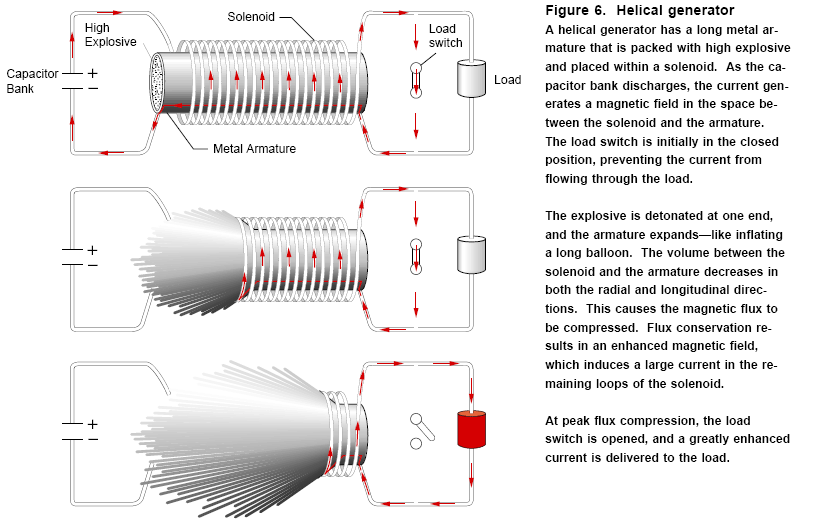
The same diagram, with a comment in French
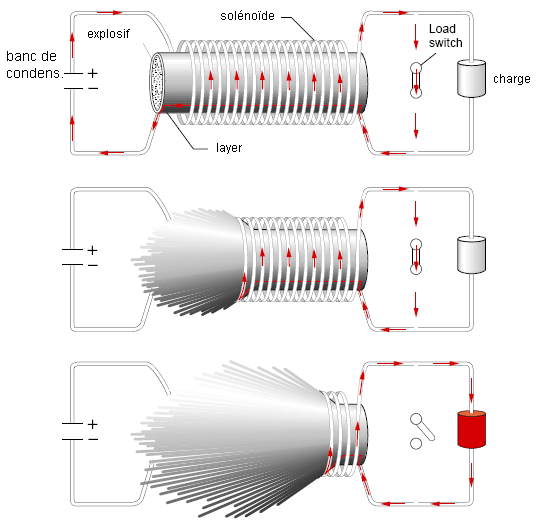
| In the report published by the Los Alamos laboratory
| this type of generator, similar to the one invented by Sakharov in 1952 and called "helical generator". The diagram is the same. It is only mentioned that the load is connected to the generator when the last turns are fully shorted |
|---|
A field of one megagauss (100 teslas) is associated with a pressure of 40.00 bars. Such a pressure easily deforms a flat conductor. As mentioned in the Los Alamos report, between 1 and 2 megagauss (for pressures between 40,000 and 160,000 bars), the surface of this conductor melts and vaporizes. Beyond 2 megagauss, this vaporization phenomenon occurs so quickly and violently that the surface of the conductor is sublimated (blasted off) and shock waves penetrate into the material.
A field of 10 megagauss exerts a pressure of 4 million atmospheres, four megabars. The pressure at the center of the Earth is only 3.7 megabars. According to the Los Alamos article, with flux compression systems such as those described at the beginning of this article and built by Fowler in the USA and Lyudaev in Russia, magnetic fields of the order of 1.5 megabars have been obtained. It should be noted that Sakharov claims fields of the order of 25 megagauss ( ? ..).
A generator can be designed differently depending on whether it is intended to obtain very high magnetic pressures or intense electric currents. The "helical" generator (as well as its "ancestor" the MK2 generator by Sakharov) are designed to deliver high intensities to a system located outside the area where the explosion takes place. These devices are then used as the "first stage" of a two-stage system. This configuration is found in Sakharov's text, accompanied by a very illustrative illustration where one sees how an MK2 generator ( "helical") is used as a current source for an MK1 flux compression system.

Sakharov's two-stage system where a current generator of the MK2 type powers the solenoid of an MK1 flux compression system, whose explosive charge is visible at the bottom and to the right
Compression of a liner
If one has a powerful electric current source, delivered for a very brief time, one can consider powering a liner to create an implosion. As mentioned above, the innovation of the Sandia people was to use a "cylindrical liner" divided into a sheet containing several hundred wires. Such a device has the effect of preserving the axisymmetry of the discharge for as long as possible. On the contrary, with a continuous liner, MHD instabilities occur. Axisymmetry is lost. In experiments, for example, reported in the Los Alamos report, 6 cm diameter liners converge towards a point offset by one centimeter from the geometric center of the initial system.
In the experiments conducted at Sandia, the wire sheet has a diameter of 8 cm (in the experiments that led to a temperature of 2 billion degrees) and the total current is 20 mega-ampères, delivered between 100 nanoseconds (a tenth of a microsecond). The student reader will easily find the following result:
**| The magnetic field prevailing at the surface of a cylindrical conductor is equal to that which would be produced if all the current were concentrated in a filamentary conductor arranged along the axis of the cylinder. |
|---|
In an axisymmetric implosion, the field therefore varies as 1/r since the field created by a linear conductor is: B = mo I / 2r
( I'm not very sure about the 2 in the denominator ).
Conceptually, one can very well build the differential equation describing the implosion by assuming that the wires remain distinct. These are therefore elements with constant mass, traversed by constant currents (in fact, the people from Sandia specify that 70% of the metal making up the wires manages to gather along the axis while 30% of the mass forms a kind of metallic vapor trail). Let M be the mass of the liner (n times the mass of each wire). The evolution equation is:
r r" + ( mo I / 2M) = 0
The profile of the implosion evolution has the following appearance (a reader will program this for us. With a current of 20 million amperes, I believe the total mass of the wire network must be in the hundreds of milligrams. Maybe 250, from memory (to be verified).
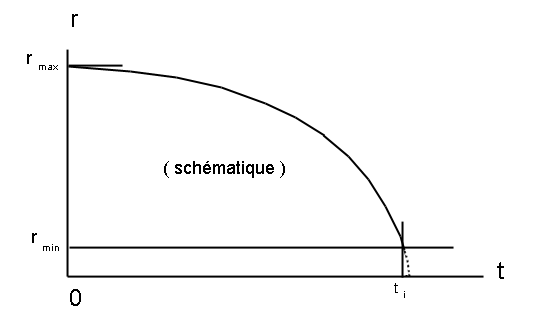
Schematic appearance of the implosion curve.
If nothing opposed the collapse of the material along the axis, the radius of the liner would tend towards zero in a finite time, while the impact speed would tend towards infinity. According to Sandia's data (observational), the entire set of wires turns into a plasma cord of 1.5 mm in diameter, if I remember correctly. Readers should be able to tell us the impact speed at the "stopping point". When 20 million amperes are applied, the stainless steel of the wires is transformed into plasma. The atoms that make up the wires are completely ionized. The nuclei acquire a thermal agitation velocity which is related to the absolute temperature of the plasma by the relation:
1/2 m < V2> = 3/2 k T
where m is the mass of a nucleus of iron and k = 1.38 10-23 the Boltzmann constant. Iron is the element number 20. The mass of the nucleus is therefore 26 multiplied by the mass of the proton which is 1.67 10-27 kilograms, which makes 4.34 10-26 kilograms. The impact speed is anyway higher than the initial radius, 4 cm, divided by the implosion time: 100 nanoseconds, which is 400 kilometers per second.
By applying the formula above and assuming that the impact speed is 400 kilometers per second and that this, by "thermalization", is entirely converted into thermal agitation velocity, we would obtain about 168 million degrees. However, as seen on the curve above, the impact speed increases in the last lengths. To reach two billion degrees, it would be sufficient for it to reach a value 3.45 times higher. But these are just rough calculations, schematic.
How many atoms are there in 250 mg of iron, which corresponds, from memory, to the weight of the Sandia wire liner. Answer: 5.76 1021
If I'm not mistaken in my calculations, when going from 40 mm to 0.75 mm, the Sandia wire liner sees its radius reduced by a factor of 53. The magnetic field in the stagnation conditions would then reach 1600 teslas (16 gigagauss), which corresponds to a pressure of 11.2 megabars.
The Los Alamos report contains a drawing of a liner system consisting of a 6 cm diameter aluminum cylinder and 2 cm high. The effect of the implosion is said to be enhanced by the fact that the two electrodes along which this liner, transformed into a plasma curtain, follows its course have a conical shape.
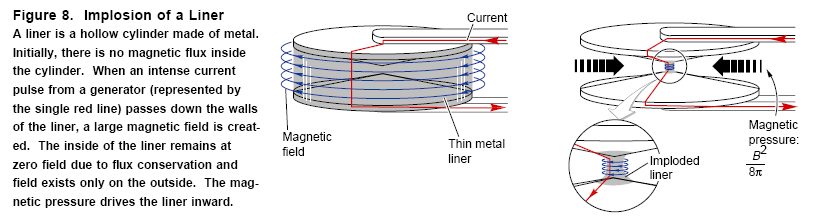
The current passes through the liner by following the generators of the cylinder (red lines). In the following part of the report, there is a description of a disk generator, developed by Chernyshev, which again testifies to the extraordinary ingenuity of the Russians.
As Yonas immediately pointed out to me in our first email exchanges, it is not enough to produce tens or even hundreds of millions of amperes, as is possible with generators of the MK2 type. It is also necessary that this "current" be delivered for an extremely brief time, less than a microsecond. The discharge time of the Sandia system is a tenth of a microsecond: 100 nanoseconds. However, the rise time for a Sakharov generator is high, linked to the speed of the detonation wave propagation. If it propagates at several kilometers per second and the generator is one meter long, we get rise times of several tens of microseconds. There is a minimum of two orders of magnitude missing. How to shorten this discharge time?
The idea came from Chernyshev, who outlined the general lines of his machine during the Megagauss III Congress, 1993. But it was not until 1989 that the Americans could see the beast up close and learn the details of its operation. Nothing of this kind had been imagined in the United States. Here is the drawing that appears in the Los Alamos report:
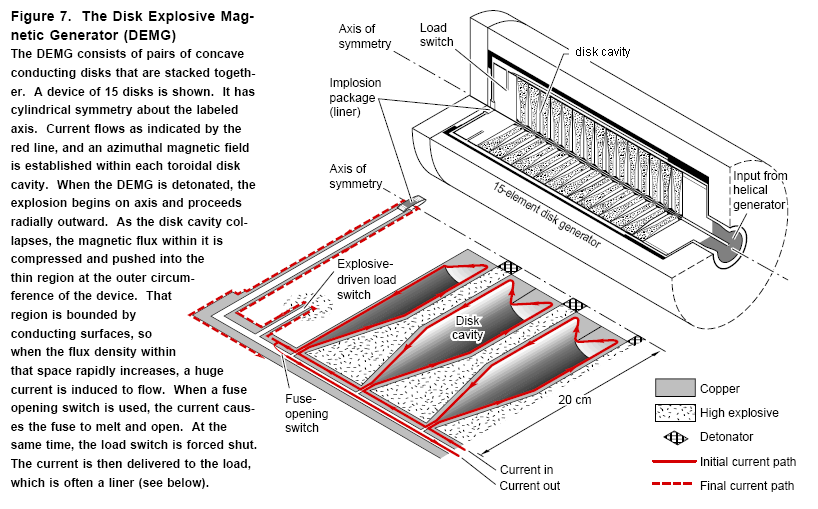
The same figure, accompanied by a comment in French:
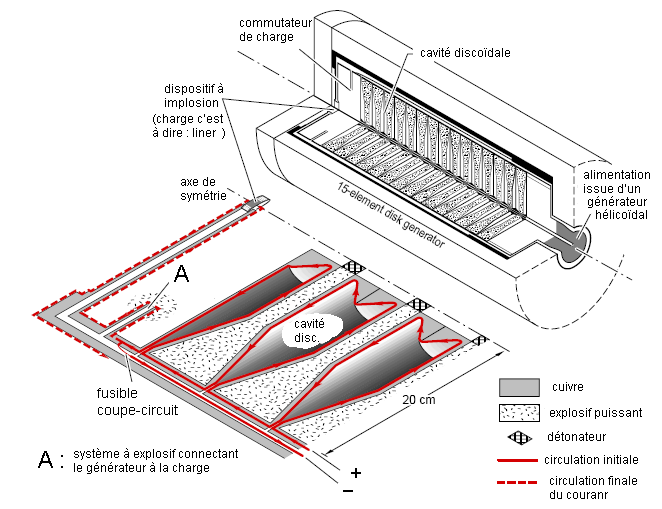
The DEMG (explosive disk generator) consists of an assembly of pairs of concave disks, the whole presenting a rotational symmetry. The current flows along the lines indicated in red. It is initially provided by a helical generator, not shown in this figure (delivering 6 giga-ampères). The establishment of this current leads to the appearance of a magnetic field that "fills" all the cavities located between these concave disk structures. When the system is fired, the detonators, located on the axis of the machine, trigger explosions that propagate radially, in a centrifugal manner. Near the axis, each disk-shaped unit has a "bulge". According to what I understand, the forces that laterally compress these disk-shaped elements propel these bulges radially, themselves disk-shaped, revolution. In my opinion, there must be a phenomenon similar to that of the hollow charge, which accelerates the filling of the cavity and shortens the "flux compression time". In such a system, the disks have a radius of 20 cm and, at a glance, a thickness five times smaller, i.e. 4 cm. If we assume similar detonation wave speeds, Chernyshev managed to shorten the time to fill these cavities, the flux compression time by a factor of 25.
The system is also equipped with a fuse that, when the current reaches its maximum value, vaporizes and delivers the current to the liner in less than a microsecond (when the current reached a critical value, the fuse melted. The high current was then delivered to the liner in less than a microsecond). The current sent into the liner was intended to reach 35 mega-ampères but an unexpected malfunction limited it) "only" 20 mega-ampères.
A more recent paper by Chernyshev: Megagauss X conference in 2004
Download the document in pdf (4 Mos)
February 2008: The two papers mentioning the operating principle of Chernyshev generators, linked in this page, having been erased remotely from my server, I have downloaded them again. For information, the impulse generators based on this principle are the key to future pure fusion bombs, a "potentially proliferating" technology
This article was presented at the tenth Megagauss conference. The previous one, Megagauss IX, dates from 2002. For information, Megagauss II was in 1979, Megagauss III in 1983.
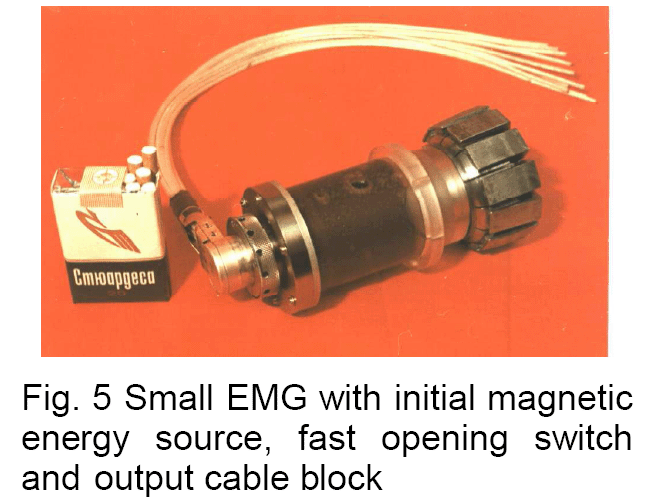
In this article, Chernyshev (who died in April 2005 at the age of 78) presents a miniaturized version of MK2 systems, smaller than a cigarette pack, which are then presented as high security and high synchronicity switches (range: 30 ns) for nuclear weapons.
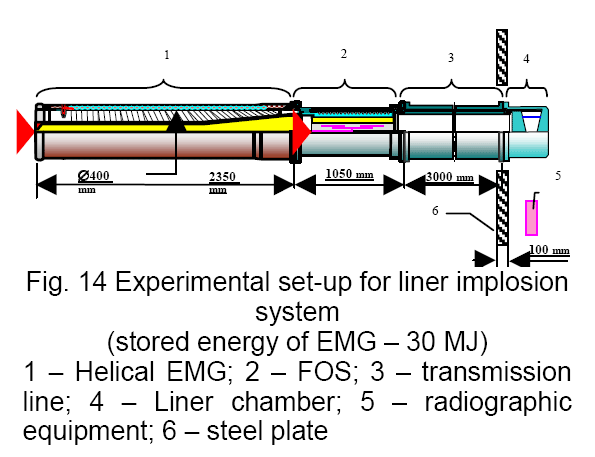
The article then mentions various collaborations. There are photos related to a Franco-Russian experiment, located in Novosibirsk. They are testing the capabilities of the most powerful helical generator, which develops 30 million amperes, of which 15 can be transmitted to the load, in this case a conical liner. It is known that a cylindrical liner tends to implode along its axis of symmetry. As in the hollow charge system, a conical liner will implode, giving rise to a spike. The paper mentions an implosion speed of the liner of 10 km/s, which rises to 40-50 km/s for the plasma spike, which, impacting on a target, produces a pressure of 10 megabars. Another application of these magnetocumulation techniques. What is interesting is the ruggedness of the setup:
The following photo shows a 100 megajoule electromagnetic generator on its test bench, outdoors:
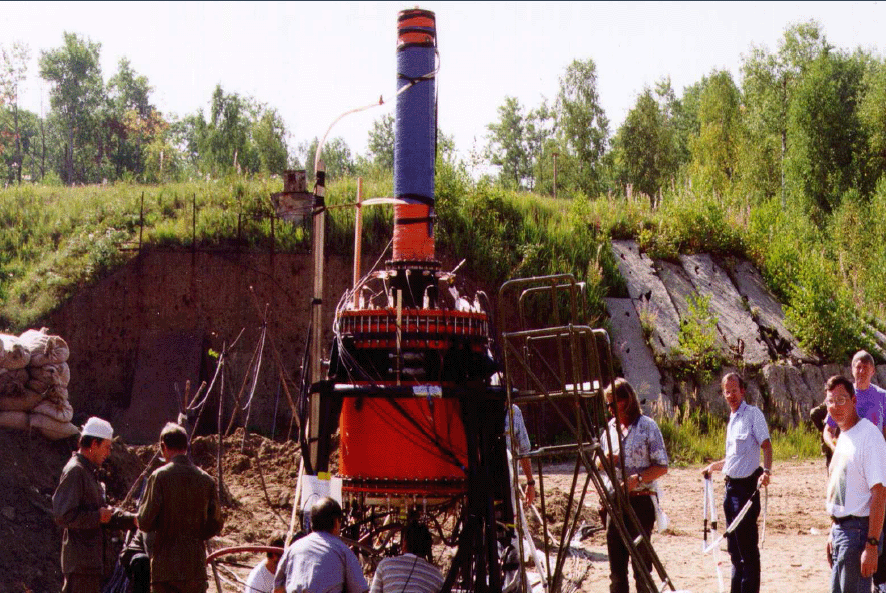
100 megajoule electromagnetic generator. Novosibirsk
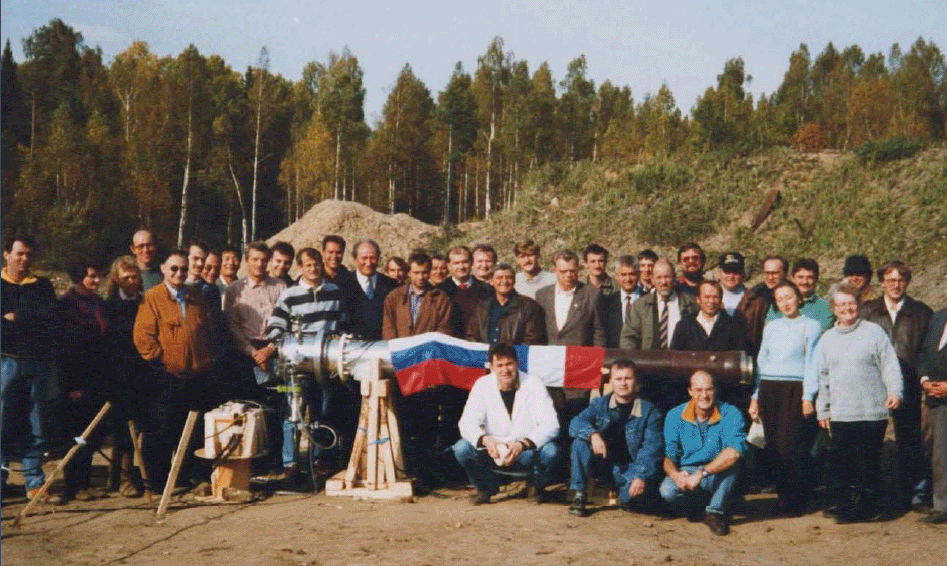
French-Russian team around an EMG (helical generator powering a conical liner, with a 50 km/s spike projection)
Next image, a disk generator, the most powerful one tried so far, on its test installation, near Novosibirsk, a Russian-American experiment.
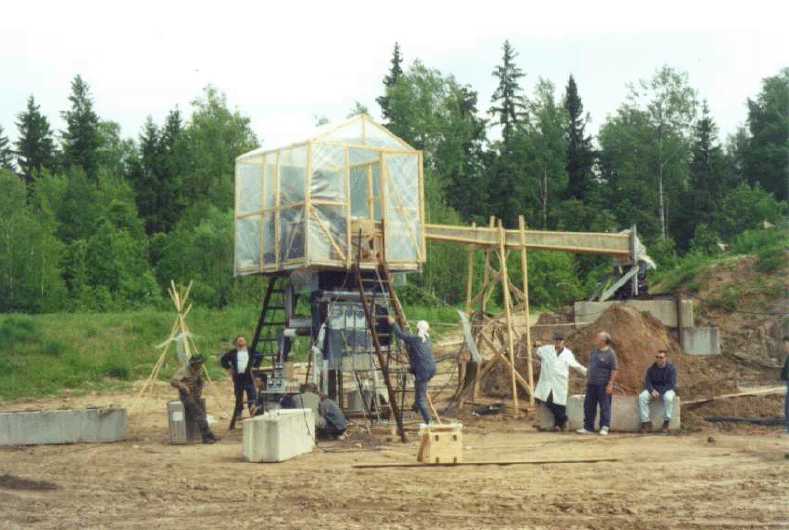
The most powerful disk generator that has functioned so far (35 million amperes). Russian-American experiment, Novosibirsk 2004
Those who fear a widespread dissemination of nuclear know-how based on the concept of impulsive fusion should meditate on these images.
**The MAGO device, the basic principles of a pure fusion neutron bomb? **
It is practically impossible to give an exhaustive presentation of this wide range of machines. But I would not be able to close this study without mentioning the Russian machine MAGO (MAGninoye Obshatiye, in English MTF, i.e. Magnetised Target Fusion or "Magnetised Target Fusion"). It is a plasma compressor that compresses a deuterium-tritium mixture. The general idea is to compress a "pre-magnetized" plasma. The first experiments date from 1994.
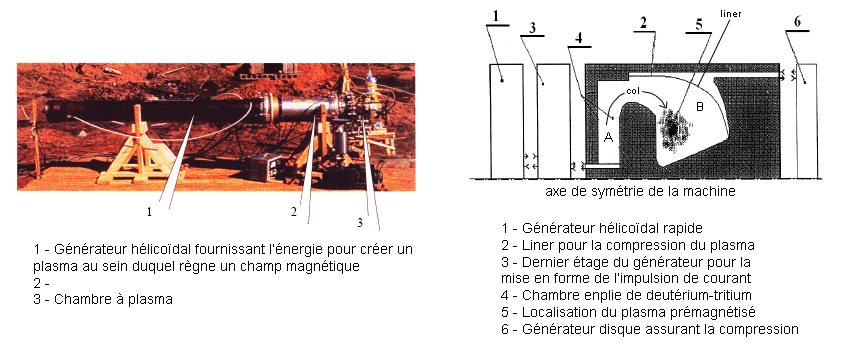
The MAGO plasma compressor
The general idea is to fill a chamber with a D-T mixture and then trigger a first discharge of 2 mega-ampères in chamber A, which sends the gas, turned into plasma, into chamber B, passing through an annular neck C. The ionized gas is traversed by the current that propelled it into this chamber B, which creates its own magnetic field. The ionized particles, deuterium and tritium nuclei and electrons, spiral along the lines of force of this field. They are "frozen in". The plasma-field coupling is intense. It is then that a second generator, located on the right, on disks, delivers a second discharge of 6-8 mega-ampères which acts on the liner, which compresses this "pre-magnetized plasma". This plasma heats up to temperatures of several hundred electron volts (several million degrees). The "lifetime" of this plasma reaches 2 microseconds. In a plasma, the electrical conductivity is essentially due to the electrons, which "transport the kinetic energy from one to another, by collisions". The fact that the plasma is immersed in a magnetic field (created by itself, in this case) reduces its thermal conductivity. It can then be compressed isentropically. When fusion reactions occur, they give rise to helium nuclei carrying a certain amount of energy, which cannot transmit this heat to the walls because the magnetic field hinders their progression (spiral trajectories).
Note (20 February 2008):
The MAGO system is a pure fusion device, where fusion is triggered by a chemical explosive. The maximum neutron emission can be obtained by designing the device accordingly. The reader can find the guiding principles of neutron bombs in Wikipedia France, for example, or in its English version. It refers to the claims made by Iraqi military personnel that American military forces may have used neutron bombs during the capture of Baghdad airport. And the text adds: "a common belief is that these bombs would only have radiation effects, but this is false, there are still the material damages inherent to the use of a kiloton (a tenth of Hiroshima). However, during the battle of Baghdad airport, no significant material damage was observed, which goes with the use of such a weapon. This is true if the neutron emitter is derived from a small hydrogen bomb, therefore centered around a fission device, plutonium. The conclusions would be different if this neutron bomb was "pure fusion", in which case there would be no mechanical damage. There remains a question "do pure fusion neutron bombs exist?"
Read the pdf by Suzanne L. Jones and Frank K. Hippel, from Princeton, dated 1998! Link
Conclusion of this study
We therefore have before our eyes a number of pieces of what seems to be a puzzle, which is both exciting and dangerous. It is not necessary to be a military engineer to understand that we have before our eyes the elements of a "pure fusion" bomb of unlimited power, both in high and low values. The ignition is based on the use of explosives. We have seen that in his mountains, Sakharov started with a field initially created by a capacitor bank. These devices can allow obtaining high intensities and creating intense fields. In my laboratory at the Institute of Fluid Mechanics in Marseille (now disappeared), I obtained in the 1960s a field of 2 teslas (20,000 Gauss) created by a current of 54,000 amperes, itself delivered by a capacitor bank of a total volume of about one cubic meter and a weight of about one ton. The use of capacitors is not very suitable from the "bomb" perspective. Moreover, capacitors do not remain charged forever. They always have a "leakage current" and discharge naturally in a relatively short time. But as Sakharov pointed out in his papers from the 1950s (whose content was known in the West only in 1961), all these generators can be installed in cascade, each stage being the current source of the next stage. Thus, he noted, the initial stage could depend on a simple ... permanent magnet.
The fusion bomb whose detonator is a magneto-cumulative system and which draws its initial energy only from a solid explosive is a perfectly valid project, linked to a relatively rugged technology and a relatively moderate cost. Now that all military laboratories know this, there is no reason to try to hide this evidence.
At the time I was writing these lines, the news of the decision made by the American Congress, made public on June 15, to suddenly replace the 6000 nuclear warheads in the American arsenal, that is, all nuclear warheads, with "a new weapon" corresponding to this type of device, free of any fissile material, above all plutonium 239, used as a detonator. The classic "old" bombs age in the sense that this plutonium, which must be of very high purity, naturally decomposes in 40-60 years. The "old" bombs are therefore no longer as "safe" as the recent ones, given the degradation of the plutonium they contain. In contrast, these new devices do not age, in the sense that all their components can be continuously replaced. A 100% maintenance is possible, including for an explosive such as lithium hydride, which is not toxic in itself. Let's say that a bomb of this type could be dismantled and "sold to the flea market" without any particular problems, its components being no more toxic than those of a computer motherboard.
The "pure" fusion bomb is obtained by assembling the "puzzle pieces" presented in this file. A "pyrotechnic chain" consisting of a series of magneto-cumulative generators produces increasingly higher intensities and magnetic fields, the starting element being based on permanent magnets (commercial elements already reach 2 teslas and defense-sealed components must exist, allowing even higher values). The problem of delivering an electrical power (several tens of mega-ampères) in a fraction of a microsecond has been solved through the disk generator described above. Other, even more performant, setups can be considered, some of which have been imagined by the French. This current is sent to a "wire liner," this technology constituting the innovation of the Sandia laboratory which led to achieving implosions with good axisymmetry, immediately causing this spectacular temperature rise to 2 billion degrees (which probably does not constitute a limit, by the way). It is then sufficient to have a lithium hydride target at the center of the system, which would have the appearance and size of a sewing needle or a matchstick to complete this detonator. This charge is simply physically connected to a larger charge, of unlimited volume.
The strongest nuclear charge fired corresponds to a Soviet device of 24 tonnes, 8 meters long and 2 meters wide, called "Tsar Bomba," designed and built by Andrei Sakharov in four months, at the request of Nikita Khrushchev at the Arzamas-16 center (which Sakharov, without his memoirs, refers to by its code name "the installation"). Here is this device, dropped on October 31, 1961 from a four-engine "Bear" bomber, modified (with turbopropellers), from an altitude of 10,000 meters.
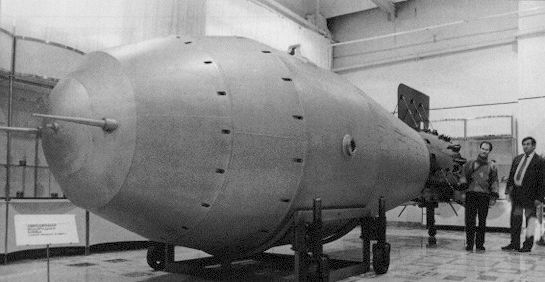
The "Tsar Bomba" Russian. The strongest bomb tested by the Russians, with a power of 60 megatons.
Length: 8 meters. Diameter: 2 meters. Weight: 24 tonnes. At the back, the parachute compartment
This bomb was detonated at an altitude of 4000 meters, after a slow descent attached to a parachute, which allowed the aircraft, the Tu 95 and the accompanying Tu 16 "Bear" to move away.
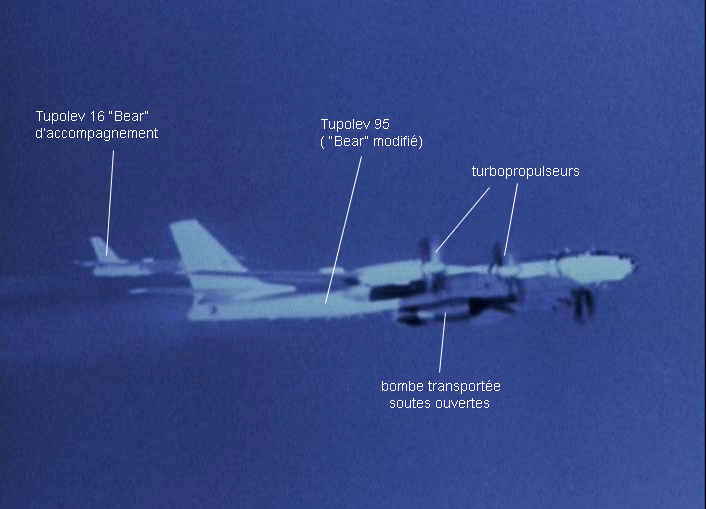
The Tsar Bomba attached under the belly of a modified four-engine Bear, flying at 10,000 meters
The "Bear" and its derivatives were the Soviet equivalent of the B-52. Instead of being, like the latter, propelled by turbojets, it was equipped with four turbopropellers driving contra-rotating variable-pitch propellers, a true aerodynamic and engineering marvel.
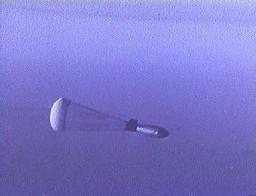
The Tsar Bomba after dropping
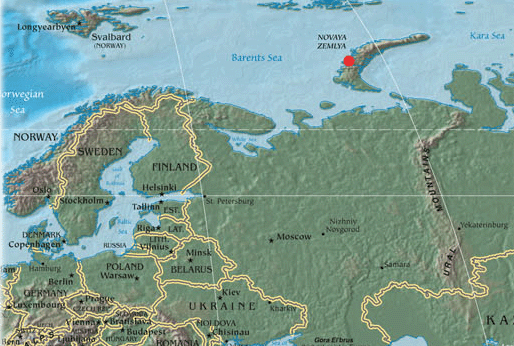
In red, the drop point
The device was dropped on the west coast of the island of Novaya Zemlya, entirely devoted to Russian nuclear tests, in the north of the country. The flash was visible at a distance of 1000 km. The mushroom cloud, 30 to 40 kilometers in diameter, reached an altitude of 64 kilometers (atmospheric thickness: 80 km). The shock wave generated by the explosion made three times the Earth and broke windows in Finland (...). Wooden buildings were pulverized at hundreds of kilometers. Despite the fact that the detonation was carried out at 4000 meters altitude, the ground was completely vitrified at the site of the explosion. It is estimated that this bomb would have been capable of causing third-degree burns to people living within a radius of 100 kilometers. In short, at full power, it would have been perfectly capable of destroying all human life in a quarter of a country like France.
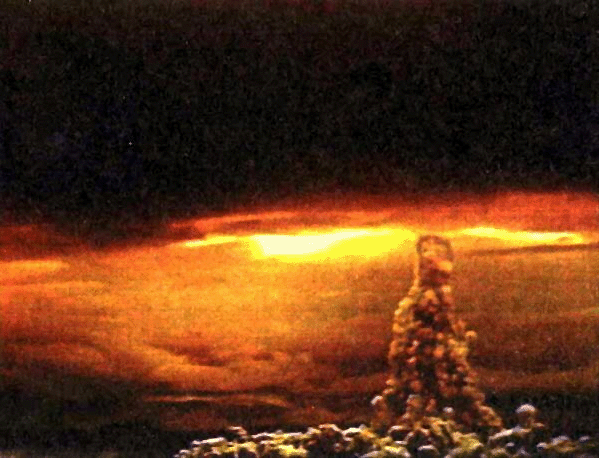
The explosion of the Russian Tsar Bomb. Fireball diameter: 7 km
The mushroom, 30 to 40 km in diameter, rose to 64 km altitude
This bomb was of the "F F F" type (three "stages": fission - fusion - fission), that is, where a fission-fusion assembly constituting a classic "H" bomb was surrounded by a shell of "depleted" uranium U 238. By capturing the neutrons emitted, this U238 was transformed into plutonium Pu 239 which fissioned in turn, doubling the power of this H bomb and dispersing extremely toxic pollutants. If in this test this uranium shell had not been replaced by lead, it would have developed 100 megatons (3500 times Hiroshima) and would have dispersed radioactive fallout equivalent to 24% of what had been spread since the first explosion of Hiroshima.
It was "doubled" by a practically identical device, shortly after, which Sakharov recounts in his memoirs, built in a secret center of which he himself was unaware. It was as a result of this observation that the future Soviet Nobel Peace Prize winner decided to abandon all military research and turn towards research reoriented towards cosmology (twin universes, 1960s). Sakharov, in his memoirs, says that he roughly calculated the number of cancers these bombs alone could cause, concluding that if he had worked so far to defend his country, he now refused to collaborate with an enterprise that would ultimately mean the destruction of all life on Earth.
The Americans, on their part, were not behind. As early as March 1954, the thermonuclear explosion of Bikini corresponded to a power of 15 megatons, that is a quarter of the power of the Russian Tsar Bomb.

| March 26, 1954: The sinister explosion "Castle Romero"
| (atoll of Bikini) whose mushroom rises quickly into the upper atmosphere. Fifteen megatons. The fireball measured 6 km in diameter. The cloud rose to 160 km in altitude (double the Earth's atmospheric layer). 80 million tons of earth and coral were vaporized. At 50 km away, the personnel received a radiation dose equivalent to 100 X-rays. |
|---|
The following photo, not faked as some had imagined, shows how the Americans tested "the resistance of human material" during nuclear tests in the open.
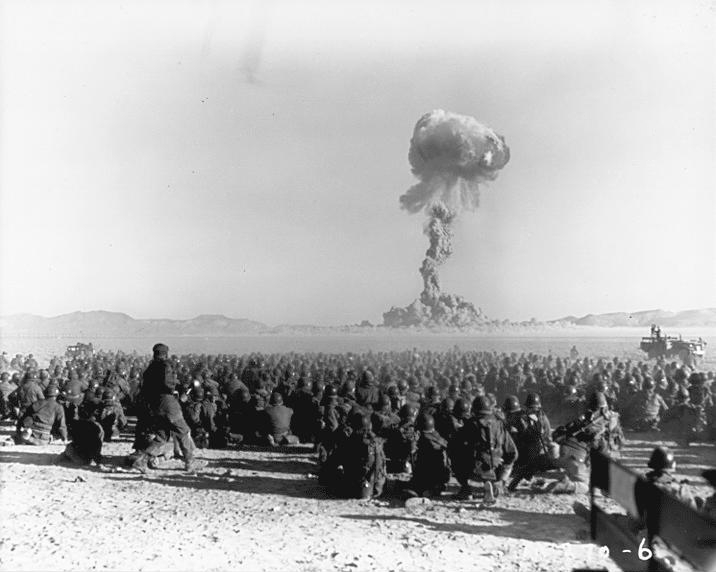
Buster Dog explosion, Nevada desert, 1951
The aftermath of such outdoor experiments resulted in an incalculable number of cancers and leukemias that emerged years later, for which the victims could not obtain any compensation, facing the deafness of the American administration. For those who still have some illusions about ethical standards in the transatlantic world, it should be known that Oppenheimer, at the time, and this could be historically established, signed an authorization for injecting plutonium doses into young recruits, to evaluate the effects produced.
This first presentation showed us the extraordinary richness of MHD, with, in the end, its exo-energetic applications, mainly military. The formulas and new ideas to discover are countless, provided one knows how to ask the right questions. The Russian setups are simple and logical. For example, with the disk generator, the distance was simply reduced so that the walls (resembling the bellows of an accordion) would come into contact with each other, "compressing the magnetic field gas." This shortens the implosion time of the cavities containing "magnetic energy." One should keep in mind that pressure is nothing more than an energy density per unit of volume. It should also be noted that the device's power can be increased by increasing the number of disks.
What should be done at this point? Obviously, reestablish a proper MHD activity. This should have the dimension and character of a planetary project and be managed by a worthy international organization. - Be conducted in a climate of total transparency. The stakes are too important to be concerned with "details" like national security or patent exploitation.
A pious wish of an incorrigible idealist, no doubt.
Everyone should get involved by sharing know-how, ideas, and results. Only in this way could things move very quickly. Of course, one should not imagine that military laboratories have been inactive. A fierce competition has immediately arisen between Livermore and Los Alamos, which is already being echoed by the Internet. Researchers "are working day and night to design new nuclear weapons, which are safer."
Well, of course...
But how to "civilize" this effort? It would be unrealistic to imagine that the result of Sandia remained a dead letter, despite the obvious media silence.
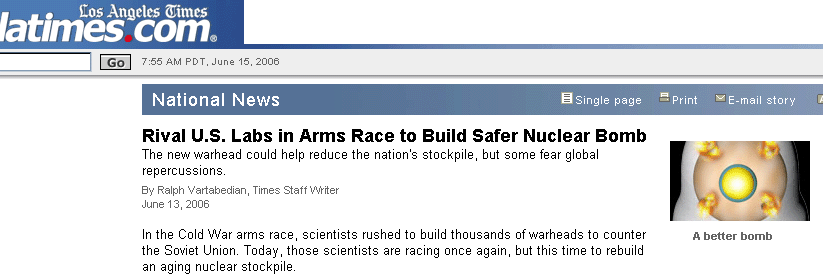
See this article from the Los Angeles Times:
**


Los Angeles Times announcement, June 15, 2006 at 7:55:
Rival U.S. Labs in Arms Race to Build Safer Nuclear Bomb
Rival US laboratories are in a race to build safer nuclear bombs
(...)
The new warhead could help reduce the nation's stockpile, but some fear global repercussions. By Ralph Vartabedian, Times Staff Writer June 13, 2006
New nuclear warheads could reduce the nation's stockpile, but some fear global repercussions. By Ralph Vartabedian, Times Staff Writer.
During the Cold War arms race, scientists rushed to build thousands of warheads to counter the Soviet Union. Today, those scientists are racing once again, but this time to rebuild an aging nuclear stockpile.
During the Cold War, scientists rushed to produce thousands of nuclear warheads to counter the Soviet Union. These same scientists are now in a race, but this time to replace aging nuclear warheads.
( this sentence suggests that this race is also at work in Russia due to the prevailing global paranoia )
Scientists at Los Alamos National Laboratory in New Mexico are locked in an intense competition with rivals at Lawrence Livermore National Laboratory in the Bay Area to design the nation's first new nuclear bomb in two decades.
Scientists at the two rival laboratories, Los Alamos in New Mexico and Livermore in California, are engaged in a fierce competition to be the first to design the nation's new nuclear bomb in two decades.
The new weapon, under development for about a year, is designed to ensure long-term reliability of the nation's inventory of bombs. Program backers say that with greater confidence in the quality of its weapons, the nation could draw down its stockpile, estimated at about 6,000 warheads.
The new weapon, under development for about a year
( just after the breakthrough at Sandia on the Z-machine )
is designed to ensure long-term technological superiority in nuclear weapons for the nation. Program managers say that with more reliable weapons, the country could reduce its stockpile, estimated at 6,000 warheads
( the reliability argument is invoked to justify a complete change in weapon type and the transition to "pure fusion" bombs ).
Scientists also intend for the new weapons to be less vulnerable to accidental detonation and to be so secure that any stolen or lost weapon would be unusable.
Scientists intend for these new weapons to not detonate accidentally
( ...)
and to be so secure that any lost
( ...)
or stolen
( ...)
weapon would be unusable
( here, we are really being taken for fools ... )
By law, the new weapons would pack the same explosive power as existing warheads and be suitable only for the same kinds of military targets as those of the weapons they replace. Unlike past proposals for new atomic weapons, the project has captured bipartisan support in Congress.
The idea is that these new weapons could have the same destructive power as the current stock and could only be used for the same types of military targets as those of the existing weapons
( this sentence is intended to counter any invocation of treaties concerning the possession and use of nuclear weapons ).
In contrast to previous proposals, this one has attracted many supporters in Congress
( well, of course. "Pure fusion" weapons, non-polluting, with no minimum limit, that we could finally use! But anyway, the "big news" is known to all. The emergence of these "new weapons" has become inevitable and will be accompanied by an uncontrollable proliferation )
But some veterans of nuclear arms development are strongly opposed, contending that building new weapons could trigger another arms race with Russia and China, as well as undermine arguments to stop nuclear developments in Iran, North Korea and elsewhere.
But some veterans of nuclear arms development are strongly opposed to this project, arguing that this endeavor could reignite the competition with countries like Russia and China, while undermining arguments to stop nuclear developments in Iran, North Korea and elsewhere
( it's worse than that. Russia and China are already in the race, following the publication of this result in February 2006, and perhaps even earlier, thanks to their espionage networks. When it comes to "other countries," they will be able to have a field day since it is no longer necessary, to acquire thermonuclear weapons, also known as "H-bombs," to go through the uranium enrichment process. Anyone who has read my articles of the last few weeks can easily be convinced of this. ).
And, the critics say, It would eventually increase pressure to resume underground nuclear testing, which the U.S. halted 14 years ago.
The critics add that this would create pressure to resume underground nuclear testing, which the United States halted 14 years ago
( that's a big lie. These tests have never stopped. But techniques of attenuation have allowed to reduce their seismic signature to magnitude 3 and below, making it indistinguishable from those generated by mining operations. Even the French have understood the trick since the early 1990s, which allowed to stop the tests at Mururoa while continuing them quietly ... in the hexagon ).
Inside the labs, however, emotions and enthusiasm for the new designs are running high.
However, within the laboratories, emotions and enthusiasm for these new bomb designs are at their peak
(...).
"I have had people working nights and weekends," said Joseph Martz, head of the Los Alamos design team. "I have to tell them to go home. I can't keep them out of the office. This is a chance to exercise skills that we have not had a chance to use for 20 years."
"I've had people working nights and weekends," said Joseph Martz, head of the Los Alamos design team. "I have to tell them to go home. I can't keep them out of the office. This is a chance to exercise skills that we have not had a chance to use for 20 years."
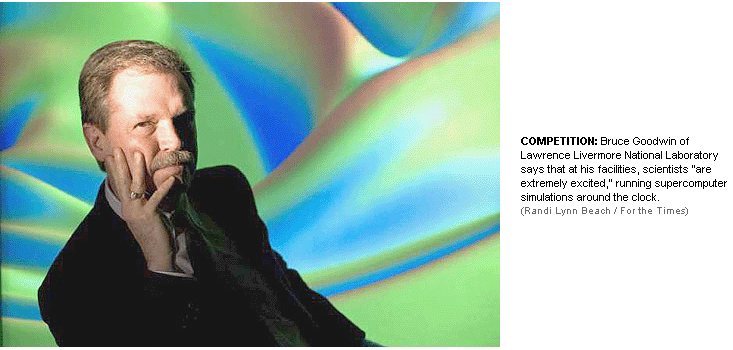
A thousand miles away at Livermore, Bruce Goodwin, associate director for nuclear weapons, described a similar picture: The lab is running supercomputer simulations around the clock, and teams of scientific experts working on all phases of the project "are extremely excited."
A thousand miles away at Livermore, Bruce Goodwin, associate director for nuclear weapons, described a similar picture: The lab is running supercomputer simulations around the clock, and teams of scientific experts working on all phases of the project "are extremely excited."
The program to build the new bomb, known as the "reliable replacement warhead," was approved by Congress in 2005 as part of a defense spending bill. The design work is being supervised by the National Nuclear Security Administration, which is part of the Energy Department.
The program to build the new bomb, known as the "reliable replacement warhead," was approved by Congress in 2005
( after the breakthrough at Sandia ),
and included in the defense spending bill.
( the "pure fusion" bombs are "more convenient to use" because, in contrast to conventional H-bombs
there is no lower limit of power
. In addition, their use
as neutron bombs
, which kill humans but preserve the equipment, is evident. Those who tell me "not to draw people's attention to these destructive applications" are completely out of their minds. The people at Livermore and Los Alamos, as well as the members of Congress, did not take long to react. If the Sandia statement and the paper published by Haines had not been a major blunder, the cover of the defense confidentiality would have immediately fallen on the published result and the disinformation would have completed the work ).
The laboratories submitted detailed design proposals in March that ran more than 1,000 pages each to the Nuclear Weapons Council, the secretive federal panel that oversees the nation's nuclear weapons. A winner will be declared this year.
The laboratories submitted detailed design proposals in March that ran more than 1,000 pages each to the Nuclear Weapons Council, the secretive federal panel that oversees the nation's nuclear weapons. A winner will be declared this year.
If the program is implemented, it would require an expensive remobilization of the nation's nuclear weapons complex, creating a capacity to turn out bombs at the rate of three or more a week.
If the program is implemented, it would require an expensive remobilization of the nation's nuclear weapons complex, creating a capacity to turn out bombs at the rate of three or more a week.
Proponents of the project foresee a time when nuclear deterrence will increasingly rest on the nation's capacity to build new bombs, rather than on maintaining a massive stockpile.
Proponents of the project foresee a time when nuclear deterrence will increasingly rest on the nation's capacity to build new bombs, rather than on maintaining a massive stockpile.
( of course. The megatonne, monstrous bombs are impossible to use. However, these authentic "mini-nukes," of such low power that they do not generate a nuclear winter effect or radioactive fallout on the attacker, will constitute an increased effectiveness "deterrent system." Add that these new "pure fusion" bombs are wonderfully clean, non-polluting. "kill me cleanely." They can even be used, in a preventive way, of course, against adversaries with evident bad intentions ).
The proposal comes as Russia and the United States have agreed to further reduce nuclear stockpiles. The Moscow Treaty signed in 2002 by President Bush and Russian President Vladimir V. Putin calls for each country to cut inventories to between 1,700 and 2,200 warheads by 2012.
The proposal comes as Russia and the United States have agreed to further reduce nuclear stockpiles. The Moscow Treaty signed in 2002 by President Bush and Russian President Vladimir V. Putin calls for each country to cut inventories to between 1,700 and 2,200 warheads by 2012.
Without the reliable replacement warhead, U.S. scientists say the nation will end up with old and potentially unreliable bombs within the next 15 years, allowing adversaries to challenge U.S. supremacy and erode the nation's so-called strategic deterrent.
Without the reliable replacement warhead, U.S. scientists say the nation will end up with old and potentially unreliable bombs within the next 15 years, allowing adversaries to challenge U.S. supremacy and erode the nation's so-called strategic deterrent.
The new bomb "is one way of ensuring that our capability is second to none," said Paul Hommert, a physicist who heads X Division, the Los Alamos unit that built the first atomic bomb during World War II. "Not only today, but in 2025."
The new bomb "is one way of ensuring that our capability is second to none," said Paul Hommert, a physicist who heads X Division, the Los Alamos unit that built the first atomic bomb during World War II. "Not only today, but in 2025."
But critics say the program could plant the seeds of a new arms race.
But critics say the program could plant the seeds of a new arms race.
It's already done ......
The existing stockpile will be safe and reliable for decades to come, according to defense experts and nuclear scientists who have long supported strategic weapons. They say that rather than making the nation safer, the program will squander resources, broadcast the message that arms control is dead and even undermine the reliability of U.S. weapons.
According to these experts, who have long been supporters of strategic weapons, the existing stockpile will be safe and reliable for decades to come. They say that rather than making the nation safer, the program will waste resources, broadcast the message that arms control is dead, and even undermine the reliability of U.S. weapons.
The discovery of Sandia and the prospect of creating thermonuclear "pure fusion" weapons, which are much more "convenient" (reliable), has immediately triggered a new arms race. The effect is inevitable, each one saying "if I don't do it, the other will."
The new bomb would have to be built and deployed without testing. The U.S. last conducted an underground test in Nevada in 1992 and has since imposed a moratorium on new testing.
The new bomb would have to be built and deployed without testing. The U.S. last conducted an underground test in Nevada in 1992 and has since imposed a moratorium on new testing.
But without a single test, doubts about the new bomb's reliability would eventually grow, said Sidney Drell, former director of Stanford University's Linear Accelerator Center and a longtime advisor to the Energy Department.
But without a single test, doubts about the new bomb's reliability would eventually grow, said Sidney Drell, former director of Stanford University's Linear Accelerator Center and a longtime advisor to the Energy Department.
"If anybody thinks we are going to be designing new warheads and not doing testing, I don't know what they are smoking," Drell said. "I don't know of a general, an admiral, a president or anybody in responsibility who would take an untested new weapon that is different from the ones in our stockpile and rely on it without resuming testing."
"If anybody thinks we are going to be designing new warheads and not doing testing, I don't know what they are smoking," Drell said. "I don't know of a general, an admiral, a president or anybody in responsibility who would take an untested new weapon that is different from the ones in our stockpile and rely on it without resuming testing."
If the U.S. breaks the moratorium on testing, then Russia, China, India and Pakistan, if not Britain and France, probably would conduct tests as well, said Philip Coyle, former assistant secretary of Defense and former deputy director of Livermore. Those countries would gain more information from testing than would the U.S., which has invested heavily in scientific research as an alternative to testing.
If the U.S. breaks the moratorium on testing, then Russia, China, India and Pakistan, if not Britain and France, probably would conduct tests as well, said Philip Coyle, former assistant secretary of Defense and former deputy director of Livermore. Those countries would gain more information from testing than would the U.S., which has invested heavily in scientific research as an alternative to testing.
( we find the theme of Mégajoule, the French alternative to the development of nuclear weapons )
Physicist Richard Garwin, who helped design the first hydrogen bomb in the early 1950s and remains a leading authority on nuclear weapons, opposes the new bomb and is worried it would lead to new testing. "We don't need it," he said. "No science will be able to keep these political doubts away."
Physicist Richard Garwin, who helped design the first hydrogen bomb in the early 1950s and remains a leading authority on nuclear weapons, opposes the new bomb and is worried it would lead to new testing. "We don't need it," he said. "No science will be able to keep these political doubts away."
Linton F. Brooks, chief of the National Nuclear Security Administration, disagrees, saying warheads based on modern technology and advanced electronics would be more reliable
Linton F. Brooks, chief of the National Nuclear Security Administration, disagrees, saying warheads based on modern technology and advanced electronics would be more reliable.
"We are more likely to face a problem if we stick with the existing stockpile," Brooks said. "It is easy to overstate the degree to which the current stockpile [has been] tested."
"We are more likely to face a problem if we stick with the existing stockpile," Brooks said. "It is easy to overstate the degree to which the current stockpile [has been] tested."
The stockpile includes thousands of weapons held in reserve in case a defect is discovered. Each year, some of those weapons are disassembled for inspection. The U.S. could significantly reduce the reserve if it had greater confidence in the reliability of its warheads, Brooks said.
The stockpile includes thousands of weapons held in reserve in case a defect is discovered. Each year, some of those weapons are disassembled for inspection. The U.S. could significantly reduce the reserve if it had greater confidence in the reliability of its warheads, Brooks said.
That confidence involves not only whether a weapon will explode, but whether it will do so with the intended force. In every U.S. nuclear weapon, a primary blast must be strong enough to trigger a secondary thermonuclear reaction. If the first stage falls short, the weapon has half the power.
That confidence involves not only whether a weapon will explode, but whether it will do so with the intended force. In every U.S. nuclear weapon, a primary blast must be strong enough to trigger a secondary thermonuclear reaction. If the first stage falls short, the weapon has half the power.
The driving force for developing the new weapon has come from the scientific community and members of Congress. Although the Defense Department did not initiate the program, it has won wide support within the military as well as the Bush administration.
The driving force for developing the new weapon has come from the scientific community and members of Congress. Although the Defense Department did not initiate the program, it has won wide support within the military as well as the Bush administration.
Democrats who are closely involved in nuclear weapons issues, including Reps. Ellen O. Tauscher of Alamo, John M. Spratt Jr. of South Carolina and Ike Skelton of Missouri, have also given the program support, according to their spokesmen.
Democrats who are closely involved in nuclear weapons issues, including Reps. Ellen O. Tauscher of Alamo, John M. Spratt Jr. of South Carolina and Ike Skelton of Missouri, have also given the program support, according to their spokesmen.
The support of Tauscher and the other lawmakers is conditional on a reduction in the total number of U.S. nuclear weapons and an absence of testing — precisely the policy set up by Rep. David L. Hobson (R-Ohio), who spearheaded the program in Congress.
The support of Tauscher and the other lawmakers is conditional on a reduction in the total number of U.S. nuclear weapons and an absence of testing — precisely the policy set up by Rep. David L. Hobson (R-Ohio), who spearheaded the program in Congress.
In the past, a wide range of proposals for new bombs fizzled politically, including the neutron bomb, the bunker-busting "mini-nuke" and the "robust nuclear Earth penetrator." Each represented weapons envisioned for specific military missions, triggering fears that they might be used preemptively rather than to deter an attack.
In the past, a wide range of proposals for new bombs fizzled politically, including the neutron bomb, the bunker-busting "mini-nuke" and the "robust nuclear Earth penetrator." Each represented weapons envisioned for specific military missions, triggering fears that they might be used preemptively rather than to deter an attack.
The reliable replacement warhead has dodged such opposition, largely because it is not intended for a new military mission.
The reliable replacement warhead has dodged such opposition, largely because it is not intended for a new military mission.
Still, the U.S. maintains a goal of staying ahead of any other nuclear power that could pose a challenge, according to S. Steve Henry, a Pentagon advisor on nuclear weapons to Defense Secretary Donald H. Rumsfeld. "It is hard to say what kind of a threat we will face in the future," Henry said.
Still, the U.S. maintains a goal of staying ahead of any other nuclear power that could pose a challenge, according to S. Steve Henry, a Pentagon advisor on nuclear weapons to Defense Secretary Donald H. Rumsfeld. "It is hard to say what kind of a threat we will face in the future," Henry said.
To assuage fears that scientists and military leaders have a hidden agenda to build new classes of bombs, Congress has directed that the new warhead be limited to the same explosive yield as the existing bomb and usable only for the same kinds of targets.
To assuage fears that scientists and military leaders have a hidden agenda to build new classes of bombs, Congress has directed that the new warhead be limited to the same explosive yield as the existing bomb and usable only for the same kinds of targets.
The first design would replace the W76, the warhead used on the submarine-launched Trident missile. The W76 was introduced in 1979 and has maximum explosive power estimated at 400 kilotons of TNT — roughly 27 times more powerful than the bomb dropped on Hiroshima.
The first design would replace the W76, the warhead used on the submarine-launched Trident missile. The W76 was introduced in 1979 and has maximum explosive power estimated at 400 kilotons of TNT — roughly 27 times more powerful than the bomb dropped on Hiroshima.
Production would require approval by Congress and construction of new manufacturing facilities — all of which would be at least several years off.
Production would require approval by Congress and construction of new manufacturing facilities — all of which would be at least several years off.
Meanwhile, the Los Alamos and Livermore labs are revving up their culture of one-upmanship.
Meanwhile, the Los Alamos and Livermore labs are revving up their culture of one-upmanship.
During the Cold War, the scientists adhered to a motto that the Soviet Union was the rival, but the competing lab was "the enemy." Still, it is a scholarly competition with few fighting words.
During the Cold War, the scientists adhered to a motto that the Soviet Union was the rival, but the competing lab was "the enemy." Still, it is a scholarly competition with few fighting words.
"I feel we have a great design for the country," said Martz, 41, the Los Alamos program manager who began working at the lab as an 18-year-old college undergraduate. "Ours is better without a doubt."
"I feel we have a great design for the country," said Martz, 41, the Los Alamos program manager who began working at the lab as an 18-year-old college undergraduate. "Ours is better without a doubt."
But Livermore's Goodwin, 55, counters: "We have chosen a particularly effective design. I believe we have done the better job."
But Livermore's Goodwin, 55, counters: "We have chosen a particularly effective design. I believe we have done the better job."
In summary: "Are you for Livermore or for Los Alamos?" Find out: they may even sell T-shirts for supporters (it is very likely that this is the case).
Brooks, the federal nuclear weapons chief, gives no hint about whose bomb he favors, saying only that both "are very good designs, very responsive to what we are trying to do."
Brooks, the federal nuclear weapons chief, gives no hint about whose bomb he favors, saying only that both "are very good designs, very responsive to what we are trying to do."
Though neither lab has developed a new weapon since the late 1980s, they have received billions of dollars in investments by the federal government for office buildings and massive physics machines.
Though neither lab has developed a new weapon since the late 1980s, they have received billions of dollars in investments by the federal government for office buildings and massive physics machines.
Since the end of the Cold War, the labs' top priority has been to maintain existing weapons. The labs predict that the plutonium components in existing weapons have a life of 45 to 60 years, meaning that in the next 15 years some will begin to deteriorate and replacements will be needed.
Since the end of the Cold War, the labs' top priority has been to maintain existing weapons. The labs predict that the plutonium components in existing weapons have a life of 45 to 60 years, meaning that in the next 15 years some will begin to deteriorate and replacements will be needed.
Christopher Paine, a program critic and nuclear weapons specialist at the Natural Resources Defense Council, contends the labs have everything to gain from these kinds of assessments — generating funds for a new program even though older weapons remain in perfect condition.
Christopher Paine, a program critic and nuclear weapons specialist at the Natural Resources Defense Council, contends the labs have everything to gain from these kinds of assessments — generating funds for a new program even though older weapons remain in perfect condition.
But the labs say their actions are subject to oversight by government agencies and independent boards. "We take the integrity of our job pretty seriously," said Hommert, the Los Alamos division chief.
But the labs say their actions are subject to oversight by government agencies and independent boards. "We take the integrity of our job pretty seriously," said Hommert, the Los Alamos division chief.
Though the labs say they don't yet have a cost estimate, they believe the reliable replacement warhead will save money over time. They aren't providing any details.
Although the laboratories say they have not yet estimated the cost of replacing the warheads, they think the country will save money in the long run, but without giving more details.
On average, the U.S. has spent an estimated $6 million per warhead since World War II, said Stephen I. Schwartz, author of "Atomic Audit," a history of strategic weapons costs. Based on that, replacing all of the nation's 6,000 nuclear weapons could cost $36 billion.
On average, the United States has spent about $6 million per nuclear warhead since World War II. Based on that, replacing all of the nation's 6,000 nuclear weapons could cost $36 billion.
So far, a fraction of the ultimate cost of the program has been spent; Congress approved $25 million this fiscal year.
So far, a portion of the total cost of the program has already been spent; Congress has approved $25 million for this fiscal year.
A portion of the cost involves engineering designed to make the bombs more secure. In charge of that is Sandia National Laboratories, which has vowed to ensure that terrorists cannot use a stolen or lost weapon.
A portion of the cost involves engineering designed to make the bombs more secure. Sandia National Laboratories, which is in charge of this task, has assured that terrorists cannot use a stolen or lost weapon.
"We are setting the goal of absolute control — that you always know where the weapon is and what state it is in and that you have absolute control over its state," said Joan B. Woodard, executive vice president at Sandia. "People will say you can break the bank achieving that goal, but it is the right goal to set."
"We are setting the goal of absolute control — that you always know where the weapon is and what state it is in and that you have absolute control over its state," said Joan B. Woodard, executive vice president at Sandia. "People will say you can break the bank achieving that goal, but it is the right goal to set."
Los Alamos sits atop a 7,000-foot-high mesa, a half-hour drive from Santa Fe, occupying 43 square miles of pine forests. Livermore has dozens of buildings jammed into a single square mile on the outer edge of the Bay Area, amid rolling hills.
Los Alamos is located on top of a 7,000-foot-high mesa, a half-hour drive from Santa Fe, covering 43 square miles of pine forests. Livermore has dozens of buildings crammed into a single square mile on the outskirts of the Bay Area, surrounded by rolling hills.
The idea of having two labs compete to design nuclear weapons dates to the 1950s, when federal officials concluded that such a system would promote innovation and also allow the labs to monitor each other's science in an area crucial to national security. The labs are federally funded and operate under contract with the National Nuclear Security Administration.
The idea of having two laboratories compete to design nuclear weapons dates back to the 1950s, when federal officials concluded that such a system would promote innovation and also allow the laboratories to monitor each other's scientific work in an area crucial to national security. The laboratories are federally funded and operate under contract with the National Nuclear Security Administration.
Each has about 20 physicists, chemists, metallurgists and engineers on its reliable replacement warhead team, backed by a few hundred other experts working part time on the weapon. Among them are younger scientists learning the art and craft of nuclear bomb design from Cold War veterans.
Each has about 20 physicists, chemists, metallurgists, and engineers on its reliable replacement warhead team, supported by a few hundred other experts working part-time on the weapon. Among them are younger scientists learning the art and craft of nuclear bomb design from Cold War veterans.
Over the last decade, the labs have invested several billion dollars in computing, creating a succession of the world's fastest supercomputers and other innovations. Livermore has taken the lead in that field. Its "purple" computer, with a footprint the size of a tennis court, does mathematical models of nuclear detonations. It uses enough megawatts of electricity to supply about 4,000 homes with power.
Over the last decade, the laboratories have invested several billion dollars in computing, creating a series of the world's fastest supercomputers and other innovations. Livermore has taken the lead in this field. Its "purple" computer, the size of a tennis court, performs mathematical models of nuclear detonations. It consumes enough megawatts of electricity to power about 4,000 homes.
Meanwhile, Los Alamos is developing better ways to cast molten plutonium into hollow spheres, a key part of nuclear bombs, according to Deniece Korzekwa, a casting expert at the lab's manufacturing center.
Meanwhile, Los Alamos is developing better ways to cast molten plutonium into hollow spheres, a key component of nuclear bombs, according to Deniece Korzekwa, a casting expert at the lab's manufacturing center.
Each laboratory's culture and body of technology is very different from the other's. Each has developed its own recipes for plastic explosives used to start an atomic chain reaction.
Each laboratory has a very different culture and body of technology. Each has developed its own recipes for plastic explosives used to initiate an atomic chain reaction.
Even in promoting their designs, each lab has taken a different approach.
Even when promoting their designs, each lab has taken a different approach.
At Los Alamos, scientists took defense officials inside a "virtual reality cave," where they could walk around and look inside images of the proposed bomb. At Livermore, scientists took a less glitzy approach, building physical models that visiting officials could hold in their hands.
At Los Alamos, scientists took defense officials into a "virtual reality cave," where they could walk around and look inside images of the proposed bomb. At Livermore, scientists took a less flashy approach, building physical models that visiting officials could hold in their hands.
( in other words, Los Alamos and Livermore are the Disneyland of weapons )
The advanced tools are giving nuclear weapons managers insights into the science of nuclear weapons they never had before.
The advanced tools are giving nuclear weapons managers insights into the science of nuclear weapons they never had before.
Last year, the nation's top nuclear weapons managers packed a high-security auditorium at Los Alamos, elbow-to-elbow, and donned 3-D glasses to watch a classified simulation of the new hydrogen bomb.
Last year, the nation's top nuclear weapons managers packed a high-security auditorium at Los Alamos, elbow-to-elbow, and donned 3-D glasses to watch a classified simulation of the new hydrogen bomb.
On a movie-theater-sized screen, powered by a supercomputer, the audience was taken inside the bomb. As it detonated, they were engulfed in the blast.
On a movie-theater-sized screen, powered by a supercomputer, the audience was taken inside the bomb. As it detonated, they were engulfed in the blast.
The thermonuclear Disneyland.....
Los Angeles Times, June 15, 2006, 7:55 AM:
Rival U.S. Labs in Arms Race to Build Safer Nuclear Bomb
Rival U.S. Labs in Arms Race to Build Safer Nuclear Bomb
(...)
The new warhead could help reduce the nation's stockpile, but some fear global repercussions. By Ralph Vartabedian, Times Staff Writer June 13, 2006
The new warhead could help reduce the nation's stockpile, but some fear global repercussions. By Ralph Vartabedian, Times Staff Writer June 13, 2006
In the Cold War arms race, scientists rushed to build thousands of warheads to counter the Soviet Union. Today, those scientists are racing once again, but this time to rebuild an aging nuclear stockpile.
In the Cold War arms race, scientists rushed to build thousands of warheads to counter the Soviet Union. Today, those scientists are racing once again, but this time to rebuild an aging nuclear stockpile.
( this sentence suggests that this race is also taking place in Russia due to global paranoia )
Scientists at Los Alamos National Laboratory in New Mexico are locked in an intense competition with rivals at Lawrence Livermore National Laboratory in the Bay Area to design the nation's first new nuclear bomb in two decades.
Scientists at Los Alamos National Laboratory in New Mexico are locked in an intense competition with rivals at Lawrence Livermore National Laboratory in the Bay Area to design the nation's first new nuclear bomb in two decades.
The new weapon, under development for about a year, is designed to ensure long-term reliability of the nation's inventory of bombs. Program backers say that with greater confidence in the quality of its weapons, the nation could draw down its stockpile, estimated at about 6,000 warheads.
The new weapon, under development for about a year, is designed to ensure long-term reliability of the nation's inventory of bombs. Program backers say that with greater confidence in the quality of its weapons, the nation could draw down its stockpile, estimated at about 6,000 warheads.
( just after the breakthrough at Sandia on the Z-machine )
is designed to ensure long-term reliability of the nation's inventory of bombs. Program backers say that with greater confidence in the quality of its weapons, the nation could draw down its stockpile, estimated at about 6,000 warheads.
( the reliability argument is used to justify a complete change in weapon type and the shift to "pure fusion" bombs. )
Scientists also intend for the new weapons to be less vulnerable to accidental detonation and to be so secure that any stolen or lost weapon would be unusable.
Scientists also intend for the new weapons to be less vulnerable to accidental detonation and to be so secure that any stolen or lost weapon would be unusable.
By law, the new weapons would pack the same explosive power as existing warheads and be suitable only for the same kinds of military targets as those of the weapons they replace. Unlike past proposals for new atomic weapons, the project has captured bipartisan support in Congress.
By law, the new weapons would pack the same explosive power as existing warheads and be suitable only for the same kinds of military targets as those of the weapons they replace. Unlike past proposals for new atomic weapons, the project has captured bipartisan support in Congress.
( this phrase is intended to counter any invocation of treaties concerning the possession and use of nuclear weapons. )
In contrast to previous proposals, this one has attracted support from both parties in Congress
( well, of course. "Pure fusion" weapons, non-polluting, with no minimum limit, which could finally be used! But in any case, the "big news" is known to all. The emergence of these "new weapons" has become inevitable and will be accompanied by completely uncontrollable proliferation. )
But some veterans of nuclear arms development are strongly opposed, contending that building new weapons could trigger another arms race with Russia and China, as well as undermine arguments to stop nuclear developments in Iran, North Korea and elsewhere.
But some veterans of nuclear arms development are strongly opposed, contending that building new weapons could trigger another arms race with Russia and China, as well as undermine arguments to stop nuclear developments in Iran, North Korea and elsewhere.
( it's even worse than that. Russia and China are already in the race, following the publication of this result in February 2006, and perhaps even earlier, thanks to their espionage networks. When it comes to other countries, they will be able to have a field day since it is no longer necessary, to acquire thermonuclear weapons, alias "H-bombs", to go through the uranium enrichment process. Anyone who has read my articles in recent weeks can easily be convinced of this. )
And, the critics say, It would eventually increase pressure to resume underground nuclear testing, which the U.S. halted 14 years ago.
And, the critics say, It would eventually increase pressure to resume underground nuclear testing, which the U.S. halted 14 years ago.
( that's a big lie. These tests have never stopped. But techniques have been developed to reduce their seismic signature to magnitude 3 and below, making them indistinguishable from those generated by mining operations. Even the French have understood this, since the 1990s, which allowed them to stop testing at Mururoa while continuing them quietly ... in the hexagon. )
Inside the labs, however, emotions and enthusiasm for the new designs are running high.
Inside the labs, however, emotions and enthusiasm for the new designs are running high.
(...).
"I have had people working nights and weekends," said Joseph Martz, head of the Los Alamos design team. "I have to tell them to go home. I can't keep them out of the office. This is a chance to exercise skills that we have not had a chance to use for 20 years."
"I have had people working nights and weekends," said Joseph Martz, head of the Los Alamos design team. "I have to tell them to go home. I can't keep them out of the office. This is a chance to exercise skills that we have not had a chance to use for 20 years."
A thousand miles away at Livermore, Bruce Goodwin, associate director for nuclear weapons, described a similar picture: The lab is running supercomputer simulations around the clock, and teams of scientific experts working on all phases of the project "are extremely excited."
A thousand miles away at Livermore, Bruce Goodwin, associate director for nuclear weapons, described a similar picture: The lab is running supercomputer simulations around the clock, and teams of scientific experts working on all phases of the project "are extremely excited."
The program to build the new bomb, known as the "reliable replacement warhead," was approved by Congress in 2005 as part of a defense spending bill. The design work is being supervised by the National Nuclear Security Administration, which is part of the Energy Department.
The program to build the new bomb, known as the "reliable replacement warhead," was approved by Congress in 2005 as part of a defense spending bill. The design work is being supervised by the National Nuclear Security Administration, which is part of the Energy Department.
( after the breakthrough at Sandia )
and included in the defense spending envelope.
( "more convenient to use" bombs are "more convenient to use" because there is no lower limit of power, unlike conventional H-bombs. Also, their use as neutron bombs, which kill humans but preserve equipment, is evident. Those who tell me "not to draw attention to these destructive applications" are completely out of their minds. The people at Livermore and Los Alamos, as well as members of Congress, have not been slow to react. If the Sandia statement and the paper published by Haines had not been a major blunder, the cover of the defense secrecy would have immediately fallen on the published result and the disinformation would have completed the work. )
The laboratories submitted detailed design proposals in March that ran more than 1,000 pages each to the Nuclear Weapons Council, the secretive federal panel that oversees the nation's nuclear weapons. A winner will be declared this year.
The laboratories submitted detailed design proposals in March that ran more than 1,000 pages each to the Nuclear Weapons Council, the secretive federal panel that oversees the nation's nuclear weapons. A winner will be declared this year.
If the program is implemented, it would require an expensive remobilization of the nation's nuclear weapons complex, creating a capacity to turn out bombs at the rate of three or more a week.
If the program is implemented, it would require an expensive remobilization of the nation's nuclear weapons complex, creating a capacity to turn out bombs at the rate of three or more a week.
Proponents of the project foresee a time when nuclear deterrence will increasingly rest on the nation's capacity to build new bombs, rather than on maintaining a massive stockpile.
Proponents of the project foresee a time when nuclear deterrence will increasingly rest on the nation's capacity to build new bombs, rather than on maintaining a massive stockpile.
( of course. The megaton-class, monstrous bombs are impossible to use. However, these authentic "mini-nukes," of such low power that they do not cause a nuclear winter or radioactive fallout on the attacker, will constitute an "effective deterrent system." Add that these new "pure fusion" bombs are wonderfully clean, non-polluting. "kill me cleanly." They can even be used, in a preventive way, of course, against adversaries with obvious bad intentions. )
The proposal comes as Russia and the United States have agreed to further reduce nuclear stockpiles. The Moscow Treaty signed in 2002 by President Bush and Russian President Vladimir V. Putin calls for each country to cut inventories to between 1,700 and 2,200 warheads by 2012.
The proposal comes as Russia and the United States have agreed to further reduce nuclear stockpiles. The Moscow Treaty signed in 2002 by President Bush and Russian President Vladimir V. Putin calls for each country to cut inventories to between 1,700 and 2,200 warheads by 2012.
Without the reliable replacement warhead, U.S. scientists say the nation will end up with old and potentially unreliable bombs within the next 15 years, allowing adversaries to challenge U.S. supremacy and erode the nation's so-called strategic deterrent.
Without the reliable replacement warhead, U.S. scientists say the nation will end up with old and potentially unreliable bombs within the next 15 years, allowing adversaries to challenge U.S. supremacy and erode the nation's so-called strategic deterrent.
The new bomb "is one way of ensuring that our capability is second to none," said Paul Hommert, a physicist who heads X Division, the Los Alamos unit that built the first atomic bomb during World War II. "Not only today, but in 2025."
"The new bomb 'is one way of ensuring that our capability is second to none,' said Paul Hommert, a physicist who heads X Division, the Los Alamos unit that built the first atomic bomb during World War II. 'Not only today, but in 2025.'"
But critics say the program could plant the seeds of a new arms race.
But critics say the program could plant the seeds of a new arms race.
It's already done......
The existing stockpile will be safe and reliable for decades to come, according to defense experts and nuclear scientists who have long supported strategic weapons. They say that rather than making the nation safer, the program will squander resources, broadcast the message that arms control is dead and even undermine the reliability of U.S. weapons.
The existing stockpile will be safe and reliable for decades to come, according to defense experts and nuclear scientists who have long supported strategic weapons. They say that rather than making the nation safer, the program will squander resources, broadcast the message that arms control is dead and even undermine the reliability of U.S. weapons.
The discovery of Sandia and the prospect of creating thermonuclear "pure fusion" weapons, much more "convenient" ( reliable ) has triggered an immediate arms race. The effect is inevitable, each one saying "if I don't do it, the other will."
The new bomb would have to be built and deployed without testing. The U.S. last conducted an underground test in Nevada in 1992 and has since imposed a moratorium on new testing.
The new bomb would have to be built and deployed without testing. The U.S. last conducted an underground test in Nevada in 1992 and has since imposed a moratorium on new testing.
But without a single test, doubts about the new bomb's reliability would eventually grow, said Sidney Drell, former director of Stanford University's Linear Accelerator Center and a longtime advisor to the Energy Department.
But without a single test, doubts about the new bomb's reliability would eventually grow, said Sidney Drell, former director of Stanford University's Linear Accelerator Center and a longtime advisor to the Energy Department.
"If anybody thinks we are going to be designing new warheads and not doing testing, I don't know what they are smoking," Drell said. "I don't know of a general, an admiral, a president or anybody in responsibility who would take an untested new weapon that is different from the ones in our stockpile and rely on it without resuming testing."
"If anybody thinks we are going to be designing new warheads and not doing testing, I don't know what they are smoking," Drell said. "I don't know of a general, an admiral, a president or anybody in responsibility who would take an untested new weapon that is different from the ones in our stockpile and rely on it without resuming testing."
If the U.S. breaks the moratorium on testing, then Russia, China, India and Pakistan, if not Britain and France, probably would conduct tests as well, said Philip Coyle, former assistant secretary of Defense and former deputy director of Livermore. Those countries would gain more information from testing than would the U.S., which has invested heavily in scientific research as an alternative to testing.
If the U.S. breaks the moratorium on testing, then Russia, China, India and Pakistan, if not Britain and France, probably would conduct tests as well, said Philip Coyle, former assistant secretary of Defense and former deputy director of Livermore. Those countries would gain more information from testing than would the U.S., which has invested heavily in scientific research as an alternative to testing.
( we find the theme of Megajoule, the French alternative to the development of nuclear weapons )
Physicist Richard Garwin, who helped design the first hydrogen bomb in the early 1950s and remains a leading authority on nuclear weapons, opposes the new bomb and is worried it would lead to new testing. "We don't need it," he said. "No science will be able to keep these political doubts away."
Physicist Richard Garwin, who helped design the first hydrogen bomb in the early 1950s and remains a leading authority on nuclear weapons, opposes the new bomb and is worried it would lead to new testing. "We don't need it," he said. "No science will be able to keep these political doubts away."
Linton F. Brooks, chief of the National Nuclear Security Administration, disagrees, saying warheads based on modern technology and advanced electronics would be more reliable
Linton F. Brooks, chief of the National Nuclear Security Administration, disagrees, saying warheads based on modern technology and advanced electronics would be more reliable
"We are more likely to face a problem if we stick with the existing stockpile," Brooks said. "It is easy to overstate the degree to which the current stockpile [has been] tested."
"We are more likely to face a problem if we stick with the existing stockpile," Brooks said. "It is easy to overstate the degree to which the current stockpile [has been] tested."
The stockpile includes thousands of weapons held in reserve in case a defect is discovered. Each year, some of those weapons are disassembled for inspection. The U.S. could significantly reduce the reserve if it had greater confidence in the reliability of its warheads, Brooks said.
The stockpile includes thousands of weapons held in reserve in case a defect is discovered. Each year, some of those weapons are disassembled for inspection. The U.S. could significantly reduce the reserve if it had greater confidence in the reliability of its warheads, Brooks said.
That confidence involves not only whether a weapon will explode, but whether it will do so with the intended force. In every U.S. nuclear weapon, a primary blast must be strong enough to trigger a secondary thermonuclear reaction. If the first stage falls short, the weapon has half the power.
That confidence involves not only whether a weapon will explode, but whether it will do so with the intended force. In every U.S. nuclear weapon, a primary blast must be strong enough to trigger a secondary thermonuclear reaction. If the first stage falls short, the weapon has half the power.
The driving force for developing the new weapon has come from the scientific community and members of Congress. Although the Defense Department did not initiate the program, it has won wide support within the military as well as the Bush administration.
The driving force for developing the new weapon has come from the scientific community and members of Congress. Although the Defense Department did not initiate the program, it has won wide support within the military as well as the Bush administration.
Democrats who are closely involved in nuclear weapons issues, including Reps. Ellen O. Tauscher of Alamo, John M. Spratt Jr. of South Carolina and Ike Skelton of Missouri, have also given the program support, according to their spokesmen.
Democrats who are closely involved in nuclear weapons issues, including Reps. Ellen O. Tauscher of Alamo, John M. Spratt Jr. of South Carolina and Ike Skelton of Missouri, have also given the program support, according to their spokesmen.
The support of Tauscher and the other lawmakers is conditional on a reduction in the total number of U.S. nuclear weapons and an absence of testing — precisely the policy set up by Rep. David L. Hobson (R-Ohio), who spearheaded the program in Congress.
The support of Tauscher and the other lawmakers is conditional on a reduction in the total number of U.S. nuclear weapons and an absence of testing — precisely the policy set up by Rep. David L. Hobson (R-Ohio), who spearheaded the program in Congress.
In the past, a wide range of proposals for new bombs fizzled politically, including the neutron bomb, the bunker-busting "mini-nuke" and the "robust nuclear Earth penetrator." Each represented weapons envisioned for specific military missions, triggering fears that they might be used preemptively rather than to deter an attack.
In the past, a wide range of proposals for new bombs fizzled politically, including the neutron bomb, the bunker-busting "mini-nuke" and the "robust nuclear Earth penetrator." Each represented weapons envisioned for specific military missions, triggering fears that they might be used preemptively rather than to deter an attack.
The reliable replacement warhead has dodged such opposition, largely because it is not intended for a new military mission.
The reliable replacement warhead has dodged such opposition, largely because it is not intended for a new military mission.
Still, the U.S. maintains a goal of staying ahead of any other nuclear power that could pose a challenge, according to S. Steve Henry, a Pentagon advisor on nuclear weapons to Defense Secretary Donald H. Rumsfeld. "It is hard to say what kind of a threat we will face in the future," Henry said.
Still, the U.S. maintains a goal of staying ahead of any other nuclear power that could pose a challenge, according to S. Steve Henry, a Pentagon advisor on nuclear weapons to Defense Secretary Donald H. Rumsfeld. "It is hard to say what kind of a threat we will face in the future," Henry said.
To assuage fears that scientists and military leaders have a hidden agenda to build new classes of bombs, Congress has directed that the new warhead be limited to the same explosive yield as the existing bomb and usable only for the same kinds of targets.
To assuage fears that scientists and military leaders have a hidden agenda to build new classes of bombs, Congress has directed that the new warhead be limited to the same explosive yield as the existing bomb and usable only for the same kinds of targets.
The first design would replace the W76, the warhead used on the submarine-launched Trident missile. The W76 was introduced in 1979 and has maximum explosive power estimated at 400 kilotons of TNT — roughly 27 times more powerful than the bomb dropped on Hiroshima.
The first design would replace the W76, the warhead used on the submarine-launched Trident missile. The W76 was introduced in 1979 and has maximum explosive power estimated at 400 kilotons of TNT — roughly 27 times more powerful than the bomb dropped on Hiroshima.
Production would require approval by Congress and construction of new manufacturing facilities — all of which would be at least several years off.
Meanwhile, the Los Alamos and Livermore labs are revving up their culture of one-upmanship.
During the Cold War, the scientists adhered to a motto that the Soviet Union was the rival, but the competing lab was "the enemy." Still, it is a scholarly competition with few fighting words.
"I feel we have a great design for the country," said Martz, 41, the Los Alamos program manager who began working at the lab as an 18-year-old college undergraduate. "Ours is better without a doubt."
But Livermore's Goodwin, 55, counters: "We have chosen a particularly effective design. I believe we have done the better job."
In short: "Are you for Livermore or for Los Alamos?" Find out: they may even sell T-shirts for supporters (it's very likely that's the case).
Brooks, the federal nuclear weapons chief, gives no hint about whose bomb he favors, saying only that both "are very good designs, very responsive to what we are trying to do."
Though neither lab has developed a new weapon since the late 1980s, they have received billions of dollars in investments by the federal government for office buildings and massive physics machines.
Since the end of the Cold War, the labs' top priority has been to maintain existing weapons. The labs predict that the plutonium components in existing weapons have a life of 45 to 60 years, meaning that in the next 15 years some will begin to deteriorate and replacements will be needed.
Christopher Paine, a program critic and nuclear weapons specialist at the Natural Resources Defense Council, contends the labs have everything to gain from these kinds of assessments — generating funds for a new program even though older weapons remain in perfect condition.
But the labs say their actions are subject to oversight by government agencies and independent boards. "We take the integrity of our job pretty seriously," said Hommert, the Los Alamos division chief.
Though the labs say they don't yet have a cost estimate, they believe the reliable replacement warhead will save money over time. They aren't providing any details.
On average, the U.S. has spent an estimated $6 million per warhead since World War II, said Stephen I. Schwartz, author of "Atomic Audit," a history of strategic weapons costs. Based on that, replacing all of the nation's 6,000 nuclear weapons could cost $36 billion.
So far, a fraction of the ultimate cost of the program has been spent; Congress approved $25 million this fiscal year.
A portion of the cost involves engineering designed to make the bombs more secure. In charge of that is Sandia National Laboratories, which has vowed to ensure that terrorists cannot use a stolen or lost weapon.
"We are setting the goal of absolute control — that you always know where the weapon is and what state it is in and that you have absolute control over its state," said Joan B. Woodard, executive vice president at Sandia. "People will say you can break the bank achieving that goal, but it is the right goal to set."
Los Alamos sits atop a 7,000-foot-high mesa, a half-hour drive from Santa Fe, occupying 43 square miles of pine forests. Livermore has dozens of buildings jammed into a single square mile on the outer edge of the Bay Area, amid rolling hills.
The idea of having two labs compete to design nuclear weapons dates to the 1950s, when federal officials concluded that such a system would promote innovation and also allow the labs to monitor each other's science in an area crucial to national security. The labs are federally funded and operate under contract with the National Nuclear Security Administration.
Each has about 20 physicists, chemists, metallurgists and engineers on its reliable replacement warhead team, backed by a few hundred other experts working part time on the weapon. Among them are younger scientists learning the art and craft of nuclear bomb design from Cold War veterans.
Over the last decade, the labs have invested several billion dollars in computing, creating a succession of the world's fastest supercomputers and other innovations. Livermore has taken the lead in that field. Its "purple" computer, with a footprint the size of a tennis court, does mathematical models of nuclear detonations. It uses enough megawatts of electricity to supply about 4,000 homes with power.
Meanwhile, Los Alamos is developing better ways to cast molten plutonium into hollow spheres, a key part of nuclear bombs, according to Deniece Korzekwa, a casting expert at the lab's manufacturing center.
Each laboratory's culture and body of technology is very different from the other's. Each has developed its own recipes for plastic explosives used to start an atomic chain reaction.
Even in promoting their designs, each lab has taken a different approach.
At Los Alamos, scientists took defense officials inside a "virtual reality cave," where they could walk around and look inside images of the proposed bomb. At Livermore, scientists took a less glitzy approach, building physical models that visiting officials could hold in their hands.
( in other words, Los Alamos and Livermore are the Disneyland of weapons )
The advanced tools are giving nuclear weapons managers insights into the science of nuclear weapons they never had before.
Last year, the nation's top nuclear weapons managers packed a high-security auditorium at Los Alamos, elbow-to-elbow, and donned 3-D glasses to watch a classified simulation of the new hydrogen bomb.
On a movie-theater-sized screen, powered by a supercomputer, the audience was taken inside the bomb. As it detonated, they were engulfed in the blast.
The thermonuclear Disneyland.....
Excerpts from George W. Bush's State of the Union address, January 2006
For America to remain competitive, it needs energy that matches its means. And there we face a problem: America is dependent on oil, often imported from unstable parts of the world. Technology is the best way to stop this dependence.
Since 2001, we have spent $10 billion to develop cleaner, less expensive, and more reliable alternative energy sources, and we are now on the verge of incredible breakthroughs.
So tonight, I announce the Advanced Energy Initiative, an increase of 22% for clean energy research at the Department of Energy, to encourage breakthroughs in two vital areas. To change the way we power our homes and offices, we will invest more in clean power plants, in revolutionary solar and wind energy technologies, and in clean and safe nuclear energy. (Applause).
We must also change the way we power our cars. We will intensify our research to equip hybrid and electric vehicles with better batteries and to produce non-polluting hydrogen-powered cars. We will also fund other research in cutting-edge techniques to produce ethanol, not only from corn, but also from wood chips and plant stems or grasses. Our goal is to make this new kind of ethanol practical and competitive within the next six years. (Applause).
Breakthroughs in this area and other new technologies will allow us to achieve another goal: replacing more than 75% of our oil imports from the Middle East by 2025. (Applause).
Using the talents and technologies of America, this country can dramatically improve our environment, surpass an oil-based economy, and put our dependence on Middle Eastern oil behind us.
(Applause).
And for America to be competitive, one commitment is paramount: we must remain the world leader in talent and creativity. Our greatest asset in the world has always been the level of education, work ethic, and ambition of our people, and we will keep this advantage. Tonight I announce the American Competitiveness Initiative, to encourage innovation in all sectors of our economy, and to give our nation's children a solid foundation in math and science.
(Applause).
Excerpts from George W. Bush's State of the Union address, January 2006:
For America to remain competitive, it needs energy that matches its means. And there we face a problem: America is dependent on oil, often imported from unstable parts of the world. Technology is the best way to stop this dependence.
Since 2001, we have spent $10 billion to develop cleaner, less expensive, and more reliable alternative energy sources, and we are now on the verge of incredible breakthroughs.
So tonight, I announce the Advanced Energy Initiative, an increase of 22% for clean energy research at the Department of Energy, to encourage breakthroughs in two vital areas. To change the way we power our homes and offices, we will invest more in clean power plants, in revolutionary solar and wind energy technologies, and in clean and safe nuclear energy. (Applause).
We must also change the way we power our cars. We will intensify our research to equip hybrid and electric vehicles with better batteries and to produce non-polluting hydrogen-powered cars. We will also fund other research in cutting-edge techniques to produce ethanol, not only from corn, but also from wood chips and plant stems or grasses. Our goal is to make this new kind of ethanol practical and competitive within the next six years. (Applause).
Breakthroughs in this area and other new technologies will allow us to achieve another goal: replacing more than 75% of our oil imports from the Middle East by 2025. (Applause).
Using the talents and technologies of America, this country can dramatically improve our environment, surpass an oil-based economy, and put our dependence on Middle Eastern oil behind us.
(Applause).
And for America to be competitive, one commitment is paramount: we must remain the world leader in talent and creativity. Our greatest asset in the world has always been the level of education, work ethic, and ambition of our people, and we will keep this advantage. Tonight I announce the American Competitiveness Initiative, to encourage innovation in all sectors of our economy, and to give our nation's children a solid foundation in math and science.
(Applause).
( If anyone has suggestions for improving this translation, please feel free to do so ).
A question in passing. This statement is from June 15, 8 a.m. How long will it take before the French press will cover it, and if they do, how will it be presented? How will François de Closets explain to us "there is no reason to be alarmed"?
Anyway, here is the immediate impact of this major discovery on "the scientific community": researchers are rushing, "full of enthusiasm" to create "new nuclear weapons" using these new concepts (it is the "pure fusion," which dispenses with the need to use a fission trigger). This recalls the hallucinating conclusion of a French researcher &&& whose name I have forgotten, who had participated in the United States, in the development of the atomic bomb, at Los Alamos. Returning, years later, on the "mesa"
The "mesa" of Los Alamos, where the first atomic bomb was designed
He found that the place, now deserted, had lost "that stimulating atmosphere that had existed during the war," and he concluded by writing "that he had lived there the most romantic period of his life" (authentic)
For these new bombs, the American Congress has already voted the funds. You now understand why this breakthrough by Sandia was followed by a rather remarkable media silence. The last mystery is to understand how it happened that the Englishman Malcolm Haines published his paper in Physical Review Letters on February 24, 2006 (followed by a Sandia press release dated March 8, 2006). It is possible that no one paid attention to this article, addressed by the scholar Cosinus of service, residing in England, to a journal that had not received any specific confidentiality instructions regarding these experiments referring to "a strong X-ray source." It is also possible that Haines considered it his duty to warn the world of what had just happened, in a credible and large-scale way, that is to say, in the form of a publication appearing in an unquestionable journal, under the pretext of explaining an anomaly in the machine's behavior (four times more energy emitted than energy injected).
I was trying to think, last night, about how to design an electric generator operating in a "non-polluting" pulsed fusion regime. To make the operation quickly repeatable, it is necessary to be able to store part of the electrical energy delivered by the MHD generator, which I have already described. It is necessary to remember that if the compression is brutal (100 nanoseconds), the production and partial storage of energy can be conceived over longer periods (one thousandth, one hundredth of a second, or even more). In a two or four-stroke engine, the fragments of the cycle are equal durations, which is imposed by the rotation of the flywheel. Here the problem is different. Multiple solutions must be able to be considered. The whole is that the right people get to think about the subject.
How to reconstruct the "liner" at each cycle? Instead of installing a wire system, one could consider injecting liquid metal through fine holes. Christophe Tardy, a real "idea machine," already found half a dozen solutions during our last phone call. The first remark is that a power plant, for example of a thousand megawatts, is not necessarily based on a single "cage." Otherwise it would be equivalent to an engine or a compressor with ... a single cylinder. What did we do when we invented the internal combustion engine? We immediately moved to multi-cylinder engines (two for the 2CV, eight for the famous American V8, eleven for the radial engines of World War II fighter planes (the radial engine is, I believe, a French invention from the immediate post-World War I period).
Therefore, the non-polluting fusion electric generator can be "multi-cellular," the number of cells not being limited.
Power electronics specialists will tell us what we can consider as "flywheels," to store part of the electrical energy produced in the MHD generator, which, by the way, does not pose any problems and has an excellent efficiency. The capacitor is an "electric flywheel." Can we consider discharging and recharging capacitors at high capacity, and at what rate? As I said, the time for energy recharging can be an order of magnitude completely different from that of the "cage" compression (100 nanoseconds). This would fit very well with the idea inspired by the "radial engine."
Finally, it should be noted that storing energy in mechanical form is not the worst thing. The first French tokamak was once installed in Fontenay-aux-Roses, near Paris. Its operation involved the use (in non-superconducting copper conductors) of very strong currents. Initially, this discharge was obtained by using a bank of capacitors charged at 5 kV, triggered by "ignitrons." Later, tokamaks were powered by electric inertia generators. A flywheel is launched, then this electric generator is abruptly switched to the tokamak coil, which, given the low electrical resistance of the whole (designed for this), is equivalent to putting it in a short circuit. Thus, we obtain extremely high electric currents, which go hand in hand with a rather abrupt slowdown of the rotor. Thus, we convert the rotational energy into electrical energy:
1/2 I w2
where I is the moment of inertia of the rotating assembly and w its angular velocity, in radians per second. In these tokamaks, the discharge time corresponding to magnetization is several tens of milliseconds, considerably longer than the time to rotate the rotor.
A flywheel is capable of storing a phenomenal amount of energy, which is not the case for capacitors, which have a very mediocre efficiency in this regard. This is why when the Fontenay-aux-Roses tokamak was dismantled, all these capacitors were sent to the scrap yard, except those I was able to recover to try to build the MHD manipulator of Rouen, the shock wave annihilation, a prospect that amused Combarnous, who was then in charge of the Physics Department for Engineers at the CNRS, at a time when the amiable Papon was running this place (whose successor was a certain Feneuille, a obscure third-rate figure from the team running the ... Lafarge cement company). In Rouen, if nothing had been compromised by the imprudent initiatives of the polytechnician Gilbert Payan, we could have "done cutting-edge research with scrap equipment."
End of the anecdote.
On reflection, a powerful flywheel might perhaps be a way to store and dispatch energy to a multi-cellular generator. Power electronics specialists know solutions for "compressing current pulses" (shaping them) to shorten their duration. I think that if imaginative people looked into these issues, a lot of solutions would emerge quickly.
Speaking of reconstructing the liner in a "cage" and repositioning a lithium hydride target along the axis, Christophe Tardy immediately assimilated the idea that the reinitialization of such a system, of very small size, could take much longer than its destruction by compression suggested that all of this could correspond to simple mechanical systems. The steel wires can be supplied by coils, as well as the thicker lithium hydride wire, central. A disk with holes descends at each cycle to apply itself on another, from which emerge about two hundred wires, simply pushed from below. These wires easily slide into holes in an upper disk (one of the electrodes delivering tens of millions of amperes) and are then clamped by an identical disk, performing a slight rotation (avoiding cutting them, obviously). It is then sufficient to lift everything to pull on the two hundred wires and reconstruct the cage with excellent precision. The same goes for the lithium hydride wire (lithium is quite soft) which can perhaps be reinforced by a central steel core.
June 18, 2006: Yannick Sudrie suggests that a feeding system similar to that which feeds cartridges in a machine gun re-supplies the machine with electrode sets, wire cage, axial lithium hydride target. This proves that behind a good idea, another even better one can hide. He also suggests the creation of a structure that would be called:
Energy Without Borders
Nice...
Regarding the rate, it depends on the number of joules delivered by each fusion sequence. I remember, when I discussed in 1976 with Nuchols, a laser fusion theorist at Livermore, that he told me that the fusion reactions, occurring in the deuterium-tritium mixture contained in the spherical targets, of a few tenths of a millimeter in diameter, would have released, in case of success, "as much energy as a big firecracker." Nuchols had also at the time considered using part of this energy (the one carried by the helium nuclei) with an MHD induction generator, which did not solve the problem of capturing and exploiting that carried by the 14 MeV neutron.
Assuming all this had worked, which it did not, to end up with an electric generator, it would have been necessary to consider the fall of these balls, in a cascade by simple gravity, with the laser firing when they would have reached the geometric center of the system.
By the way, how was deuterium introduced into these closed balls? Answer: simply by letting the deuterium pass, under pressure, through the glass wall.
How many joules would be released by the fusion of each lithium hydride rod reinserted into the implosion-cage? Certainly much more than in the laser fusion experiment. At what rate would it be necessary to operate to obtain a power of so many megawatts? All of this can be calculated.
The design of the polluting fusion electric generator is gradually emerging. I am convinced that if competent, imaginative, and motivated people got to work on it, a lot of solutions would emerge. Regarding this, there is one thing that amuses me. In 1998 or 1999, I don't remember exactly, I participated in a Franco-French astrophysics conference in Montpellier, the very same one where my colleague Albert Bosma, who was stationed at the Marseille Observatory like me, prevented me from speaking (although my presentation would have simply dealt with the observational implications of my theory of the twin universe).

Albert Bosma (very faithful portrait) who has never discovered anything in his entire career, in progress
The president of the University of Montpellier then described the critical situation of the university's physics department "practically in free fall, due to a lack of ... thesis topics."
How many healthy physics thesis topics, both experimental and theoretical (simulations), would there be around the development of such a generator?
At the moment, according to what we know thanks to Haines' paper, the important new development, emanating from Sandia, is summarized as:
- We were able to achieve fantastic temperatures using an impulsive system, with magnetic compression. - We were able to achieve good focusing using a wire system. We had waited so long for this that no one believed it was possible anymore. - Since this setup has already worked, beyond all expectations (two billion degrees!), other devices must be able to be considered, equally performant.
I am completely convinced, as I said above, that these people rushed to perform fusion experiments on LiH or BH targets in the days following this fantastic experimental breakthrough. Given the strategic implications, they obviously won't shout it from the rooftops. Hence the awkward response that Yonas gave me a month ago, where he told me that, in his opinion, "we won't be able to achieve fusion for a thousand years."
As shown by the article in the Los Angeles Times, the frantic race toward fusion bombs is irreversibly underway. What can be done? Try to prevent scientists from all countries from developing these weapons? It's impossible. The discovery at Sandia marks the signal of the most fantastic arms race ever seen, because this one won't be automatically reserved for "great powers," the holders of precious fissile materials. It's not only the USA that is working on it. The Russians and the Chinese must have already made their arrangements. If the French are slow to do so, they will certainly follow this path.
The people who want their planet to escape its apocalyptic fate should wake up and get in touch with each other. It's not an easy task. It would require valuable scientists in large numbers, politicians with real stature. It would require "emblematic figures." It would require that somewhere, in a technologically advanced country not interested in war, a large research center is created where scientists from all backgrounds and nationalities work as quickly as possible to achieve a project for the peaceful use of non-polluting and non-radioactive fusion. It's a race against time. The electric generator against the bombs. If these people manage to complete such a project, this prospect might have a chance to reduce the planetary paranoia that will soon turn into complete hysteria and eventually lead us to catastrophe.
Common sense, which others call utopia.
For the American Congress to have voted a budget allowing the replacement of all conventional nuclear warheads with new weapons, which represents a colossal budget, there must have been tangible results and products. Such a decision would never have been made on the basis of mere speculation. I am convinced that as soon as these two billion degrees were achieved on the Z-machine in May 2005, those who operate it hurriedly placed a lithium hydride needle in the center of the "cage." And fusion was immediately achieved. Otherwise, this decision would not have been made. The American government already has enough on its plate with the fragility of its dollar and the cost of its wars, without taking on such a burden "just to make the national nuclear arsenal safer." Who would believe such a story?
I felt something was preparing, but I didn't think it would happen so fast. It's like a bad science fiction story. ---
Here is what you can find on Wikipedia about lithium. ****
Lithium is widely distributed but does not occur in nature in its free form. Because of its reactivity, it is always found bound with one or more other elements or compounds. It forms a minor part of almost all igneous rocks and is also found in many natural brines (saline waters). Lithium is the thirty-first most abundant element, contained in trace amounts in the minerals spodumene, lepidolite, and amblygonite. The Earth's crust contains 65 parts per million (ppm) of lithium. Along with hydrogen, helium, and beryllium, some lithium was created in the big bang.
Since the end of World War II, lithium production has greatly increased. The metal is separated from other elements in igneous rocks, and is also extracted from the water of mineral springs. Lepidolite, spodumene, petalite, and amblygonite are the more important minerals containing it.
In the United States lithium is recovered from brine pools in Nevada.[1] Today, most commercial lithium is recovered from brine sources in Argentina and Chile. The metal, which is silvery in appearance like sodium, potassium and other members of the alkali metal series, is produced electrolytically from a mixture of fused lithium and potassium chloride. There is little market for lithium in its pure metal form and price information is scarce. In 1998 it was about US$ 43 per pound ( $95 per kg ).[2] Chile is currently the leading pure metal lithium producer in the world.
For those who don't read English: Lithium is found everywhere in the world, in the form of minerals or brines (there are plenty in the oceans). Chile is one of the main producing countries. The price per kilogram is 95 dollars.
Lithium is widely distributed but does not occur in nature in its free form. Because of its reactivity, it is always found bound with one or more other elements or compounds. It forms a minor part of almost all igneous rocks and is also found in many natural brines (saline waters). Lithium is the thirty-first most abundant element, contained in trace amounts in the minerals spodumene, lepidolite, and amblygonite. The Earth's crust contains 65 parts per million (ppm) of lithium. Along with hydrogen, helium, and beryllium, some lithium was created in the big bang.
Since the end of World War II, lithium production has greatly increased. The metal is separated from other elements in igneous rocks, and is also extracted from the water of mineral springs. Lepidolite, spodumene, petalite, and amblygonite are the more important minerals containing it.
In the United States lithium is recovered from brine pools in Nevada.[1] Today, most commercial lithium is recovered from brine sources in Argentina and Chile. The metal, which is silvery in appearance like sodium, potassium and other members of the alkali metal series, is produced electrolytically from a mixture of fused lithium and potassium chloride. There is little market for lithium in its pure metal form and price information is scarce. In 1998 it was about US$ 43 per pound ( $95 per kg ).[2] Chile is currently the leading pure metal lithium producer in the world.
For those who don't read English: Lithium is found everywhere in the world, in the form of minerals or brines (there are plenty in the oceans). Chile is one of the main producing countries. The price per kilogram is 95 dollars.
If one day electricity production is based on lithium, no country in the world will be able to claim the status of "producer of this raw material"!
Here is what you can find about boron:
The United States and Turkey are the world's largest producers of boron. Boron does not appear in nature in elemental form but is found combined in borax, boric acid, colemanite, kernite, ulexite and borates. Boric acid is sometimes found in volcanic spring waters. Ulexite is a borate mineral that naturally has properties of fiber optics.
Borax crystals Economically important sources are from the ore rasorite (kernite) and tincal (borax ore) which are both found in the Mojave Desert of California, with borax being the most important source there. Turkey is another place where extensive borax deposits are found.
Even a boron-containing natural antibiotic, boromycin, isolated from streptomyces, is known.[2][3]
Pure elemental boron is not easy to prepare. The earliest methods used involve reduction of boric oxide with metals such as magnesium or aluminium. However the product is almost always contaminated with metal borides. (The reaction is quite spectacular though). Pure boron can be prepared by reducing volatile boron halogenides with hydrogen at high temperatures. The highly pure boron, for the use in semiconductor industry, is produced by the decomposition of diborane at high temperatures and than further purified with the Czochralski process.
In 1997 crystalline boron (99% pure) cost about US$5 per gram and amorphous boron cost about US$2 per gram.
The United States and Turkey are the world's largest producers of boron. Boron does not appear in nature in elemental form but is found combined in borax, boric acid, colemanite, kernite, ulexite and borates. Boric acid is sometimes found in volcanic spring waters. Ulexite is a borate mineral that naturally has properties of fiber optics.
Borax crystals Economically important sources are from the ore rasorite (kernite) and tincal (borax ore) which are both found in the Mojave Desert of California, with borax being the most important source there. Turkey is another place where extensive borax deposits are found.
Even a boron-containing natural antibiotic, boromycin, isolated from streptomyces, is known.[2][3]
Pure elemental boron is not easy to prepare. The earliest methods used involve reduction of boric oxide with metals such as magnesium or aluminium. However the product is almost always contaminated with metal borides. (The reaction is quite spectacular though). Pure boron can be prepared by reducing volatile boron halogenides with hydrogen at high temperatures. The highly pure boron, for the use in semiconductor industry, is produced by the decomposition of diborane at high temperatures and than further purified with the Czochralski process.
In 1997 crystalline boron (99% pure) cost about US$5 per gram and amorphous boron cost about US$2 per gram.
Reported by a reader, a good, recent article on Wikipedia
http://fr.wikipedia.org/wiki/Z_machine
Machine to save us or destroy us
Back to Guide Back to Home Page
Number of visits to this page since June 15, 2006: