MHD Machines
These machines that will save us
or destroy us
June 11, 2006
I would like to tell you a story that is currently being written before our eyes. Something has just been born, has cried out from the entrails of the Sandia Z-machine, a laboratory in New Mexico. The child let out its first cry in May 2005. It suddenly emerged from the depths of nothingness.
For half a century, men have been chasing the mirage of fusion. While the demon of fission had been relatively easily tamed; in the early 1940s, giving birth to the first atomic bomb that exploded at Alamogordo, United States
The explosion of the first atomic bomb at Alamogordo
the second child of mankind, the Promethean child, only emerged as the child of the first. As soon as men knew they could release the fantastic energy hidden within matter itself, they began to consider implementing reactions not of fission but of fusion.
Initially, the "atomists," the "nuclear physicists," as they were later called, were simply chemists (like the discoverer of the atom, the New Zealander Ernest Rutherford). For a chemist, fission is nothing more than a dissociation reaction, strongly exo-energetic, involving a self-catalytic process. Uranium 235 is eager to dissociate into fragments of comparable mass, releasing some neutrons in the process. These neutrons, striking neighboring nuclei, trigger the fire of the "chain reaction," provided that the quantity of atoms gathered is large enough for these neutrons to collide with another nucleus of 235. Rather than speaking of a critical mass, one should speak of a critical volume. See
http://www.savoir-sans-frontieres.com/JPP/telechargeables/Francais/energetiquement_votre.htm
After exploiting the instability of uranium 235, which exists in trace amounts (0.7%) in natural uranium 238 ore, another "isotope" of this element, humans exploited that of plutonium 239, an element that did not exist in nature but could be made by doping uranium 238 with a "fast neutron" emitted during the fission of a U235. Plutonium is also "fissile," has a "critical mass," and is suitable for bomb making. This second bomb was "tested" in Nagasaki, Japan.
Still with the eye of a chemist, fusion resembled much more the ordinary chemical reactions we knew. On the left, the "reaction products." On the right, the result of the reaction. Schematically
A combined with B gives C plus energy
The fusion reaction that occurs at the lowest temperature involves two isotopes of hydrogen: deuterium and tritium (constituting what is called heavy hydrogen), the latter having the defect of being unstable, "radioactive" (half-life: 12 years). This temperature is 100 million degrees. The Americans tried to trigger this reaction by using the X-rays produced by the explosion of a fission bomb, simply placing a deuterium-tritium mixture "next to" a "A" bomb, fission. This experiment was called "Greenhouse," the "greenhouse." Hydrogen had the disadvantage of having to be in a condensed, liquid form, that is, at very low temperature. Equipped with a large cryogenic installation, this first "H bomb" was therefore not operational.
There was a second reaction that allowed the use of an explosive in solid form: lithium hydride LiH. But the temperature to be used was five times higher: 500 million degrees instead of 100. In Russia, the young Andrei Sakharov had the idea of placing the (small) fission bomb at the focus of an ellipsoid shaped like an elongated egg, a hollow shell acting as a reflector with respect to the X-rays. All the opticians in the world had known this for centuries. By placing a radiation source at the first focus of this elliptical reflecting surface, it concentrates this radiation at the second focus. It was therefore sufficient to place the end of a lithium hydride charge shaped like a "loaf of sugar."
&&&
Sakharov-Teller-Ulam Assembly
In the United States, two young Jewish researchers, the first of Ukrainian origin, Stanislaw Ulam:
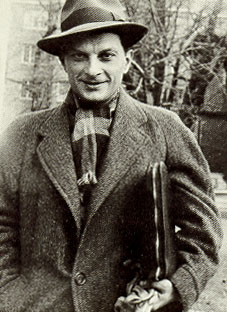
Stanislaw Ulam
the second of Hungarian nationality, Edward Teller, had the same idea at the same time, which the Anglo-Saxons called "technically sweet."
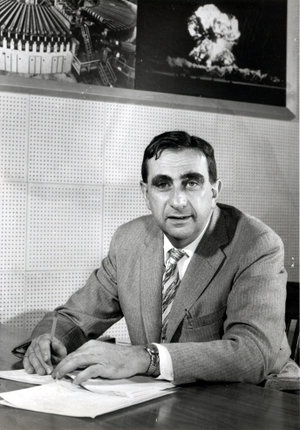
Edward Teller in 1958, who served as a model for the character "Dr. Strangelove" and who affectionately called the H bomb "my baby" ("My baby")
(citing simply for memory the rather dubious sense of humor of some scientists who wrote books about the birth of such devices, one of them, Antoine Schwerer, gave the title "Next to My Bomb" to his own book, published in 1990 (120 pages))
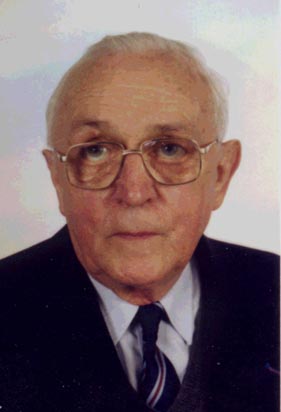
Antoine Schwerer: "Next to My Bomb" ...
The Americans chose to first test the "hydrogen bomb," operating at 100 million degrees, with a deuterium-tritium mixture. But, to everyone's surprise, the Soviets skipped this step, thanks to the calculations made by Andrei Sakharov, and put into operation the first "dry bomb," whose charge was in the form of a solid: lithium hydride. A bomb that was therefore immediately operational. This sudden advancement of the "Eastern Bloc" forces triggered an absolutely frenzied arms race.
At this stage, the reader must keep in mind this "miracle mixture" Lithium6 + Hydrogen1, which produces two nuclei of Helium4 and ... no neutrons. This "H bomb" is therefore "non-polluting." Unfortunately, if one day earthlings suffer its effects, they will probably not have much time to enjoy this effect. If "H bombs" are so "polluting," it is mainly due to the fission charge that serves as their detonator and to the "activation" of the reflector in "depleted uranium," made of uranium 238. This one, by absorbing a neutron emitted by the fusion reaction, transforms into plutonium 239, which then fissions. We then obtain the most horrible device ever to come out of the imagination of men, the "FFF" bomb (fission - fusion - fission), the most rich in radioactive fallout.
While the military were busy developing their bombs, the civilians, on their side, tried to ignite a deuterium-tritium mixture in toroidal chambers, the "tokamaks," invented by the Russian Artsimovitch (incredibly imaginative, these Russians, indeed ...).
Most readers now know the scheme of such machines where the gaseous mixture, heated to very high temperature, is "magnetically confined," that is, at the core of a winding shaped like a torus (or today more precisely the shape of the letter "D," rotating around an axis. This idea is at the heart of this cathedral for engineers that bears a name: ITER.
The ITER machine
On the illustration above, one can distinguish, e...