Mathias Bavay's thesis on the French Z-machine
The French Z-machine
Mathias Bavay's thesis
file uploaded on June 17, 2006
This thesis, well documented, can be found at:
http://mathias.bavay.free.fr/these/sommaire.html
Title:
Flux compression in a sub-microsecond regime for achieving high pressures and X-ray radiation
submitted on July 8, 2002 at CEG (Military Experimentation Center of Gramat, Lot).
The Gramat generator (see images above) is capable of delivering current pulses of 2.5 million amperes, lasting 800 nanoseconds.
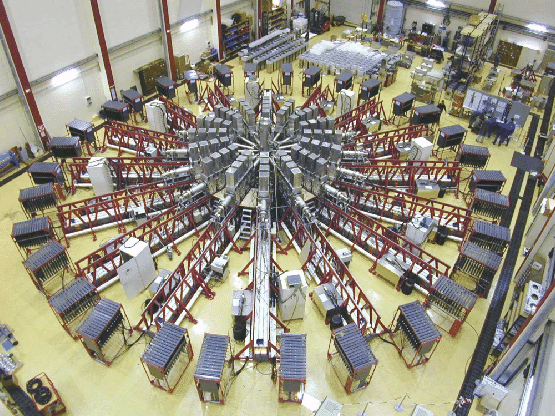
ECF Gramat Electric Generator
A close-up view shows the size of the installation, approximately 20 meters (33 meters for the Sandia Z-machine).
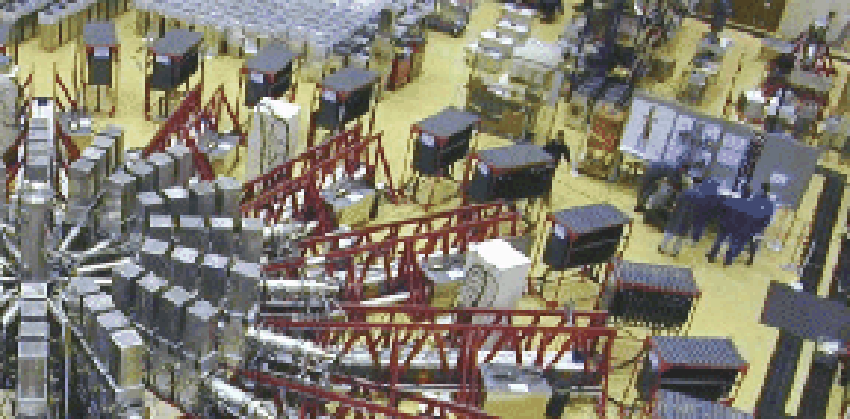
Close-up view
Central part of the ECF installation at Gramat
The setup designed by Bavay, tested at Gramat and on the Sandia generator, is very original. The Soviets had developed flux compression systems where a chemical explosive exerted pressure on a "liner" made of an electrically conductive material, copper or aluminum. This liner imploded, compressing a magnetic field inside, previously installed using an electrical discharge in a solenoid powered by a capacitor bank. The idea developed in Bavay's thesis consists of using a wire liner as a "piston" and replacing the external pressure, of chemical origin for magneto-cumulative compressors, with a "magnetic pressure." Two ideas are found:
- Use a lighter liner, with less inertia
- Ensure all the energy is transferred to it, the "magnetic gas" having "zero inertia." *
This leads to a two-stage compressor, with ... two liners, a large and a small one. This is roughly what would have been obtained with Sakharov's plasma cannon if we had ... plugged it!
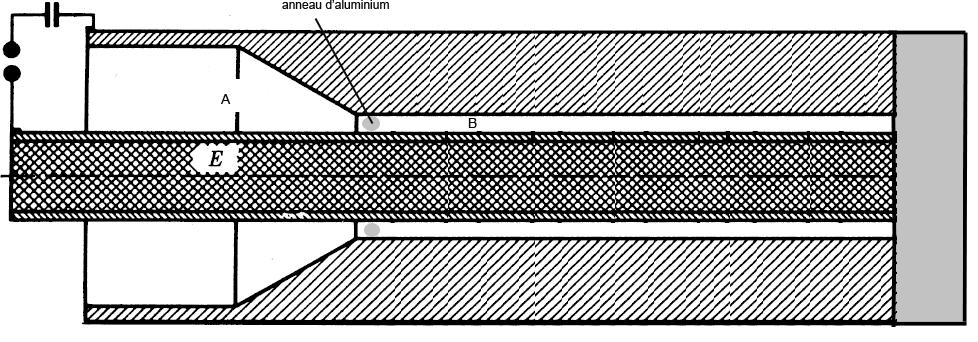
Modified Sakharov plasma cannon
We take back the initial diagram. An electrical discharge creates a magnetic field in the "chamber" A. Then, the explosive is ignited on the left side, causing the expansion of the copper "liner."
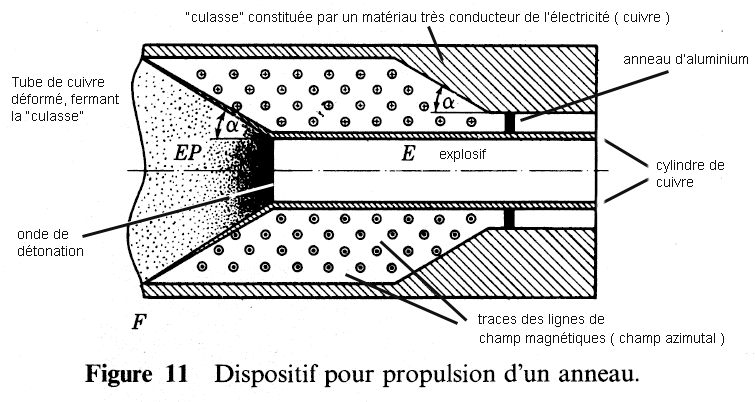
The copper cone closes the chamber, trapping the magnetic field which, "compressed," tends to expel the aluminum ring into the space between the copper "cannon" and the central explosive-lined liner. However, in the new setup, the expulsion of this ring is prevented, which then impacts at high speed the closed end of the "cannon," generating strong pressures. Of course, a vacuum will have been created between the copper ring and the grey-colored shutter on the right. The aluminum ring plays the role of a second "liner" by being vaporized, transformed into plasma, as it passes. The central liner also undergoes a plastic transformation.
Returning to Bavay's thesis. We will recognize elements of the above setup, but constructed differently. As we said, the two liners are "wire" and will become plasma. A certain magnetic pressure must be created in the chamber A before it is closed. It remains to replace the propelling element, the gas from the explosion, with a magnetic pressure. We then obtain this:

Setup of Mathias Bavay's thesis
To better understand, it might be useful to reassemble the two phases shown here on a single image. Here is first Bavay's setup, in its initial state:

Mathias Bavay's setup, in its initial state
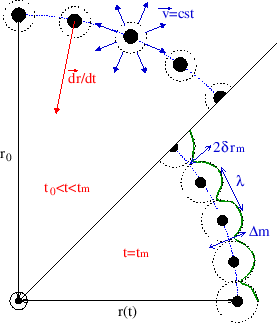
There are two electrical discharges, one represented in purple, the "primary discharge," and another in red, the "secondary discharge." These two discharges create a magnetic field inside two coaxial cavities, toroidal in geometry. A cylindrical "liner" is actually made up of a first set of wires. It is learned in Bavay's thesis that when these wires are traversed by a strong electric current, they do not instantly transform into metallic plasma. On the contrary, they have a fairly long lifetime, which can reach 80% of the time it takes for this "wire curtain" to move radially and converge towards the axis. This is therefore the secret to maintaining axisymmetry in the Sandia experiment. When this object implodes, it is neither a set of wires placed next to each other, nor a plasma curtain, but a "mix of both." This has been theorized by Malcolm Haines, who calls it "the formation of a shell":
Formation of the "shell"
At the top, the wires a short time after the discharge is initiated. They start to sublime superficially. These still solid wires are surrounded by a metallic plasma sheath. In Bavay's thesis, it is stated that the wires keep a cold, solid core. They vaporize at their periphery, emitting a plasma made of metal atoms that expands. When these plasma cylinders meet, the "corona" forms. Bavay writes that this corona forms when 80% of the implosion time has elapsed. This means that during all this time, the current circulations occur in the wires individually. If MHD instabilities can occur in a plasma (ionized gas) where the local current density can fluctuate, as well as the intensity of the magnetic field, this is not the case in a wire curtain.
It is found in his thesis that the expansion speed of the metallic vapor is 10,000 m/s for tungsten and 22,000 m/s for aluminum. The order of magnitude of the wire diameter (240 wires): 10 microns.
I have not found the expansion speed for stainless steel wires. The people from Sandia were very surprised to see that the temperature reached at the end of the implosion reached 2 billion degrees. A possible explanation could be that the expansion speed of the stainless steel vapor would be lower, delaying the formation of the "corona" where instabilities can arise. As it was said above that the wires would keep a "cold core," they are practically "wires" that meet at the axis, the plasma cord being formed in the very last moments of the implosion. Thus, instead of several hundred kilometers per second, the radial speed at the moment of impact could reach 1000 km/s. Hence this temperature rise linked to a ... material change. Open question.
At time tm these plasma sheaths meet. We then gain on two fronts. This closure allows the creation of an "airtight" "partition" with respect to the magnetic field, while the non-uniformity of the medium, in the azimuthal direction, opposes the growth of MHD instabilities and maintains the axisymmetry of the process.
Let us return to the diagram of Bavay's thesis, after having revised it:
![](/legacy/science/Z-mac...