Books on the massacre of the Tutsis
Books on the massacre of the Tutsis
6 April 2012
I am reproducing here the email that Bruno Boudiguet sent me

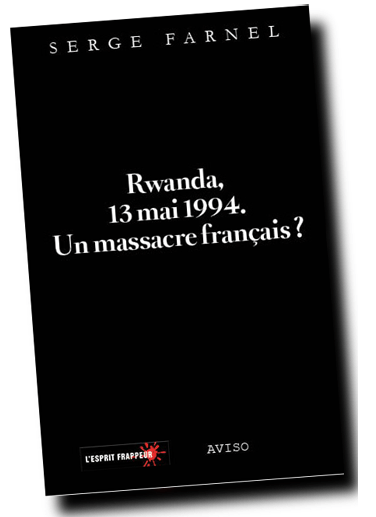
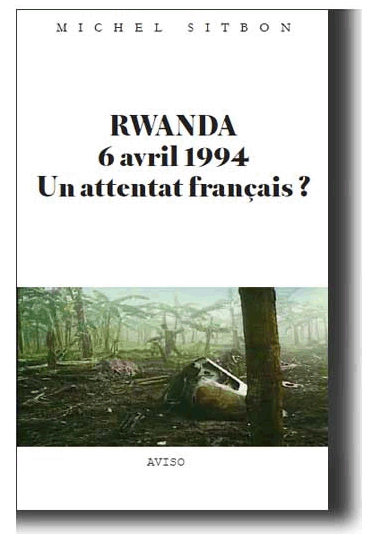
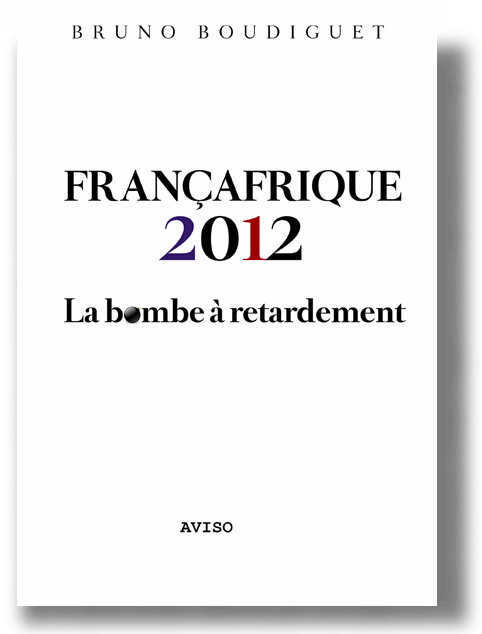
| The most unbearable scandal of the Fifth Republic | The French policy in Rwanda during the period of the genocide against the Tutsis in 1994 has often been criticized for its blindness, or even its complicity. | "However, never before had it been seriously claimed, let alone proven, that French army commandos had directly participated in certain massacres. This is now a fact." (Géraud de la Pradelle, author of the preface of the book by Serge Farnel, Rwanda, 13 May 1994. A French massacre?) | On 13 and 14 May 1994, 40,000 men, women, and children were exterminated in the hills of Bisesero. This fact is well known. What is less known is the presence of French soldiers among the users of heavy or automatic weapons. Opening fire on these civilians, they would have caused a real massacre. | A thorough investigation carried out in 2009 and 2010 with numerous precise testimonies from survivors and perpetrators (see the book's website www.rwanda13mai1994.net). | A landmark book of more than 800 pages documenting the direct involvement of the Elysée in the genocide. | That's already a lot, but it's not all. | Last January, a dramatic twist. A report commissioned by Judge Trévidic definitively dismissed the theory of the FPR's responsibility in the 6 April 1994 attack that cost the life of President Juvénal Habyarimana and served as a pretext for the start of the genocide. This hypothesis was already far-fetched from the start. On the other hand, the responsibility of the French executive appears increasingly serious, even if it is still only vaguely mentioned. If there is someone who has remained on this line for 18 years, it is Michel Sitbon, editor at l'Esprit frappeur. An anthology of his texts on the assassination had to be published: the analysis is relentless and sometimes vertiginous. | We are now in an election period. Candidates avoid controversial issues, like Françafrique. The real, the predatory one, not the one of small intrigues that is constantly talked about, even though it has been declared dead and buried for twenty years. Ten years ago, I created the stop-françafrique website with its interactive map, having read Verschave, shocked by the discovery of this unknown and terrifying abyss that is French policy in Africa. In 2012, neocolonialism is still current. The Gabonese and Togolese tyrants, influence agents of France for 40 years, have been replaced by their sons who continue the colonial tradition. The Ivorian and Libyan crises have paralyzed public opinion with their complexity. I also wanted to analyze the path of the two major political parties, the UMP, the main branch of Françafrique, and the Socialist Party, which has always denied its promises to end this system. | You can purchase these books in bookstores, on Amazon, Fnac.com, etc., and directly on | Bruno Boudiguet |
|---|
Regarding these atrocities in Françafrique, I only have the oral testimony of a journalist who once worked in Gabon. But I trust his word, although he never considered testifying openly. He testified to me about the complicit presence of people, who later became prominent political figures, with loud humanitarian claims, who at the time had organized the evacuation of killers, French soldiers with bloodstained hands, using aircraft intended for the evacuation of children and the injured.
Are we still redeemable? I honestly ask myself this question.
Politics is an activity that involves Machiavellianism and cynicism. Recently, I watched a long series of DVDs about significant events of the Second World War. The source was clearly American. The translations often make me smile. It is certain that no French-speaking military expert was consulted to check the translation given to the reader. Among the ten DVDs, of uneven quality, I can't help but cite a sentence:
Then the Russian rocket launchers, called Stalin's organs, come into action.
In English, "organ" is "organ." And the English text clearly referred to the Katiushka rocket launchers that the Russians themselves had named "Stalin's Organs."
It doesn't matter. These endless documents show the inexhaustible energy that people have deployed, what they have always done, to kill each other consciously. The character of de Gaulle is not shown in the best light, although the military exploits of the expeditionary force led by Generals Leclerc and de Lattre are often cited. If General Eisenhower, who later became President of the United States (which did not prevent him from carrying out some shady operations in Central America), was a real war leader, de Gaulle rather appears as a media spokesperson for the "Free French Forces," a great politician and a great opportunist.
One remembers the distrust that the allies had for him. But we will only cite this scandalous anecdote. In England, de Gaulle had established his headquarters in a building in London, provided for him. In the middle of the night, his aide-de-camp came to warn him that an invasion in North Africa had just taken place. Furious, the general, not realizing that his quarters had been bugged by the British, retorted:
- Well, I hope they will give it to the Vichy troops!
How can one be surprised, after such a scandalous statement, that the Anglo-Americans mistrusted such a person, a real swollen-up ego.
The series provides a brief insight into the role played by Admiral Darlan, a Vichyite, commander-in-chief of the French forces under Pétain in North Africa. He was discreetly contacted by a French officer, and he had agreed to switch sides by ordering his troops not to oppose the Allied invasion. He was quickly assassinated when leaving his office by a man who was quickly executed without trial. Although it is unthinkable to place these two characters on the same level, we find the style of the assassination of Kennedy, by a group that was quickly able to produce a suspect, Lee Oswald, skillfully manipulated and killed before he could speak, by the mobster Ruby, at the time of his transfer to a prison.
When we talk about "theater of operations," the word seems appropriate. For millennia, men have been sent to fight and kill each other, after being skillfully manipulated by politicians.
When one places oneself in "the other's system of thought," one rarely finds the cynicism one imagines, but a very strong sense of "one's own right." In the end, the one who was on the right path was simply the one who won. Depending on whether you belonged to one camp or another, you were either a terrorist or a re...