Consolidated document. 28 original pages have been gathered here; the links below open each section.
Find again: Scientific documents.
Contents
The Möbius Strip with a half-twist.
| The Möbius Strip with a half-twist. .... For centuries men and women fastened their belts by giving them a half-twist, but until the nineteenth century no one had had the idea of giving a name to this object, of a remarkable banality. One day, Moebius, after buckling his trousers, was struck by this deficiency. Having no name at hand, he decided to give it his own and it was henceforth called "The Moebius strip". Nowadays, many scientists have acquired a reputation, or an increased reputation, simply by creating words. Sir Archibald Wheeler was a great creator of words (black hole, wormhole, etc). |
|
The 'Boy-cube'.
| The "Boy-cube". ... The first implicit equation of the Boy was given by the Frenchman Apéry, who was able to reach this result because I had shown that this surface could be described using elliptic meridians. The Boy is abundantly described in my comic book "Le Topologicon" (see the "cd-Lanturlu"). I invented the "Boy-Cube" in 83. You will find all the assembly instructions in the topologicon, page 47. Smooth Version |
|
Kleincube
| ... I presented this version of the "Klein-cube" in 83 in my comic book "Le Topologicon", page 46. Easy to build with plexiglass, or rhodoid, or plywood. Smooth Version |
|
Polyhedral version of the Lactohedron
| Polyhedral version of the Lactohedron ... Return to the Smooth version |
|
Polyhedral version of the Möbius strip with three half-twists.
| Polyhedral version of the Möbius strip with three half-twists. (J.P.Petit, Imagery C.Tardy) ... A small amusing object, to build in cardboard, wood or metal. ... Smooth version |
|
Polyhedral version of the trefoil knot J.P.Petit Imagery C.Tardy.
| Polyhedral version of the trefoil knot J.P.Petit Imagery C.Tardy. ... For ten years this object has served as the logo of the GESTO association, which I chair. A simple curiosity, it is the polyhedral version of the "trefoil knot". |
|
The Klein bottle (photo)
| The Klein bottle (photo) ... It does not present itself in its "usual" form (but how does one use a one-sided bottle?). It is a figure eight that turns around an axis while making one turn on itself. If it did not do that, the object would be an immersion of the torus (Article in preparation). The folds are artifacts due to the need to represent the object economically. At higher resolution, this would disappear. There are similar problems with the Boy and an identical solution will be provided soon, but those objects will take a little longer to load, that's all. Polyhedral Version |
|
The Withney umbrella
| The Withney umbrella Withney was a mathematician who shared his time between mathematics and a profession as a tightrope walker in a circus. Challenged one day by his director to invent an umbrella with only two ribs, he created this object, which he began to use in his acts. He unfortunately killed himself a few years later by falling onto the crowd. Some mathematicians, somewhat embarrassed to have a circus artist in their ranks, preferred to impose the word "cusp" afterwards. |
|
The Crosscap.
| The Crosscap. ... It is one of the different faces of the projective plane. See article . This surface possesses two "cuspidal points", or "Withney umbrellas . See also the article, to understand better. The psychoanalyst Jacques Lacan saw in it an image of the "fundamental fantasy" and located "object a", the "linguistic phallus", on the central cuspidal point. See "J.P.Petit chez Jacques Lacan". ... Penetrate with a little skill into the interior of the Crosscap to observe from this viewpoint the central cuspidal point and note that it is identical to the other. Polyhedral Version |
|
Boy's surface:
| Boy's Surface: ... Boy, in 1902, was a young student of the great mathematician Hilbert. One day he imagined that "the projective space of dimension 2" could be the subject of a representation in 3d space in the form of an "immersion". This gave the object opposite. Hilbert was very interested in this major discovery. He told his student "we'll talk about it again after the summer", then he left on vacation. On his return he waited in vain for the young Boy. He had terminated his lease with his landlady and had... vanished. Hilbert set out in vain to find him, in vain. We don't even know where he is buried. See, on the site "The different faces of the projective plane ". Polyhedral Version |
|
|
First image of the monohedron in virtual reality (J.P.Petit & C.Tardy)
| First image of the monohedron in virtual reality (J.P.Petit & C.Tardy) ... I invented the monohedron, a polyhedron composed of a single face and a single edge. It therefore has no vertices. It is generated by the rotation of a square, which moreover turns on itself. Christophe represented two positions of this square, in transparency. ... See article devoted to the monohedron . |
|
|
Moebius with three half-turns. Imagery C.Tardy.
| Moebius with three half-turns. Imagery C.Tardy. ... This object was used as a logo by the woolen laundry detergent brand "Woolmark". Christophe and I expected to find something as readable by rotating a segment perpendicular to a circle along it, while imposing three half-turns on it. But the result is not as pretty as for the one-half-turn version. Polyhedral version |
|
|
Torecube
| If the "torus-cube" is easy to imagine, the polyhedral version of the torus with zero genus is less so. You have to move the object away. You only see green because you have your nose on it. Smooth Version |
|
|
Lactohedron
| Lactohedron ... The first description of the lactohedron was given in 1956 by Grossman, but we know that its existence had been conjectured by Hilbert, as is mentioned in one of his correspondences with Klein. To this day we have only parametric representations and the search for an implicit equation of this surface (of the sixth degree, like that of the Boy) mobilizes a small handful of specialists. The images that can be found on this site come from recent results by Iéronimus Holstein and Miroslav Milka. Polyhedral version |
|
|
x 2 y 2 + y 2 z 2 + z 2 x 2 - 2 x y z = 0
| ... This is the famous Steiner Roman surface, so named because he invented it in Rome, after a visit to the Colosseum. One-sided, like the Boy and the Crosscap, it is yet another face of the " projective plane ". It has a triple point at the center and six cuspidal points. Steiner surfaces are generally constructed with salvaged Withney umbrellas. Its 4th degree equation is astonishingly simple: x 2 y 2 + y 2 z 2 + z 2 x 2 - 2 x y z = 0 Polyhedral Version |
|
|
Num withney
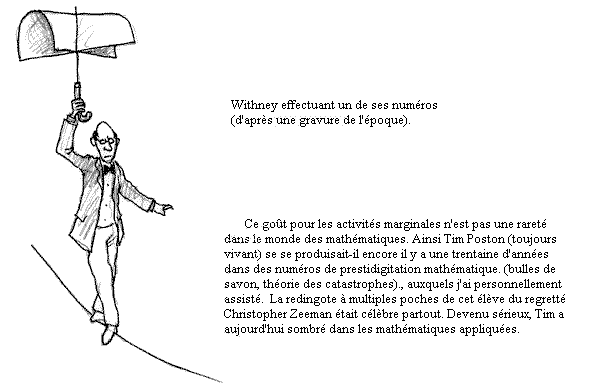
... Central model of the cube eversion. (J.P.Petit 1991, imagery C.TARDY)
| ... Central model of the cube eversion. (J.P.Petit 1991, imagery C.TARDY) ... This is the polyhedral version of the central model of the sphere eversion according to B.Morin (see the article in the January 79 issue of Pour la Science). ... Why "central model"? Because this model represents a cube, for example green on the outside and yellow on the inside, half everted. It therefore has "four ears", alternately green and yellow. If there exists a sequence of transformations making it possible to transform the cube into this model, the eversion is constructed, since it suffices to rotate the model by 90° along its axis and to repeat all the transformations in reverse. |
|
|
Steinercube
| All the explanations on the Steiner and the "Steiner-cube" can be found in "the different faces of the projective plane ". It cannot be said that the object is complicated to construct. Smooth Version |
|
|
Beginning of the cube eversion. (J.P.Petit & C.Tardy)
| Beginning of the cube eversion. (J.P.Petit & C.Tardy) ... This is the polyhedral version of the initial model of Morin's "tobacco pouch" eversion, whose central model is a two-sheeted covering of Boy's surface. For the moment (April 2000) I have only found this, but Christophe Tardy was quick to transform my cardboard model into a new element of the virtual reality bestiary. To be continued, therefore... |
|
|
The Torus:
| The Torus: Or rather its "standard embedding". As I will show in a future article, there exist four classes of immersions of the torus, one of them being a figure eight that turns around an axis, without turning itself. |
|
|
Torezero
Klein Bottle. Photo Christophe Tardy
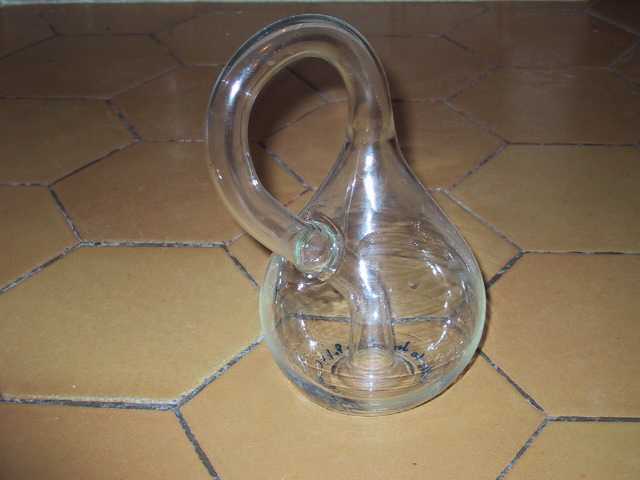
Klein Bottle. Photo Christophe Tardy
- Tardy will do that better for you. Me, I don't have the time....
| ... This is the polyhedral version of the Withney umbrella. It looks like this surface was made of plywood, but that's because Fred (click and forget), who made all these images in three hours' time, had not yet found in the doc the routine that built faces. He therefore used ultra-flat thingamajigs. - Tardy will do that better for you. Me, I don't have the time.... Smooth Version |
|
|
Num withney
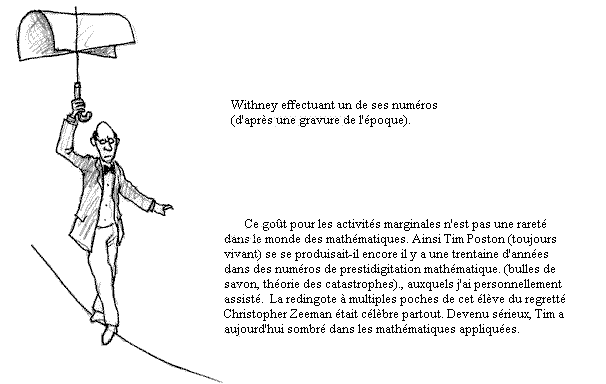
... Central model of the cube eversion. (J.P.Petit 1991, imagery C.TARDY)
| ... Central model of the cube turning inside out. (J.P.Petit 1991, imagery C.TARDY) ... Here we show how this model can be built by making four elements using yellow and green card stock. A cutting pattern, invented in 91 at the same time as the model, will be given soon. ... For information, the other stages of this cube turning inside out remain to be invented. We will indicate another one very soon (I need to pass the card-stock model on to Christophe so that he can convert it into a new object for the virtual-reality bestiary) |
|
Unsolved (psychoanalytical) problem.
| ... The polyhedral version is very simple. You can moreover imagine an infinity of them and build them out of cardboard. By making two holes to put your eyes through, on the "square bottom", you will be able to verify that the central cuspidal point, seen from this viewpoint, is indeed identical to the other one. This is what I had done in 85 when presenting the object at a Lacanian psychoanalysis congress, in Aix-en-Provence. ... The 400 psychoanalysts then gravely passed the object around, to ascertain visually this "identification" (I showed in passing that one could "father-mutate" the two points). Thus Lacan's dear fundamental fantasy possessed two linguistic phalluses instead of one. Unsolved (psychoanalytical) problem. Smooth Version |
|
Klein bottle. Photo Christophe Tardy
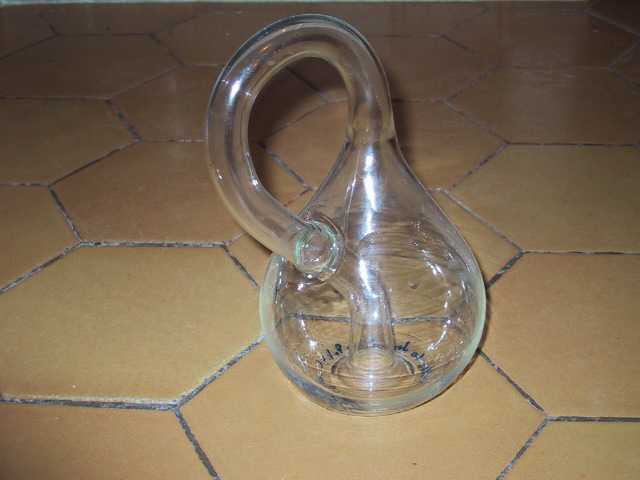
Klein bottle. Photo Christophe Tardy
The 'Boy-cube', 2nd version.
| The "Boy-cube", 2nd version. Model: Anthony Phillips. Imagery C.Tardy. ... This is another polyhedral version of Boy's surface, suggested by the American mathematician Anthony Phillips (inventor of the first version of the sphere turning inside out) as soon as he learned of the one I had proposed. It is only a matter of aesthetics. This model differs from mine in that the "pole" of the object has been "pushed in". In the "smooth" version one would then obtain what is called a (genuine) "monkey's bottom". Smooth Version |
|
Original pages: moebius_un_demi_t.html, boycube.html, kleincube.html, moebius_cube.htm, noeud_trefle-cube.htm, klein.html, withney.html, crosscap.html, boy.html, mono_transp.htm, moebius_trois_demi.htm, torecube.html, lactoedre.html, steiner.html, num_withney.htm, mod_cent_ret_c_vj.html, steinercube.html, deb_ret_cube.htm, tore.html, klein_photo.htm, withneycube.html, num_withney.htm, mod_cent_ret_c_vj_c.html, crosscapcube.html, klein_photo.htm, boycube2.html