Transformation of the Crosscap into a Boy's surface, via the Roman surface of Steiner
How to transform a crosscap into a Boy's surface (left or right, as you choose) by passing through the Roman surface of Steiner.
September 27 - October 25, 2003
page 1
All of this, as Kipling would say, is "big trick and strong magic".
I am retired, but, I could say, I still do a little research, despite myself, like others line up knitting rows. If you have patience and you get some 200g graph paper, you can easily reconstruct all these models. My friend Christophe Tardy is currently making an animation from this, which should be quite nice.
The Cross cap will appear in the following drawings, as well as the Roman surface of Steiner. But you can discover them by going to the Virtual Reality section, which requires that you have downloaded Cosmoplayer on your machine. Do it, it's really nice. Everything is done through the "cusp points". These points naturally form when you ride a horse and suddenly squeeze your legs. The horse's body is then crushed along a segment. Its left thigh then connects with its right shoulder, while its right thigh connects with its left shoulder. As for the cusp point, don't look for it: you are simply sitting on it;
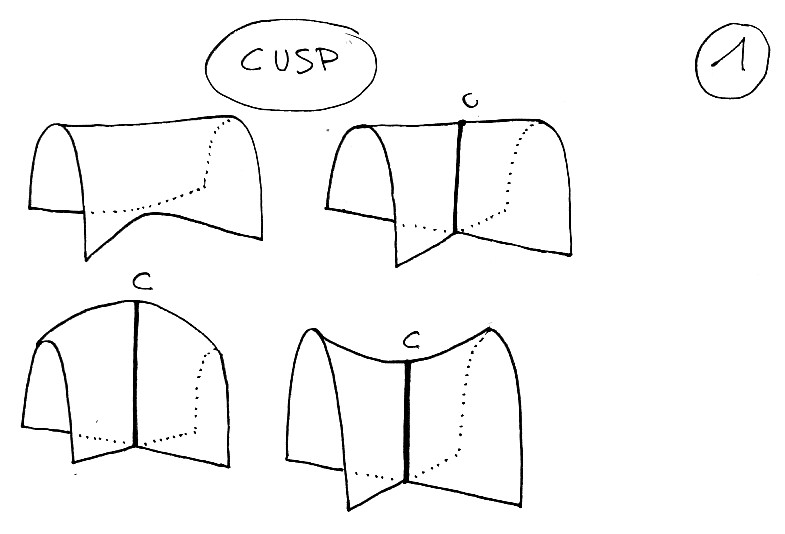
But all of this is... clumsy. Let's move on to a "polyhedral representation" of the cusp point (just as a cube or a tetrahedron can be considered as polyhedral representations of a simple sphere). The thick line represents the "self-intersection curve", which is also terminated by the cusp point C.
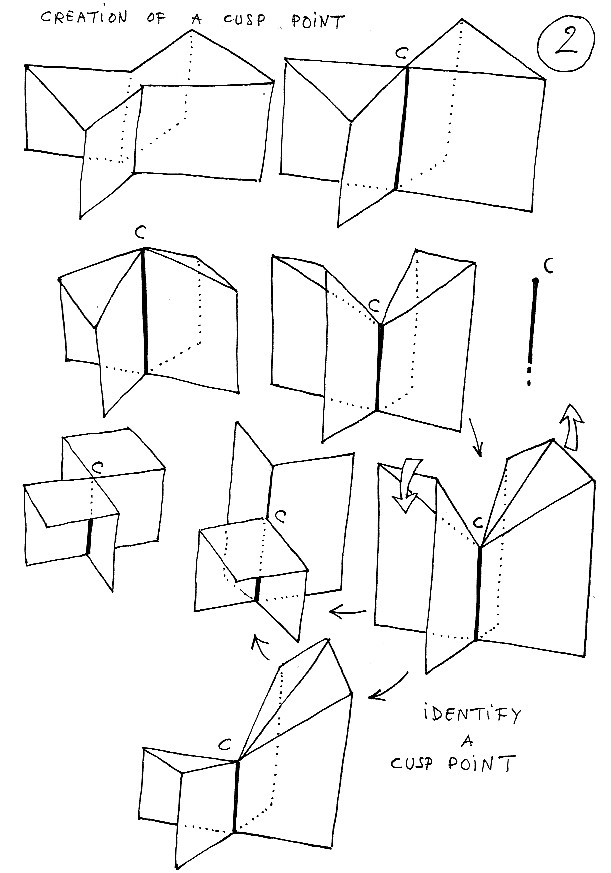
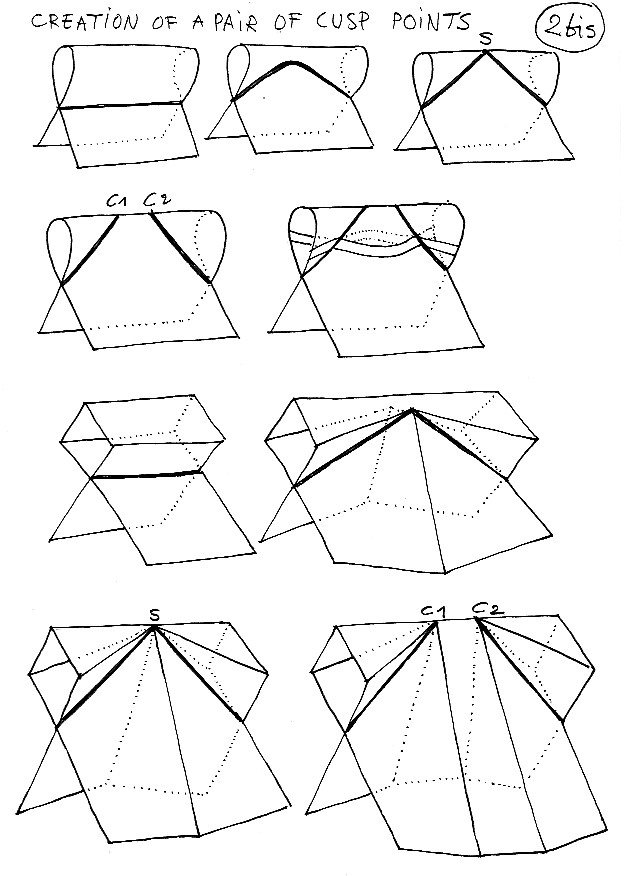
Print these sheets, it will be better. In what follows you will have to recognize a cusp point in "different configurations" and not confuse it with a simple vertex of the polyhedron. Build, if you have the courage, these different objects with cardboard, you will understand them better. Below we have an essential operation, called "creation-decreation of a pair of cusp points". The first drawing represents a kind of cylinder that overlaps itself along the thick line and whose cross-section resembles the Greek letter gamma, upside down. This surface is then deformed by pinching the tube whose cross-section has the shape of an "upside-down tear". This tear degenerates into a point S. Then this point splits into two cusp points. This is the creation of a pair. The inverse operation causes two cusp points to annihilate. Below you find the polyhedral version of the operation.
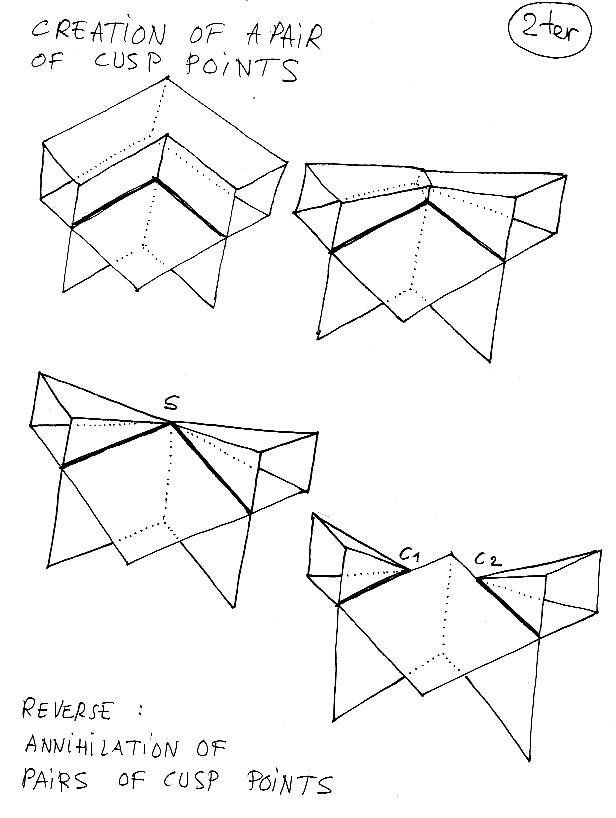
Here is another polyhedral representation of the transformation, which is close to what you will see happen in the surface later.
Back to the table of contents "Transformation of a Cross Cap into Boy"
Back to Guide Back to Home Page
Number of views since October 25, 2003: