Transformation of the Crosscap into a Boy surface, via the Roman surface of Steiner
How to transform a crosscap into a Boy surface (right or left, as desired) by passing through the Roman surface of Steiner.
September 27, 2003
Page 4
The model is now presented from another angle:
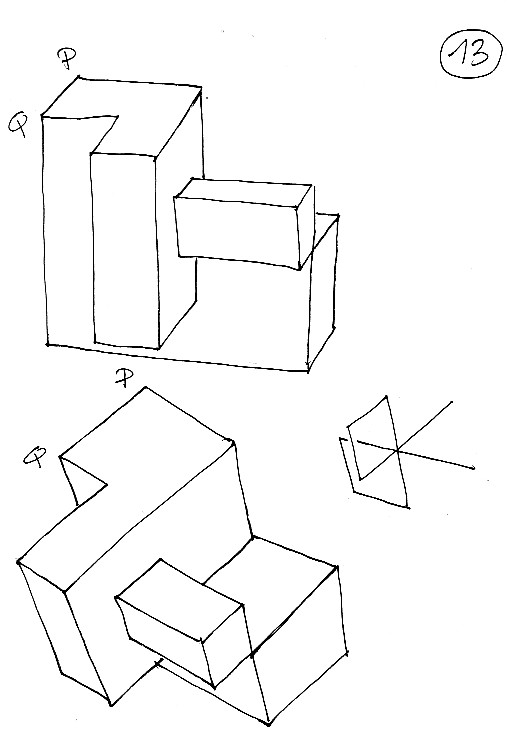
Plate 14: The same operation is repeated, creating the third "ear" of the self-intersection curve. In polyhedral form, it has the shape of three squares with a common vertex: the triple point T.
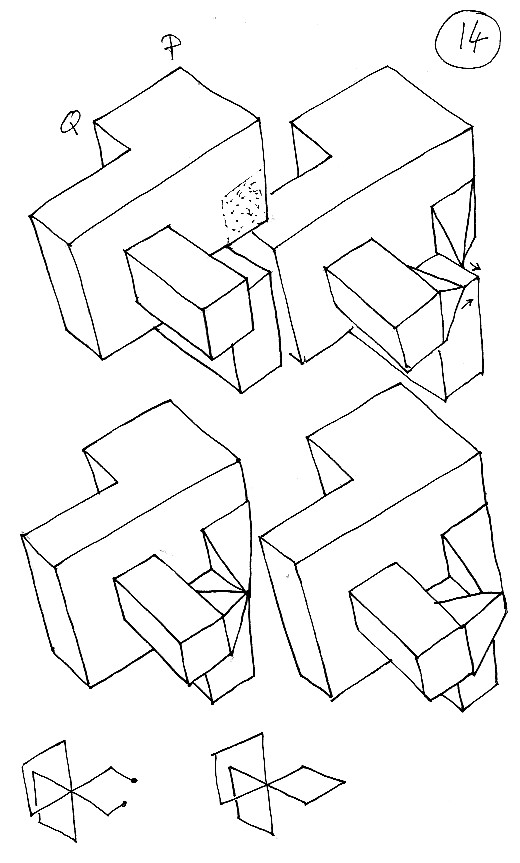
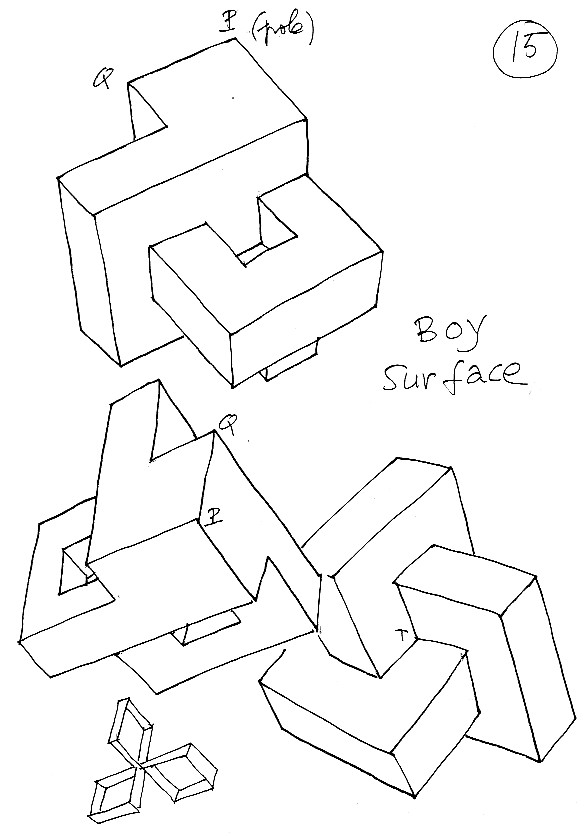
Plate 15: By rotating the object, you find the polyhedral version of the Boy surface that I had introduced and presented in the Topologicon (which contains a cut-out allowing its construction).
Last plate: I tried to represent the Steiner surface (of the 4th degree, while the Boy surface is of the 6th degree) in the act of twisting and transforming into a Boy surface.
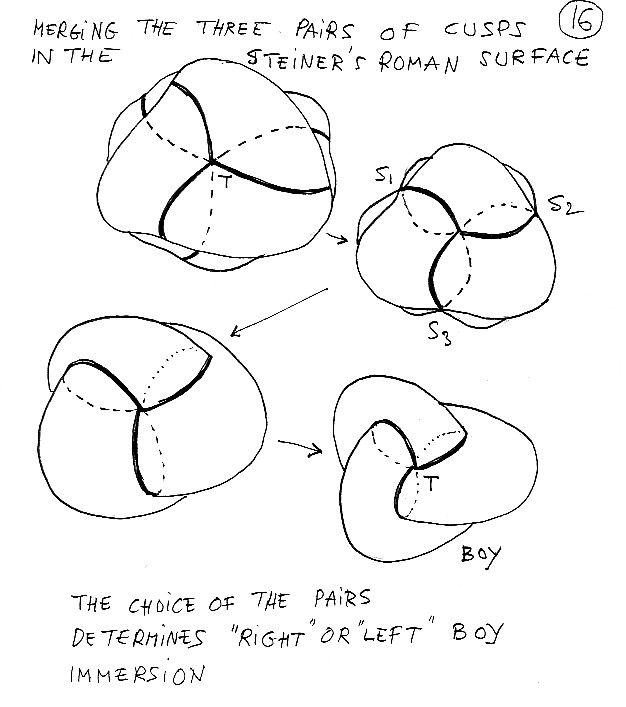
It can be seen that, in a "rounded" way, it takes quite some practice to understand the object. Our eye is very uncomfortable when it comes to understanding an object where, on a single line of sight, more than two layers overlap. Hence the interest of the polyhedral version, which makes transformations considered sophisticated in geometry accessible to the general public, as people make the effort to build the models themselves. Incidentally, it is observed that depending on the chosen pair of cusp points, one obtains a "right" or "left" Boy surface (completely arbitrary terms). The projective plane is immersed in two "enantiomorphic" representations, mirror images. It can be seen that one can go from a right Boy surface to a left one through a "central" model, which is the Roman surface of Steiner.
It would certainly be pleasant if such drawings were published in Pour la Science or La Recherche. But for twenty years I have been "banned from publication" in these journals due to my "UFO deviationism." Thank you gentlemen Hervé This and Philippe Boulanger. I no longer count the number of articles of this kind I have sent to these journals and which have been politely returned. One eventually gets used to one's status as an outcast.
Anecdotically, there is in France a "Alembert Prize" intended to reward authors of popular mathematics books. The story was told to me by a member of the committee responsible for deciding who should receive the prize (there is some money involved). Dialogue:
-
But finally, couldn't we award the prize to Petit? He has written remarkable works such as Géométricon, Le Trou Noir, and Le Topologicon.
-
Yes, but he hasn't only done these albums.
-
What are you referring to?
-
He also wrote Le Mur du Silence.
-
Ah, in that case...
Yes, Le Mur du Silence, published in 1983, is an album dedicated to MHD. And, as everyone knows, this controversial science has the virtue, or the trick, of allowing flying saucers to move at supersonic speeds without making a bang.
Hide this science, I cannot see it
I have in my files a version of the "cube inversion" that is superb, with a central model of extraordinary beauty, which is not the polyhedral version of the Morin variant. All of it is my own creation. One of these days...
October 22, 2003: These pages are not very crowded, if I believe the counter's number. I gave a seminar on October 13, 2003 at the CMI (Centre de mathématiques et d'informatique de Château-Gombert-Marseille) at the invitation of Trotman. At the occasion I was able to display a collection of about thirty cardboard models, which you will soon have the privilege of seeing, having been photographed by Christophe Tardy.
When giving a seminar, an atmosphere emerges. In the following photo, a geometer expressing his perplexity.
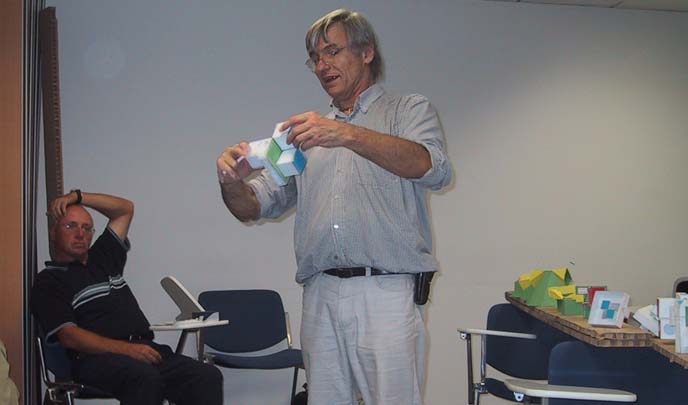
In the background, part of the models on display. At one point I asked:
- Who here has ever seen a Roman surface of Steiner? Raise your hand.
No one had ever seen it. I therefore deemed it useful to present the object, actually virtual, on the laptop I had brought, an object realized with the help of Christophe Tardy, an engineer, and Frédéric Descamp, from the Institut Laue Langevin de Grenoble (ILL). Obviously, this presentation bewildered the audience, not used to seeing mathematical surfaces fluttering at will.
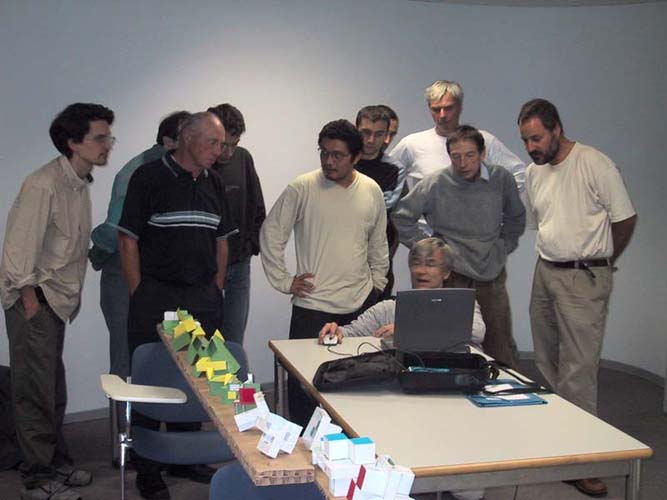
Two cardboard panels, visible in the foreground, allowed the presentation of the following models in logical order. The "green and yellow" models illustrate, in polyhedral form, the essential tool for creating and annihilating a pair of cusp points. The farthest white object is a polyhedral version of the Cross Cap, which first transforms into a polyhedral version of the Roman surface of Steiner, one meter away, and then, at will, into a "right" or "left" Boy surface.
The analysis of the models led to various comments from the audience. One of the geometers asked:
- If, by following the model in this direction, we can go from the Cross Cap to the Boy, it seems that by reversing the process we should be able to transform a Boy into a Cross Cap.
I answered in the affirmative. Encouraged, my interlocutor added:
- If, at the stage of the Roman surface of Steiner, we stop, it then becomes possible to go back towards a mirror Boy surface.
I approved a second time. But alas, no one will offer explanations on this strange world where immersions of closed surfaces are endowed with cusp points, created or annihilated in pairs, the whole constituting a sort of extension of the world of immersions. The word "submersions" seems appropriate to me. If a reader finds some clarifications, they will be welcome.
Curvature concentrated at a cusp point
It will be calculated by summing the angles at the vertex and comparing this sum to the Euclidean sum: 2π.
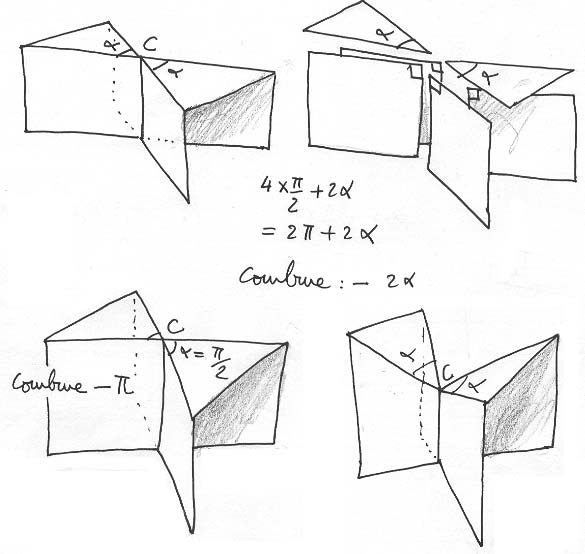
At the top and left, one of the multiple polyhedral representations of the cusp point is shown. The "disassembly" of the object (on the right) leads to a sum exceeding the Euclidean sum 2π by a value of 2α. It can be deduced that the angular curvature concentrated near this point C is -2α. If the angle α is equal to π/2, then the negative curvature is c (figure at the bottom and left). In fact, the curvature concentrated at a cusp point can take an infinite number of values. At the bottom and right, the angular sum is increased and the curvature then < 2α. The negative curvature is increased.
By operating in the inverse way, one can arrive at a rather surprising situation: making the curvature (angular) concentrated at C be ... zero:
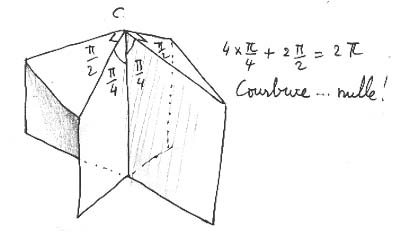
Now we can start from a polyhedral representation of the Crosscap, which has two cusp points, each with a negative curvature equal to -π:
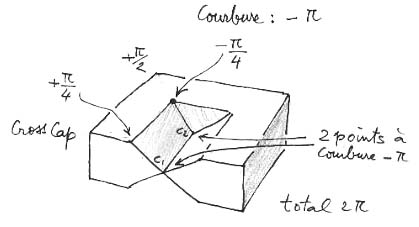
There are eight "posicoins" corresponding to a value of +π/2. Let's add four more "posicoins" with curvature +π/4 and four "negacoins" with curvature -π/4.
Plus the two cusp points with curvature -π.
Total: 2π
By dividing this total curvature by 2π, we find the Euler-Poincaré characteristic...